



Inert UV-LED chamber BSL-01i
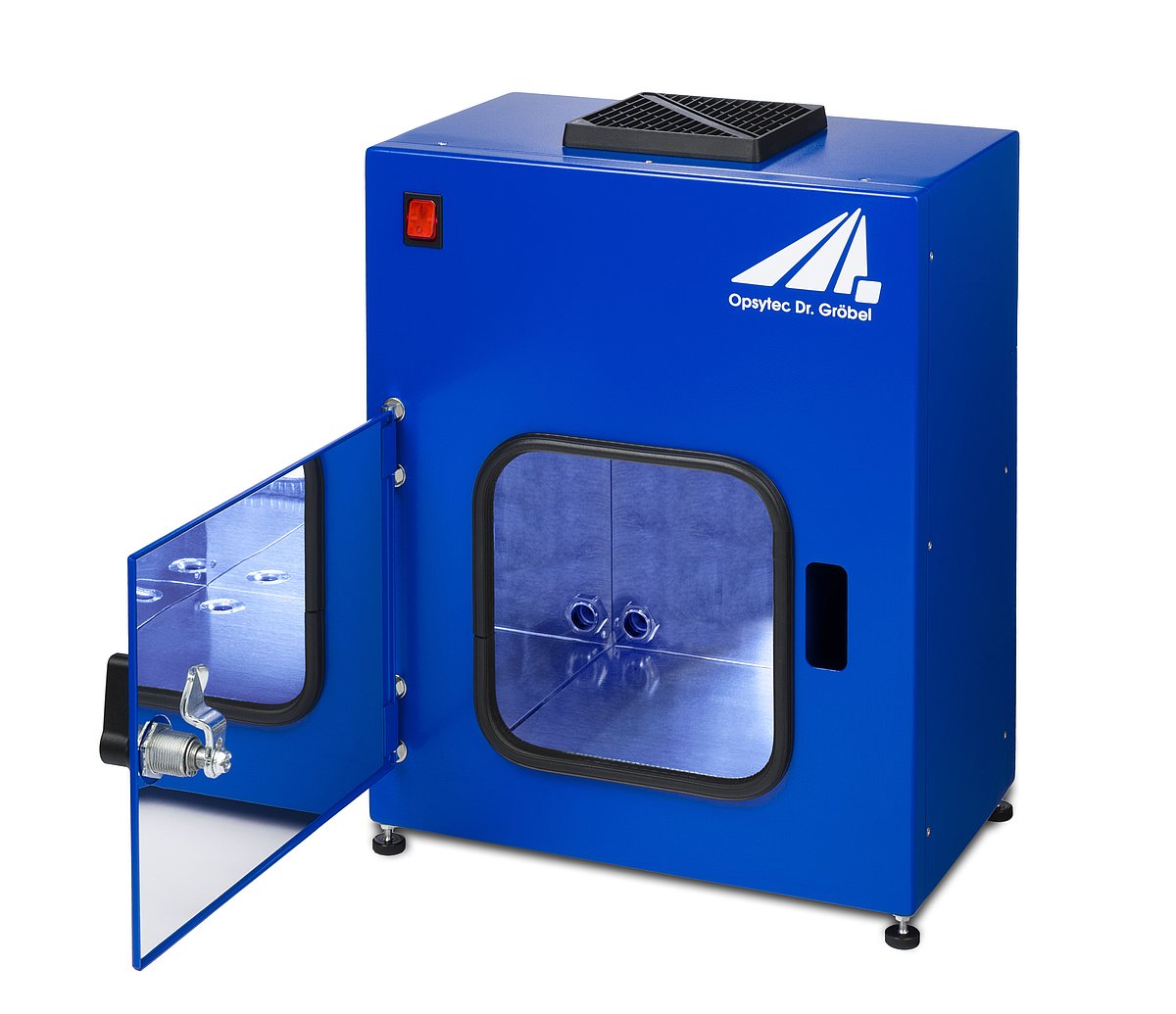
The BSL-01i is a compact UV LED irradiation chamber for curing and bonding under inert conditions. Within an interior of 20 × 20 × 20 cm it reaches an irradiance of up to 800 mW/cm² using modern UV LED technology – 80 times the irradiance of our classical irradiation chambers. As a tabletop unit it is classified in group 0 according to DIN EN 12198 and is suitable for laboratories and manufacturing.
For different applications, the wavelengths 365 nm, 385 nm, 395 nm, 405 nm and 450 nm are available. Optionally, two wavelengths can be controlled separately. This means that the irradiation chamber can be perfectly adapted to the photoinitiator‘s requirements and is ideal for laboratory use or product changes.
A nearly airtight design with separate gas inlets and outlets allow irradiations under inert conditions. For this purpose, we recommend using nitrogen as a scavenging gas with a slight overpressure. The measurement of the O2 concentration can be optionally performed at the rear gas outlet for this purpose.
The irradiance is adjustable from 1% to 100%. The integrated timer controls the irradiance precisely.
For even better results, we recommend one of our calibrated UVA+ sensors.
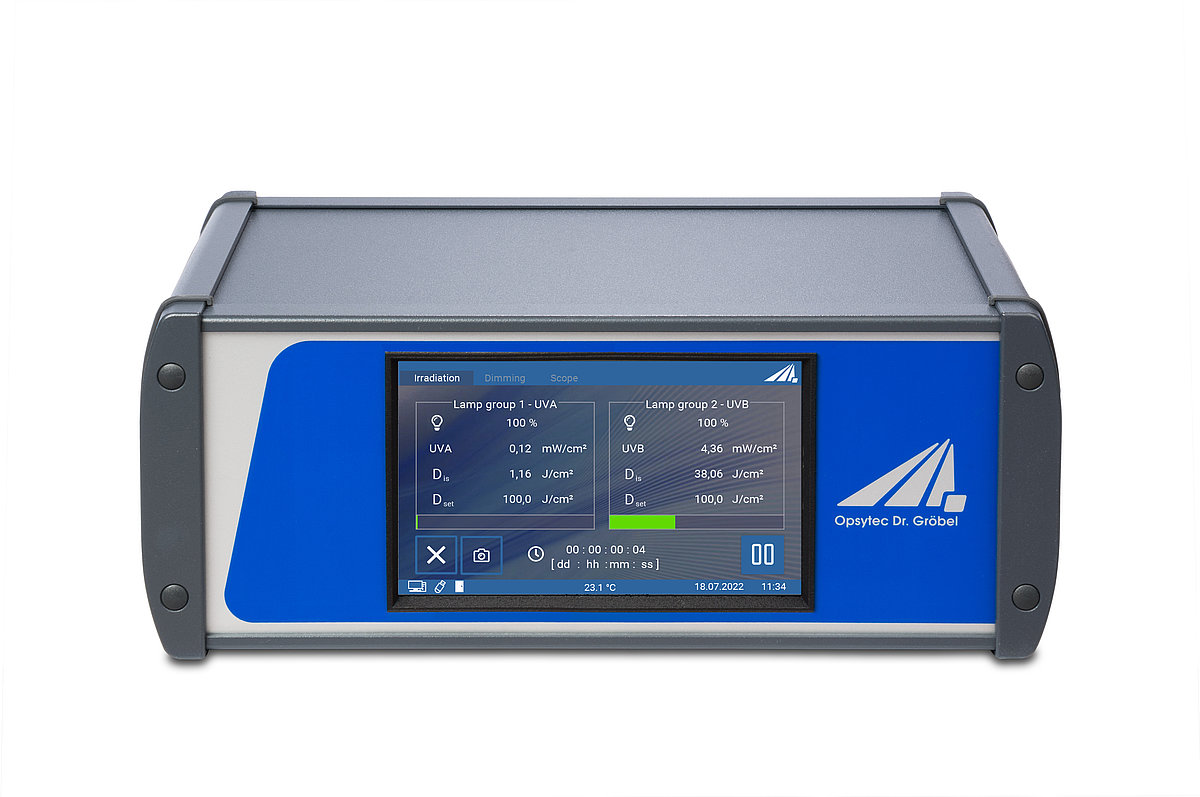
The dose control is already integrated in the UV-MAT Touch and UV-MAT control units in the BSL-01i UV LED chamber. By means of an optional sensor, the UV-MAT measures the irradiance continuously, and stops the irradiance at the set target dose.
Due to the free adjustability of the irradiance and the exposure time, the optimum parameters can be determined reliably.
We offer the BSL-01i with three irradiances:
- 0 to 800 mW/cm² (version HO)
- 0 to 400 mW/cm² (version ECO)
- 0 to 200 mW/cm² (version ECO+)
Due to the low heat input of the UV LEDs, thermal damage of the samples is minimized. A heating/cooling plate is optionally available for sample temperature control.
In the completely closed and monitored irradiation chamber, the operating personnel are fully protected from the UV radiation.

Calculate irradiance and dose of the BSL-01i
Set up the BSL-01i virtually in advance:
Calculate irradiance, uniformity and exposure time for each LED wavelength.
Oxygen inhibition: why the surface stays tacky
UV curing is a radical chain reaction: the photoinitiator splits, the radical formed starts the chain, and the chain grows until it meets another radical. Oxygen intervenes at exactly that point. It intercepts the growing radical and forms a peroxy radical, which does not carry the chain forward. The reaction stops before it has begun.
This is not a marginal effect but a surface effect, for a simple reason: deeper down the dissolved oxygen is used up by the first radicals and curing proceeds normally. At the surface it is continuously replenished from the air. The result is a layer cured underneath and tacky on top. It is thin – a few micrometres, depending on formulation and irradiance – but it is precisely the layer that gets touched, measured, coated and bonded.
The consequences go beyond the tacky feel: gloss is off, a second layer adheres less well, and unreacted monomer remains able to migrate – which decides release in food-contact and medical applications.
More irradiance, more initiator, an amine synergist or a cover film all help against oxygen inhibition. Each of them changes the formulation or the process. Removing the oxygen itself changes neither – and that is what the BSL-01i is built for: a nearly airtight housing, separate gas inlet and outlet, nitrogen as purge gas at slight overpressure, and optional measurement of the O₂ concentration at the rear gas outlet, so that inerting is a documented quantity rather than an assumption.
For a bench trial this means: the same adhesive can be cured once in air and once under nitrogen at the same dose. The difference between the two samples is the oxygen inhibition.
Calculate the exposure time of the BSL-01i in advance
With up to 800 mW/cm² the BSL-01i reduces exposure times to seconds – which makes an advance estimate all the more valuable. The UV irradiation chamber simulator calculates the irradiance in the selected measurement plane for the 20 × 20 × 20 cm interior and shows after which time a target dose is reached.

Technical data of UV-LED chamber BSL-01i
| Interior chamber | 20 × 20 × 20 cm |
| Dimensions, chamber | 35 × 27 × 45 cm (B x T x H) |
| Weight | ~ 20 kg |
| Power consumption | 200 W - 650 W |
| Mains | 110–230 V, 50/60 Hz |
| Operation temperature | 10 to 40 °C |
| Storage temperature | -10 to 60 °C |
| Humidity | < 80% non-condensing |
| Cooling | air cooling |
| Sample temperature | Heating of the samples due to high UV irradiation with long exposure |
| Classification | group 0 according to DIN EN 12198:2000 |
| Timer | 0.01 s to 9999 h |
| Resolution | 0.01 s |
| Dose control | with optional sensor |
| Internal security circuit | Over-temperature, door contact |
| Gas inlet / gas outlet | Festo QSK-G1/4-10 for 10 mm hose diameter |
| PC interface | USB 2.0 |
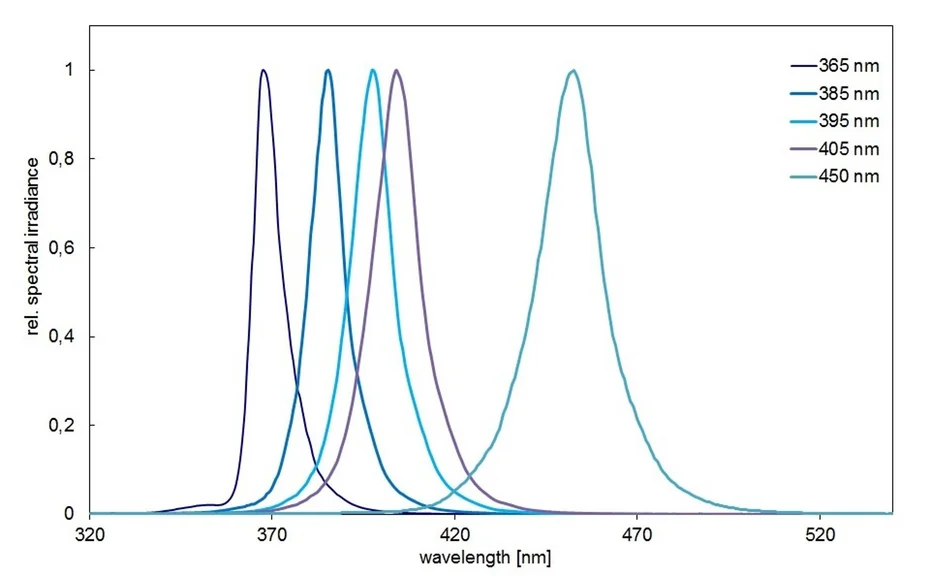
Spectra of the irradiation chamber BSL-01i
The BSL-01i is fitted with one of the five wavelengths 365, 385, 395, 405 and 450 nm; every LED emits a narrow band with a half width of 10 to 20 nm. Two wavelengths can be installed and controlled separately, one for through-curing and one for the surface. Under nitrogen the oxygen inhibition disappears, so the surface cures at a lower dose as well.
Irradiance, uniformity and LEDs
The chamber is available in three power levels. The values are the typical irradiances at an interior height of 30 mm; the basic version is EcO+, the levels EcO and HO can be ordered as an upgrade.
| Wavelength | EcO+ | EcO | HO |
|---|---|---|---|
| 365 nm | 100 mW/cm² | 200 mW/cm² | 400 mW/cm² |
| 385, 395, 405 nm | 150 mW/cm² | 300 mW/cm² | 600 mW/cm² |
| 450 nm | 200 mW/cm² | 400 mW/cm² | 800 mW/cm² |
The table shows the irradiance across the 20 × 20 cm² irradiation area: each cell stands for one field of that area, the value being the irradiance measured there as a percentage of the maximum. Across the central fields it is 90 % and above, at the edges it falls to about 60 %. These are values for orientation - the actual distribution depends on the wavelength, the power level and the height of the sample.
| 82 % | 87 % | 89 % | 84 % | 75 % |
| 91 % | 95 % | 98 % | 92 % | 82 % |
| 95 % | 98 % | 100 % | 97 % | 88 % |
| 84 % | 89 % | 90 % | 85 % | 78 % |
| 64 % | 71 % | 73 % | 68 % | 59 % |
| Wavelength | 365, 385, 395, 405, 450 nm |
| Peak wavelength | ± 5 nm |
| Emission, FWHM | 10 to 20 nm |
Equipment in detail
The chamber has a modular design and can therefore be adapted to different applications. These functions are always included:
 | Dose control The irradiance is measured continuously; the UV-MAT ends the irradiation once the set target dose is reached. The UV-MAT Touch offers the same functions but simplifies operation and documentation. |
 | Dimming and spectral adjustment The LEDs can be dimmed continuously from 2 % to 100 %. They are available in five wavelengths for different applications; as an option two wavelengths are available in one chamber and are controlled separately. |
 | Timer As an alternative to dose control the UV-MAT offers an adjustable timer for time-controlled irradiations between 0.01 s and 9999 h. |
 | Irradiation records Irradiations can be recorded with a PC. The UV-MAT Touch also records them to a USB stick without a PC. |
The two irradiation controls compared
| Feature | 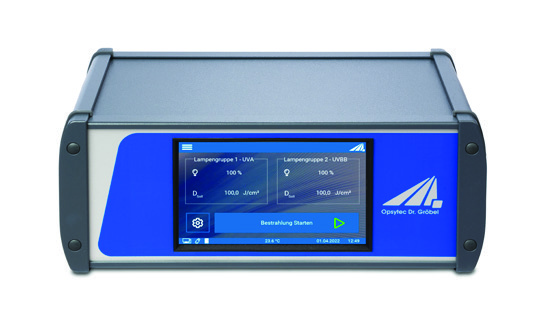 | |
|---|---|---|
| Display | capacitive touch display | monochrome, 128 x 64 px |
| Memory | USB stick | – |
| Number of channels | 1 | 1 |
| Irradiance, dose and temperature measurement | yes | yes |
| Time- and dose-controlled irradiations | yes | yes |
| Recording of measurements | yes | – |
| Oscilloscope view | yes | – |
| Screenshots can be saved to a USB stick | yes | – |
| Pausing and restarting irradiations | yes | – |
| Adding notes and comments to an irradiation | yes | – |
| Remote control from a PC | yes | – |
| Irradiation records | on a USB stick | on the PC |
| User management and admin mode | yes | – |
| Simple firmware upgrades | yes | yes |
Both controls use the same sensors, so one sensor can be used with either device.
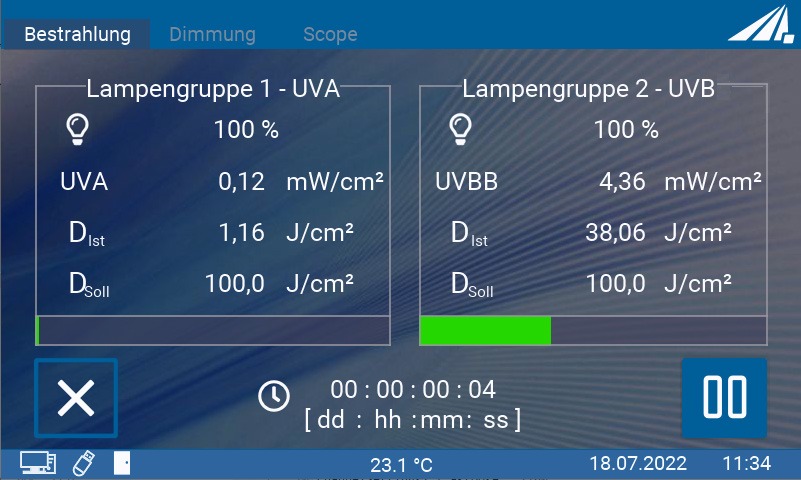
The UV-MAT Touch is operated through a high-resolution capacitive touchscreen. A Cortex ARM processor provides durability and the ability to update - new functions can be installed on site. The device and the PC software are compatible with Windows 10 and 11. Single- and multi-channel irradiations are shown numerically and graphically, together with oscillograms and the settings. Parameters are set directly on the device and are password protected.
| Sensor inputs | 24 bit, fully digital |
| Number of sensor inputs | 1 |
| Dose setting range | 0 to 1,000,000 J/cm² |
| Dose resolution | 1 mJ/cm² |
| Irradiation time | 0.01 s to 9999 h |
| PC interface | USB 2.0 |
| Sensor recognition | yes |
| Dimensions | 185 × 251 × 100 mm |
| Permissible operating temperature | 5 to 60 °C |
| Feature | UV-MAT Touch | UV-MAT |
|---|---|---|
| Display | capacitive touch display, 5″ WVGA | graphic, 128 × 64 px, monochrome |
| Display output | irradiance and dose, oscilloscope view | irradiance and dose |
| Data recording rate | adjustable: 1 s to 1 h | – |
| Recording period | > 24,000 h | – |
| Storage interface | 1 × USB stick (up to 32 GB) | data export via USB |
Options
These options are available in addition to the standard equipment:
Heating and cooling plate For products and processes that require a higher or lower temperature, a heating and cooling plate is available. It is placed inside the chamber and controls the sample temperature independently of the heating caused by the LEDs. | |
 | Remote control option Complex, multi-stage irradiations - for example a pre-irradiation at low irradiance followed by a high-intensity irradiation - can be parameterised with the remote control option. Up to 30 dose- or time-controlled steps and pauses are possible. At the same time the irradiation is logged and stored on the PC. |
Technical data of the radiometer sensors
The calibrated radiometer sensors are available for every LED wavelength. They are traceably calibrated, can be recalibrated and are supplied with a factory calibration certificate; an ISO 17025 calibration certificate from our accredited calibration laboratory is available as an option. The measuring ranges given are our recommendation and can be adapted on request - please state this with your order.
| Sensor type | UVA+ |
| Spectral range | 330 to 455 nm |
| Measuring range, typical | 0 to 10 W/cm² |
| Resolution | 1 µW/cm² |
| Dose measuring range | 0 to 100 MJ/cm² |
| Dynamic range | up to 10⁷ |
| A/D conversion | 24 bit |
| Temperature sensor | integrated |
| Dimensions | Ø 40 mm, height 35 mm |
| Optical area | Ø 6 mm |
| Weight | 160 g |
| Connecting cable | 1.8 m |
| Operating temperature | 0 to 40 °C |
| Storage temperature | -10 to 60 °C |
| Humidity | < 80 %, non-condensing |
Order numbers, scope of delivery, accessories and versions
| Version | Order number |
|---|---|
| BSL-01i EcO+ version | 860901L-ECO+ |
The inert UV-LED chamber is supplied in the EcO+ power level; please state the required wavelength with your order.
| Wavelength | Order number |
|---|---|
| 365 nm | 365 nm |
| 385 nm | 385 nm |
| 395 nm | 395 nm |
| 405 nm | 405 nm |
| 450 nm | 450 nm |
The wavelength completes the order number, for example 860901L-ECO+ 395 nm.
| Version | Order number |
|---|---|
| UV-MAT TOUCH | 820930L |
| UV-MAT | 820920L |
The chamber is controlled by the UV-MAT - either as the UV-MAT with a graphic display or as the UV-MAT Touch with a 5-inch touch display and oscilloscope view. Both measure the irradiance and switch off under dose control.
| Version | Order number |
|---|---|
| Upgrade to EcO version | 860901L1 |
| Upgrade to HO version | 860901L2 |
The EcO+ base version can be upgraded to the EcO and HO levels – each level raises the available irradiance.
EcO and HO raise the irradiance; the values per wavelength are listed above under irradiance per power level.
| Order number | 860801X2 |
|---|---|
| Selectable wavelengths | 365 nm, 385 nm, 395 nm, 405 nm, 450 nm |
The chamber can be equipped with a second wavelength; both are controlled separately. With two wavelengths half the irradiance is available per wavelength.
| Designation | Order number |
|---|---|
| PC software UV-MAT TOUCH | 860901 |
| UVA+ sensor | 814447 |
| Heating and cooling plate | 860901L-HC |
| Designation | Order number |
|---|---|
| Calibration | 17025 |
Accredited calibration to ISO/IEC 17025 in our own calibration laboratory.
The sensors are supplied with a factory calibration certificate as standard; an ISO 17025 calibration certificate is available as an option.
Publications using BSL-01i
The 10 most recent works in which BSL-01i was used. The complete, searchable list is in the publication finder.
Frequently asked questions: BSL-01i
At 800 mW/cm² in the HO version, 1 J/cm² is delivered after 1.25 seconds, 5 J/cm² after 6.3 seconds and 10 J/cm² after 12.5 seconds. The same 10 J/cm² take about 21 minutes in a conventional UVA chamber at 8 mW/cm². Post-curing therefore drops from minutes to seconds. A generally transferable time cannot be derived from this, however: what matters is the target dose of the resin, and a time means the same dose only as long as source, distance and part geometry stay the same. If the LED output declines over the operating life, the dose falls at an unchanged time without this being visible on the unit. The step becomes reproducible only when the exposure ends on reaching the target dose measured by a calibrated sensor – on the BSL-01i the UV-MAT dose control does this. Under nitrogen the oxygen inhibition is also absent, so the surface cures through at a lower dose. How deep the exposure reaches, and why twice the dose does not give twice the cure depth, is explained under additive manufacturing and 3D printing.
Applications of High-Power UV-LED chamber BSL-01i
- Inert irradiations in nitrogen atmosphere
- UV curing and UV bonding
- Sealing and encapsulating
- Laboratory use
- Assembly of opto-electronical components