



UV-LED Spot P – powerful UV spot
The UV-LED Spot P is a focusable UV LED spot light source for automated and manual bonding. Measuring Ø 15 × 143 mm, it reaches irradiances of more than 39,000 mW/cm² at the working distance and therefore allows extremely short process times. The typical service life is 20,000 h; according to DIN EN 62471:2009-03 the spot is classified in risk group 3.
For applications such as bonding, potting or fluorescence excitation, the wavelengths 365, 385, 395, 405 and 450 nm are available. With the variety of wavelengths as well as the exchangeable optics, you remain particularly flexible and can upgrade and change over at any time.
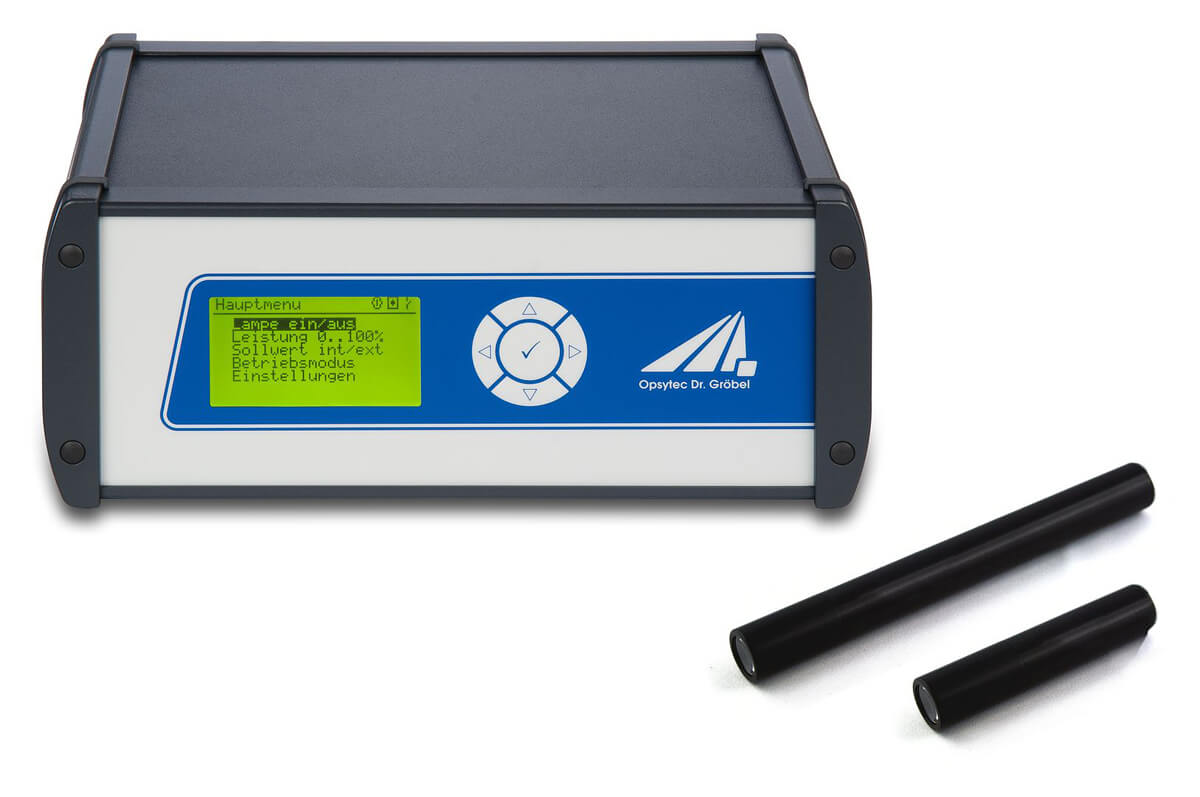
For controlling the UV-LED Spot P, we offer the LedControl S as a table top device or the LedControl DC for DIN rail mounting.
With the LedControl S and DC UV LED controllers, the ultraviolet LED output can be set between 2% and 100%.
A timer for irradiation times between 0.01 s and 9999 s is already integrated. Optionally, continuous operation or externally triggered operation are available.
Both LedControl systems can be controlled via RS485, USB or RS232. Additional digital and analog PLC inputs are also available as an option.
Due to the operation with safety extra-low voltage the LedControl DC is easy and safe to integrate into PLC systems.
Applications of UV-LED spots LedControl
- Industrial UV curing and bonding
- IC Encapsulation
- UV sealing
- Hairline / leak detection using fluorescence markers
- Fluorescence Spectroscopy
- Surface Inspection
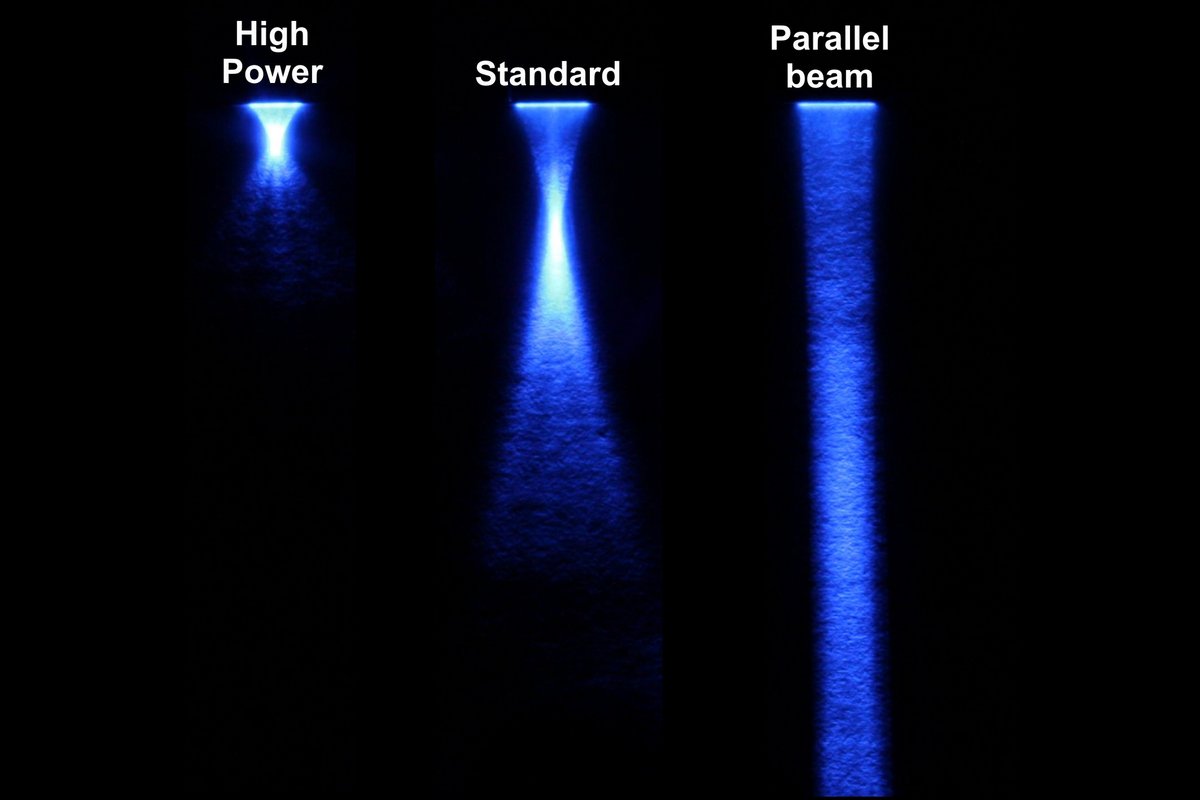
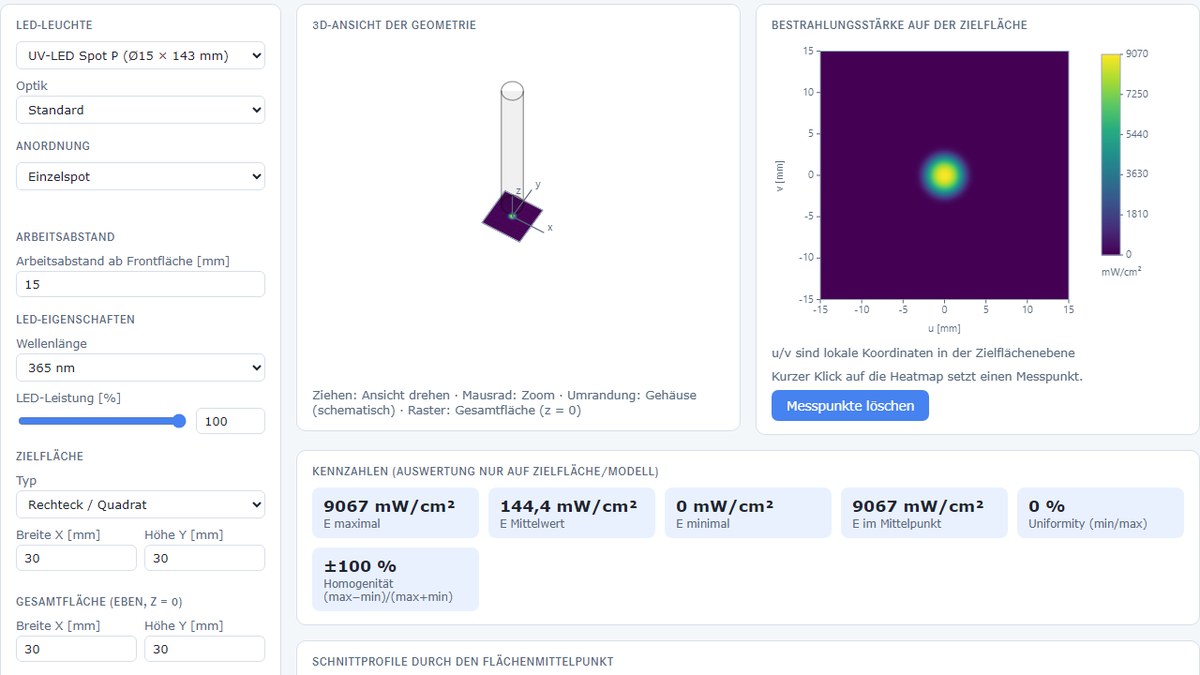
Simulate the Spot P in advance: beam profile and irradiance per optics
Which optics suit the application? The UV LED spot source simulation calculates for the Spot P with Standard, High Power or Parallel Beam optics the irradiance on the target, the beam profile as in the datasheet photo and the working distance at best focus. Up to 16 spots can be arranged in a row, square or ring and optimised for uniform illumination; STEP models of your own parts are irradiated directly.
Start directly: Standard optics · High Power · Parallel Beam
Technical data UV-LED spots
| Wavelength | 365, 385, 395, 405 or 450 nm |
| Emission, peak tolerance | ± 5 nm |
| Emission, FWHM | 10–20 nm |
| Max. irradiance | > 39000 mW/cm² |
| Lifetime | 20,000 h, typical |
| Dimensions, Spot P | Ø 15 × 143 mm |
| Dimensions, Spot P short | Ø 15 × 60 mm |
| Cable length | 1.5 m, optionally up to 5 m |
| Weight | ~130 g |
| Classification | risk group 3 according to DIN EN 62471:2009-03 |
| Operating temperature | 5 to 40 °C |
| Surface temperature | max. 60 °C; with a duty cycle above 0.5 and for the "short" model an additional heat sink may be required |
| Cooling mount, dimensions | D 50 mm, h = 25 mm |
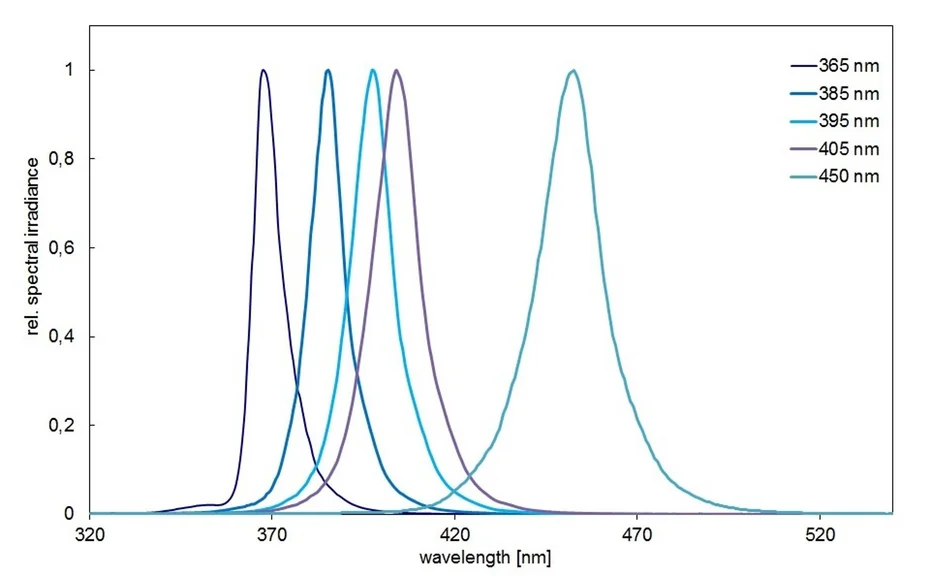
Spectra of the UV-LED Spot P
The Spot P focuses a high-power UV LED through interchangeable optics. The spectrum is unaffected by this: an optic changes the irradiance at the working distance, not the wavelength. Available are 365, 385, 395, 405 and 450 nm with a peak tolerance of ± 5 nm and a half width of 10 to 20 nm. For two wavelengths on one bond line, two spots run on separate channels of a LedControl.
Safety instructions
The device emits UV-A and blue light. UV radiation is invisible. Any visible light is only luminescence excited by the radiation; it is usually much weaker than the exciting UV radiation. The irradiance of the device is several hundred times stronger than that of sunlight.
UV-A radiation can cause cataracts in the lens of the eye and inflammation of the retina. Always wear suitable UV protective goggles when operating the device. UV-A also causes skin discolouration and skin ageing; use suitable clothing, gloves and further personal protective equipment - depending on the irradiation dose.
The devices are designed and classified according to DIN EN 62471:2009-03 "Photobiological safety of lamps and lamp systems"; the Spot P falls into risk group 3. Do not look into the LED and do not expose the skin to the UV radiation permanently.
We are glad to support you in setting up UV workplaces and with the risk assessment according to DIN EN 14255:2005.
The PLready safety option
To make machines safe and to meet the requirements of the machinery directive 2006/42/EC, safety functions are needed in the controls. Usually the required performance level PLr is determined for every safety function. This is where the first difficulty with UV installations begins: the severity of the injury, the frequency and duration of exposure and the avoidance of the UV hazard have to be determined.
In the short term, UV exposure of the skin leads to erythema, elastosis and skin cancer; exposure of the eye can lead to photokeratitis, conjunctivitis and cataractogenesis. Skin cancer is a severe and usually irreversible injury.
Directive 2006/25/EC on artificial optical radiation permits regular exposure up to a daily exposure limit of 30 J/m². The severity of the injury can therefore be reduced through the duration and the intensity of the exposure without having to achieve absolute zero exposure: if the limit is observed, healthy adults can be expected to be exposed repeatedly without acute harmful effects. In the event of a fault, a short exposure may cause a reversible injury such as a slight erythema. The boundary is not reliable, however, and measures and safety functions are needed in every case.
Measurements are possible on existing installations; during the planning phase they are not, or only with additional effort, which is why a higher PLr is often demanded. This is exactly what the LedControl S and the PLready option are for - already at the planning stage.
The PLready safety option is suitable up to PL category 4 according to EN ISO 13849-1 and SIL 3 according to EN 62061, provided that cross-faults in the control of the LED module and in the sensor circuit can be excluded.
It works with a safety extra-low voltage (SELV) of 48 VDC that is safely separated by an external circuit and can switch the LED modules off completely in the event of a fault.
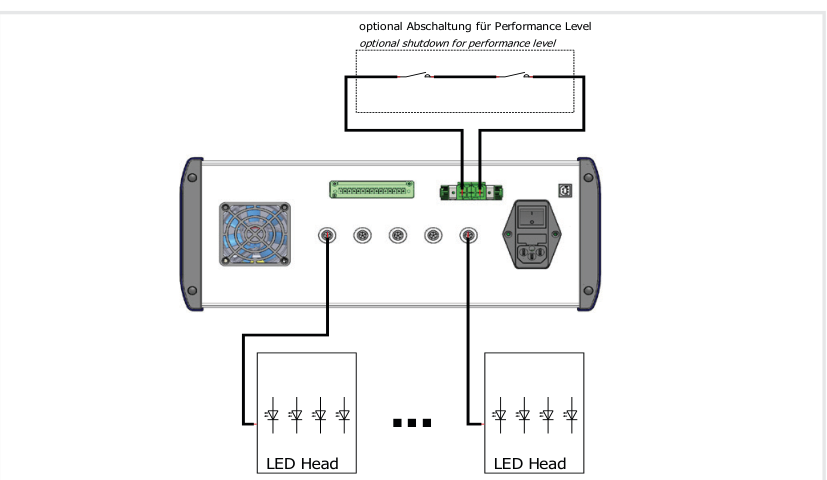
The optional shutdown for the performance level separates the LED modules through an external contact:
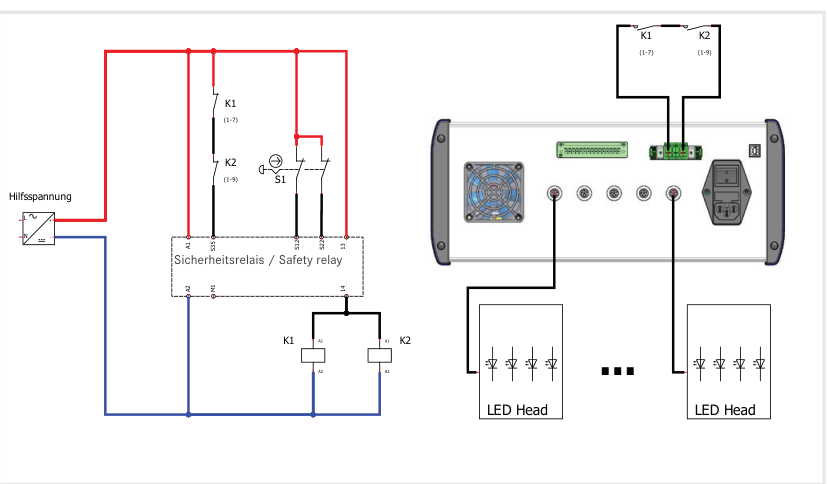
A two-channel safety door monitoring with automatic start is shown in the following example. Compared with simply separating the DC voltages, the advantage is the monitoring of the external contactors. The example is suitable up to category 4, PL e (EN ISO 13849-1) or SIL 3 (EN 62061), provided that cross-faults in the control of the actuator and in the sensor circuit can be excluded.
Order numbers, scope of delivery, accessories and versions
| Version | Order number |
|---|---|
| UV-LED Spot P | 860608 |
| UV-LED Spot P short | 860608SH |
The Spot P is 143 mm long, the short version Spot P short only 60 mm. Scope of delivery: the UV-LED spot including optic, mains cable and manual. Please specify the wavelength, the optic and the options.
| Wavelength |
|---|
| 365 nm |
| 385 nm |
| 395 nm |
| 405 nm |
| 450 nm |
Please state the required wavelength with your order; it is not part of the order number. The peak wavelength lies within ± 5 nm.
| Optic | maximum irradiance |
|---|---|
| High-Power | 39 W/cm² |
| Standard | 9.0 W/cm² |
| Parallel beam | 1.8 W/cm² |
The optic determines the focus and the irradiance that can be reached; the additional optic is available as an accessory.
| Version | Order number |
|---|---|
| LEDCONTROL S | 860610B1 |
| LEDCONTROL 5S | 860610B5 |
| LEDCONTROL 16S | 860610B16 |
| LEDControl DC | 860610DC |
The spots are operated through a LedControl: S for one spot, 5S for five, 16S for sixteen, DC for operation at 24 V. At the LedControl different wavelengths can also be operated together.
| Option | Order number |
|---|---|
| PLready safety option | 860609PL |
| PLC interface option (I/O) | 860609-CP |
| Programming interface RS485 | 860609-RS485 |
| Programming interface RS232 | 860609-RS232 |
| Programming interface USB | 860609-USB |
| Test and control software | 860609-SW |
The programming interfaces and the PLready safety option are ordered together with the control unit.
| Designation | Order number |
|---|---|
| Foot switch | 860611 |
| Additional optic | 860605 |
| Cooling mount | 860605c |
| Kink protection extension, cable 3 m | 860604V3 |
| Kink protection extension, cable 5 m | 860604V5 |
| Cable, per further metre | 86060X-m |
Additional cable length beyond the standard length is charged per metre; please ask us. For simple operation we recommend ordering the foot switch as well; for work in places that are hard to reach we offer extension cables with kink protection.
Publications using Opsytec UV LED light sources
We do not keep a separate bibliography for this individual device – publications usually name the product family, not the model. Listed here are the 10 most recent works in which Opsytec UV LED light sources were used.
Downloads
Matching accessories
- LedControl S
- LedControl DC
- Radiometer
- PLC sensors