



tinyTracker 172 nm: Band radiometer for precise measurements of 172 nm xenon excimer radiation
The tinyTracker 172 is a calibrated belt radiometer for irradiance and dose measurement on xenon excimer lamps at 172 nm. Its SiC photodetector is calibrated by PTB and sensitive from 155 nm to 520 nm, and the measuring range is 0–200 mW/cm². At a height of 10 mm the instrument travels through irradiation channels and records for up to three hours at 1 to 100 Hz – including under an inert gas atmosphere.
Xenon excimer lamps enable new, resource-saving and more efficient production possibilities. They are used in the field of surface treatment for matting, cleaning, surface activation or to reduce photoinitiator consumption.
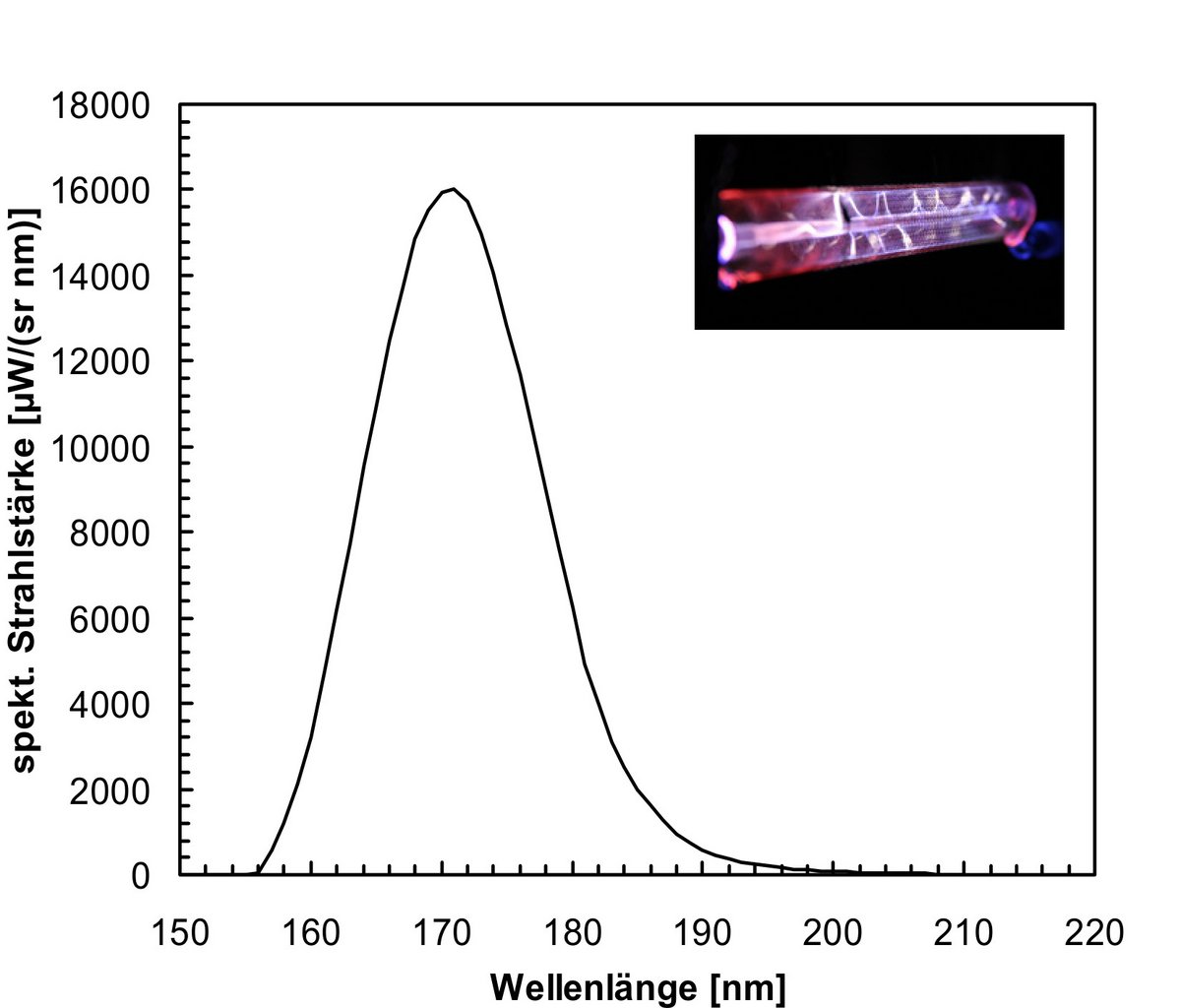
For this purpose, the narrow-band spectrum around 172 nm is usually used to irradiate under inert gas conditions. Then the high photon energy is sufficient to split almost all organic compounds.
The measurement of 172 nm (VUV) is an important component for process control and optimization.
With the tinyTracker 172 we offer a calibrated band radiometer which is suitable for use in an inert atmosphere. The tinyTracker 172 is absolutely calibrated and measures the irradiance and irradiation dose of xenon excimer lamps directly at 172 nm.
Due to its particularly flat design, the tinyTracker 172 can be guided through the irradiation channels of UV belt dryers and other industrial equipment.
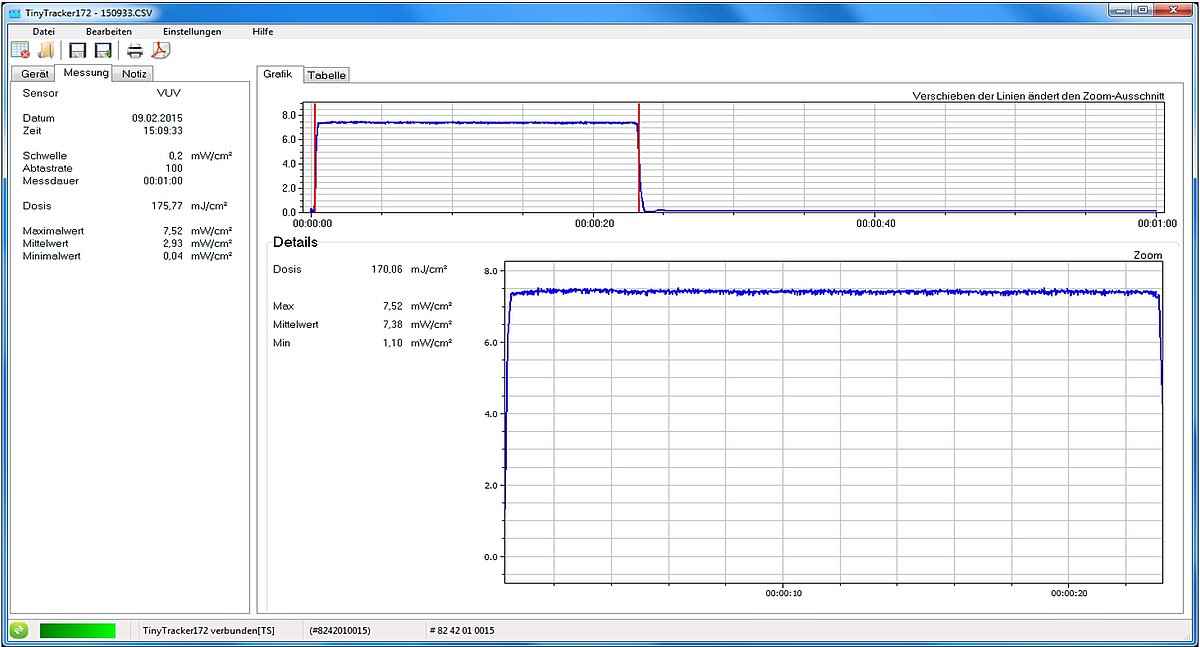
The recording of the values starts automatically when an adjustable minimum irradiance is exceeded. The built-in photodetector is calibrated by PTB.
Data is recorded on an exchangeable SD card and transferred via USB to PC.
Evaluation and data export are conveniently performed by the PC software for tinytracker 172.
The Li-Ion battery ensures a recording duration of up to 3 hours. The Li-ion battery can be charged directly via the USB interface. An additional power supply unit is included.
Highlights of tinyTracker 172 for Xenon Excimer Lamps
- Calibrated photo detector for VUV radiation
- Ideal for the measurement of 172 nm radiation
- Low height of only 10 mm
- Fast data recording with up to 100 measurements per second
Why a measurement at 172 nm depends on distance, atmosphere and window material is explained on the page measuring 172 nm VUV radiation.

| Product type | UV meter: VUV process dosimeter for 172 nm xenon excimer lamps in inert gas |
| Spectral range | 172 nm (nominal wavelength) |
| Measuring range | 0–200 mW/cm² |
| Calibration uncertainty (typ.) | 4.5–6.0 % (k = 2) |
| Output / interface | Interface: Mini-USB 2.0 |
| Time resolution | Recording frequency: 1–100 Hz, adjustable |
| Calibration | recalibratable |
| Standards / guidelines | no product-specific standard; calibration per DIN EN ISO/IEC 17025:2018 available |
| Suitable for | Electronics and semiconductors; Optics and precision components; Automotive |
| Not suitable for | spectrally resolved measurement (peak wavelength, bandwidth); irradiance above 200 mW/cm² (standard range); sensor temperatures above 60 °C; use under water or under pressure |
| Datasheet revision | Rev. 2026-09-08 (E_tinyTracker172_for_xenon_excimer_lamps.pdf) |
The calibration uncertainty stated above is the expanded uncertainty of the calibration (k = 2, confidence level approx. 95 %) and applies to the calibration source and the calibration conditions. In use the measurement uncertainty is larger: spectral mismatch at the source actually used, the sensor temperature, ageing since calibration as well as distance and alignment to the source are added to it. How these combine into an uncertainty budget is explained under Measurement uncertainty in UV measurement.
View the tinyTracker 172 nm as a 3D model
Look at the data logger from every side, rotate and zoom – directly in your browser.
The tinyTracker 172 nm can be viewed from all sides in the 3D product viewer – true to the original, generated from the CAD design data. At 10 mm overall height and running under an inert gas atmosphere, every millimetre decides whether the instrument passes through the irradiation channel – the spatial view shows that more clearly than a figure.

Technical data of tinyTracker 172 for Xenon excimer lamps
| Measuring range | 0–200 mW/cm² |
| Resolution | 12 bit |
| Recording time | up to 3 hours |
| Sampling frequency | 1–100 Hz, adjustable |
| Photodetector | SiC |
| Spectral sensitivity | 155 to 520 nm |
| Dimensions | 195 × 79 × 10 mm |
| Permissible operating temperature | 60 °C |
| Supply voltage | 5 V DC |
| Power supply | Li-ion battery, 1250 mAh |
| Interface | Mini-USB 2.0 |
| System requirements | Windows 10 / 11, 300 MB HDD, 4 GB RAM |
Frequently asked questions: tinyTracker 172 nm
Xenon excimer lamps at 172 nm emit in the vacuum UV, which is absorbed by air within a few millimetres; standard UVC sensors with filters for 200–280 nm do not capture this wavelength. The tinyTracker 172 nm is calibrated at 172 nm, its detector is sensitive from 155 to 520 nm and is positioned directly under the lamp for measurement in nitrogen or inert gas atmosphere. The measuring range is 0–200 mW/cm².
Typical processes are surface activation and cleaning in semiconductor and display manufacturing, pre-treatment before bonding or coating and the matting of coatings with excimer lamps. In all cases the dose in mJ/cm² at the substrate is determined because it defines the process; the instrument travels with the substrate through the inert gas zone and records the time profile.
The detector is sensitive from 155 to 520 nm, but the instrument is calibrated only at 172 nm. At 185 nm (ozone-generating low-pressure lamps) or 222 nm (KrCl excimer) it delivers relative values, not traceable irradiance; a source-specific calibration would be required, which Opsytec checks on request. For 222 nm lamps a spectroradiometer such as the SR900 is also recommended to assess side emissions in the UVC.
The calibration certificate states the expanded calibration uncertainty with k = 2; for the tinyTracker 172 nm it is typically 4.5–6.0 %. In use the measurement uncertainty is larger, because spectral mismatch at the source actually used, sensor temperature, ageing and measuring geometry are added to it. How these combine into an uncertainty budget is explained under Measurement uncertainty in UV measurement.