



SR900 for spectral measurements in the laboratory
The SR900 is a compact spectroradiometer for spectrally resolved measurements in the UV, the visible range and the IR – on UV lamps, LEDs, irradiation systems and luminaires. Unlike a broadband radiometer it disperses the radiation and therefore makes lamp types with different spectra comparable, without a spectral mismatch error distorting the result. An array spectrometer without moving parts and a silicon detector with 2048 pixels deliver 2.3 nm resolution (FWHM) at 0.44 nm pixel spacing; the low stray-light design preserves sensitivity in the UV.
Reference spectra of common UV sources are collected in the UV spectra database.
The SR900 is combined with an SMA-905 quartz light guide and our radiometric sensor heads for measuring the irradiance and illuminance.
Traceable to the PTB, the SR900 is factory-calibrated. An ISO 17025 calibration in our accredited laboratory is optionally available. The SR900 thus enables exact spectroradiometric measurements for the assessment of irradiances and illuminances, biological effectiveness and color measurements. Due to the nearly scatter-free construction, a high sensitivity in the UV range is reached. Control and data evaluation is carried out by the spectral software SRpro.
For the SR900 we additionally offer a wide range of accessories, which are combinable with customized extensions.
For luminous flux measurements and LED measurements, the SR900 can be combined with our integrating sphere.

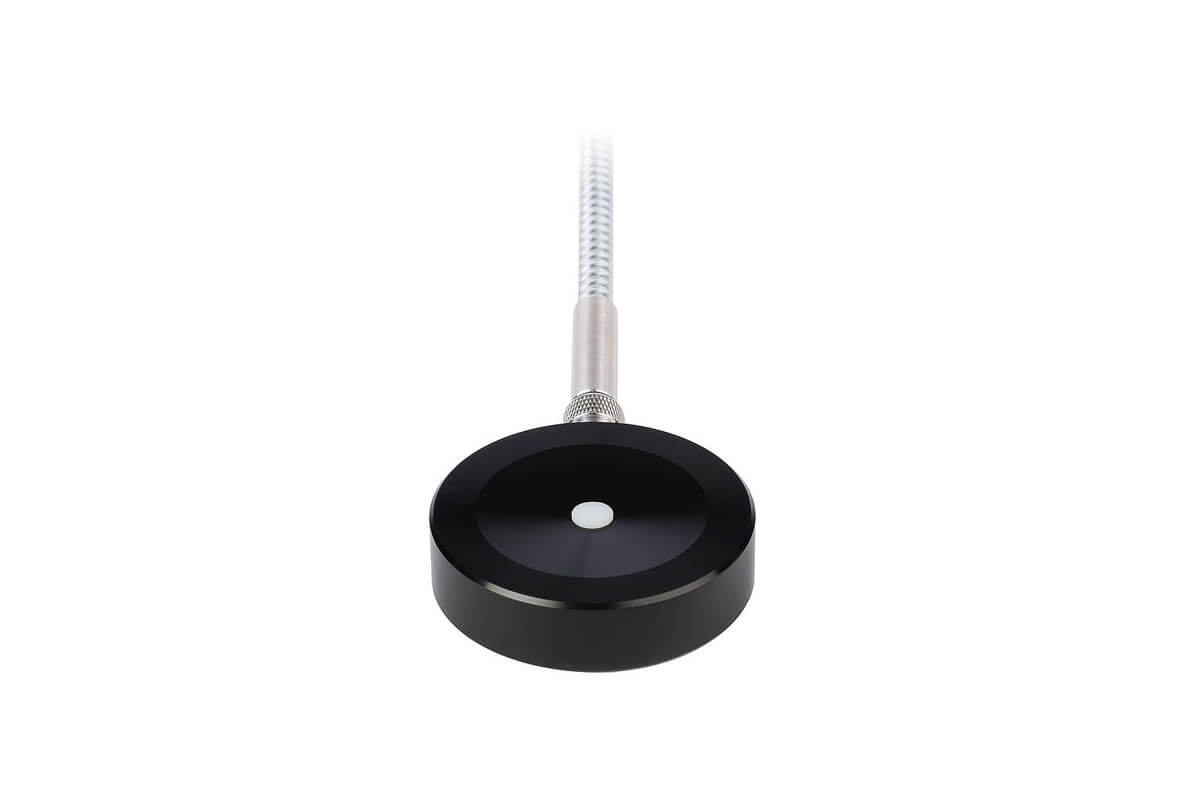
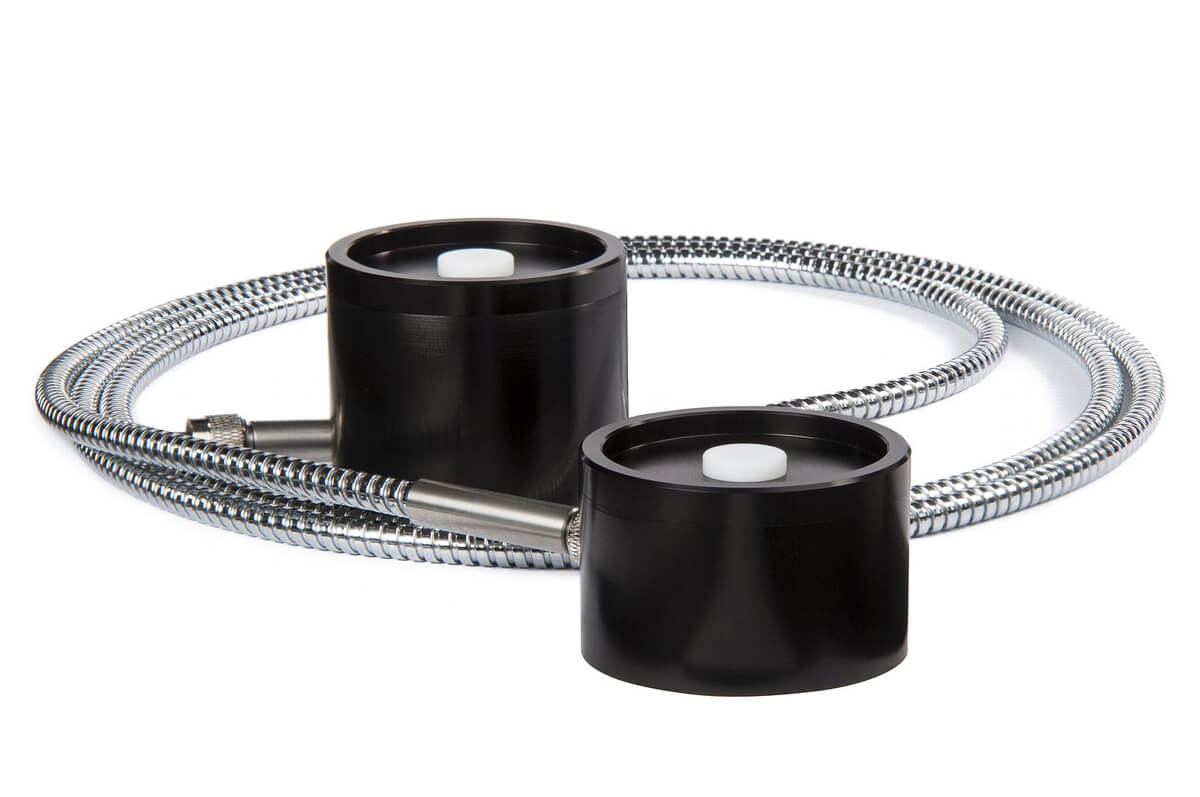
| Product type | Spectroradiometer: PC spectroradiometer 200–1100 nm for laboratory, lamp characterisation and action spectra |
| Spectral range | 200–1100 nm (spectrally resolved) |
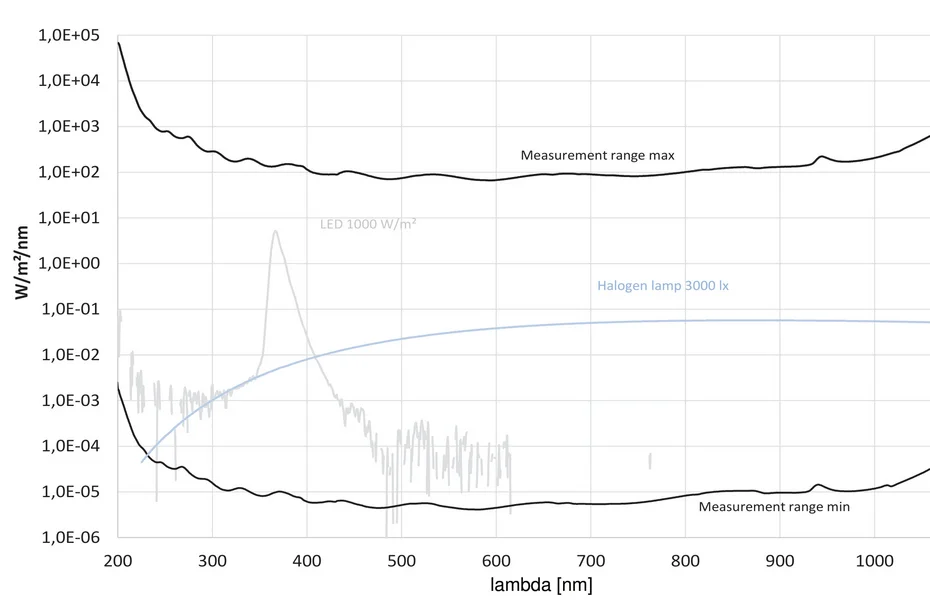
| Measuring range | ~ 1–2000 mW/cm² (standard), ~ 0.01–20 W/cm² (high-power) |
| Calibration uncertainty (typ.) | 5.0–9.5 % (k = 2) |
| Output / interface | Interface: USB 2.0 |
| Time resolution | Integration time: 0.01 ms–60 s |
| Calibration | factory calibration |
| Standards / guidelines | CIE 250:2022 |
| Suitable for | Photobiology and biotechnology; UV disinfection; Photocatalysis; Water and environmental technology |
| Not suitable for | sensor temperatures above 40 °C; use under water or under pressure; dose measurement without instrument or controller; VUV measurement at 172 nm |
| Datasheet revision | Rev. 2026-09-08 (e_spectroradiometer_sr900.pdf) |
The calibration uncertainty stated above is the expanded uncertainty of the calibration (k = 2, confidence level approx. 95 %) and applies to the calibration source and the calibration conditions. In use the measurement uncertainty is larger: spectral mismatch at the source actually used, the sensor temperature, ageing since calibration as well as distance and alignment to the source are added to it. How these combine into an uncertainty budget is explained under Measurement uncertainty in UV measurement.
Highlights of spectrometer SR900
- Spectral range 200-1100 nm
- Nearly scatter-free grid with 300 lines/mm
- Spectral resolution 0.4 nm and 2,3 nm bandwidth
- Order filtering
- Spectral software for the color measurement, radiometric and effects-based measurements
- Simple validation by means of the user concept
- Wide range of accessories
Applications of UV-VIS spectrometer & spectroradiometer
- Spectroradiometry
- Spectroradiometry
- Online process control, quality control
- Testing of light sources (lamps, LEDs)
- Color measurements and color control
- Measurement of the global radiation
- Inspection of optical materials and components, e.g. light conductors
- Qualitative and quantitative analyses in chemistry, pharmacy and biology
In the Markets & Applications section, the SR900 appears wherever a broadband measurement no longer suffices: classifying solar simulators in photovoltaics, narrowband primaries in light and display measurement, weighted action spectra in photobiology, separating the UV and VIS channels under ICH Q1B in photostability testing, and 172 nm and 222 nm sources in semiconductor manufacturing.
How the SR900 measures LEDs from the UV to the near infrared – spectrum, luminous flux and chromaticity – is described on the page Measuring LEDs spectrally.
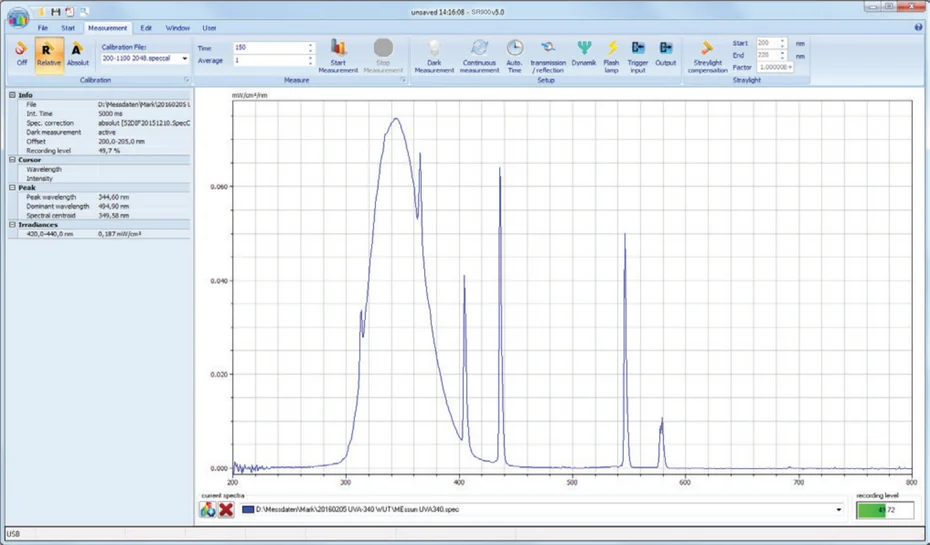
What does a spectrometer measure?
The Spectral Database Explorer shows typical emission spectra of UV LEDs and UV lamps, together with parameters such as UV proportions, illuminance and erythemal irradiance – exactly what the SR900 also delivers for your own light source.
Technical data spectrometer / spectroradiometer SR900
| Spectral range | 200–1100 nm |
| Versions | standard, high-power |
| Measuring range | ~ 1–2000 mW/cm² (standard), ~ 0.01–20 W/cm² (high-power) |
| Spectral resolution (pixel distance) | 0.44 nm |
| Spectral bandwidth (FWHM) | 2.3 nm |
| Grating | 300 l/mm, holographic |
| Focal length | 75 mm |
| Blaze wavelength | 250 nm |
| Order sorting filter | yes |
| Detector | Si |
| Pixel size | 14 × 200 µm |
| Number of pixels | 2048 |
| Resolution | 16 bit |
| Integration time | 0.01 ms to 60 s |
| Max. dynamic range | 10⁴:1 with 3 measurements |
| Interface | USB 2.0 |
| Dimensions | 177 × 125 × 45 mm |
| Weight | 0.6 kg |
| Supply voltage | 5 V, 500 mA through USB |
| Power consumption | < 3 W |
| Operating temperature | 5 to 40 °C |
| Storage temperature | -10 to 60 °C |
| Humidity | below 80 %, non-condensing |
| System requirements | Windows 11, at least 4 GB RAM, 50 MB free disk space |
Frequently asked questions: SR900
The SR900 measures from 200 to 1100 nm with a pixel pitch of 0.44 nm and a spectral bandwidth of 2.3 nm (FWHM). It thus captures UV lamps, LEDs and solar simulators from the UVC to the near infrared in one measurement and calculates irradiance, peak wavelength, half width as well as photometric and colorimetric quantities from it. The holographic grating has 300 lines/mm with a 75 mm focal length; the detector is a silicon array.
Array spectrometers have a stray-light suppression of about 10⁻³ to 10⁻⁵; when measuring a source with a strong visible component, a small part of it appears as an apparent signal in the UVC. With low-pressure lamps with a dominant 254 nm line the effect is small, with xenon or halogen lamps with a weak UVC component it is relevant. Opsytec compensates for this with order filtering and dark offset; for safety assessments per DIN EN 62471:2009-03 the UVC component is additionally checked with a radiometer.
With an integrating sphere the SR900 measures the radiant flux and luminous flux of LEDs and lamps; with cosine diffuser or SMA light guide the spectral irradiance at the measuring plane, with UV probes at hard-to-reach points. The software exports spectra as CSV and calculates action spectra, for example erythema, actinic hazard or PPFD for horticultural lighting. Calibration is against irradiance standards, traceable to the PTB, in the accredited laboratory per DIN EN ISO/IEC 17025:2018.
The calibration certificate states the expanded calibration uncertainty with k = 2; for the SR900 it is typically 5.0–9.5 %. In use the measurement uncertainty is larger, because spectral mismatch at the source actually used, sensor temperature, ageing and measuring geometry are added to it. How these combine into an uncertainty budget is explained under Measurement uncertainty in UV measurement.
Work in which measurements were made with the SR900 spectroradiometer:
- Liquid metal nano-gyroid stretchable transparent conductor for ultra-resilient optoelectronics and electroluminescence — Alhais Lopes, P.; Calisto Freitas, M.; F. Silva, A. et al. · npj Flexible Electronics · 2026
The details come from Crossref. Authorship and content rest with the respective research groups.
These are the rules most often consulted in practice for spectrometers — from measurement through limits to the requirements on the device:
- DIN EN ISO/IEC 17025:2018-03 — General requirements for the competence of testing and calibration laboratories
- DIN EN 62471:2009-03 — Photobiological safety of lamps and lamp systems
- DIN EN 14255-1:2005 — Measurement and assessment of personal exposure to incoherent optical radiation — Part 1: UV radiation from artificial sources in the workplace
All rules for spectrometers are listed in the standards finder.
Not a normative reference. What counts is always the currently valid edition in the original text.
Order numbers, scope of delivery, accessories and versions
| Version | Order number |
|---|---|
| SR900 spectroradiometer | 840310 |
| SR900 high-power | 840310HP |
Scope of delivery: the spectroradiometer SR900 and a USB cable. The radiometry set, the software and the calibration are ordered separately.
The high-power version is designed for high irradiance (measuring range ~ 0.01–20 W/cm²); all other data are those of the standard version.
| Set | Order number |
|---|---|
| Radiometry set 1 (35 mm) | 840311 |
| Radiometry set 2 (25 mm) | 840311-1 |
| Radiometry set 3 (10 mm) | 840311-2 |
Each set consists of a silica optical fibre (1.5 m) and a radiometer measuring head. Set 2 matches set 1 with a lower overall height. Set 3 is the flat measuring head and about half as sensitive as sets 1 and 2; it is not suitable for the high-power version (840310HP).
| Item | Order number |
|---|---|
| Software package SRpro | 940151 |
| Transport case | 921002 |
| Service | Order number |
|---|---|
| ISO 17025 calibration certificate | 17023 |
| Factory calibration | 710104 |
Our calibrations are traceable to the PTB, either as a factory calibration or as an accredited ISO 17025 calibration from our own calibration laboratory.