LedControl DC – UV LED control in category 4, PL e and SIL 3
The LedControl DC is a DIN rail controller for one UV LED module with dimming from 2 to 100 %, an integrated timer and continuous operation; interlock and trigger inputs are galvanically isolated. With the PL+ extension and suitable wiring it is suitable for safety functions up to category 4 / PL e according to EN ISO 13849-1 and SIL 3 according to EN 62061 – the basis for designing UV systems safely under the Machinery Directive 2006/42/EC.
The LedControl DC operates on safety extra-low voltage (SELV) of 24 VDC. The LED modules it controls also work with SELV and can be switched off completely in the event of a fault. If the specification of a performance level is desired, this can be realized by the extension PL+. PL+ is suitable up to category 4 / PL e according to EN ISO 13849-1 and SIL 3 according to EN 62061, if cross-circuits in the control to the LED module as well as in the sensor circuit can be excluded.
All our LED modules can be combined with the LedControl DC and the PL+ extension.
As a UV LED control unit with functional safety, the LedControl DC covers the case where switching the radiation off is part of the protective function.


LED systems with a power of up to 2 kW can be operated on the LedControl DC. With the UV-LED series L we offer air-cooled high-power LED modules for the LedControl. The series SFL is water-cooled and available with even higher power. Both series can be combined with the LedControl DC or the LedControl S. The series Spot P is designed for spot bonding and is likewise available for the LedControl DC or the LedControl S.
Applications of UV-LED LedControl DC with category 4, PL e and SIL 3
- Industrial UV curing and bonding
- IC Encapsulation
- UV sealing
- Hairline / leak detection using fluorescence markers
- Fluorescence Spectroscopy
- Surface Inspection
Technical data LedControl DC
| Number of UV-LED modules | 1 |
| Functions | dimming 2–100 %, timer and continuous operation |
| Display | graphical, 128 × 64 px |
| Connections, standard | Interlock |
| Connections, PLC option | trigger (on/off) and dimming in (0–10 V), common, galvanically isolated |
| Signals, PLC option | 24 V, 5 mA max |
| Programming interface | RS485, RS232 or USB, optional |
| Switch-on time | < 2 s after applying voltage |
| Mounting type | DIN rail |
| Dimensions, approx. | 10.5 × 7.0 × 21.5 cm |
| Cooling | passive |
| Operating temperature | 5 to 40 °C |
| Storage temperature | -10 to 60 °C |
| Humidity | below 80 %, non-condensing |
| Power supply | 24 VDC, 10 W |
| Safety monitoring | over-temperature, LED N.C. |
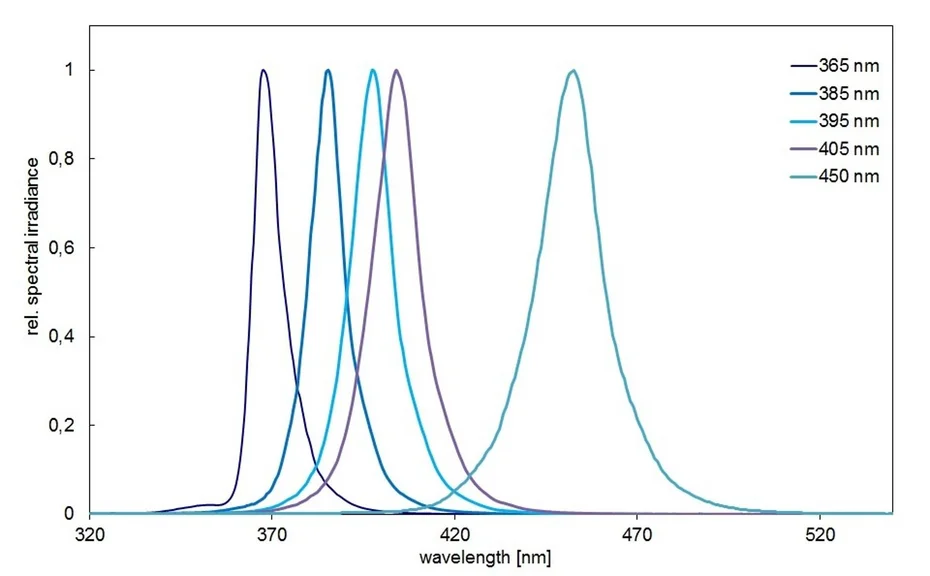
Spectra of the UV-LED modules on the LedControl DC
The LedControl DC drives one UV-LED module, so the wavelength is decided by the module connected. The five bands of the figure are available. If two wavelengths are needed in one machine, two LedControl DC go on the DIN rail and are driven together from the PLC; the safety-related shutdown up to category 4 / PL e is retained per channel.
Connection and configuration
One DC power supply unit each is needed to operate the LedControl DC and the LED module. At the 24 V auxiliary voltage the LedControl DC needs an output power of 10 W; the output power for the LED system depends on the module and lies between about 20 W and about 2000 W.
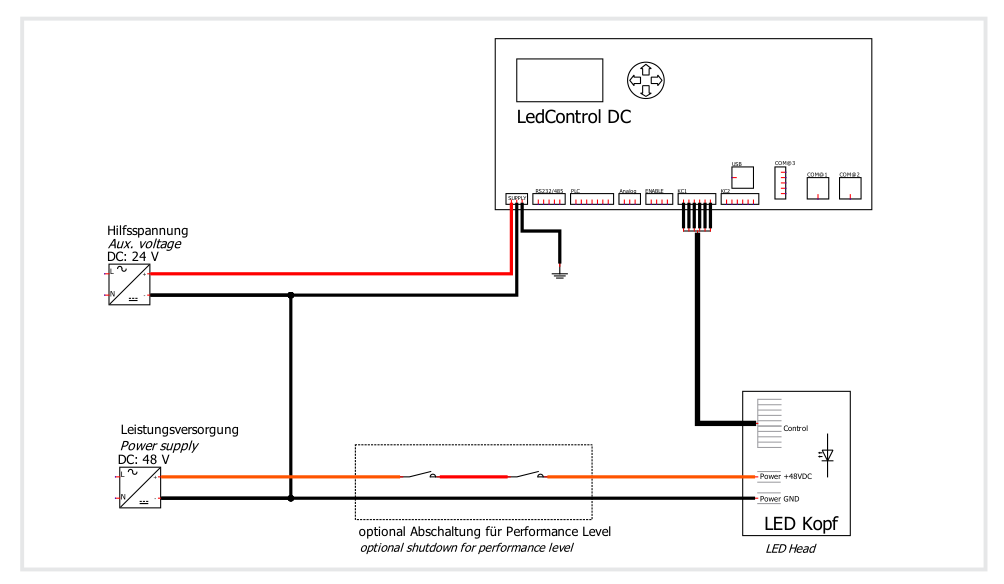
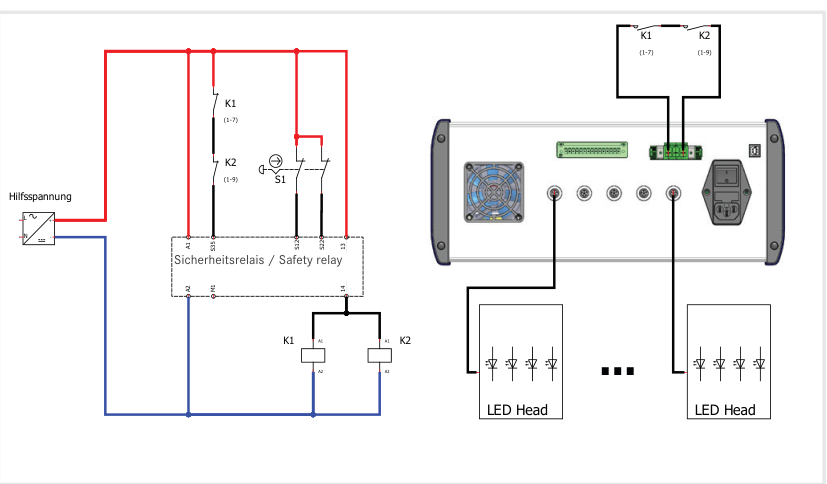
A two-channel safety door monitoring with automatic start is shown in the following example. Compared with simply separating the DC voltages, the advantage is the monitoring of the external contactors. The example is suitable up to category 4, PL e (EN ISO 13849-1) or SIL 3 (EN 62061), provided that cross-faults in the control of the actuator and in the sensor circuit can be excluded.
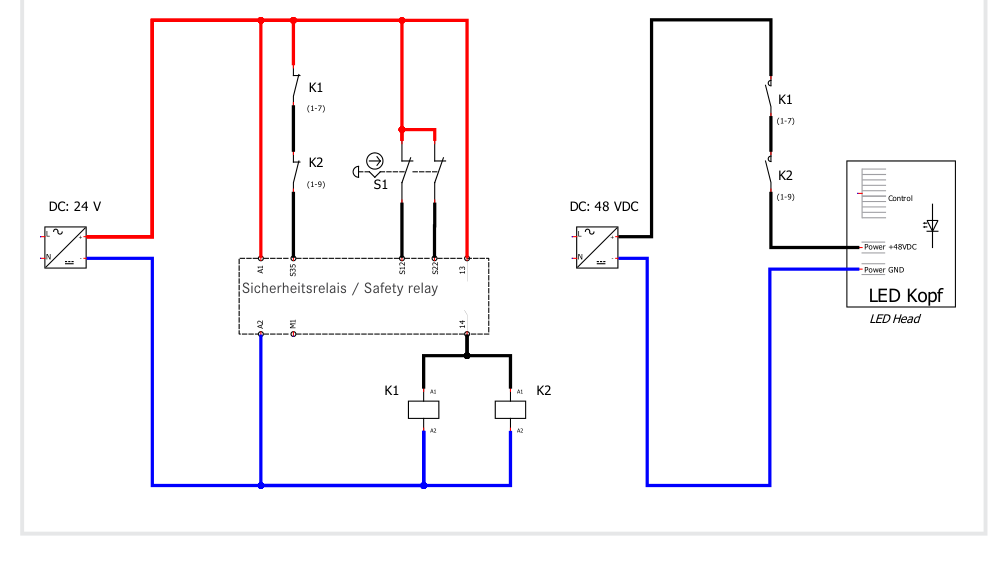
With the PL+ extension we supply all components ready-assembled for simple integration into a plant.
The LED systems that suit the LedControl DC have separate connections for the power supply and for the control. A seven-pole M23 flange plug for the power is built into the LED system; the control runs separately through a twelve-pole M23 flange plug.
Pre-assembled cables with sockets and open cable ends are available as a cable set. The standard length is 10 m; further cable lengths and intermediate sockets are available on request.
The PLready safety option
To make machines safe and to meet the requirements of the machinery directive 2006/42/EC, safety functions are needed in the controls. Usually the required performance level PLr is determined for every safety function. This is where the first difficulty with UV installations begins: the severity of the injury, the frequency and duration of exposure and the avoidance of the UV hazard have to be determined.
In the short term, UV exposure of the skin leads to erythema, elastosis and skin cancer; exposure of the eye can lead to photokeratitis, conjunctivitis and cataractogenesis. Skin cancer is a severe and usually irreversible injury.
Directive 2006/25/EC on artificial optical radiation permits regular exposure up to a daily exposure limit of 30 J/m². The severity of the injury can therefore be reduced through the duration and the intensity of the exposure without having to achieve absolute zero exposure: if the limit is observed, healthy adults can be expected to be exposed repeatedly without acute harmful effects. In the event of a fault, a short exposure may cause a reversible injury such as a slight erythema. The boundary is not reliable, however, and measures and safety functions are needed in every case.
Measurements are possible on existing installations; during the planning phase they are not, or only with additional effort, which is why a higher PLr is often demanded. This is exactly what the LedControl and the PLready option are for - already at the planning stage.
The PLready safety option is suitable up to PL category 4 according to EN ISO 13849-1 and SIL 3 according to EN 62061, provided that cross-faults in the control of the LED module and in the sensor circuit can be excluded.
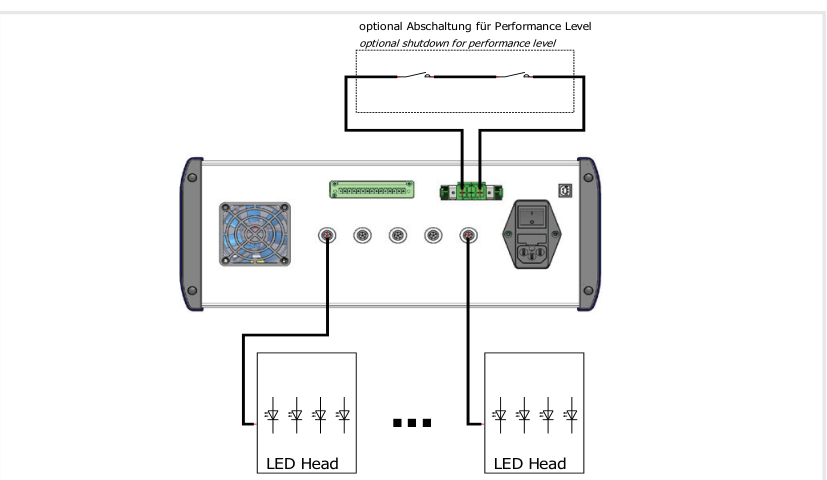
It works with a safety extra-low voltage (SELV) of 48 VDC that is safely separated by an external circuit and can switch the LED modules off completely in the event of a fault.
The optional shutdown for the performance level separates the LED modules through an external contact:
A two-channel safety door monitoring with automatic start is shown in the following example. Compared with simply separating the DC voltages, the advantage is the monitoring of the external contactors. The example is suitable up to category 4, PL e (EN ISO 13849-1) or SIL 3 (EN 62061), provided that cross-faults in the control of the actuator and in the sensor circuit can be excluded.
Remote control of the LedControl DC
The LedControl DC can be controlled through the optional programming interface - USB, RS485 or RS232 as required. Communication uses ASCII, here with "switch on" as an example:
- the control sends:
LOnOff:1! - the LedControl answers:
LOnOff: 1 (CRC-16)
Every channel can be controlled individually. Remote software for testing the programming interface straight away is available.
Through the PLC interface option the LED power (0 to 10 V), switching on and off (trigger input 24 V) and the status (trigger output 24 V) are set and queried. With its robust signals this option suits simple integration into a plant.
Control uses short ASCII commands. A selection:
| Command | Meaning |
|---|---|
| LAnzahlCH? | query the connected channels |
| LSelect: 0 1 !? | set the active channels |
| LPowerSet: 000.0 033.7!? | set the power |
| LTriggerOnOff: 11!? | activate the trigger input |
| LFirmware? | query the firmware version |
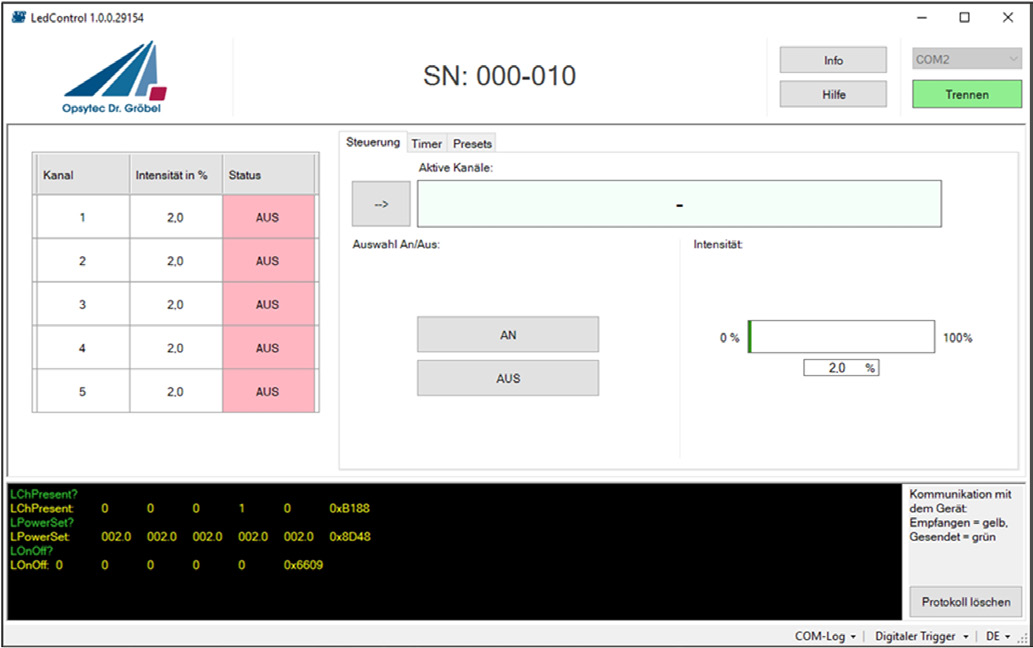
The test and control software shows the channels with intensity and status, switches them individually, sets timers and presets and logs the communication with the device.
Safety instructions
The device emits UV-A and blue light. UV radiation is invisible. Any visible light is only luminescence excited by the radiation; it is usually much weaker than the exciting UV radiation. The irradiance of the device is several hundred times stronger than that of sunlight.
UV-A radiation can cause cataracts in the lens of the eye and inflammation of the retina. Always wear suitable UV protective goggles when operating the device. UV-A also causes skin discolouration and skin ageing; use suitable clothing, gloves and further personal protective equipment - depending on the irradiation dose.
The devices are designed and classified according to DIN EN 62471:2009-03 "Photobiological safety of lamps and lamp systems"; the LED modules fall into risk group 3. Do not look into the LED and do not expose the skin to the UV radiation permanently.
We are glad to support you in setting up UV workplaces and with the risk assessment according to DIN EN 14255:2005.
Order numbers, scope of delivery, accessories and versions
| Version | Order number |
|---|---|
| LedControl DC | 860610DC |
The LedControl DC drives one UV-LED module at 24 V and is mounted on a DIN rail.
Scope of delivery: the LedControl DC, the interface assignment, the operating manual and the options ordered. Please state the LED type, the wavelength and, where applicable, the optic and the options with your order.
| Designation | Order number |
|---|---|
| PL+ safety extension | 860609PLDC |
With the extension the control reaches performance level e according to ISO 13849 and SIL 3.
| Option | Order number |
|---|---|
| Programming interface RS485 * | 860609-RS485 |
| Programming interface RS232 * | 860609-RS232 |
| Programming interface USB * | 860609-USB |
| Test and control software | 860609-SW |
| PLC interface option (I/O) | 860609-CP |
* including the PLC interface option.
| Designation | Order number |
|---|---|
| Cable set, 10 m | 860609CDC |
The cable set holds pre-assembled cables with sockets and open cable ends for the power and for the control; the standard length is 10 m. Further cable lengths and intermediate sockets are available on request.
| Series | Description |
|---|---|
| UV-LED series L | high-power UV-LED modules in five sizes |
| UV-LED series SFL | UV-LED flood lamps in three sizes |
| UV-LED Spot P | UV-LED spot light source |
The order numbers of the modules are listed on their own pages: series L, flood lamp SFL and Spot P. They are available in five wavelengths: 365, 385, 395, 405 and 450 nm.
Anschluss der LedControl DC
For the operation of the LedControl DC and the LED module, one DC power supply unit each is required. The output power of the 24 V auxiliary voltage required for the LedControl DC is 10 W.
The necessary output power of the LED systems depends on the LED system and can be approx. 20 W to approx. 2000 W. The technical data for this can be found in the data sheets of the LED systems.
For two-channel safety door monitoring with automatic start, the LedControl DC reaches up to category 4 / PL e (EN ISO 13849-1) and SIL 3 (EN 62061). The connection examples are shown in the accordion “Connection and configuration”.
Compared with simply separating the DC voltages, the advantage is the monitoring of the external contactors. The connection example is suitable up to category 4, PL e (EN ISO 13849-1) or SIL 3 (EN 62061) if cross-circuits in the control line to the actuator and in the sensor circuit can be ruled out. With the PL+ extension we supply all components ready-assembled for simple integration into a plant.
SIL 3 UV control: what the classification means
A SIL 3 UV control is not a better controller but one with a demonstrated probability of failure. SIL 3 to EN 62061 and PL e to EN ISO 13849-1 describe how reliably the safety function switches off – not how well it irradiates.
It becomes necessary where the radiation itself is the hazard: open systems, robot cells, manual workstations. The risk assessment of the installation sets the level, not the light source.