


UV panel meter RM-32
The mains-driven panel meter RM-32 provides a continuous and precise measurement of irradiance with preamplified UV sensors. The integrated electronics produce a signal voltage that is transmitted to the radiometer, so that inferences are minimized. Different UV and visible spectral ranges, measuring ranges, and output signals can be selected to match the measurement task.
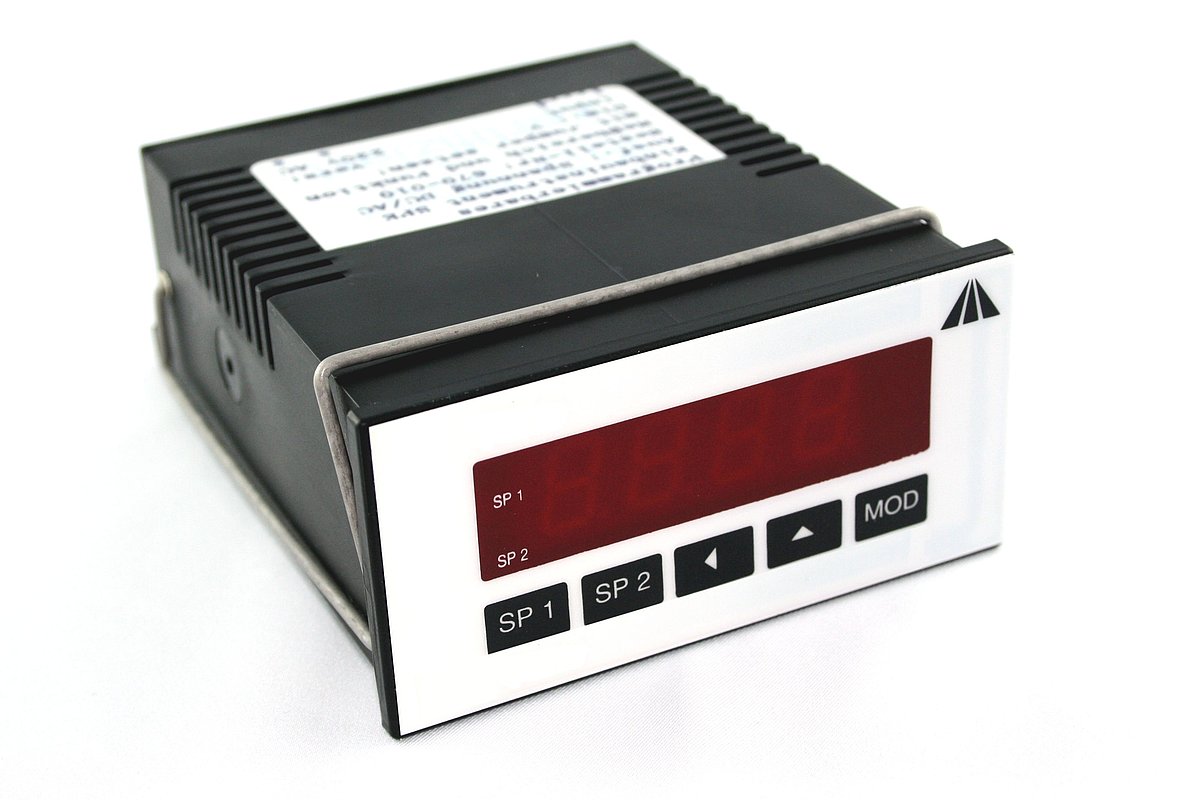
The current irradiance is shown on a 3.5-digit digital display. The lamp state with respect to two threshold values is indicated by LEDs. Two relay contacts can be used for switching warning and failure signals. With its optional USB, RS232 or RS485 interface the RM-32 can be used to monitor ultraviolet (UV) irradiance.
The RM-32 is designed for control cabinet mounting. The housing matches the DIN 43700 panel cut-out (96 × 48 mm) with an installation depth of approximately 115 mm: the display sits in the cabinet door while sensor, power supply and relay outputs are wired at the rear. UV monitoring therefore becomes part of the system control and requires no separate measuring station.
Applications of UV panel meter RM-32
- Control of light sources and irradiation systems
- Precise measurement of irradiances
- Logging of the irradiance
- UV monitor for process control and documentation
| Product type | Panel-mount display unit: Panel-mount monitor for the control cabinet with threshold and alarm relays |
| Spectral range | depending on the connected PLC sensor: UVC 200–280 nm, UVB 280–315 nm, UVA 315–400 nm, UVA+ 330–455 nm, UVBB 230–400 nm, VISB 400–480 nm, LUX 380–780 nm, V(λ) |
| Measuring range | Sensor input 0–10 V; measuring range set by the connected PLC sensor (three ranges between 0–100 mW/cm² and 0–5000 mW/cm²) |
| Calibration uncertainty (typ.) | 4.5–6.0 % (k = 2) |
| Output / interface | Alarm contacts: 2 × 250 V, 1 A; sensor supply: 24 V DC, max. 30 mA; interface: optional USB, RS-232 or RS-485 |
| Time resolution | analogue sensor signal, determined by the instrument |
| Calibration | factory calibration |
| Standards / guidelines | DIN 43700 |
| Suitable for | UV disinfection; UV curing and photopolymerisation; Automation and process integration |
| Not suitable for | spectrally resolved measurement (peak wavelength, bandwidth); sensor temperatures above 40 °C; use under water or under pressure; dose measurement without instrument or controller |
| Datasheet revision | Rev. 2026-09-08 (e_rm-32.pdf) |
The calibration uncertainty stated above is the expanded uncertainty of the calibration (k = 2, confidence level approx. 95 %) and applies to the calibration source and the calibration conditions. In use the measurement uncertainty is larger: spectral mismatch at the source actually used, the sensor temperature, ageing since calibration as well as distance and alignment to the source are added to it. How these combine into an uncertainty budget is explained under Measurement uncertainty in UV measurement.
Technical data for panel meter RM-32
| Display | 3½ digits, digital |
| Sensor signal input | 0–10 V |
| Alarm threshold | 0–10 V |
| Resolution | 10 mV |
| Alarm contacts | 2 × 250 V, 1 A |
| Alarm hysteresis | programmable |
| Alarm delay | adjustable |
| Sensor supply voltage | 24 VDC, max. 30 mA |
| Interface | optional USB, RS-232 or RS-485 |
| Dimensions to DIN 43700 | 96 × 48 mm |
| Installation depth | ~ 115 mm |
| Weight | 410 g |
| Mains | 230 V or 110 V, 50 Hz, 3 W |
| Operating temperature | 0 to 40 °C |
| Storage temperature | -10 to 40 °C |
| Humidity | below 80 %, non-condensing |
Frequently asked questions: RM-32
The RM-32 evaluates sensors with a 0–10 V signal: the PLC sensors in the voltage version, the waterproof UVC-SE and UVx-SE and inline sensors FLT in the matching electronics version. The sensor input processes 0–10 V; the RM-32 supplies the sensor with 24 V DC (max. 30 mA). Radiometer sensors for RMD or RM-12 cannot be connected directly.
A threshold in the unit of the sensor is set on the RM-32; if the irradiance falls below this value for longer than the set alarm delay, the alarm contacts switch. A switching hysteresis prevents chattering around the limit. A UV system can thus be monitored without a PLC: the contact switches a warning light or stops the conveyor drive when a lamp fails or drops below 80 % of its initial output.
Yes, the housing follows the 96 × 48 mm front dimension per DIN 43700 and is inserted into the matching panel cut-out; the installation depth is approx. 115 mm, the weight 410 g. Optionally the unit can be equipped with USB, RS-232 or RS-485 to pass readings to a PC or a higher-level controller. Without this option the RM-32 works purely as a display with relay outputs.
The calibration certificate states the expanded calibration uncertainty with k = 2; for the RM-32 it is typically 4.5–6.0 %. In use the measurement uncertainty is larger, because spectral mismatch at the source actually used, sensor temperature, ageing and measuring geometry are added to it. How these combine into an uncertainty budget is explained under Measurement uncertainty in UV measurement.
Matching UV sensors for the RM-32
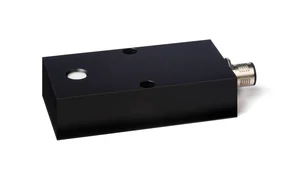
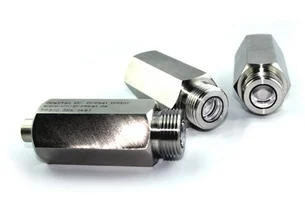
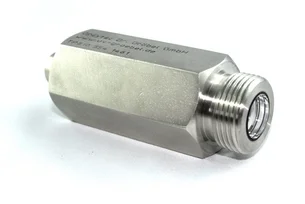
The RM-32 suits, for example, the following sensors: PLC sensors, the pressure-water-tight sensors UVC-SE and the sensors UVx-SE.