UV probes: Calibrated precision instruments for measuring points that are difficult to access
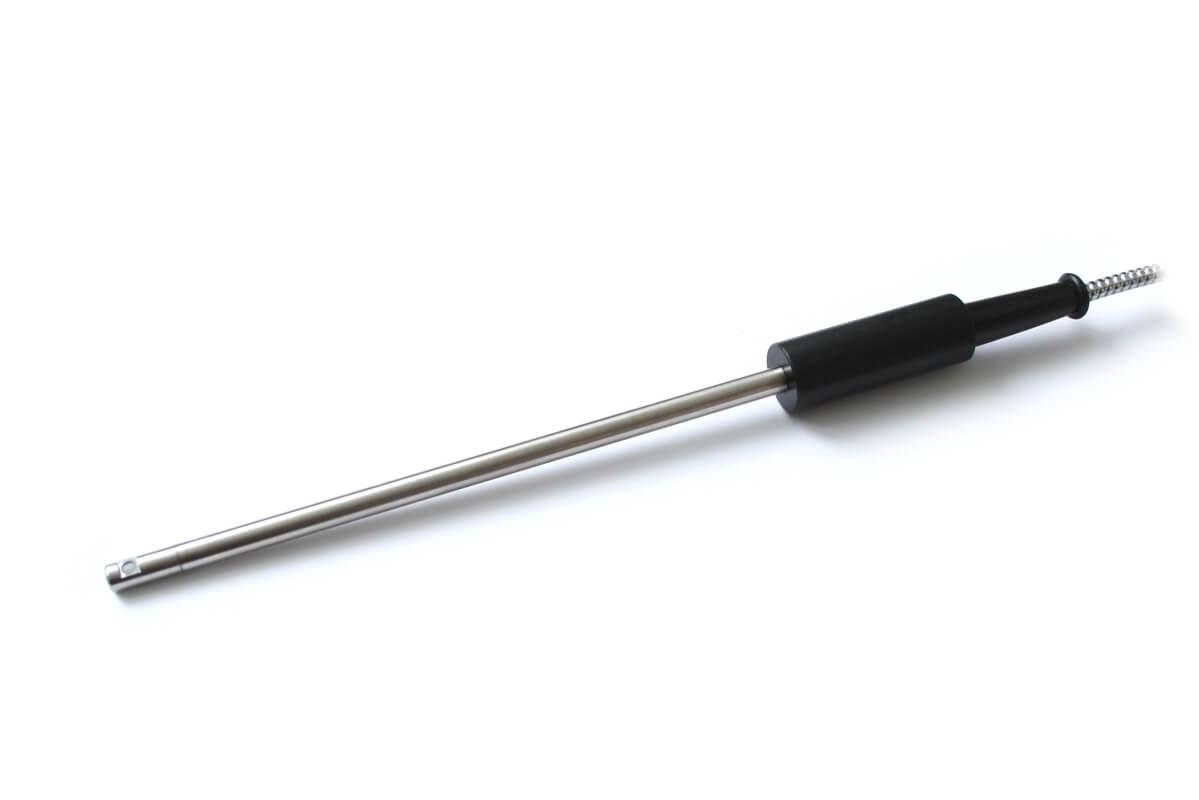
The Opsytec UV probes measure irradiance at measuring points that are difficult to access. They are available in three versions and the standard lengths 15 cm and 30 cm; with an outer diameter of only 6 mm and a probe operating temperature of up to 200 °C, they complement the RMD UV radiometer and the spectroradiometers UVpad E and SR900. All UV probes come with a diffuser, which enables the absolute measurement of irradiance and ensures the required cosine correction during non-perpendicular irradiation.
The UV probes are, together with the radiometers, traceably calibrated to the PTB, recalibratable and are supplied with a factory calibration certificate.
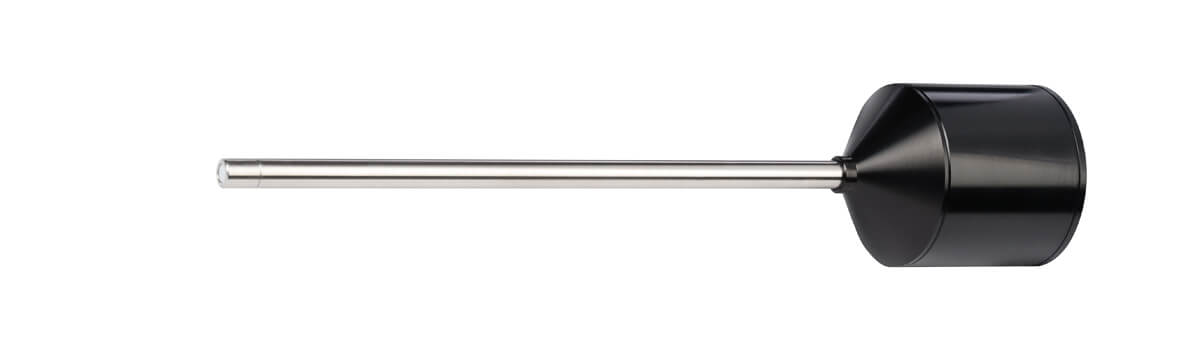
The versions “side-on” and “head-on” are suitable for irradiance measurements e.g. of mercury medium pressure emitters or the effective disinfecting UVC irradiance (UVGI). The “integrating” version measures in all directions and is thus designed as entrance optics for spectral radiometers for the detection of the lamp spectra.
For the use with a radiometer, our standard range contains seven spectral ranges and three measuring ranges. Due to the integrated electronics, several UV probes can be connected to one radiometer.
For the use with a spectral radiometer, the UV probes are delivered with a changeable SMA connection.


| Product type | UV sensor: Compact probes for hard-to-reach measuring points, band-selective or as light guide |
| Spectral range | 200–780 nm |
| Measuring range | depending on sensor (interchangeable sensor) |
| Calibration uncertainty (typ.) | 4.5–6.0 % (k = 2) |
| Output / interface | RMD, UVpad E, SR900, SMA |
| Time resolution | analogue sensor signal, determined by the instrument |
| Calibration | factory calibration |
| Standards / guidelines | no product-specific standard; calibration per DIN EN ISO/IEC 17025:2018 available |
| Suitable for | UV curing and photopolymerisation; Optics and precision components; Electronics and semiconductors |
| Not suitable for | spectrally resolved measurement (peak wavelength, bandwidth); sensor temperatures above 200 °C; use under water or under pressure; handheld measurement without instrument or PLC |
| Datasheet revision | Rev. 2026-09-08 (e_uv-probes.pdf) |
The calibration uncertainty stated above is the expanded uncertainty of the calibration (k = 2, confidence level approx. 95 %) and applies to the calibration source and the calibration conditions. In use the measurement uncertainty is larger: spectral mismatch at the source actually used, the sensor temperature, ageing since calibration as well as distance and alignment to the source are added to it. How these combine into an uncertainty budget is explained under Measurement uncertainty in UV measurement.
Highlights of UV probes
- Diameter of only 6 mm
- Measurements in difficult to reach areas
- UV diffuser for precise measurements
- 7 spectral ranges available
- For radiometers or spectral radiometers
- Long-term stable and recalibratable
View the UV probes as a 3D model
Look at all three probe heads from every side, rotate and zoom – directly in your browser.
The UV probes can be viewed from all sides in the 3D product viewer – true to the original, generated from the CAD design data. The side-on, head-on and integrating versions are included, so the head shapes can be compared directly.

Frequently asked questions: UV probes
The probes are supplied in 15 cm or 30 cm length and have a small probe diameter, so they reach through openings of a few millimetres into pipes, ducts or chambers. The electronics sit in a separate housing on the cable and stay outside the measuring point; the electronics housing is about 40 mm long.
There are three versions: side-measuring for the irradiance at a pipe wall, front-measuring in the direction of the probe axis and an integrating probe that captures radiation from all directions, for example in an irradiation chamber with several lamps. The band-selective probes deliver their signal to the RMD; the light-guide version with SMA connector carries the light to the spectroradiometer UVpad E or SR900 for a spectral measurement.
Yes, a higher temperature range applies to the probe than to the electronics, because only the tip reaches into the hot zone; the probe is rated up to 200 °C, the electronics up to 60 °C. Typical uses are measurements inside UV dryers, in lamp cooling ducts or in reactors where a 40 mm sensor head does not fit or would become too hot.
The calibration certificate states the expanded calibration uncertainty with k = 2; for the UV probes it is typically 4.5–6.0 %. In use the measurement uncertainty is larger, because spectral mismatch at the source actually used, sensor temperature, ageing and measuring geometry are added to it. How these combine into an uncertainty budget is explained under Measurement uncertainty in UV measurement.
Order numbers, scope of delivery, accessories and versions
| Spectral range | Order number |
|---|---|
| UVC | 814410p15 |
| UVB | 814420p15 |
| UVA | 814432p15 |
| UVA+ | 814447p15 |
| UVBB | 814411p15 |
| VISB | 814443p15 |
| LUX | 814461p15 |
These probes are operated on the radiometer RMD Pro.
| Item | Value |
|---|---|
| Sensor connector | 5-pole, pluggable |
| Measuring ranges | 0–10 W/cm², 0–20 W/cm² (option -2) |
| Spectral range | Order number |
|---|---|
| UVC | 814410p30 |
| UVB | 814420p30 |
| UVA | 814432p30 |
| UVA+ | 814447p30 |
| UVBB | 814411p30 |
| VISB | 814443p30 |
| LUX | 814461p30 |
| Instrument and probe length | Order number |
|---|---|
| UV probe SMA UVpad E, 15 cm | 670027p15 |
| UV probe SMA UVpad E, 30 cm | 670027p30 |
| UV probe SMA SR900, 15 cm | 840320p15 |
| UV probe SMA SR900, 30 cm | 840320p30 |
These probes are connected to the UVpad E or the SR900 through an optical fibre.
| Item | Value |
|---|---|
| Diameter, probe | Ø 6 mm |
| Length, probe | 15 cm or 30 cm |
| Optical fibre, connector | SMA 905 |
| Optical fibre, length | 1.5 m |
| Optical fibre, type | UV silica fibre with metal shielding |
| Diameter, connector | 15 mm |
| Weight | about 100–200 g |
| Operating temperature, probe | 0 to 200 °C |