Industrial UV light sources for laboratory and production
Industrial UV light sources are selected by spectrum, irradiated area, working distance, uniformity, intensity and mode of operation. Broadband lamps, hand-held sources, spot sources and UV-LED systems serve different tasks in curing, inspection, photochemistry and laboratory testing.
| Design | Suitable for |
|---|---|
| Broadband UV lamp | Photochemistry, reference and laboratory tasks, Small, defined area |
| UV hand lamp | Mobile inspection and local testing |
| UV-LED system | Switchable, wavelength-specific processes |
The largest share is adhesive curing: UV adhesives, potting compounds and coatings cross-link within seconds under irradiation. What matters is that the wavelength suits the photoinitiator and the irradiance suits the cycle time. The second field is material inspection, where the radiation does not cure but makes fluorescent markers visible.
The switchable, narrowband systems are listed under UV-LED light sources, the mobile instruments under UV hand lamps. Irradiance at the point of treatment can be monitored with UV meters and radiometers.
Applications of our UV light sources
- Adhesive curing of acrylates and epoxies
- Sealing, potting and IC encapsulation
- Curing of coatings and varnishes
- Material inspection and surface inspection
- Crack and leak detection using fluorescent markers
- Surface activation prior to bonding
- Post-curing in rapid prototyping and 3D printing
HP-120i

Point light source with light guide for high-intensity UVA radiation, time-controlled via shutter and timer.
UV hand-held lamps
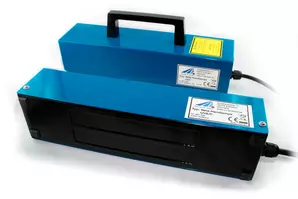
UV hand-held lamps for UVA and UVC, for fluorescence inspection and disinfection.
UV lamp or UV LED: which fits when
UV lamp, UV emitter, UV floodlight – the words usually mean the same thing: a source with a broad spectrum that is not tied to one wavelength. Facing it is the UV LED with a band ten to twenty nanometres wide. The choice between them is rarely a question of power.
- The lamp is tolerant. A mercury medium-pressure lamp hits every common photoinitiator somewhere in its spectrum. Where several formulations run through the same line, or the recipe is not known, that is the decisive advantage.
- The LED is selective. It is at full power instantly, ages more slowly, contains no mercury and barely heats the sample. But it cures only what absorbs at its wavelength – and a formulation developed for mercury lamps does not necessarily do so. Which initiator suits which source is set out under photoinitiators and UV absorbers.
There is a regulatory side too: exemptions under RoHS for mercury-containing lamps have expired or are expiring – what is permitted and what is not is covered under RoHS and UV lamps. And every source ages regardless of technology; how fast, and how it shows, is covered under ageing of UV lamps and UV LEDs.
This category holds the broadband sources: the HP-120i spot source for point irradiation through a light guide and the UV hand lamps for inspection at the part. The narrowband sources are under UV LED light sources.