



solo P – compact high-power UV LED for bonding
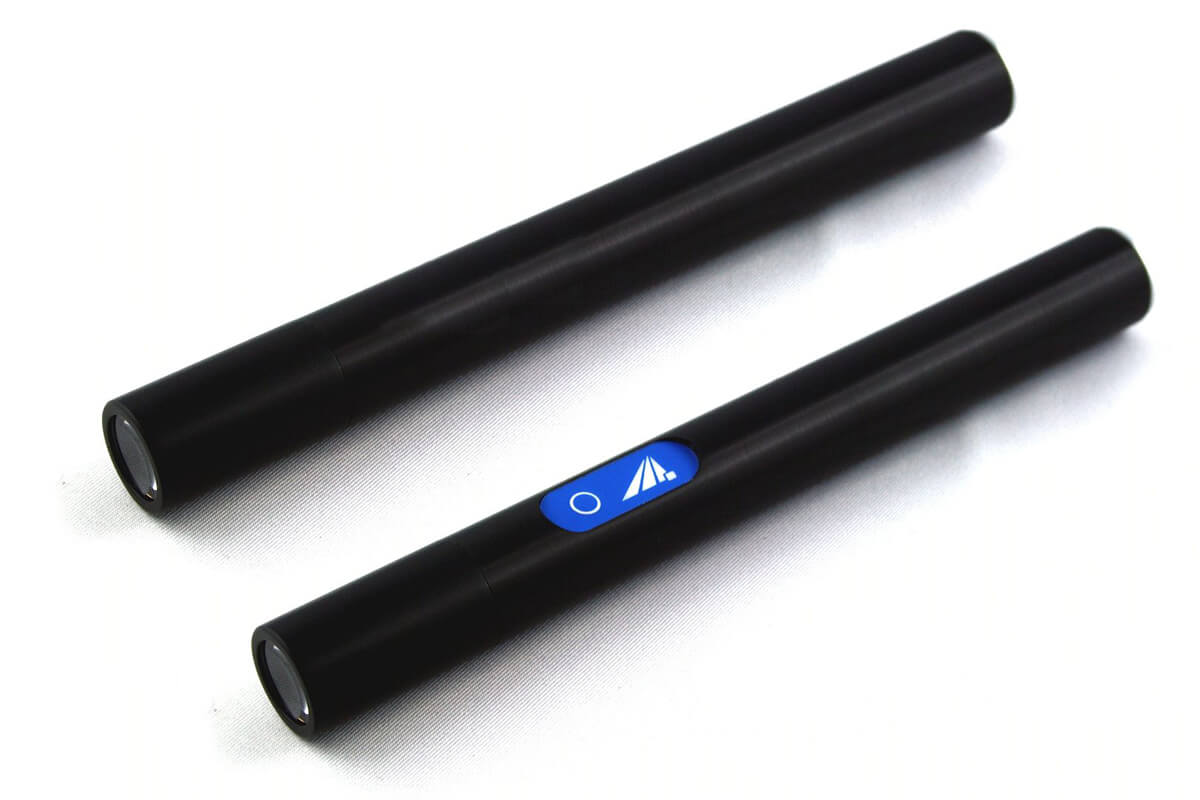
The high-power UV LED solo P is a compact, economical UV LED spot light source for manual bonding. It reaches up to 24,000 mW/cm² in the wavelengths 365, 385, 395, 405 and 450 nm, measures Ø 15 × 143 mm and weighs about 130 g. No external controller is required – the solo P runs directly from a mains power adapter and, like all our UV LEDs, is quickly switchable.
Wavelength, beam profile, and optic
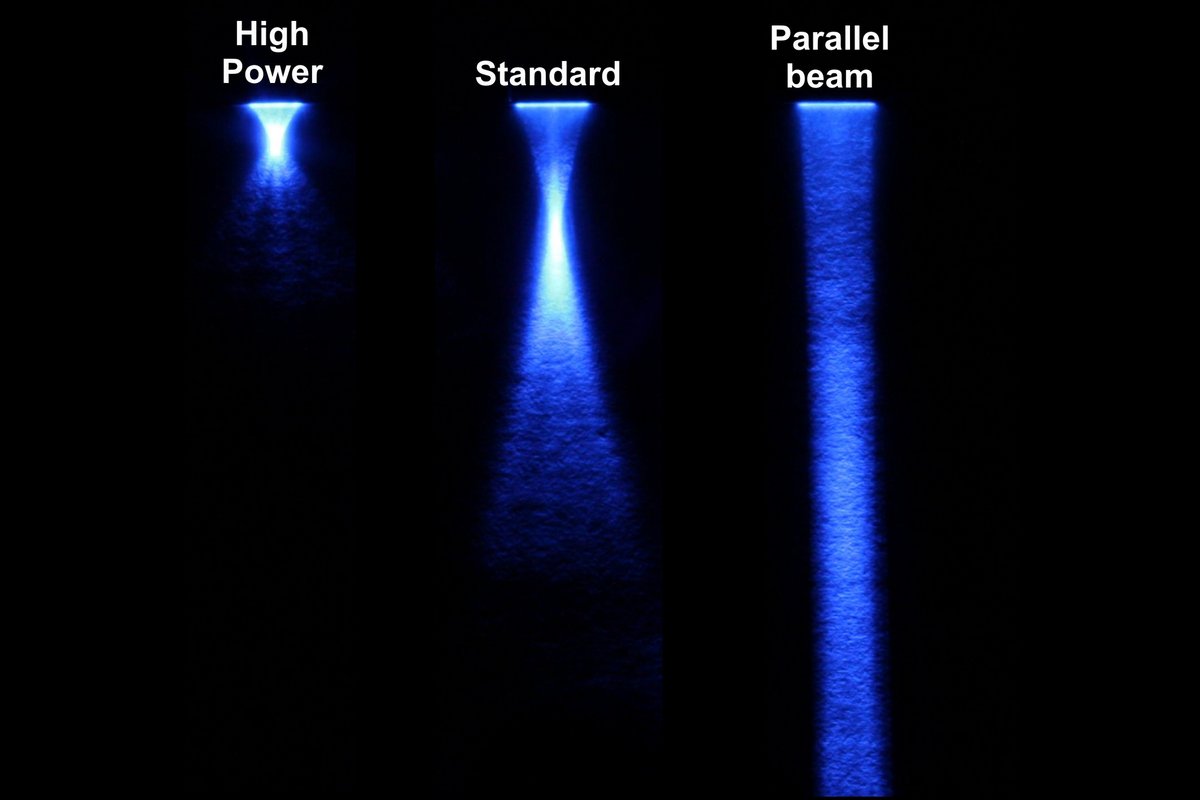
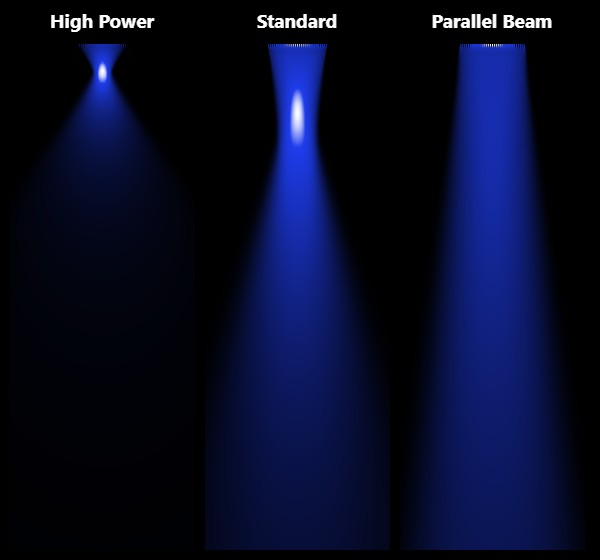
Several beam profiles with interchangeable optics are available. The UV radiation of the high-power LED is focused at the desired working distance.
Applications of high-power UV-LED solo P
- UV curing and bonding and UV sealing
- Micro curing
- Irradiation of biological samples
- Hairline or leak detection using fluorescence markers
solo P: calculate the irradiance at the workpiece in advance
How much irradiance arrives at the workpiece? In the spot source simulation you choose optics, wavelength and working distance of the solo P and immediately see the heat map, cross-section profiles and key figures of the target. The section view shows how spot size and irradiance change with distance; one click sets the working distance to the best focus. Results can be exported as CSV and as a PDF simulation report – a basis for the design, while the measurement with a UV radiometer remains binding.
Advantages of UV-LED solo P
- Ergonomic design
- High power UV-LED
- 365, 385, 395, 405, or 450 nm
- Highly efficient UV radiation
- No thermal radiation
- Long lifetime
- Built-in pushbutton and optional foot switch available
Technical data UV-LED solo P
| Wavelength | 365, 385, 395, 405 or 450 nm |
| Max. irradiance | > 24000 mW/cm² |
| Dimensions | Ø 15 × 143 mm |
| Weight | ~130 g |
| Operating voltage | 100–240 V, 50/60 Hz |
| Power | 5 W |
| Cable length | 1 m |
| Connection | DC in, foot switch (optional) |
| Button | 1 (pressed = on) |
| Cooling mount, dimensions | D 50 mm, h = 25 mm |
| Classification | risk group 3 according to DIN EN 62471:2009-03 |
| Operation temperature | 5 to 40 °C; with a duty cycle above 0.5 cooling may be required |
| Storage temperature | -10 to 60 °C |
| Humidity | below 80 %, non-condensing |
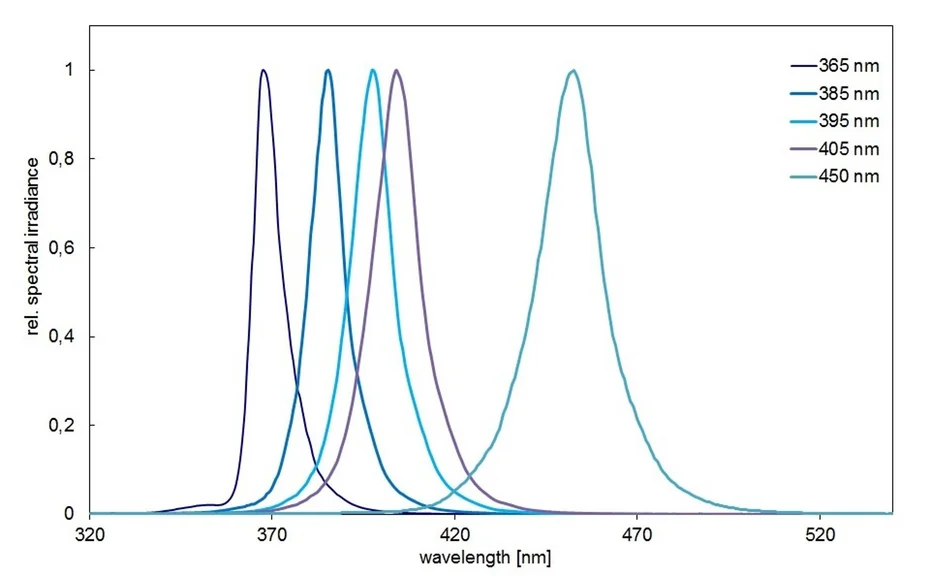
Spectra of the UV-LED point light source solo P
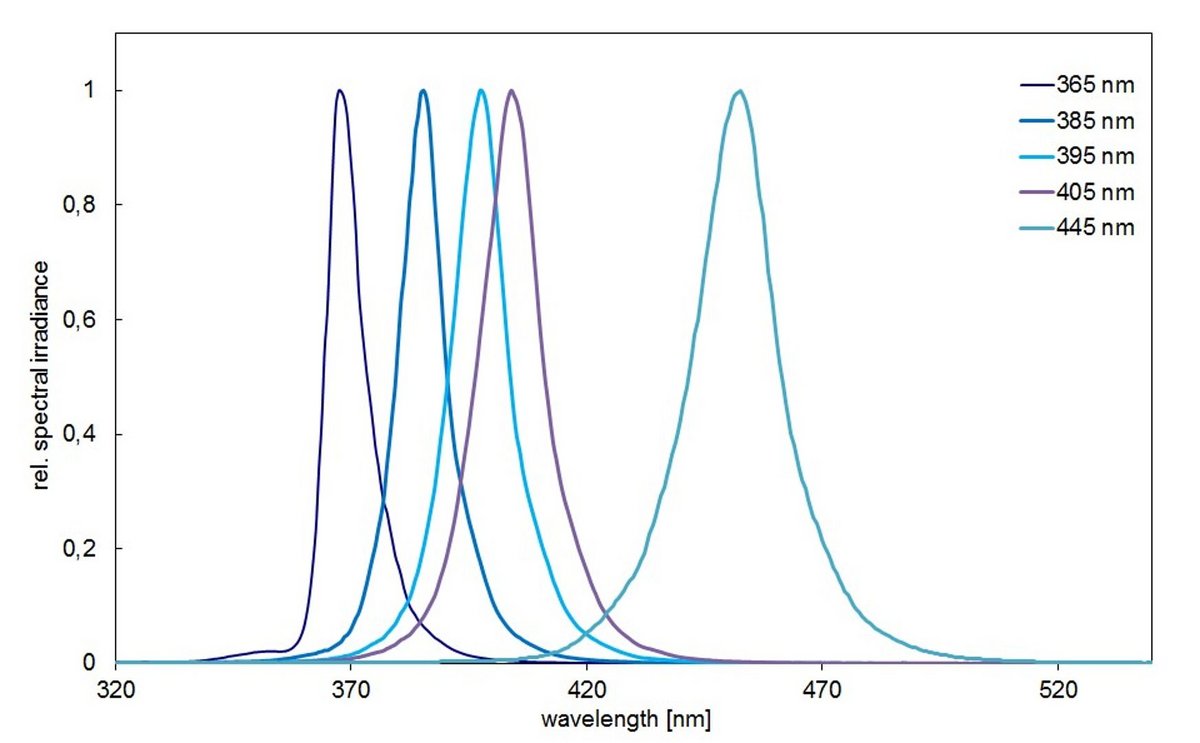
The wavelength of the solo P is fixed when ordering and cannot be changed in the unit. The figure helps with that choice because it shows the range a curve actually covers: an adhesive specified for 395 nm still receives a useful share from a 405-nm LED, but hardly anything from a 365-nm LED. For two wavelengths, two solo P are used.
Safety instructions
The device emits UV-A and blue light. UV radiation is invisible. Any visible light is only luminescence excited by the radiation; it is usually much weaker than the exciting UV radiation, so the impression of a low irradiance is misleading.
UV-A radiation can cause cataracts in the lens of the eye and inflammation of the retina. Always wear suitable UV protective goggles when operating the device. UV-A also causes skin discolouration and skin ageing; use suitable clothing, gloves or sunscreen.
The devices are designed and classified according to DIN EN 62471:2009-03 "Photobiological safety of lamps and lamp systems"; the solo P falls into risk group 3. Do not look into the LED and do not expose the skin to the UV radiation permanently. Stray radiation from the LEDs is usually uncritical, but workplace safety remains the responsibility of the user.
We are glad to support you in setting up UV workplaces and with the risk assessment according to DIN EN 14255:2005.
Order numbers, scope of delivery, accessories and versions
| Version | Order number |
|---|---|
| UV-LED spot light source solo P | 860614 |
Scope of delivery: the solo P including optic and plug-in power supply. Unless specified otherwise we supply the optic "Standard" and the wavelength 365 nm; please state other optics and wavelengths with your order.
| Wavelength |
|---|
| 365 nm |
| 385 nm |
| 395 nm |
| 405 nm |
| 450 nm |
Please state the required wavelength with your order; it is not part of the order number. The peak wavelength lies within ± 5 nm.
| Designation | Order number |
|---|---|
| Foot switch | 860611 |
| UV protective goggles | 918800 |
| Additional optic | 860605 |
| Cooling mount | 860605C |
| Plug-in power supply | 400POW |
| Kink protection extension, cable 3 m | 860604V3 |
The additional optic focuses the beam more tightly, the cooling mount absorbs the waste heat at a high duty cycle. For simple operation we recommend ordering the foot switch as well; for work in places that are hard to reach we offer extension cables with kink protection.