RMD Pro – the fully digital UV radiometer
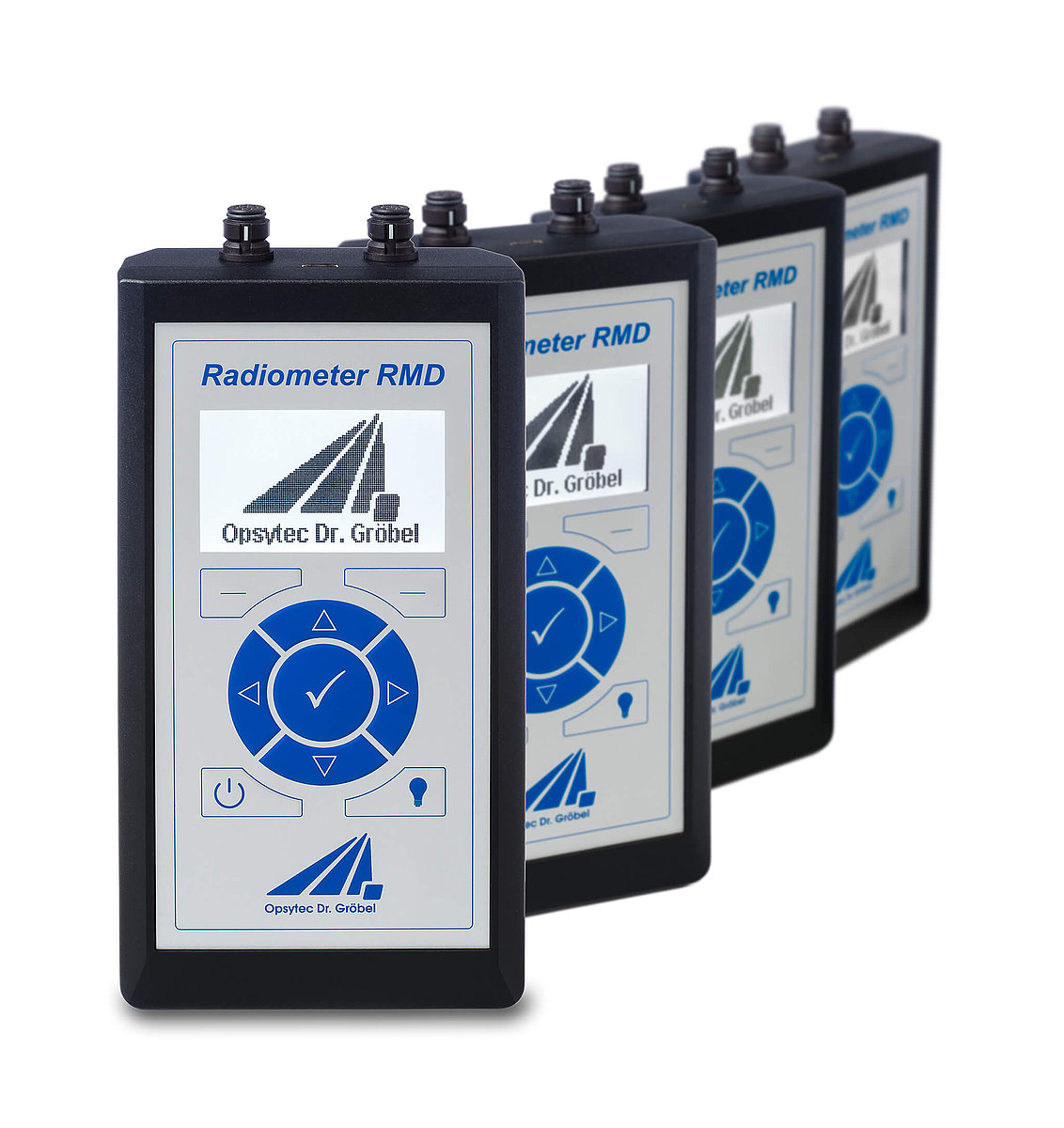
The RMD Pro is a fully digital hand-held UV radiometer for measuring UV irradiance, UV dose and illuminance. Through two digital sensor ports it works with interchangeable, calibrated sensors – typically 0–10 W/cm², dose up to 100 MJ/cm² and illuminance up to 500,000 lx with 24-bit conversion. Measurement series are stored internally on 8 GB and read out via USB 2.0.
The wide dynamic range with low noise comes from the sensor: it contains multi-stage amplification, a 24-bit analog-to-digital converter and a temperature sensor. The memory contained in the sensor contains all sensor identifications and the calibration history.
This allows several ultraviolet sensors and visible sensors to be used on the UV-Radiometer RMD. A wide range of sensors is available for a wide variety of production and control processes. Two sensors can be read out simultaneously. Sensors for the evaluation of erythema-weighted radiation and multi-channel sensors are also available.
The measurement data are clearly displayed on the graphic display.
The calibration itself is carried out in our own laboratory; details are given under UV calibration.
The newly developed diffuser achieves a very good cosine correction with excellent lateral uniformity. The radiation to be measured is distributed evenly over several channels, so that, for example, the simultaneous determination of UVA irradiance and illuminance is possible.
Compared to the RM-22, the RMD features a significantly higher resolution of 24-bit, an extended measuring range of up to 7 orders of magnitude, multi-channel sensors and the simplified operation.
The measured values can be stored in the RMD and output via USB. With the corresponding software, the RMD can be controlled from the PC. The device can be supplied with power via battery or power supply unit and records measurement data for up to 100 days.
Applications of the RMD Pro UV radiometer
- Measurement of UV LEDs & UV light sources
- NDT, material testing
- Monitoring of UV irradiation systems
- Measurement of workplace safety
- Measurement of Heff and HUVA
- Multi-channel measurements
- Applications with high dynamics
- Measurement of UVC radiation
- Measurement of UVC LEDs & UVC light sources
- Dose measurement
- Proof of UVC surface disinfection
- Data logging


| Product type | UV meter: Fully digital handheld UV radiometer with two sensor inputs, dose function and 8 GB memory (Pro) |
| Spectral range | depending on the interchangeable sensor: UVC 200–280 nm, UVB 280–315 nm, UVA 315–400 nm, UVA+ 330–455 nm, UVBB 230–400 nm, VISB 400–480 nm, LUX 380–780 nm, V(λ) |
| Measuring range | 0–10 W/cm²; 0–1 W/cm²; 0–10 mW/cm² |
| Calibration uncertainty (typ.) | 4.5–6.0 % (k = 2) |
| Output / interface | PC interface: USB 2.0 |
| Time resolution | Sampling rate: adjustable: 1 s–15 min |
| Calibration | factory calibration, ISO 17025 calibration optional (DIN EN ISO/IEC 17025:2018) |
| Standards / guidelines | DIN EN 62471:2009-03; DIN EN 14255-1:2005 |
| Suitable for | Additive manufacturing and 3D printing; Photobiology and biotechnology; Plants, agriculture and food; UV disinfection |
| Not suitable for | spectrally resolved measurement (peak wavelength, bandwidth); sensor temperatures above 40 °C; use under water or under pressure; VUV measurement at 172 nm |
| Datasheet revision | Rev. 2026-09-08 (E_RMD.pdf) |
The calibration uncertainty stated above is the expanded uncertainty of the calibration (k = 2, confidence level approx. 95 %) and applies to the calibration source and the calibration conditions. In use the measurement uncertainty is larger: spectral mismatch at the source actually used, the sensor temperature, ageing since calibration as well as distance and alignment to the source are added to it. How these combine into an uncertainty budget is explained under Measurement uncertainty in UV measurement.
Experience the RMD UV radiometer as an interactive 3D model
Rotate the handheld unit and the measuring head, switch the display on and page through the menu – just like on the real device.
The RMD UV radiometer can be viewed from all sides in the 3D product viewer – true to the original, generated from the CAD design data, with measuring head and membrane keypad. The power key wakes the display, then the navigation pad and the softkeys lead through the menu, just as on the real device.

Technical data digital UV radiometer RMD
| Sensor connectors | 2, digital |
| PC interface | USB 2.0 |
| Display | graphical, 128 × 64 px |
| Display output | 1 + 2 channels |
| Irradiance + Dose | |
| Min/Max Irradiance | |
| Dimensions | 160 × 85 × 35 mm |
| Weight | 250 g |
| Power supply | internal Li-Ion battery, USB |
| 110–240 V USB power supply | |
| Internal memory | 8 GB |
| Sampling rate | adjustable: 1 s - 15 min |
| Recording time | > 2400 h |
| Operation temperature | 0 to 60 °C |
| Storage temperature | -10 to 60 °C |
| Humidity | < 80% non-condensing |
| UVC | 200–280 nm |
| UVB | 280–315 nm |
| UVA | 315–400 nm |
| UVA+ | 330–455 nm |
| UVBB (broadband) | 230–400 nm |
| VISB | 400–480 nm |
| LUX | 380–780 nm, V(λ) |
| NDT (365 nm + LUX) | 315–400 nm, 380–780 nm |
| Erythema + UVA | 200–400 nm, Ery(λ) |
| Spectral ranges | UVA, UVA+, UVBB |
| Measuring range, typ. | 0–10 W/cm² |
| Resolution | 0.001 µW/cm² |
| Spectral ranges | UVB, UVC, VISB |
| Measuring range, typ. | 0–1 W/cm² |
| Resolution | 0.001 µW/cm² |
| Spectral ranges | UVC (for proof of occupational safety), erythema + UVA |
| Measuring range, typ. | 0–10 mW/cm² |
| Resolution | 0.001 µW/cm² |
| Dose measuring range | 0–100 MJ/cm² |
| Illuminance, measuring range | 0–500,000 lx |
| Resolution | 0.001 lux |
| Dynamic range | 1 : 10⁷ |
| AD conversion | 24 bit |
| Temperature sensor | integrated |
| Dimensions | Ø 40 mm, h 35 mm |
| Optical area | Ø 7 mm |
| Weight | 160 g |
| Connecting cable | 1.8 m |
| Operating temperature | 0 to 60 °C |
| Storage temperature | -10 to 60 °C |
| Humidity | below 80 %, non-condensing |
| Calibration uncertainty (typ.) | 4.5–6.0 % (k = 2) |
| Linearity error | < 1 % |
| Ageing per year | < 3 % |
Used in these application fields
The RMD Pro is the broadband instrument for routine monitoring of known sources. It measures fluence in UV disinfection, dose at the workpiece in UV curing, UV-A irradiance at the inspection position in fluorescent inspection, dose in the treatment plane in medical phototherapy and weighted exposure in occupational safety.
How the RMD Pro records the irradiance of UV LEDs and which sensor suits 365 to 405 nm is shown on the page LED measurement technology.
The RMD UV radiometer is available in two versions - as RMD Pro with all functions and as more economical RMD. The RMD can be subsequently upgraded with the Pro functions. For this purpose, please order upgrade kit article number 814403. You can perform the upgrade yourself. It is not necessary to send in the device. We would be pleased to perform the upgrade during the annual recalibration.

RMD and RMD Pro compared
| Function | RMD | RMD Pro |
|---|---|---|
| Irradiance measurement | yes | yes |
| Dose measurement | yes | yes |
| 2 digital sensors connectable | yes | yes |
| Integrated temperature sensor | yes | yes |
| Language switching German / English | yes | yes |
| Internal memory | – | 8 GB |
| Recording of measurements | – | yes |
| Real-time clock | – | yes |
| USB port | – | yes |
| Remote control from the PC | – | yes |
| PC software | – | yes |
| MIN/MAX evaluation of the data | – | yes |
| Easy firmware upgrades | yes | yes |
Both devices measure irradiance and dose with the same sensors. The difference lies in the recording and in the connection to the PC.


Frequently asked questions: RMD Pro / RMD
Both instruments measure with the same digital sensors on two inputs and display irradiance, illuminance and dose. The RMD Pro adds the internal memory of 8 GB, on which measurement series with an adjustable interval of 1 s to 15 min are stored as a CSV file and read via USB. Anyone who only wants to read momentary values or the dose on the instrument is served by the RMD; for records and long-term measurements the RMD Pro is intended.
The digital sensors work with 24-bit conversion and a dynamic range of 10⁷:1; the resolution is 0.001 µW/cm², the measuring range extends to 1 or 10 W/cm² depending on the spectral range. One and the same UVC sensor thus measures stray radiation at the workplace of a few µW/cm² and the irradiance directly at the reactor window without switching ranges. The typical calibration uncertainty is 4.5–6.0 % (k = 2).
In addition to the spectral ranges UVC, UVB, UVA, UVA+, UVBB, VISB and LUX there are sensors with biological weighting: erythema plus UVA for tanning beds and phototherapy as well as NDT with 365 nm plus LUX for fluorescent penetrant testing. For the risk assessment per DIN EN 62471:2009-03 and DIN EN 14255-1:2005 the actinic effect is measured with the matching weighted sensor; the sensor table of the product page lists the ranges with their measuring ranges.
The calibration certificate states the expanded calibration uncertainty with k = 2; for the RMD and the RMD Pro it is typically 4.5–6.0 %. In use the measurement uncertainty is larger, because spectral mismatch at the source actually used, sensor temperature, ageing and measuring geometry are added to it. How these combine into an uncertainty budget is explained under Measurement uncertainty in UV measurement.
Yes, the calibration data is stored directly in the radiometer sensors, which makes it easy to retrofit them at any time. By using different sensors with one UV radiometer RMD, you can react flexibly to different measurement requirements.
Yes, the radiometer can determine the dose automatically. The RMD Pro also saves it. The unit of dose is J/m². This corresponds to one watt times one second and is related to an area, e.g. one square meter. So J/m² is also Ws/m².
Yes, the RMD is suitable for process control. The sensors have a very high dynamic range for this purpose. Measure with the RMD UV radiometer at the point on the surface that you illuminate with UV. Carry out these measurements weekly, for example. For continuous measurements, we recommend our PLC and inline sensors. These are mounted at a lateral position and can also monitor the UV system during production. The adjustment is then carried out using the weekly measurements, for example.
The RMD UV radiometer is suitable for measuring PWM (pulse width modulation) dimmed LEDs. Due to the internal averaging and the sampling rate of the 24 bit ADC, the time average of the irradiance is output precisely. For the same reason, however, individual pulses or flashes cannot be measured.
For measuring fast UV systems, we recommend our curelog fast-measuring belt radiometers, which measure very quickly with up to 2000 measurements per second. For measurements of pulsed flash lamps, we recommend our integrating spectroradiometers UVpad and UVpad E. These also output the time-averaged irradiance as well as the dose.
Yes, the RMD UV radiometer is suitable for UV risk assessment in the workplace. It enables precise measurements of UV radiation at very low irradiance levels. This means that the daily exposure dose of 30 J/m² can be measured.
For general measurements for UV risk assessment at the workplace, we recommend our erythema sensor. Assessments, e.g. for LEDs, can also be carried out with the UVA+ sensor and a simplified weighting with the erythema function S(λ).
No. For permanent outdoor use, Opsytec Dr. Gröbel offers the RM-12 and IP-65 sensors. The RM-12 is IP-65 waterproof, the RMD is not. The RMD should therefore only be used in dry environments.
The RMD Pro from Opsytec Dr. Gröbel records the data and is suitable for permanent monitoring. Please also compare our RMD Touch Laboratory UV radiometer or the cheaper SPS sensors.
Yes, Opsytec Dr. Gröbel recommends the DVGW reference radiometer RMD Pro with DVGW sensors for DVGW/ÖNORM-compliant measurements. The UV reference radiometer meets the required standards. The DVGW sensors can be calibrated in accordance with DIN 19294-3 for low-pressure lamps or DIN 19294-4 for medium-pressure lamps. We also have a large selection of available UV LEDs in stock as calibration lamps for special calibration requirements, such as UV LEDs.
Yes, the measurement data is saved directly as a CSV file on the 8 GB memory. You can open it in Excel. The CSV file contains the date & time, measuring device and sensor identification, the irradiance, the dose and the sensor temperature.
Application notes
UV low-pressure lamps and UVC amalgam lamps usually reach irradiances below 200 mW/cm². UV spot light sources such as the HP-120i, by contrast, lie in the range of a few W/cm².
UV LEDs emit at 365, 385, 395 or 405 nm, for example. The UVA+ sensor was developed for measuring them - it covers 330 to 455 nm and thus captures the common LED wavelengths with one sensitivity curve.
For medical applications, process reliability and calibration come first. Our sensors are stable over the long term and can be recalibrated; repair and spare-parts service are available for many years. Applications with different UV emitters can be measured reproducibly with our radiometer sensors. Where all spectral ranges are to be captured at once, the UVpad is the right choice.
For risk assessments and considerations of occupational safety, DIN EN 14255-1:2005 governs the measurement and assessment of personal exposure to artificial optical radiation. The standard itself contains no limit values - these are given in directive 2006/25/EC on artificial optical radiation, which has been transposed into national law. For UVA radiation the limit there is 104 J/m².
For such measurements the sensors have to be sensitive enough. Choose a sensor - UVA or UVB, for example - with the measuring range 0 to 2 mW/cm².
For process monitoring, the spectral range of the sensor follows the UV application and therefore usually the photoinitiator. The measuring ranges stated are our recommendations; they can be adapted to customer requirements. Please ask us about this or state the required measuring range with your order.
One instrument - many possibilities
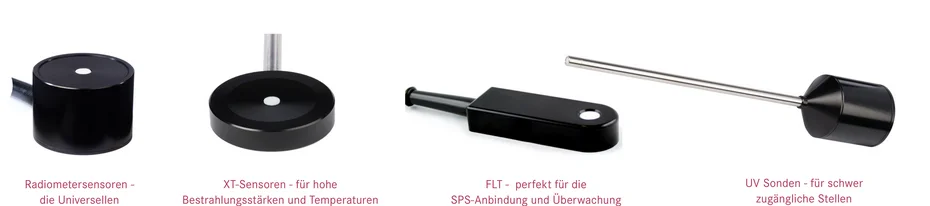
Our radiometer sensors are stable over the long term, robust and suitable for many applications. For some applications - where only a low overall height is available or at high temperatures - we recommend one of our other sensor series. These can be connected to the RMD and the RMD Pro as well. The overview of the designs is given further down with the order numbers.
Order numbers, scope of delivery, accessories and versions
| Version | Order number |
|---|---|
| RMD Pro | 814400 |
Scope of delivery: the radiometer, the power supply unit, a USB cable, the manual and one sensor to suit the application; with the RMD Pro additionally an SD card and the PC software. Calibration is traceable to PTB standards, with a factory calibration certificate and optionally with an ISO 17025 calibration certificate.
| Designation | Order number |
|---|---|
| UV-Radiometer RMD | 814401 |
The smaller version without internal memory, recording, real-time clock, USB port and PC software. The RMD can be upgraded to an RMD Pro later with the upgrade kit (order number 814403); the device does not have to be sent in for that.
| Spectral range | Order number |
|---|---|
| UVC | 814410 |
| UVB | 814420 |
| UVA | 814432 |
| UVA+ | 814447 |
| UVBB (broadband) | 814412 |
| VISB | 814443 |
| LUX | 814461 |
| NDT (365 nm + LUX) | 814491 |
| Erythema + UVA | 814470 |
Two sensors can be operated on one RMD at the same time. The sensors are calibrated with traceability to the PTB and can be recalibrated.
| Design | Suitable for |
|---|---|
| Radiometer sensors | the universal sensor for most applications |
| XT sensors | high irradiance and high temperatures |
| FLT | PLC connection and continuous monitoring |
| UV probes | measuring points that are hard to reach |
All designs can be connected to the RMD and the RMD Pro. For some applications - where only a low overall height is available or at high temperatures - we recommend one of the other sensor series.
| Designation | Order number |
|---|---|
| Transport case | 921001 |
| Service | Order number |
|---|---|
| Factory calibration | 710000 |
| ISO 17025 calibration | 17025 |
Accredited ISO 17025 calibration and testing in our own calibration laboratory. On delivery the device is already factory-calibrated.
The specified measuring ranges are our recommended measuring ranges. These can be adapted to customer requirements. Please ask us for this or specify it when ordering.
The stated resolution of 0.001 µW/cm² is the display resolution of the RMD and is independent of the measuring range. It should not be confused with the detection limit: the detection limit is determined by the sensor's noise equivalent power and depends on the selected measuring range. With the UVC sensor for occupational safety (measuring range 0–10 mW/cm²), irradiance from about 0.05 µW/cm² can be measured reliably.
Use for UVC decontamination RMD & RM-22:
How the RMD is used in UVC disinfection, which sensor suits low-pressure lamps and UVC LEDs, and which irradiance levels studies have worked with is shown in the overview UVC meter.
The RMD is used for dose measurement in irradiation experiments and for UVC decontamination. Most recently published:
- From minutes to bounds: A probabilistic UV-C control and a shape-only morphological fingerprint for postharvest Colletotrichum inactivation in cacao and coffee processing – Ahn, E.; Baek, I.; Lim, S. et al. · Food Control · 2026
- Hybrid epoxy-LMPAEK composite co-cured joints: A study on UVO pretreatment and its effect on interlaminar toughness — Katz, L.; Bor, T.; Helthuis, N. et al. · Composites Part B: Engineering · 2026
- Trainable soft electronics with memory in liquid crystal polymers — Lyu, P.; Weima, S. A. M.; Baek, J. et al. · Science Advances · 2026
- UV-C Irradiation Effectiveness on Mpox-Virus-Contaminated Surfaces — Gidari, A.; Sabbatini, S.; Pallotto, C. et al. · Pathogens · 2026
- Differential responses of Cacao pathogens Colletotrichum gloeosporioides and Pestalotiopsis sp. to UVB 305 nm and UVC 275 nm – Baek, I.; Jang, J. H.; Lim, S. et al. · Scientific Reports · 2025
The details come from Crossref. Authorship and content rest with the respective research groups.
These are the rules most often consulted in practice for radiometers and sensors — from measurement through limits to the requirements on the device:
- DIN EN ISO/IEC 17025:2018-03 — General requirements for the competence of testing and calibration laboratories
- DIN EN 62471:2009-03 — Photobiological safety of lamps and lamp systems
- DIN EN 14255-1:2005 — Measurement and assessment of personal exposure to incoherent optical radiation — Part 1: UV radiation from artificial sources in the workplace
All rules for radiometers and sensors are listed in the standards finder.
Not a normative reference. What counts is always the currently valid edition in the original text.