



UV-LED chamber BSL-04 – 86 × 64 cm for batch curing
The UV LED chamber BSL-04 is the largest LED irradiation chamber in the BSL series and cures, bonds and irradiates large-area components and large batches. The interior measures 86 × 64 × 28 cm; the irradiance reaches up to 110 mW/cm², 14 times that of the BS series, at 365, 385, 395, 405 or 450 nm. The UV-MAT dose control stops the irradiation when the target dose is reached, regardless of lamp ageing and contamination. UV LEDs start instantly, are dimmable and have a long service life.
For high irradiances, the UV LED chamber can be ordered completely with one LED wavelength. A particularly flexible application is possible when two separately controllable LED wavelengths are ordered.
With the high homogeneity of the irradiation, the samples can also be positioned as needed.
This makes the BSL-04 the chamber for batch curing: instead of irradiating sample by sample, the full 86 × 64 cm tray is loaded in one go and run at a single dose.
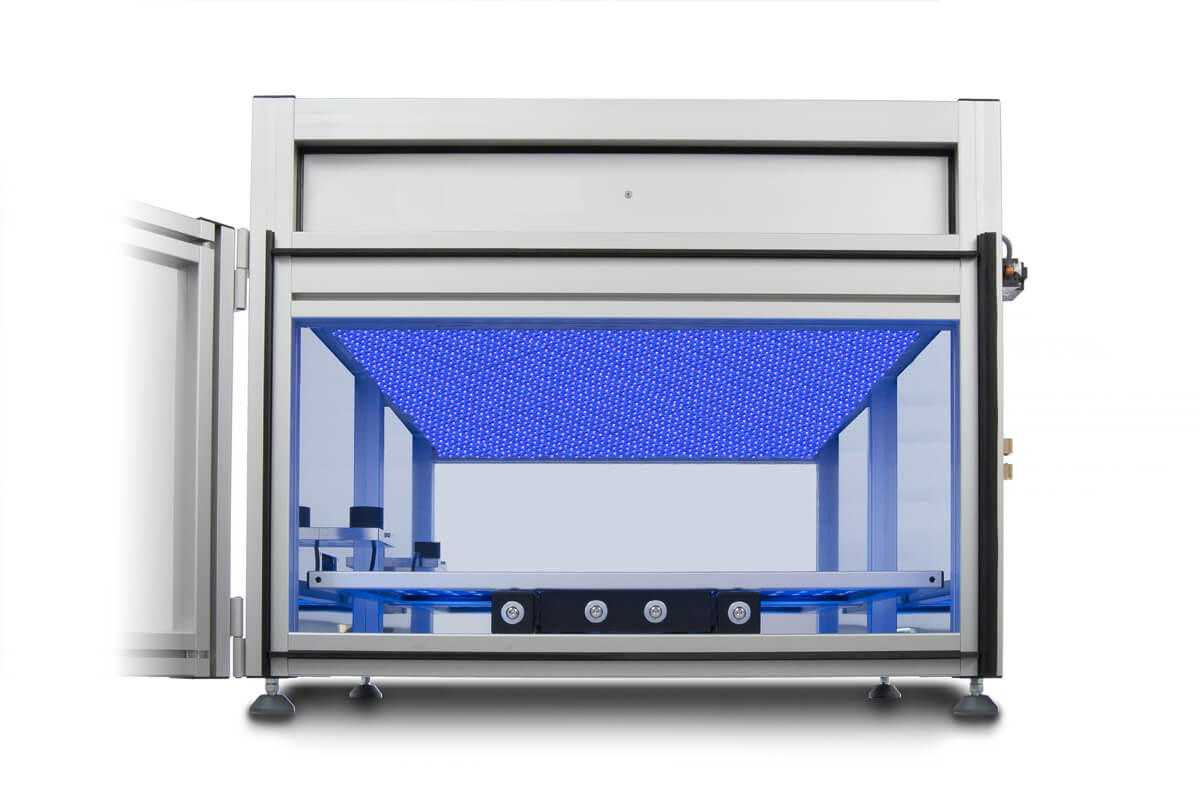
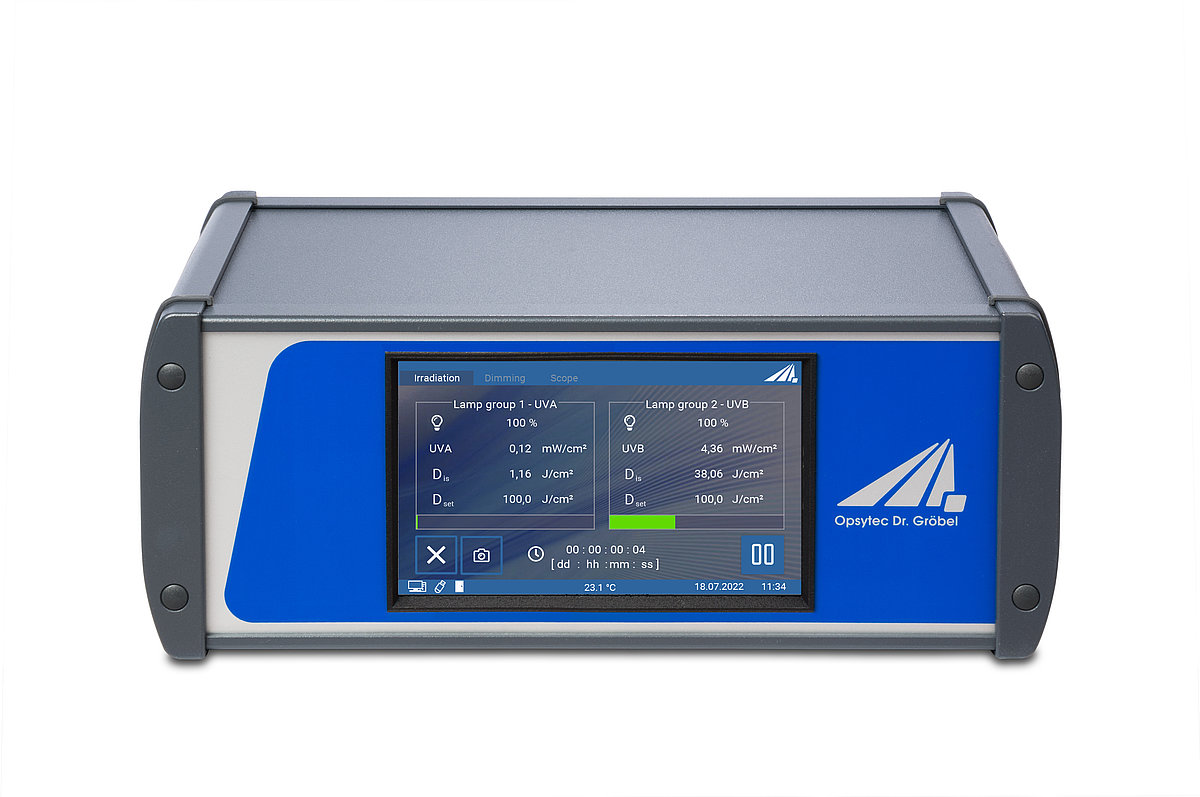
The integrated timer ensures precise irradiation control. For optimum results, we recommend our calibrated UVA+ sensors. In the BSL-04 UV LED chamber, dose control is already integrated in the UV-MAT Touch and UV-MAT control units. An optional sensor enables the UV-MAT to measure the irradiance and stop irradiation when the target dose is reached.
Across the full 86 × 64 cm area the irradiance reaches up to 110 mW/cm². Active air cooling keeps the heat input low even with a full batch and long exposure times, so samples can be distributed freely on the sample tray.
The sample room has a floor space of 86 × 64 cm and a height of 28 cm. Parts that must be bonded or cured can be positioned easily on the movable sample carrier.
The fully enclosed and monitored irradiation chamber ensures that operating personnel are fully protected from UV radiation during handling.
Calculate irradiance and dose of the BSL-04
Set up the BSL-04 virtually in advance:
Calculate irradiance, uniformity and exposure time for each LED wavelength.
Simulate the uniformity of the BSL-04 across the full area
For the BSL-04, the largest chamber in the BSL series, uniformity determines the batch size. The UV irradiation chamber simulator displays the irradiance across the 86 × 64 cm interior as a heat map and shows how dose and exposure time are distributed over the area at up to 110 mW/cm².

Technical data of UV-LED chamber BSL-04
| Interior chamber | 86 × 64 × 28 cm |
| Dimensions, chamber | 95 × 82 × 70 cm |
| Weight | ~ 80 kg |
| Power consumption | 1200 W |
| Mains | 100–240 V, 50/60 Hz |
| Operation temperature | 10 to 40 °C |
| Storage temperature | -10 to 60 °C |
| Humidity | < 80% non-condensing |
| Cooling | air cooling |
| Sample temperature | Heating of the samples due to high UV irradiation with long exposure |
| Classification | group 0 according to DIN EN 12198:2000 |
| Timer | 0.01 s to 9999 h |
| Resolution | 0.01 s |
| Dose control | with optional sensor |
| Internal security circuit | Over-temperature, door contact |
| PC interface | USB 2.0 |
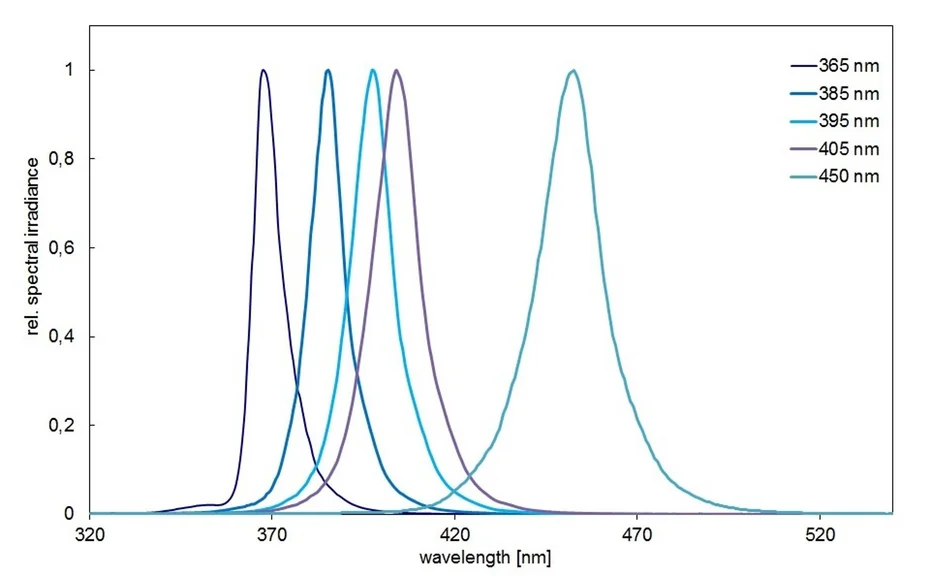
Spectra of the irradiation chamber BSL-04
The BSL-04 covers the same five wavelengths from 365 to 450 nm. For large batches the usual choice is a combination of two separately controlled wavelengths: one group does the through-curing, the second the surface. Because UV LEDs start instantly and need no warm-up, the spectrum is settled from the first moment of exposure – unlike a lamp, whose emission shifts while it runs up.
Irradiance, spectrum and LEDs
The values are the typical irradiances at an interior height of 30 mm; a shorter distance to the light source raises the irradiance further. They apply to a chamber fully populated with one LED type. With two wavelengths the chamber is populated half with each LED type, so half the irradiance is available per wavelength.
| Wavelength | Irradiance |
|---|---|
| 365 nm | 60 mW/cm² |
| 385, 395, 405 nm | 100 mW/cm² |
| 450 nm | 110 mW/cm² |
The five wavelengths side by side, each normalised to its maximum. The half width is 10 to 20 nm and the peak wavelength matches the nominal wavelength to within ± 5 nm.

| Wavelength | 365, 385, 395, 405, 450 nm |
| Peak wavelength | ± 5 nm |
| Emission, FWHM | 10 to 20 nm |
Equipment in detail
The chamber has a modular design and can therefore be adapted to different applications. These functions are always included:
 | Dose control The irradiance is measured continuously; the UV-MAT ends the irradiation once the set target dose is reached. The UV-MAT Touch offers the same functions but simplifies operation and documentation. |
 | Dimming and spectral adjustment The LEDs can be dimmed continuously from 2 % to 100 %. They are available in five wavelengths for different applications; as an option two wavelengths are available in one chamber and are controlled separately. |
 | Timer As an alternative to dose control the UV-MAT offers an adjustable timer for time-controlled irradiations between 0.01 s and 9999 h. |
 | Irradiation records Irradiations can be recorded with a PC. The UV-MAT Touch also records them to a USB stick without a PC. |
The two irradiation controls compared
| Feature | 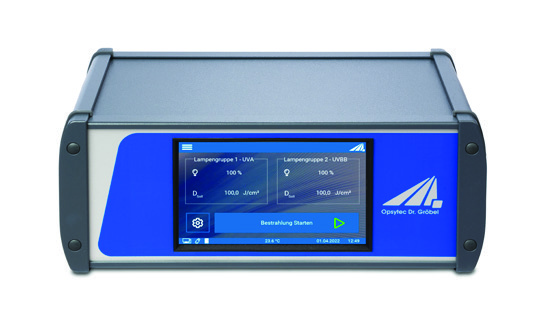 | |
|---|---|---|
| Display | capacitive touch display | monochrome, 128 x 64 px |
| Memory | USB stick | – |
| Number of channels | 1 | 1 |
| Irradiance, dose and temperature measurement | yes | yes |
| Time- and dose-controlled irradiations | yes | yes |
| Recording of measurements | yes | – |
| Oscilloscope view | yes | – |
| Screenshots can be saved to a USB stick | yes | – |
| Pausing and restarting irradiations | yes | – |
| Adding notes and comments to an irradiation | yes | – |
| Remote control from a PC | yes | – |
| Irradiation records | on a USB stick | on the PC |
| User management and admin mode | yes | – |
| Simple firmware upgrades | yes | yes |
Both controls use the same sensors, so one sensor can be used with either device.
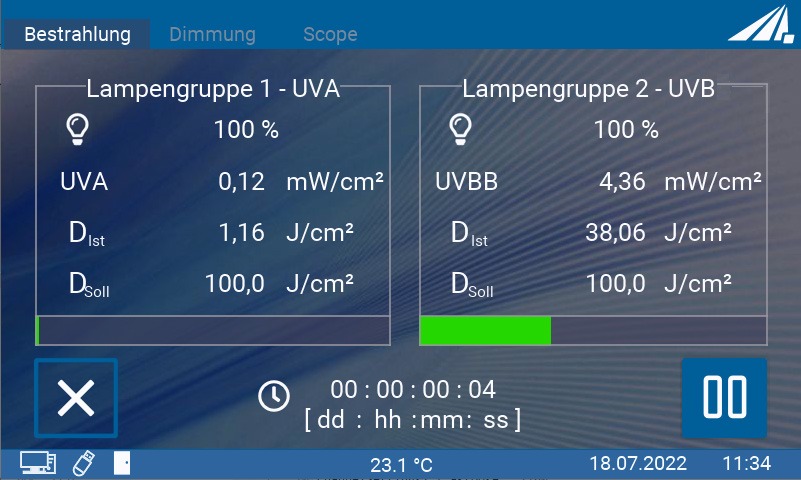
The UV-MAT Touch is operated through a high-resolution capacitive touchscreen. A Cortex ARM processor provides durability and the ability to update - new functions can be installed on site. The device and the PC software are compatible with Windows 10 and 11. Single- and multi-channel irradiations are shown numerically and graphically, together with oscillograms and the settings. Parameters are set directly on the device and are password protected.
| Sensor inputs | 24 bit, fully digital |
| Number of sensor inputs | 1 |
| Dose setting range | 0 to 1,000,000 J/cm² |
| Dose resolution | 1 mJ/cm² |
| Irradiation time | 0.01 s to 9999 h |
| PC interface | USB 2.0 |
| Sensor recognition | yes |
| Dimensions | 185 × 251 × 100 mm |
| Permissible operating temperature | 5 to 60 °C |
| Feature | UV-MAT Touch | UV-MAT |
|---|---|---|
| Display | capacitive touch display, 5″ WVGA | graphic, 128 × 64 px, monochrome |
| Display output | irradiance and dose, oscilloscope view | irradiance and dose |
| Data recording rate | adjustable: 1 s to 1 h | – |
| Recording period | > 24,000 h | – |
| Storage interface | 1 × USB stick (up to 32 GB) | data export via USB |
Options
These options are available in addition to the standard equipment:
 | Inert gas box The removable inert gas boxes allow work under inert conditions - for example with adhesives that do not cure completely in the presence of oxygen. Separate gas inlets and outlets make it possible to measure the O₂ concentration at the gas outlet. |
 | Remote control option Complex, multi-stage irradiations - for example a pre-irradiation at low irradiance followed by a high-intensity irradiation - can be parameterised with the remote control option. Up to 30 dose- or time-controlled steps and pauses are possible. At the same time the irradiation is logged and stored on the PC. |
Technical data of the radiometer sensors
The calibrated radiometer sensors are available for every LED wavelength. They are traceably calibrated, can be recalibrated and are supplied with a factory calibration certificate; an ISO 17025 calibration certificate from our accredited calibration laboratory is available as an option. The measuring ranges given are our recommendation and can be adapted on request - please state this with your order.
| Sensor type | UVA+ |
| Spectral range | 330 to 455 nm |
| Measuring range, typical | 0 to 10 W/cm² |
| Resolution | 1 µW/cm² |
| Dose measuring range | 0 to 100 MJ/cm² |
| Dynamic range | up to 10⁷ |
| A/D conversion | 24 bit |
| Temperature sensor | integrated |
| Dimensions | Ø 40 mm, height 35 mm |
| Optical area | Ø 6 mm |
| Weight | 160 g |
| Connecting cable | 1.8 m |
| Operating temperature | 0 to 40 °C |
| Storage temperature | -10 to 60 °C |
| Humidity | < 80 %, non-condensing |
Order numbers, scope of delivery, accessories and versions
| Version | Order number |
|---|---|
| BSL-04 | 860904L |
The chamber is available in one version; please state the required wavelength with your order.
| Wavelength | Order number |
|---|---|
| 365 nm | -365nm |
| 385 nm | -385nm |
| 395 nm | -395nm |
| 405 nm | -405nm |
| 450 nm | -450nm |
The wavelength completes the order number, for example 860904L-395nm.
| Version | Order number |
|---|---|
| UV-MAT TOUCH | 820930L |
| UV-MAT | 820920L |
The chamber is controlled by the UV-MAT - either as the UV-MAT with a graphic display or as the UV-MAT Touch with a 5-inch touch display and oscilloscope view. Both measure the irradiance and switch off under dose control.
| Designation | Order number |
|---|---|
| PC software for the UV-MAT Touch | 860901 |
| Order number | 860801X2 |
|---|---|
| Selectable wavelengths | 365 nm, 385 nm, 395 nm, 405 nm, 450 nm |
The chamber can be equipped with a second wavelength; both are controlled separately. The chamber is then populated half with each LED type, so half the irradiance is available per wavelength.
| Designation | Order number |
|---|---|
| UVA+ sensor | 814447 |
| Inert gas box | 860802i |
| Designation | Order number |
|---|---|
| Calibration | 17025 |
Accredited calibration to ISO/IEC 17025 in our own calibration laboratory.
The sensors are supplied with a factory calibration certificate as standard; an ISO 17025 calibration certificate is available as an option.