

Spectral mismatch for UV sensors
Spectral mismatch is the difference between the actual spectral responsivity of a UV sensor and the ideal, rectangular weighting function. It occurs with every filtered sensor, because optical filters have no ideal stop and pass bands. As a result, a sensor calibrated to one particular lamp will systematically show deviating readings on a source with a different spectrum.
In contrast to illuminance meters, UV sensors are designed for different spectra and different spectral ranges. To ensure that a UV sensor has the desired spectral sensitivity, manufacturer-specific optical filters are used to adjust the spectral sensitivity.
The following image illustrates the structure of a UV sensor or radiometer, which is typically used to measure ultraviolet radiation. The sensor consists of several optical filters and a photodiode. The other electrical components, the amplification and analog-to-digital conversion are not shown here.

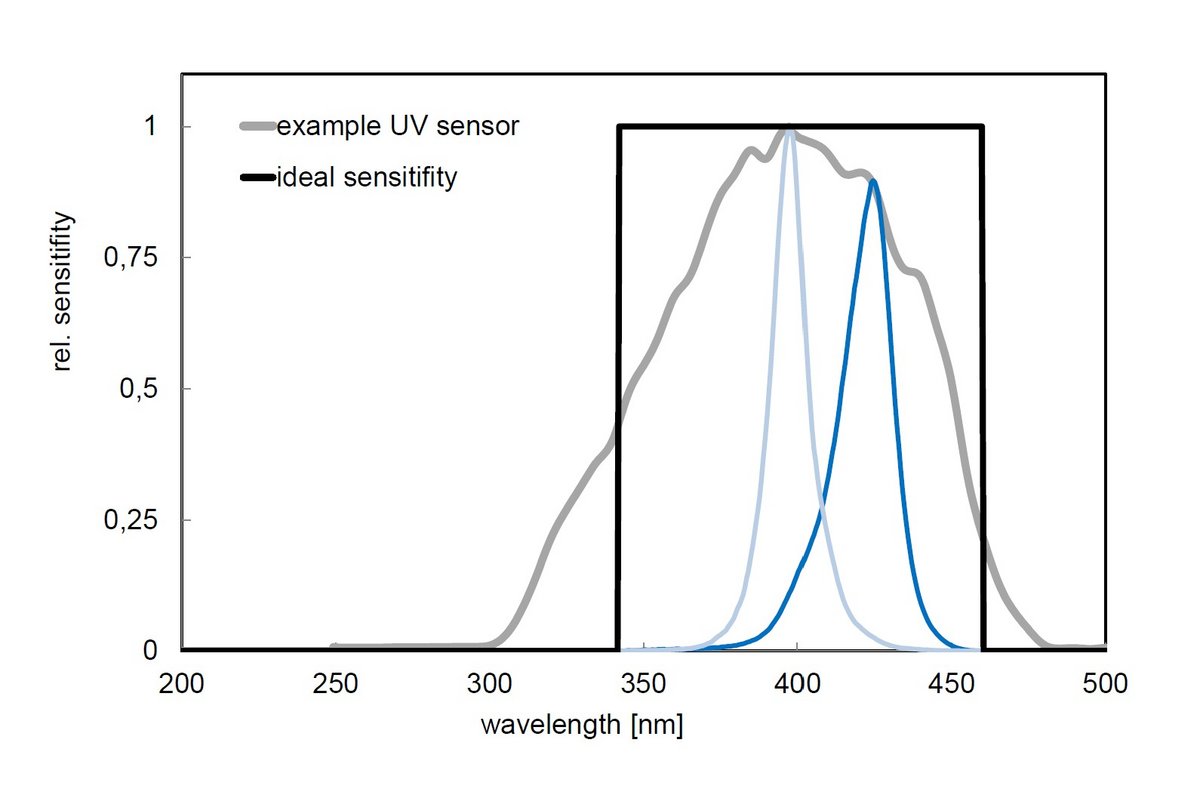
Ideally, the sensitivity curve corresponds to a constant, rectangular weighting function. In practice, however, deviations occur - the so-called spectral mismatch. This describes the difference between the actual sensitivity of the sensor and the ideal weighting function.
The reasons for this are typical for all filtered UV sensors, as the optical filters used do not have ideal cut-off and pass ranges or "infinitely" steep filter edges. Photodiodes also show a typical spectral sensitivity.

Influence of spectral sensitivity
The spectral sensitivity is a characteristic device property of every UV sensor. While sensors of the same type show similar characteristics, different sensors - depending on the manufacturer, type and spectral range - differ significantly.
The measured value of a UV sensor depends heavily on the emission spectrum of the light source. A sensor calibrated to a specific source (e.g. mercury vapor lamp or UV LED) can show significant deviations with a different source.
The result of the spectral mismatch is a source-dependent measurement uncertainty. For example, if a sensor is calibrated with a broadband lamp but used with a narrowband UV LED, the displayed value can deviate from the actual effective value by several tens of percent. These deviations are reproducible and therefore systematic in nature.
Example of a spectral mismatch
A UV sensor has a real weighting function (gray), while the ideal curve (black) describes a uniform response.
For a 400 nm LED, the relative sensitivity is 1.0.
For a 425 nm LED, the relative sensitivity drops to 0.9.
The displayed value is therefore around 10 % smaller. Modern measuring devices such as the RMD radiometer compensate for this effect internally, provided the respective lamp type (e.g. 400 nm or 425 nm) is selected correctly.
Methods for reducing spectral mismatch
1. source-dependent calibration
At Opsytec, UV sensors are calibrated to the actual lamp or LED used for the specific application. Numerous industrial UV sources are available in the laboratory for this purpose in order to adjust the calibration precisely to the desired spectral range.
2. mathematical correction
With modern radiometers, the calibration factor can be saved directly in the sensor. The appropriate calibration range - e.g. 365 nm for UVA LEDs or 450 nm for blue LEDs - is simply selected on the measuring device. For older or external systems, Opsytec can determine a correction factor, which is specified in the calibration certificate.
3. use of spectroradiometers
Spectroradiometers capture the complete spectrum and are free of spectral mismatch. The wavelength-specific calibration means that any deviation is corrected by calculation. The UVpad and UVpad E models are particularly suitable for mobile use.
Importance for precise UV measurements
Knowledge and correction of the mismatch is therefore a prerequisite for reliable UV measurements, especially in applications with narrow-band or spectrally variable sources such as UV LED systems. We have the sources or UV sensors and spectroradiometers available to us in the laboratory for this purpose.
It is important to know that the spectral adjustment can be corrected very well if only one UV lamp is to be measured. Simply inform us of the lamp to be measured or the application.
For example, a low-pressure mercury lamp is often used as a calibration source for detectors used in disinfection. Calibration is carried out, for example, in the spectral range 200-280 nm or 240-290 nm.
Although this effective spectrum covers a wide range of wavelengths, in practice only the 253.7 nm line of the mercury lamp is usually used to determine the sensitivity of the UV radiometer for this single spectral line.
The result of this calibration thus provides a calibration value for a specific operating condition, but without providing information about the spectral sensitivity of the detector.
If you want to measure many different UV lamps and UV LEDs, we recommend a spectroradiometer.
For the interested reader:
Calibration standards and norms
The spectral mismatch is described in international standards, in particular in CIE 220:2016 - Characterization and Calibration Methods of UV Radiometers.
The recommendation is to match the calibration source as closely as possible to the actual light source of the application.
For applications with multiple UV lamps or UV LEDs, Opsytec recommends the use of a spectroradiometer to fully capture and evaluate the emission spectrum.
What this means for continuous monitoring in a production line – sampling rate, sensor band and interface – is covered on the market page UV technology for automation and process integration.
Frequently asked questions on spectral mismatch
How is spectral mismatch calculated?
Via the mismatch factor F. It relates what the ideal responsivity function would give on the measured source to what the real sensor indicates there – each normalised to the calibration source:
F = [∫E_meas(λ)·s_ideal(λ)dλ / ∫E_meas(λ)·s_real(λ)dλ] · [∫E_cal(λ)·s_real(λ)dλ / ∫E_cal(λ)·s_ideal(λ)dλ]
Four quantities are needed: the spectral irradiance of the calibration source and of the measured source, plus the real and the ideal spectral responsivity of the sensor. The reading is multiplied by F. Because the deviation is systematic and reproducible, it can be stated as a fixed correction factor in the calibration certificate or stored in the radiometer as a calibration range.
How large is the error in practice?
That depends on how far apart the calibration source and the measured source are spectrally. Within a single sensor response curve it is often a few percent: for a sensor whose relative responsivity is 1.0 at 400 nm and 0.9 at 425 nm, the 425 nm LED reads about 10 % low. If a sensor calibrated with a broadband lamp is used on a narrowband UV LED, however, the reading can deviate from the true weighted value by several tens of percent. The deviation is reproducible and therefore systematic – it can be corrected, but not averaged away by repeated measurements.
How can spectral mismatch be corrected?
In three ways. First, by source-specific calibration: the sensor is calibrated against the lamp or LED actually used. Second, computationally – modern radiometers store the calibration factor in the sensor and the matching range is selected on the instrument; for older or third-party systems a correction factor can be determined and stated in the calibration certificate. Third, with a spectroradiometer, which captures the full spectrum and is therefore free of spectral mismatch in principle. With a single source to be measured, correction works very well; with many different sources the spectroradiometer is the safe route.
Why does a calibration at 253.7 nm say nothing about spectral responsivity?
Because it establishes only a single operating point. In disinfection, a mercury low-pressure lamp often serves as the calibration source, and calibration is referenced to a spectral range of roughly 200 to 280 nm or 240 to 290 nm. In practice almost only the 253.7 nm line is used from it. The result is a calibration value for exactly that condition – it says nothing about the shape of the detector's spectral responsivity, and it does not transfer to other sources in the same spectral range. CIE 220:2016 therefore recommends matching the calibration source as closely as possible to the application source.
Broadband radiometers, UV sensors and spectral radiometers for measuring UV light
Radiometer RMD Pro
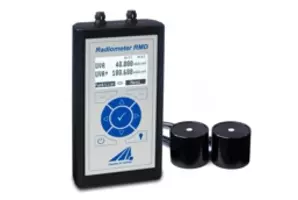
High dynamic & high-precision all-digital radiometer RMD Pro for irradiance and dose with 8 GB memory
RMD Touch
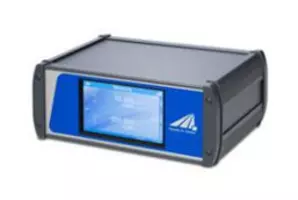
Precise, digital laboratory radiometer with touch display for measuring irradiance and dose


Author: Dr. Mark Paravia
Dr.-Ing. Mark Paravia is the managing director of Opsytec Dr. Gröbel GmbH in Ettlingen and heads the accredited calibration laboratory. Following his research on pulsed xenon excimer discharges at the Institute of Lighting Technology at KIT, his current focus is on optical radiation measurement technology. He is a recognized UV expert, vice-chair of the DIN Standards Committee FNL 7 “Optical Radiation,” and a member of the DVGW Project Group on UV Disinfection.
