
UV Curing and UV Measurement in the Automotive Industry
UV curing is the light-induced crosslinking of adhesives, coatings, potting compounds and printing inks through photopolymerization under ultraviolet radiation. In vehicle manufacturing, the process is used to make adhesive bonds, coatings and printed surfaces load-bearing within seconds to a few minutes, without thermally stressing heat-sensitive plastic, electronic or glass substrates. The technical goal is reproducible curing at every point of a component that is often three-dimensionally shaped. The central challenge is that irradiance and dose vary strongly across a curved, inclined or shadowed surface, while the photochemical reaction itself depends jointly on wavelength, intensity and exposure time – a single measured quantity is usually not enough to describe the process.
How is the market for UV processes in the automotive industry developing?
The reference frame is global vehicle production itself: according to the International Organization of Motor Vehicle Manufacturers (OICA), 96.4 million vehicles were built worldwide in 2025, an increase of 3.9 percent over the previous year; the Asia-Pacific region alone accounted for around 59.2 million units, more than 61 percent of global production (OICA, 2026). Each of these vehicles contains numerous bonded, coated or printed components for which radiation-curing processes are a candidate technology – from body painting to sensor bonding.
No exact, generally accepted market figure exists specifically for “UV curing in the automotive industry”, because market researchers scope UV-curable systems differently (adhesives, coatings, printing inks, each with or without electronics applications). As a market indicator from the adjacent field of UV-curable adhesives, Mordor Intelligence puts the global market at roughly USD 5.15 to 5.43 billion for 2025/2026, with an expected compound annual growth rate of about 5.5 percent through 2031 (Mordor Intelligence, 2026); TechSci Research puts the 2024 market at roughly USD 4.53 billion, growing at about 5.2 percent (TechSci Research, 2024). The spread between studies mainly reflects differing market definitions and should be read as an order of magnitude, not an exact figure.
More technically relevant than the absolute number is the shift in application areas: vehicle manufacturers are increasingly replacing two-component epoxies with UV-curable systems for bonding ADAS camera modules, panoramic roofs and battery-pack components, because fixture time is shortened from several minutes to under a minute (Mordor Intelligence, 2026). The market for UV adhesives in the mobility segment splits into a validation-intensive OEM/Tier-1 segment with long approval cycles and a more fragmented aftermarket segment (IndexBox, n.d.). A second driver is regulatory: tightening limits on volatile organic compounds (VOCs) in coating shift painting processes from solvent-based to radiation-curing systems, which directly creates new requirements for process monitoring and dose measurement.
How does UV curing (photopolymerization) work?
In UV curing, a photoinitiator contained in the formulation absorbs a photon of suitable energy and decomposes into reactive species – in free-radical systems (typically acrylates) into free radicals, in cationic systems (typically epoxies) into an acid that starts ring-opening polymerization. These reactive species initiate a chain reaction in which monomers and oligomers are linked into a three-dimensionally crosslinked polymer network. Unlike thermal drying, no solvent evaporates; curing is a chemical crosslinking reaction, not a physical drying process. The reaction only proceeds where photons are actually absorbed – the amount and spectral distribution of the incident light therefore directly determine reaction rate and yield. Free-radical systems are sensitive to oxygen, which scavenges radicals and delays the reaction at the surface (oxygen inhibition); cationic systems are unaffected by this but are more sensitive to humidity and often require longer post-cure times (dark reaction) to reach full final strength.
Which UV light sources and processes are used in automotive manufacturing?
Several emitter principles are available for industrial UV curing, differing markedly in spectrum, power density and operating characteristics:
- Medium-pressure mercury lamps (gas-discharge lamps): Broadband emitters with characteristic emission lines across UV-C, UV-B, UV-A and the visible range. They deliver high power densities and, because of their broad spectrum, also suit pigmented formulations that are difficult to cure, but need warm-up time, generate heat radiation and are subject to continuous ageing of the lamp tube.
- UV LED: Narrowband sources with discrete emission peaks, in practice mostly at 365 nm, 385 nm, 395 nm, 405 nm and increasingly 450 nm. They switch on instantly, emit practically no infrared radiation and age more uniformly, but require closer matching between photoinitiator absorption and LED emission wavelength, since the emission band is markedly narrower than for gas-discharge lamps.
- Excimer emitters (e.g. 172 nm, VUV): Very short-wave, high-energy radiation with shallow penetration depth into air and material. In automotive manufacturing, used mainly for surface activation and cleaning before bonding, not for bulk curing.
- Pulsed xenon flash lamps: Broadband, pulsed radiation with high peak power at low average thermal load on the component; relevant for applications that require short, intense irradiation pulses rather than continuous irradiation, e.g. with strongly heat-sensitive substrates.
| Technology | Characteristics | Advantages | Limitations | Typical application |
|---|---|---|---|---|
| Medium-pressure mercury lamp | broadband, UV-C to VIS | high power density, uncritical regarding photoinitiator choice | warm-up time, heat input, ageing, contains mercury | curing paint on large-area body panels |
| UV LED | narrowband, discrete wavelengths | ready instantly, low heat generation, long service life | close matching to photoinitiator required, shallower penetration if mismatched | spot bonding of sensor, camera and display modules |
| Excimer emitter (VUV) | very short-wave, shallow penetration depth | efficient surface activation without chemicals | no bulk curing possible | surface pretreatment before bonding |
| Pulsed xenon flash lamp | broadband, pulsed, high peak power | low average thermal load, short irradiation pulses | more complex control, specialised measurement equipment required | heat-sensitive substrates, special applications |
Which process parameters matter?
Several physical quantities matter for process design and monitoring, and none can substitute for another:
- Irradiance (mW/cm² or W/cm²): the radiant power incident per area and time. It determines the instantaneous reaction rate and the ability to overcome oxygen inhibition at the surface quickly.
- Dose / radiant exposure (J/cm²): the product of irradiance and exposure time. It roughly determines how far the crosslinking reaction progresses overall – but only under limited conditions (see the reciprocity law below).
- Spectral distribution / wavelength: determines whether the photoinitiator contained in the adhesive or coating can absorb photons at all. Without spectral overlap between source and absorption band, no reaction starts, regardless of the radiated power.
- Exposure time: not a fixed quantity for moving or robot-guided processes, but a function of path speed and irradiation field geometry at every point of the component.
- Component temperature: affects the viscosity and diffusion rate of the reactive species and thus indirectly the achievable final conversion, especially in cationic systems with a pronounced dark reaction.
- Oxygen concentration at the surface: determines the extent of inhibition in free-radical systems and thus whether an otherwise sufficient dose still leaves a tacky, incompletely cured surface.
- Layer thickness and pigmentation: determine, via light absorption in the material, how much radiation actually reaches the lower interface of a layer (penetration depth).
What limits the process or causes defects?
Electrical lamp power is not an optical dose. The electrical power set at the ballast or driver does not describe the irradiance actually reaching the component. Optical efficiency, contamination of reflectors and protective windows, degradation of the lamp tube or LED chips, and the actual working distance continuously change this relationship. A process approval based solely on the electrical power setting loses its validity as soon as any of these factors changes.
A time value alone is not meaningful without the irradiance at the component. “30 seconds of irradiation” does not describe a reproducible process unless the irradiance actually present at the critical point of the component during that time is known.
The reciprocity law only holds in a limited way. The photochemical reciprocity law (Bunsen-Roscoe law) assumes that only the product of irradiance and time – the dose – determines the outcome, regardless of how intensity and time individually combine. For many photopolymerizing acrylate systems this does not hold: an experimental study on a BisGMA/TEGDMA photopolymer showed that, at constant dose, higher irradiance led to lower final conversion than lower irradiance over correspondingly longer time, because final conversion and shrinkage stress depend on the polymerization rate itself, not only on the dose product (Wydra et al., 2014). Practical consequence: a dose approved for one particular combination of irradiance and time cannot be transferred to another combination with the same dose product without revalidation.
Measuring outside the actual process location underestimates geometry effects. If irradiance is measured at the lamp head, at a flat reference position or on a single sample part, that value describes only one point of the actual irradiation field. Curved, recessed or angled component areas receive different irradiance than the reference position – often considerably less.
Material and geometry effects are often underestimated. Pigmented coatings and filled adhesives scatter and absorb UV radiation beyond what layer thickness alone explains; component tolerances change the working distance to the source and therefore the irradiance nonlinearly. Both effects hold only under the specific conditions characterised and cannot be generalised to other materials or component geometries.
How do pigmentation, layer thickness and component geometry affect curing?
In pigmented or filled systems, photoinitiator absorption, pigment absorption and scattering compete for incoming photons. Titanium dioxide white pigments, for example, strongly absorb UV radiation up to just below 400 nm and become increasingly transmissive only above that, which is why longer-wave UV-LED systems (395–450 nm) can achieve better through-cure on pigmented coatings than short-wave sources, provided the photoinitiator used still absorbs sufficiently in that range. At the same time, strong overlap between initiator absorption and source emission speeds up surface cure but can limit penetration depth, because the radiation is already fully absorbed in the outermost layers (John et al., 2023). For three-dimensional, contoured components, edges, recesses and hidden surfaces are wholly or partly shadowed from direct irradiation. In these shadow zones, pure UV chemistry remains liquid; industrially this is addressed with dual-cure systems that crosslink primarily via UV and, in areas not directly irradiated, secondarily via a moisture, anaerobic or heat reaction.
The reciprocity law and Jacobs working curve as models for process design
Two simple models help capture the effects described above quantitatively – both with clearly stated limits.
The Bunsen-Roscoe reciprocity law defines radiant exposure (dose) as
H = E · t
where H is the dose in J/cm², E the irradiance in W/cm² and t the exposure time in seconds. It assumes that this product alone determines the photochemical outcome. This requires irradiance that is constant and homogeneous over time, in a photochemical primary process without time-dependent secondary effects. As shown above, this requirement is not met for many acrylate photopolymerizations, especially at high irradiance and short times. Practical consequence: dose is a necessary but not a sufficient process figure; it must always be documented together with the corresponding irradiance.
For estimating cure depth in a photopolymerizing layer, the stereolithography and additive manufacturing literature uses a logarithmic working curve:
Cd = Dp · ln(H / Hc)
where Cd is the achieved cure depth, Dp a material-specific penetration depth parameter, H the applied dose and Hc the critical dose needed to reach the gel point at the surface (Bennett, 2018). The model assumes Beer-Lambert-type absorption in an optically homogeneous material and does not automatically hold for strongly heterogeneous, multiphase or highly scattering formulations. The practical consequence runs counter to intuition: because the relationship is logarithmic, not linear, doubling the dose does not double the cure depth – beyond a certain point, additional penetration depth can only be gained with disproportionately higher additional dose.
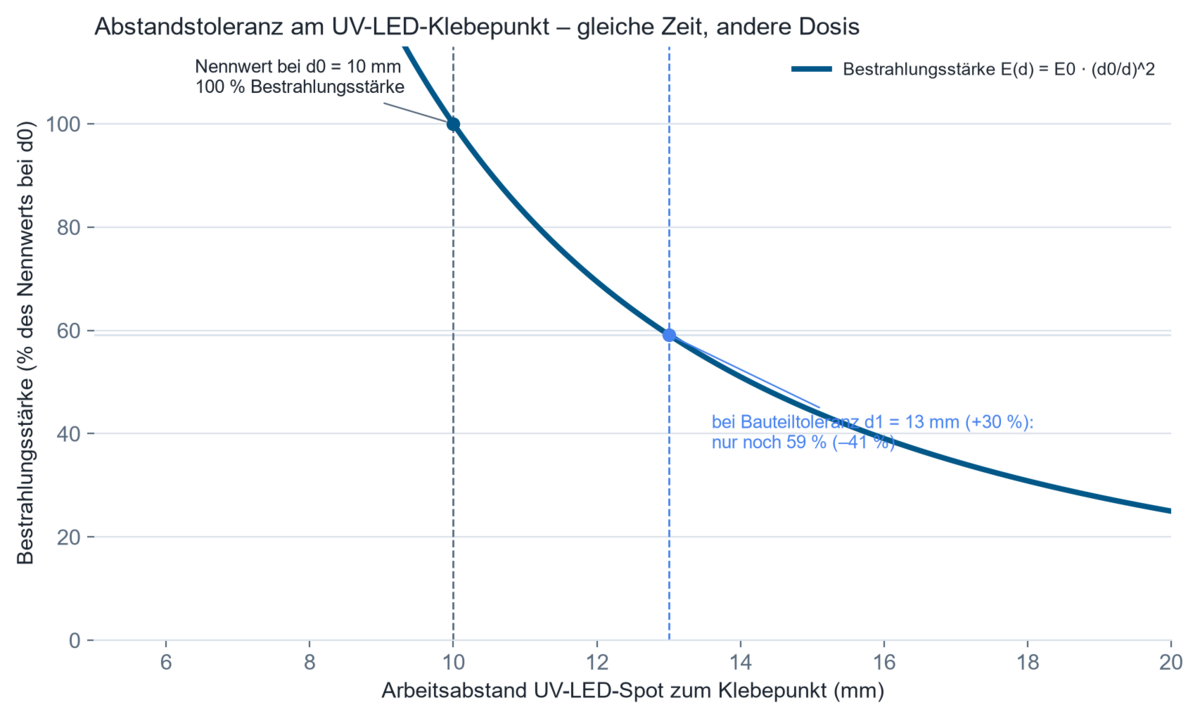
Worked example: how much does a distance tolerance affect irradiance at a UV-LED bonding point?
1. Assumptions. A UV-LED spot is used, robot-guided, for spot bonding of a sensor housing. The designed working distance is d₀ = 10 mm, with a nominal irradiance E₀ typical for series production, on the order of several 1000 mW/cm² at that position. Component and fixture tolerances can increase the actual distance in series production to d₁ = 13 mm (+30%). For distances large compared with the active emitter area, the decrease in irradiance can be approximated with the inverse-square distance law; at short working distances of a few millimetres this approximation is only of limited validity and must be verified by measurement or an optical simulation of the actual LED optics.
2. Model. E(d) = E₀ · (d₀/d)²
3. Calculation. E(d₁) = E₀ · (10/13)² = E₀ · 0.592
4. Result. Irradiance drops to roughly 59 percent of the nominal value, a loss of about 41 percent.
5. Technical interpretation. If exposure time stays unchanged, the applied dose drops by the same factor. A component tolerance that looks uncritical at first glance can thus push the dose below the critical dose Hc from the working curve, producing an incompletely cured but outwardly inconspicuous bond. This is why a single measurement on a sample part at nominal position does not cover series scatter, and why component-related or inline-captured dose values are necessary for process assurance.
Where are UV curing and UV measurement used in the automotive industry?
Painting and printing of three-dimensional plastic and body parts. UV-curable clearcoats and topcoats are increasingly replacing solvent-based systems because they cure within seconds and are immediately ready for further processing without oven drying. What matters here is uniform irradiance across curved, three-dimensional surfaces, since deviations lead to uneven scratch and chemical resistance. See the background at UV Measurement for Industrial Printing.
Bonding in sensor, camera and display modules. Advanced driver assistance systems (ADAS) require optically clear, low-distortion bonds between lenses, housings and sensor chips. UV adhesives allow precise dosing and short fixture times without heat input to sensitive electronics; a documented example is a transparent, high-temperature-resistant UV adhesive for actively aligned optics in modern headlight designs (UVEBTech / DELO, 2024). The critical process variable is the spatially resolved dose exactly in the bond gap, plus spectral matching between light source and adhesive photoinitiator, since a mismatch can compromise optical clarity or yellowing resistance. Background at UV Bonding, Potting & Encapsulation.
Power-electronics, sensor and battery-module potting in electromobility. Battery cells, power semiconductors and control units require potting and encapsulation compounds that cure quickly without thermally damaging the components. Shadow zones at connectors, edges and housing undersides are particularly critical here, making dual-cure formulations with UV primary and secondary cure necessary.
Fluorescent crack and leak detection. As a non-destructive test method, UV-A irradiation makes fluorescent penetrant indications visible in cracks and leaks. The critical process variable is uniform irradiance across the entire inspection area, since locally insufficient irradiance leaves defects undetected.
Ageing and photostability testing of interior materials. Cockpit surfaces, textiles and plastic components are subjected to accelerated ageing tests in irradiation chambers under defined UV and sunlight spectra, to predict colour fastness, yellowing and embrittlement over the vehicle's service life. What matters here is the spectrally weighted irradiance according to the reference spectrum used and the cumulative irradiation dose over the test duration. See UV Aging, Color Fastness and Photostability.
What solutions exist for special process conditions?
For three-dimensional, robot-guided irradiation processes, applied dose is not a fixed value but the integral of local irradiance along the path curve – distance, angle of incidence and path speed combine at every point. An upfront computational design based on imported component geometries can identify weak points and shadow zones before real equipment is built; final approval still takes place on the real process setup, since real optical, fixture and reflection properties are only predictable to a limited extent. Optical simulation computes this on the imported component geometries. For shadow zones that fundamentally cannot be directly irradiated because of component geometry, dual-cure systems with secondary moisture, anaerobic or heat curing are the established solution. Where mechanics, optics, safety technology and data acquisition must be developed together for a specific testing or manufacturing task, this falls within special equipment engineering.
Which quantities need to be measured or monitored?
Process assurance fundamentally requires two quantities: irradiance at the component and the dose resulting from it over time. Both should be measured as close as possible to the actual point of action – i.e. on the component itself or at a representative position in the irradiation field, not exclusively at the lamp or system output. Relevant measurement uncertainties arise, among other things, from the angular dependence of the sensor (cosine error at oblique incidence), spectral mismatch between the sensor and the actual source emission, and traceability of the calibration to national or international standards.
A broadband measurement – capturing total irradiance over a defined spectral range (e.g. UV-A) – is sufficient when the source and photoinitiator are already known and stable and only process stability over time needs to be monitored, for example with an RMD Pro. A spectrally resolved measurement becomes necessary when sources are compared, photoinitiators are newly selected, or lamp types are changed, because only the spectrum shows whether and how strongly emission and absorption actually overlap – suitable for this are spectroradiometers such as UVpad or UVpad E. Spatially resolved or component-related measurements become necessary once component geometry is three-dimensional or the source moves relative to the component – for that, the tinyTracker runs through the line with the workpiece carrier; time-resolved measurements are necessary when – as with pulsed sources or cycle-time-critical processes – irradiance is not constant over the exposure time.
How is the process monitored in modern automated lines?
In automated production lines, process monitoring shifts from spot-check sampling to continuous capture. Permanently installed inline sensors in the irradiation zone continuously record irradiance and dose during ongoing production and enable statistical process control (SPC), automatically flagging deviations from the approved process limit before insufficiently cured components leave the line. What matters technically is not the digital interface as such but the ability to attribute measured values to a specific component or production batch (traceability) and to detect ageing effects in lamps or LEDs early, for example through a continuously falling irradiance at constant electrical drive. In controlled systems, this ageing trend is used to adjust LED drive current or lamp power and keep the applied dose constant over the source's service life (closed-loop control).
What developments are shaping the market?
Transition from mercury lamps to UV LED: The substitution reduces mercury use and ozone formation but requires closer matching between the narrowband LED spectrum and photoinitiator absorption, plus wavelength-specific measurement equipment suited to that – broadband sensors calibrated for mercury lamps do not necessarily represent the narrow LED spectrum correctly. The ISO 10820 standard for UV-A LED irradiation devices with a 365 nm emission peak, published in 2025, shows that standardisation work is now following this shift (ISO 10820:2025).
New bonding and potting locations from electrification: Battery modules, power electronics and additional sensors in electrified vehicles create new, sometimes heavily shadowed bonding and potting geometries, increasing the need for dual-cure formulations and component-related dose verification.
Regulation-driven shift from solvent-based to radiation-curing systems: Tightening VOC limits in North America, Europe and Asia are accelerating the shift from painting processes to UV and UV-LED curing, and thereby increasing the need for accompanying process measurement technology in paint lines that have traditionally been thermally dominated.
Miniaturisation of radiation sources: Compact UV-LED spot and area systems allow integration into the tight installation space of sensor and camera modules, but at the same time sharpen the distance and angle dependencies described in this text, since small geometric deviations have a proportionally stronger effect at short working distances.
Digital, inline-based process control: The shift from a one-time process qualification to continuous, component-related dose monitoring is increasingly replacing static approval procedures that only reflect the state at the time of qualification.
What do scientific publications show?
An experimental study on the validity of the reciprocity law on a dental BisGMA/TEGDMA photopolymer showed that final conversion and shrinkage stress at constant dose depend significantly on the irradiance used, and not – as assumed by the idealised reciprocity law – on the dose product alone:
“The reciprocity law concerning light dose–relationships applied to BisGMA/TEGDMA photopolymers: Theoretical analysis and experimental characterization”, J. W. Wydra, N. B. Cramer, J. W. Stansbury, C. N. Bowman, Dental Materials, 2014, DOI: 10.1016/j.dental.2014.02.021. Transferability to other acrylate systems needs to be checked chemistry by chemistry, but the underlying principle – intensity dependence beyond dose alone – applies more broadly to free-radical photopolymerizations.
A study on the quantitative characterisation of commercial photopolymers introduced the critical dose Hc and the penetration depth parameter Dp as measurable, material-specific figures, and found deviations from manufacturer specifications of up to a factor of ten across several resins:
“Measuring UV Curing Parameters of Commercial Photopolymers used in Additive Manufacturing”, J. Bennett, Additive Manufacturing, 2018, DOI: 10.1016/j.addma.2017.10.009. For process design in vehicle manufacturing this matters because it shows that these figures should be determined experimentally for the actual formulation used, rather than taking generic manufacturer data at face value.
A calorimetric study on the curing kinetics of acrylate photopolymers using Photo-DSC showed that reaction heat and degree of crosslinking vary strongly with irradiation intensity and exposure strategy, and that a fragmented, multi-step exposure can markedly reduce peak temperature compared with a single full-dose exposure:
“Curing Kinetic Analysis of Acrylate Photopolymer for Additive Manufacturing by Photo-DSC”, D. Drummer, F.-Z. Jiang, Polymers, 2020, DOI: 10.3390/polym12051080. For thicker potting and bonding layers in battery and electronics applications, this offers an approach to controlling heat input through exposure strategy rather than formulation changes alone.
A recent review of the state of UV-curable coating technology summarises under which conditions strong spectral overlap between photoinitiator and light source speeds up surface cure while potentially limiting penetration depth:
“To Shed Light on the UV Curable Coating Technology: Current State of the Art and Perspectives”, J. John, J. Thomas, M. Patil, R. Patil, Journal of Composites Science, 2023, DOI: 10.3390/jcs7120513.
FAQ on UV curing and UV measurement in the automotive industry
How do irradiance and dose differ?
Irradiance (mW/cm²) describes the radiant power currently incident per area, while dose (J/cm²) is the time-integrated product of irradiance and exposure time. Both quantities are needed because – as described under the reciprocity law – the same dose can produce different curing results at different irradiance levels.
Which wavelength suits UV-LED curing in the automotive sector?
That depends on the photoinitiator in the formulation used. Common industrial UV-LED wavelengths are 365, 385, 395, 405 and 450 nm; what matters is that the LED's emission peak overlaps the photoinitiator's absorption band, not the absolute wavelength itself.
Why does UV curing fail despite apparently sufficient irradiance?
Common causes are a missing spectral overlap between source and photoinitiator, oxygen inhibition at the surface, shadow zones caused by component geometry, or a measurement that was not taken at the actual point of action and overestimates the real irradiance at the component.
How is UV dose measured on a three-dimensional component?
Via component-related sensors that travel with the workpiece carrier and record the irradiance actually reaching the component along its path through the line, complemented by recurring measurements at defined reference positions for ongoing equipment monitoring.
What factors influence cure depth?
Wavelength, photoinitiator concentration and absorption spectrum, pigmentation or filler content of the formulation, and the applied dose. The relationship between dose and cure depth is logarithmic, not linear.
When is a broadband measurement sufficient, and when is a spectral measurement needed?
A broadband measurement is sufficient for monitoring an already validated, stable process. A spectrally resolved measurement becomes necessary when light sources are compared, changed or newly selected, because only the spectrum shows the actual overlap with the photoinitiator.
What is the difference between UV curing and UV ageing testing?
UV curing uses UV radiation deliberately to trigger a crosslinking reaction and solidify a material. UV ageing testing, by contrast, uses UV and sunlight simulation to predict the unwanted degradation and discolouration of materials over a vehicle's planned service life.
Technical background and further sources
- Wydra, J. W. et al. (2014): The reciprocity law concerning light dose–relationships applied to BisGMA/TEGDMA photopolymers. Dental Materials. DOI: 10.1016/j.dental.2014.02.021
- Bennett, J. (2018): Measuring UV Curing Parameters of Commercial Photopolymers used in Additive Manufacturing. Additive Manufacturing. DOI: 10.1016/j.addma.2017.10.009
- Drummer, D.; Jiang, F.-Z. (2020): Curing Kinetic Analysis of Acrylate Photopolymer for Additive Manufacturing by Photo-DSC. Polymers. DOI: 10.3390/polym12051080
- John, J. et al. (2023): To Shed Light on the UV Curable Coating Technology: Current State of the Art and Perspectives. Journal of Composites Science. DOI: 10.3390/jcs7120513
- ISO 10820:2025 – UV-A LED irradiation devices and radiometry (ISO); CIE 220:2016 – Characterization and Calibration Methods of UV Radiometers (CIE)
- OICA – World Motor Vehicle Production Statistics 2025 (OICA); Mordor Intelligence – UV-Curable Adhesives Market Report 2025–2031 (Mordor Intelligence)
Related application fields
These applications are closely related, technically, to neighbouring fields of optical radiation measurement – for instance electronics and semiconductor manufacturing (comparable bonding and encapsulation processes), optics and precision-component manufacturing (comparable requirements on optical clarity), photovoltaics (comparable irradiation-chamber and ageing-test technology), and the more fundamental UV Bonding, Potting & Encapsulation.
Author: Dr. Mark Paravia
Dr.-Ing. Mark Paravia is the managing director of Opsytec Dr. Gröbel GmbH in Ettlingen and heads the accredited calibration laboratory. Following his research on pulsed xenon excimer discharges at the Institute of Lighting Technology at KIT, his current focus is on optical radiation measurement technology. He is a recognized UV expert, vice-chair of the DIN Standards Committee FNL 7 “Optical Radiation,” and a member of the DVGW Project Group on UV Disinfection.
Not sure how much irradiance and dose actually reach the worst-case point?
Not sure how much irradiance and dose actually reach the worst-case point of a three-dimensional component – and not just the reference position where the last measurement was taken? This can only be answered on the real component and process setup, not from electrical power ratings or generic time values. For component-related dose verification along the production line, the tinyTracker is suited; for recurring checks at fixed equipment positions, the RMD Pro. For spectral selection or comparison of light sources during a photoinitiator change, UVpad and UVpad E are available. Contact us about your process task.
