

UV Disinfection and UV Metrology in Packaging and Filling Lines
Disinfecting packaging materials and equipment surfaces with ultraviolet radiation replaces or supplements chemical and thermal processes in filling lines – on closure caps, preforms, cup rims, lidding film, carton webs and conveying elements, without residues, without heat input, and in step with the line’s cycle time. What matters is neither the irradiation time nor the electrical lamp power, but the fluence actually absorbed at the target location, in millijoules per square centimetre, weighted by the spectral effectiveness of the wavelength used. This exact quantity is difficult to access on curved, partially shadowed and rapidly moving packaging surfaces. The challenge of UV disinfection in packaging therefore lies less in generating radiation than in its dose distribution and its metrological traceability.

How is the market for packaging and filling technology developing?
The most reliable market indicator for this field is not a standalone “UV disinfection market”, but packaging machinery construction itself: VDMA reported German food and packaging machinery production of just under €17 billion for 2025; packaging machinery alone grew 8 % to €9 billion, at an industry export share of around 80 %. For UV technology, the structure of this figure is more informative than its size: export-driven equipment manufacturers sell processes that must be validated across different regulatory regions – and for UV processes, validability means measurable fluence.
Aseptic packaging serves as an adjacent indicator; commercial market studies put it at roughly USD 77 to 89 billion for 2025, with annual growth rates between 8 and 11 % (Fortune Business Insights, Mordor Intelligence, Future Market Insights, each 2025/2026). The spread of more than ten billion US dollars shows above all how inconsistent the market definition is between packaging material, machinery and filling output – the figures are useful for gauging direction, not for sizing equipment.
Technologically, three things are shifting at once: the share of cold-aseptic lines is growing, in which packaging materials are disinfected chemically and by radiation rather than thermally; permissible chemical use is declining, which raises the value of the UV component in combination processes; and regulation is changing the light sources themselves. The time-limited RoHS exemption 4(f)-IV for mercury-containing UV specialty lamps expires on 24 February 2027 – details are available under RoHS and UV Lamps – Current Regulations and Developments –, and the Minamata Convention set 2026 and 2027 as phase-out dates for general-lighting fluorescent lamps in 2023. Germicidal UV lamps are not directly covered by this, but come under substitution pressure through supply chains and corporate sustainability targets. Replacing a low-pressure mercury lamp with UV-C LEDs changes spectrum, angular distribution and temperature dependence simultaneously – a process previously released on the basis of operating hours must afterwards be released on the basis of measured irradiance.
How does UV disinfection work?
UV disinfection is a photochemical, not a thermal, process. UV-C photons in the 200 to 280 nm range are absorbed by nucleic acids; the absorption maximum of DNA lies at around 260 to 265 nm. The absorbed energy generates photoproducts between adjacent pyrimidine bases – chiefly cyclobutane‑pyrimidine dimers – that block replication and transcription: the cell remains structurally intact but is no longer able to divide. What physically distinguishes UV-C radiation is explained from the ground up under What Is UV Radiation?. Spores and conidia present an additional barrier: spore coats, dipicolinic‑acid–calcium complexes and pigments such as melanin absorb or scatter radiation before it reaches the DNA.
The effect scales with the fluence H, the product of fluence rate and exposure time; in the simplest model, a fluence equal to one D10 value reduces the microbial count by one log. Real inactivation curves deviate in two directions: an initial shoulder indicates repair capacity or shielding, while tailing at the end points to geometrically or physiologically protected subpopulations. The D10 value is therefore an average over a fluence range, not a material constant – in practice this means that the last log of a required reduction often costs more fluence than the first.
Which technologies are used?
| Technology | Characteristics | Advantages | Limitations | Typical application |
|---|---|---|---|---|
| Mercury low-pressure lamp | quasi-monochromatic at 253.7 nm, over 90 % of emission in the main line, high UV-C conversion efficiency | established dosimetry, high efficiencies, spectrum easy to model | temperature-dependent output, warm-up time, no pulsed operation, mercury and RoHS deadlines | Lidding film, cup rims, conveyor belts, process air |
| Amalgam low-pressure lamp | same line, higher power density through amalgam control of mercury vapour pressure | high UV-C output per lamp length, wider temperature window | longer warm-up time, sensitive to cooling by process air | High-output tunnels, cap and preform disinfection |
| Mercury medium-pressure lamp | polychromatic from UV-C to VIS, high power density, high heat input | compact high-dose application, short treatment times | spectrally weighted dose determination mandatory, thermal load on the packaging material | Cold-aseptic preform treatment, combined with sterile filtration |
| UV-C LED, 265–285 nm | semiconductor source, typical FWHM 10 to 15 nm, instant switching | pulsable and dimmable, mercury-free, shape-free arrangement close to the target surface | wall-plug efficiency still single-digit to just double-digit, wavelength drift with junction temperature | Cap inner surfaces, recesses, retrofit in tight installation spaces |
| KrCl excimer lamp, 222 nm | narrowband far-UVC emission, low penetration depth into tissue and organic films | higher permissible personnel exposure limits than at 254 nm, effective on surfaces | lower penetration into residues, ozone formation, inconsistent effectiveness against spores and mould | Zones with personnel presence, transfer points, belt edges |
| Pulsed xenon light | polychromatic roughly 200 to 1100 nm, pulse durations in the range of a few hundred microseconds, peak irradiances up to the MW/m² range | high effectiveness against dry mould conidia, very short treatment time | reciprocity only partially valid, thermal pulse, elaborate dosimetry | Dry packaging material surfaces, closures, carton blanks |
| UV plus hydrogen peroxide | photolytic activation of H₂O₂ and radical formation at the surface | sporicidal effect at greatly reduced peroxide concentration and short contact time | two coupled process variables, residual peroxide verification required | Aseptic bottle and carton lines |
For context: electron-beam treatment achieves very high reduction rates on preforms and carton webs, but is an ionising process with its own radiation-protection and licensing logic – not an optical alternative in the narrower sense.
Which process variables are decisive?
Irradiance at the target location. What matters is not the irradiance in the lamp manufacturer’s reference plane, but the fluence rate at the critical point of the packaging material – in the cap thread, at the sealing lip, at the preform mouth. Between the two lie the inverse-square law, angular dependence, and reflection and transmission at the quartz sleeve.
Exposure time and cycle time. In cyclic lines, exposure time is fixed by belt speed and tunnel length – the least adjustable quantity, because raising the dose via time means losing throughput. Adjustments therefore practically always run through irradiance or through geometry.
Wavelength and spectral distribution. Germicidal effectiveness is strongly wavelength-dependent; between 254 and 279 nm, an equal fluence produces a significant difference in effect, and polychromatic sources require a spectrally weighted dose. A figure of “mJ/cm²” without a reference wavelength or weighting function cannot be interpreted.
Angle of incidence and geometry. On a curved surface, irradiance varies with the cosine of the angle of incidence. The inside of a closure cap therefore systematically receives less fluence than a planar reference surface at the same distance, even with an unobstructed line of sight.
Surface condition and matrix. Organic residues, product remnants, condensate and biofilms absorb UV-C and shield microorganisms. This effect is often quantitatively larger than any optimisation of the light source.
Lamp and ambient temperature. For mercury low-pressure lamps, wall temperature determines mercury vapour pressure and thus UV-C output; process air and cooling can substantially change radiant power without any change in electrical input. For UV-C LEDs, a rising junction temperature shifts the peak wavelength and lowers radiant power.
Fouling and ageing. Quartz sleeves, windows and reflectors lose transmission or reflectance. The combination of lamp ageing and window fouling is the most common cause of a slow, unnoticed decline in actual fluence.
Target organism and initial bioburden. The required fluence follows from the most resistant relevant organism and the initial level, not from a general rule of thumb.
What limits the process or leads to errors?
Electrical wattage is not an optical dose. Two lamps with identical connected load emit very different UV-C radiant flux depending on type, ageing state and operating temperature; optical efficiency is high for mercury low-pressure lamps and currently single-digit to just double-digit for UV-C LEDs. The applied fluence of two installations with the same wattage can therefore differ by an order of magnitude.
A figure in seconds does not describe a process. “Eight seconds of UV” is neither reproducible nor transferable to another line without the irradiance at the target location and a reference wavelength.
The matrix often dominates over the dose. At an identical fluence of 1500 mJ/cm² at 272 nm, a reduction of more than seven logs was measured for Escherichia coli dried from phosphate buffer, but only about 1.5 logs when dried from nutrient medium. A fiftyfold increase in dose does not compensate such a matrix effect – cleaning before disinfection is therefore not a hygiene recommendation but a dose-relevant process step.
The resistance ranking is not source-independent. What works against bacterial spores does not necessarily work against mould conidia. At 254 nm, Aspergillus conidia on a dry surface required fluences of 0.8 to 1.3 J/cm² for two logs, while Bacillus spores in water needed only about 0.15 to 0.21 J/cm² for three logs. Under pulsed xenon light this ratio partly reverses – a technology choice made without defining the target organism is therefore not possible.
Shadowing only matters in weakly reflective chambers. In well-reflecting chambers, diffusely reflected radiation can largely compensate for geometric shadowing; in matte, absorbing environments it cannot. Whether shadowing is relevant is a property of the chamber, not of the packaging material alone.
Reciprocity does not hold without limit. The Bunsen–Roscoe law – equal fluence produces equal effect, independent of fluence rate – is the basis of every dose calculation. For pulsed light with peak irradiances around 10 MW/m² and pulse durations of roughly 250 µs, it holds only to a limited extent because photothermal contributions come into play. A dose derived from pulsed experiments cannot be transferred to continuous sources without further work, and vice versa.
A wall sensor does not see what the cap inner surface sees. A sensor in the tunnel wall measures a fraction of the radiation field, not the fluence at the critical surface. Such installed sensors are suitable for trend monitoring but do not replace a spatially resolved initial validation.
Sublethal doses can come back to bite you. Photoreactivation and dark repair can lead to a measurable regrowth of culturable microorganisms after sublethal fluences; the effect diminishes as fluence rises. Processes designed close to the minimum dose are especially sensitive to repair phenomena – particularly when ambient light still falls on the surface between disinfection and closure.
Sensor and source must match. A broadband radiometer calibrated to the 254 nm line, used on a 279 nm LED, produces a systematic error; for polychromatic medium-pressure lamps it is even larger. How large this error turns out to be and how it can be estimated is described under spectral mismatch in UV sensors.
What role do material, spectrum and geometry play?
Packaging materials are not optically neutral carriers. Polyethylene terephthalate absorbs strongly in the UV-C range; a preform wall is practically opaque at 254 nm, which is why inner and outer surfaces must be irradiated separately. Polyolefins are somewhat more transparent, but additive-dependent: UV absorbers and white pigments such as titanium dioxide reduce the fluence reaching deeper-lying surfaces while simultaneously increasing diffuse backscatter. Aluminium-coated lidding film reflects specularly and thereby creates strongly inhomogeneous fields with local maxima and minima; matte stainless-steel surfaces scatter diffusely and homogenise.
A spectral effect adds to this, becoming more important at shorter wavelengths. Far-UVC at 222 nm has a low penetration depth in organic materials – the reason behind its more favourable personnel exposure limits, but a drawback in process applications: even very thin residue or condensate films reduce effectiveness at the interface far more than at 254 nm. Below roughly 240 nm, ozone also forms from atmospheric oxygen, which concerns material compatibility, exhaust-air routing and occupational safety – the same chemistry that is deliberately exploited in surface cleaning and surface activation with UVC and ozone is here a side effect that has to be accounted for.
Geometrically, the angle is decisive, not the line of sight. A closure cap with internal thread, sealing lip and ribs has surfaces whose normal vectors deviate by more than 60 degrees from the irradiation direction; the cosine factor alone halves the irradiance there, before shadowing and increased distance are even taken into account. Material compatibility sets the second limit: high fluences can locally embrittle or discolour polymers and photolytically cleave additives, which in food-contact applications leads to a migration assessment.
Fluence, spectral weighting and the cosine law
For a continuous, spectrally distributed source, the fluence H as the germicidal effect quantity is given by Heff = t · ∫200 nm300 nm Eλ(λ) · s(λ) dλ, with Eλ(λ) as the spectral irradiance at the target location in W/(m²·nm), s(λ) as the germicidal effectiveness function normalised to the reference wavelength, and t as the exposure time. The angular dependence follows the Lambertian cosine law E(θ) = E₀ · cos θ, and inactivation in the logarithmic range log₁₀(N/N₀) = −Heff / D10.
Meaning of the variables. E₀ is the irradiance at normal incidence, θ the angle between the surface normal and the irradiation direction, D10 the fluence for one log reduction of the organism under consideration on the substrate under consideration.
Assumptions. The equations assume reciprocity – that is, independence of effect from fluence rate –, a known effectiveness function, and a homogeneous, thin microbial layer without self-shielding.
Limits of the model. With shoulder or tailing kinetics, D10 is not a constant. For pulsed sources and very high fluence rates, reciprocity loses its validity. In multilayer microbial aggregates or in residue films, the effective fluence at the target cell is attenuated by Lambert–Beer absorption, so the measured surface fluence represents an upper bound.
Practical consequence. The design must evaluate the worst point on the packaging surface, not the average. A field that reaches the required fluence on average can be a full log below it at the sealing lip – and it is precisely that point that determines the sterility of the closure.
Worked Example: Is a Cap Tunnel Sufficient for Four Log Reductions?
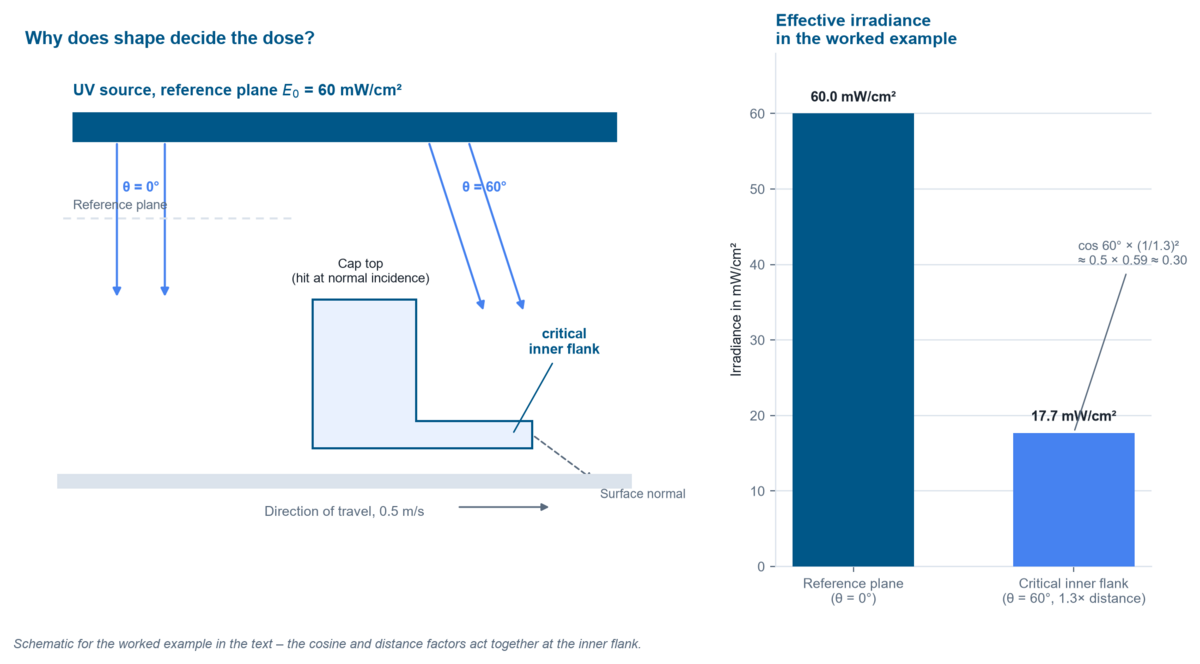
Assumptions. Closure caps travel at 0.5 m/s through a 0.6 m long UV tunnel; irradiance in the reference plane is 60 mW/cm² at 254 nm. The critical surface is an inner flank with an angle of incidence of 60 degrees, whose distance to the source is 1.3 times greater than in the reference plane.
Model. H = E₀ · cos θ · (1/1.3)² · t, followed by log₁₀(N/N₀) = −H / D10.
Calculation. Exposure time t = 0.6 m / 0.5 m/s = 1.2 s. Angle factor cos 60° = 0.5. Distance factor 1/1.69 ≈ 0.59. Effective irradiance 60 · 0.5 · 0.59 ≈ 17.7 mW/cm². Effective fluence H ≈ 17.7 · 1.2 ≈ 21 mJ/cm².
Result. Against vegetative bacteria on smooth, clean surfaces, this value lies in the effective range: with UV-C LEDs, reductions of between 2.8 and 3.8 logs were already achieved at 6 mJ/cm² on borosilicate glass for E. coli, Salmonella Enteritidis and Pseudomonas fragi. Against dry mould conidia it falls far short: with a mean D10 of around 400 mJ/cm² for Aspergillus conidia at 254 nm, derived from comparative measurements, 21 mJ/cm² yields less than 0.1 logs.
Technical interpretation. The same tunnel is reliably effective against one target group and practically ineffective against the other. The design question is therefore not “is the system sufficient”, but “which organism is decisive at which location”. Raising the dose via time costs throughput; raising it via geometry – additional emitters at a more favourable angle of incidence onto the inner flank – makes the cosine factor act immediately and without loss of cycle time. Only an angle-correct measurement at the critical surface shows which of the two routes carries the reduction.
Where is UV disinfection used in packaging and filling?
Beverage filling. In cold-aseptic PET lines, preforms, bottle necks and closure caps are disinfected, often in combination with hydrogen peroxide. The critical parameter is the fluence at the mouth and the cap inner surface, because that is where later product contact and the sealing face lie – for still beverages and low-acid products, this location determines shelf life.
Dairy and cup filling. Lidding film, cup rims and sealing surfaces are irradiated in-line, often with a focus on yeasts and moulds. The critical quantity is field homogeneity across the web width, because a single under-dosed edge zone can carry the recontamination of an entire batch.
Aseptic carton packaging. Web-shaped packaging materials allow high fluences at high web speed because the geometry is planar. Here it is not angle but web tension and distance across the width that matter; combination processes with peroxide reduce the required optical dose.
Pharmaceutical and parenteral filling. In isolators and RABS, UV-C serves surface and material-transfer disinfection as a complement to decontamination with vaporised hydrogen peroxide. What matters is reproducible fluence distributions and documentation for process validation; aseptic filling machines are typically required to demonstrate at least a four-log reduction, with a Sterility Assurance Level better than 10⁻⁶ as the target for the overall system.
Process air and process water. UV-C in ducts and overflow zones reduces airborne microorganisms; here fluence rate dominates over time because residence time is short. For water disinfection, the DVGW W 294 code of practice provides a fully normed framework – devices tested to German rules require a reduction-equivalent fluence of at least 400 J/m², referenced to Bacillus subtilis at 254 nm, evaluated biodosimetrically. No comparable binding standard yet exists for surfaces, but the framework shows what a robust UV dose definition looks like.
Cosmetics, pet food and convenience products. Wherever reduced-preservative formulations meet extended shelf-life requirements, the burden shifts from the formulation to packaging hygiene – and thus to the fluence at sealing and gasket surfaces.
Adjacent application fields: UV disinfection (fluence and dose–response relationship of the target organism in detail), UV curing and photopolymerization (printing and coating of packaging) as well as UV technology for electronics and semiconductor manufacturing.
What solutions exist for special process conditions?
- Zones with personnel presence. Where operating personnel are present, 254 nm systems can only be used with enclosures and interlocks. Far-UVC at 222 nm has significantly higher exposure limits and is being discussed for semi-open transfer points; the safety of UV disinfection describes the underlying protection concepts. Effectiveness on real, not immaculately cleaned surfaces is, however, less well established at 222 nm than at 254 nm.
- Tight installation spaces and retrofit. UV-C LEDs allow arrangements that are geometrically impossible with tube lamps – for example rows of emitters directly above a cap chute at a distance of only a few millimetres. The short distance partially compensates for the lower source efficiency, but places tighter demands on thermal management and homogeneity.
- Humidity, condensate and CIP. Sensors in the sterile zone must be resistant to cleaning agents, gap-free and thermally robust. Condensate on the sensor window produces a measurement error in the same direction as the real process error, so it does not mask it – an argument for separate reference measurements in the dry state.
- High spore load. Purely optical processes only meet sporicidal requirements at high fluences. Coupling with low-concentration hydrogen peroxide exploits the documented synergy of both mechanisms and lowers both the required peroxide concentration and the optical dose.
Which quantities must be measured or monitored?
The measurement task follows from the process task, not from the equipment on offer. What is needed is the irradiance at the critical location, integrated over the exposure time and weighted by the effective wavelength. Four levels follow from this.
Initial characterisation, spectral. For polychromatic sources – medium-pressure lamps, pulsed xenon light – and at every technology change, a spectral measurement is required, for example with the UVpad or the SR900. Only this delivers the spectral irradiance and allows the effective fluence to be calculated and sources with different spectra to be compared. For UV-C LEDs, spectral measurement is additionally necessary because peak wavelength and FWHM depend on batch, current and junction temperature – the fundamentals are covered under UV LEDs for UVA, UVB and UVC.
Spatially resolved validation. The fluence distribution across the packaging surface is measured at the position and in the orientation of the critical surface, not in a conveniently accessible plane. A handheld meter with a cosine-corrected input optic such as the RMD Pro clarifies individual positions with the line stopped; for in-line verification within the product stream, the tinyTracker at just 10 mm in height is flat enough to travel through a conveyor system while recording irradiance and dose. For very short passes, the curelog with up to 2000 readings per second across four spectral ranges resolves even fast lines in time. Only this measurement answers the question of whether the design hits the worst point.
Ongoing monitoring, broadband. Once the spectrum is known and stable, a broadband, permanently installed sensor is sufficient for operation, whose reading has been traced back to the effective fluence via the initial characterisation – as inline sensors in the beam path, connected digitally via PLC.D or PLC.net, or with an analogue output via PLC sensors. This division of labour – characterise spectrally, monitor broadband – is the standard and robust approach. It breaks down as soon as the source spectrum changes, for example through a lamp change, ageing or an LED retrofit.
Laboratory dose–response determination. D10 values for the real packaging material and the relevant target organism can only be determined with a defined, homogeneous irradiance, as provided by irradiation chambers for efficacy trials.
Measurement uncertainty. Relevant contributors are the calibration uncertainty of the reference instrument, the spectral mismatch between sensor responsivity and source spectrum, the cosine error of the input optic at oblique incidence, and positioning uncertainty, which enters disproportionately through the inverse-square law. In tight geometries, the positioning contribution is often the largest – a few millimetres of offset can produce more error than the entire calibration chain. Traceability to national standards is a prerequisite for measured values to be comparable between supplier, equipment builder and operator – this is provided by the calibration laboratory accredited to ISO/IEC 17025.
How is the process monitored in modern automated lines?
In cyclic lines, the UV step must produce a release decision, not just a reading. Technically this means a sensor that remains permanently in the radiation field, whose signal is linked in the line controller to a warning limit and a shutdown limit. The limits are not derived from the as-new state, but from the initial validation: the sensor reading recorded at the time effectiveness was demonstrated becomes the reference point, and the alarm limit lies above the value at which the required fluence at the critical location would be undershot.
More significant than the interface is trend evaluation. Lamp ageing, window fouling and reflector degradation proceed slowly and monotonically – more on this under ageing of UV lamps and UV LEDs. A threshold comparison only detects them shortly before failure; trend evaluation detects them weeks earlier and allows cleaning and lamp replacement to be planned into a scheduled stoppage anyway. For dimmable sources – LEDs and some electronically ballasted gas-discharge lamps – the sensor reading can additionally be used as a control variable: the controller holds irradiance constant and compensates for ageing until the power reserve is exhausted. The integration of such sensors into PLC and line control systems is covered in detail on the market page UV Technology for Automation and Process Integration.
For traceability, fluence values are recorded per batch and linked to belt speed and stoppage times: a line stop inside the tunnel means local overdosing with possible material damage, while a restart that is too fast, before the lamp has settled, means underdosing.
Which developments are shaping the market?
- Regulatory pressure on mercury sources with a concrete deadline. When the RoHS exemption 4(f)-IV expires on 24 February 2027, installations whose efficacy evidence rests on a 254 nm line will need a new dose basis when switching to LED or excimer sources – the changeover is not a component swap but a revalidation.
- Rising wall-plug efficiency of UV-C LEDs. In 2025, a 265 nm emitter with 200 mW radiant power was reported with a validated wall-plug efficiency of just over 10 % at more than 20,000 hours of lifetime – roughly double the previously available high-power types. Fluences that were previously only achievable with amalgam lamps thereby become reachable in compact, pulsable arrangements; heat removal becomes the limiting design problem rather than radiant power.
- Dose shifting from chemistry to optics. Falling permissible residual peroxide levels and sustainability targets are reducing the chemical component in combination processes – the optical share must rise, and so must the accuracy of its determination.
- Standardisation of fluence determination for water. The revised DIN 19294-2:2026-04 specifies the conversion of biodosimetric results to the reduction-equivalent fluence of 400 J/m². The separation it establishes between device sensor reading, reference radiometer and reduction-equivalent fluence is becoming a model for surface applications, for which comparable standardisation is still lacking.
- Far-UVC as a safety, not an efficiency, argument. 222 nm sources are gaining ground wherever personnel exposure determines equipment layout. The design shifts from maximum to maximum-permissible fluence, and the pre-cleaning stage becomes more important because the shallow penetration depth tolerates residues less.
- Inline metrology as a release criterion. Fluence is increasingly not just documented but used as an interlock condition. Sensors must be hygienic, resistant to cleaning and stable over the long term, and their calibration intervals are becoming part of the maintenance plan rather than a recommendation.
What do scientific publications show?
Six studies provide the technical basis for the central claims of this text on matrix influence, resistance ranking and material-dependent effectiveness:
- How strongly the carrier matrix dominates the UV-C effect. At an identical fluence of 1500 mJ/cm² at 272 nm, the reduction of E. coli ranged from more than seven logs (from phosphate buffer) to about 1.5 logs (from nutrient medium); shadowing, by contrast, had no measurable effect in the reflective chamber. – Duering, H.; Westerhoff, T.; Kipp, F.; Stein, C.: Short-Wave Ultraviolet-Light-Based Disinfection of Surface Environment Using Light-Emitting Diodes, Microorganisms 11(2), 386, 2023.
- That the resistance ranking depends on the radiation source. A direct comparison of pulsed light and monochromatic UV-C showed that bacterial spores were more sensitive at 254 nm, whereas pigmented Aspergillus conidia on a dry surface were more sensitive under pulsed light – a source-independent dose figure for mixed target flora is therefore not possible. – Dorbani, I.; Berberian, A.; Riedel, C.; Duport, C.; Carlin, F.: Comparing resistance of bacterial spores and fungal conidia to pulsed light and UVC radiation at a wavelength of 254 nm, Food Microbiology 121, 104518, 2024.
- What fluences suffice on real contact surfaces. With UV-C LEDs at 279 nm, just 6 mJ/cm² on borosilicate glass already achieved reductions of roughly 2.8 to 3.8 logs for dried bioaerosols, with systematically less on 316L stainless steel and silicone rubber – direct evidence for the material dependence of the design. – Sharma, A.; Singh, A.; Pendyala, B.; Balamurugan, S.; Patras, A.: Inactivation of deposited bioaerosols on food contact surfaces with UV-C light emitting diode devices, Applied and Environmental Microbiology 91(1), e01093-24, 2024.
- Why 222 nm behaves differently from 254 nm on packaging and food surfaces. A comparative study with a KrCl excimer lamp found that the lower penetration depth leads to different inactivation mechanisms and a stronger dependence on surface characteristics. – Ha, J.-W.; Lee, J.-I.; Kang, D.-H.: Application of a 222-nm krypton-chlorine excilamp to control foodborne pathogens on sliced cheese surfaces and characterization of the bactericidal mechanisms, International Journal of Food Microbiology 243, 96–102, 2017.
- Why hydrogen peroxide and UV are combined in aseptic lines. A mechanistic study of the sporicidal interaction shows that photolytic activation of the peroxide increases the effect superadditively and allows reduced concentrations and contact times. – Reidmiller, J. S.; Baldeck, J. D.; Rutherford, G. C.; Marquis, R. E.: Characterization of UV-peroxide killing of bacterial spores, Journal of Food Protection 66(7), 1233–1240, 2003.
- That sublethal doses can lead to regrowth. A model of photoreactivation and dark repair as a function of UV-C fluence is relevant to all processes designed just above the minimum dose. – Nebot Sanz, E.; Salcedo Dávila, I.; Andrade Balao, J. A.; Quiroga Alonso, J. M.: Modelling of reactivation after UV disinfection: Effect of UV-C dose on subsequent photoreactivation and dark repair, Water Research 41(14), 3141–3151, 2007.
UV Disinfection of Liquid Foods in Customer Publications
Publications by Opsytec customers also address UV-C treatment of liquid foods – raising the same questions of penetration depth and matrix influence that are decisive for closures and lidding film.
Investigates a temperature-dependent anomaly in the UV translucency of milk relevant to the design of UV-C preservation processes – measured on an Opsytec BS-04 irradiation chamber.
Observation of a temperature dependent anomaly in the UV translucency of milk useful for UV-C preservation techniques
Fiege, Jaayke L., et al. "Observation of a temperature dependent anomaly in the UV translucency of milk useful for UV-C preservation techniques." Scientific Reports 13.1 (2023): 21937.
Shows at pilot scale how bacteriophages in whey can be reduced by UV-C treatment – a case where turbidity of the medium feeds directly into the achievable reduction.
From lab to technical scale: Ultraviolet C treatment for the reduction of Lactococcus lactis bacteriophage P008 in whey
Schubert, Christina, et al. "From lab to technical scale: Ultraviolet C treatment for the reduction of Lactococcus lactis bacteriophage P008 in whey." International Dairy Journal 147 (2023): 105785.
Compares membrane filtration followed by thermal or UV-C treatment as orthogonal strategies for making whey phage-free – evidence that UV-C processes for liquid foods are usually assessed as part of a process chain, not in isolation.
Orthogonal processing strategies to create “phage-free” whey–membrane filtration followed by thermal or ultraviolet C treatment for the reduction of Lactococcus lactis bacteriophages
Michel, Christina, et al. "Orthogonal processing strategies to create ‘phage-free’ whey–membrane filtration followed by thermal or ultraviolet C treatment for the reduction of Lactococcus lactis bacteriophages." International Dairy Journal 122 (2021): 105149.
Further customer work on related topics is collected under Publications by Customers, by Topic.
Technical Foundations and Further Reading
- DVGW code of practice W 294-1 to W 294-3 together with DIN 19294-2:2026-04 – reference framework for reduction-equivalent fluence, device sensors and biodosimetry in water disinfection.
- ISO 15858:2016, UV-C Devices – Safety information – Permissible human exposure – minimum requirements for personnel protection with UV-C devices; for more detail see Guidelines, Standards and Norms in UV.
- 21 CFR 179.39 and 21 CFR 179.41 (US Food and Drug Administration) – permissible conditions for UV radiation and pulsed light, respectively, in food treatment.
- EHEDG Doc. 3 (Microbiologically safe aseptic packing of food products) and EHEDG Doc. 39 (Design Principles for Equipment and Process Areas for Aseptic Food Manufacturing), in the EHEDG guideline catalogue – hygienic design of disinfection and filling zones.
- Jildeh, Z. B.; Wagner, P. H.; Schöning, M. J.: Sterilization of Objects, Products, and Packaging Surfaces and Their Characterization in Different Fields of Industry: The Status in 2020, physica status solidi (a), 2020 – overview of sterilisation methods, requirements for aseptic filling machines and the SAL concept.
- IUVA Guidance Documents on fluence determination, together with Bolton, J. R.; Linden, K. G.: Standardization of Methods for Fluence (UV Dose) Determination in Bench-Scale UV Experiments, Journal of Environmental Engineering 129(3), 209–215, 2003 – methodological basis of fluence determination, including petri factor, reflection and spectral weighting.
FAQ on UV Disinfection and UV Metrology in Packaging and Filling Technology
Which wavelength is suitable for UV disinfection of packaging?
The decisive range is UV-C, between 200 and 280 nm, because that is where nucleic acids absorb; the DNA absorption maximum lies at around 260 to 265 nm. Mercury low-pressure lamps deliver 253.7 nm, UV-C LEDs typically 265 to 285 nm, KrCl excimer lamps 222 nm. The choice depends on target organism, geometry, personnel protection and material compatibility – not on effectiveness alone.
What UV dose is required for a closure cap or lidding film?
No universally valid figure exists. The required fluence follows from the most resistant relevant organism, the initial bioburden, the required log reduction and the surface condition. Vegetative bacteria on smooth, clean surfaces need a few to several tens of mJ/cm², dry mould conidia orders of magnitude more; the design is based on the worst point of the surface.
Why does UV disinfection fail despite nominally sufficient lamp power?
Because electrical power is not an optical dose, and the fluence at the critical location depends on angle, distance, shadowing, window fouling and lamp ageing. The most common single reason, however, is the matrix: organic residues absorb UV-C and can lower the achieved reduction by several logs without any reading at the tunnel wall changing.
Which point on a closure cap matters for measurement?
Not the externally accessible top of the cap, but the inner flank and the sealing lip – exactly where angle of incidence and distance depress fluence most strongly relative to the reference plane. A sensor that only captures the convenient position at mid-tunnel systematically misses this point; only a spatially resolved measurement in the geometry of the critical surface reveals the actual value.
Why isn’t the fluence from the reference plane sufficient as a figure of merit?
Because it only describes conditions directly under the source. The cosine factor and the inverse-square law often reduce the energy density actually arriving at an obliquely oriented inner surface to a third or less – in the worked example on this page, irradiance drops from 60 to around 18 mW/cm². Only the fluence at the critical location itself correlates with the achieved microbial reduction.
When is a spectral measurement necessary, and when does broadband measurement suffice?
A spectral measurement is required for polychromatic sources such as medium-pressure lamps and pulsed xenon light, for UV-C LEDs because of wavelength drift and FWHM, and at every source change. Once the spectrum is known and stable, a broadband device with a traceable reference to the initial spectral characterisation is sufficient for operational monitoring.
Why doesn’t UV-C replace hydrogen peroxide in every case?
Because spores and pigmented conidia are optically shielded and can only be inactivated by purely optical means at high fluences, which cost throughput in cyclic lines. Photolytic activation of hydrogen peroxide acts superadditively and allows both the peroxide concentration and the optical dose to be reduced.
Are UV-disinfected packaging materials automatically safe with respect to the material itself?
Not automatically. High UV-C fluences can alter polymer surfaces and photolytically cleave additives; below roughly 240 nm, ozone also forms. For food contact, material compatibility in the actually applied fluence range must therefore be assessed alongside microbiological effectiveness – including local overdosing at a line stop.
Author: Dr. Mark Paravia
Dr.-Ing. Mark Paravia is the managing director of Opsytec Dr. Gröbel GmbH in Ettlingen and heads the accredited calibration laboratory. Following his research on pulsed xenon excimer discharges at the Institute of Lighting Technology at KIT, his current focus is on optical radiation measurement technology. He is a recognized UV expert, vice-chair of the DIN Standards Committee FNL 7 “Optical Radiation,” and a member of the DVGW Project Group on UV Disinfection.
Central Technical Question
Not sure what fluence the inner flank of the closure cap actually reaches during the running cycle – and whether the sensor reading at the tunnel wall represents that location at all? This question can only be answered through a spatially resolved, angle-correct measurement at the critical surface and a spectral characterisation of the source in use. For the design, validation and ongoing monitoring of UV disinfection steps in packaging and filling lines, the accredited calibration laboratory of Opsytec Dr. Gröbel GmbH is available with traceable radiometric instrumentation – send us your question.
