

Cary 60 DRA – diffuse reflectance and transmittance measurement
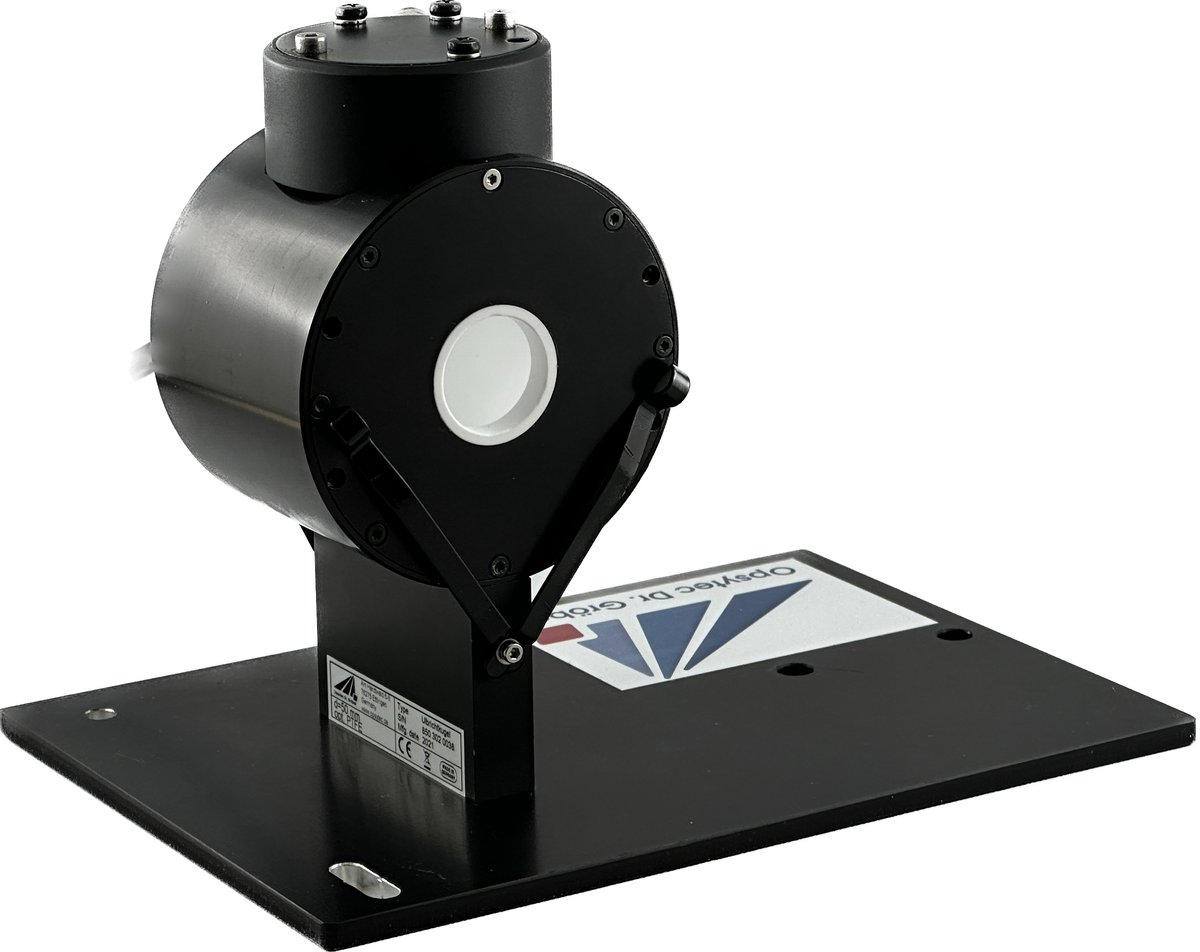
The Opsytec integrating sphere for the Agilent Cary 60 spectrophotometer extends the instrument to measure the diffuse transmission and reflection of translucent samples – the Cary 60 itself measures only direct transmission and reflection. The PTFE sphere with a diameter of 50 mm works in a usable spectral range from 200 nm to 1100 nm and supports geometries such as 0° and 8°. With the extensive accessory set, liquid and powder samples can be measured as well.
Enrich your spectrophotometric measurements with our highly reflective integrating sphere, specially developed for the Agilent Cary 60 spectrophotometer. Perfect for comprehensive material characterization!
Diffuse reflectance and transmittance measurement thus become possible on an instrument that can do neither on its own – the integrating sphere retrofits the Cary 60 for both.
Agilent lists the accessory as the DRA – diffuse reflectance accessory. The Opsytec Cary 60 DRA is the matching integrating sphere: same geometry, same holders, with a traceably calibrated reflectance standard among the accessories.
Discover the outstanding features of our integrating sphere:
- Designed to work seamlessly with the Agilent Cary 60 spectrophotometer, making it easy to integrate into your existing setup.
- The sphere is made of a high quality diffuse reflective material (PTFE) that ensures uniform light distribution and minimal absorption.
- The sphere is equipped with a special bracket that allows easy mounting on your Agilent Cary 60 spectrophotometer.
- Manufactured from high quality materials, as solid hollow spheres in a cylindrical aluminum housing to ensure long life and reliable performance.
Rely on our high-quality integrating sphere to take your spectrophotometric analysis to the next level.
Increase the precision and accuracy of your measurements and get reliable results that meet your research and quality control requirements.
Contact us today for more information and to purchase your high-reflectance integrating sphere for the Agilent Cary 60 spectrophotometer.
Get ready for excellent measurements in your lab!
Technical data, accessories & brackets for Cary 60 integrating sphere
| Diameter | 50 mm |
| Material | PTFE |
| Detector | Si photodetector |
| Spectral range, usable | 200 nm - 1100 nm |
| recommended | 200 nm - 950 nm |
| Photometric range | ~ OD 2.5 |
| Inputs/outputs | 2 |
| Opening for sample access | 10 mm |
| Filter holder | Fixed sample holder, on both sides |
| Accessory package: | 8° Sample holder, 6 mm |
| Port reducer from 10 mm to 6 mm | |
| Powder cuvette holder 28 mm | |
| Cuvette holder 10 mm |
Order numbers, scope of delivery, accessories and versions
| Version | Order number |
|---|---|
| Integrating sphere for the Cary 60 | 850305 |
The sphere is placed in the sample compartment of the Agilent Cary 60 and measures diffuse reflectance and transmittance.
| Designation | Order number |
|---|---|
| Accessory set | 850308 |
| 8° sample holder, diameter 6 mm | 850309 |
| Port reducer from 10 mm to 6 mm | 850310 |
| Powder cuvette holder 28 mm | 850311 |
| Cuvette holder 10 mm | 850312 |
The accessory set contains the 8° sample holder, the port reducer, the powder cuvette holder and the cuvette holder; individual parts are also available on their own. The port reducer narrows the 10 mm opening to 6 mm, to match the 8° sample holder with 6 mm.
| Designation | Order number |
|---|---|
| Reflectance standard (diffuse) | 850313 |
| Calibration of the reflectance standard | 850314 |
The diffuse reflectance standard serves as a white standard; the calibration can be ordered separately.
Publications using Opsytec integrating spheres
We do not keep a separate bibliography for this individual device – publications usually name the product family, not the model. Listed here are the 3 most recent works in which Opsytec integrating spheres were used.
| Title | Authors | Journal | Year |
|---|---|---|---|
| Luminescence and Photochromism in Lanthanide‐Doped Hackmanites | Baggott, J.; Tuomisto, M.; Williams, J. A. G. et al. | Advanced Optical Materials | 2026 |
| Customizing Tactile and Visual Perceptions of Organic Light–Emitting Diodes by Surface Coatings | Buhl, J.; Cojocaru, A.; Gerken, M. | Advanced Intelligent Systems | 2021 |
| Design of Instrumentation & Control and Optical Table Instruments for the Divertor Flow Monitor Diagnostic at ITER | — | — | — |
Notes and FAQs for the Cary 60 integrating sphere
Direct vs. diffuse transmission
Direct transmission typically occurs when the optical sample is homogeneous and transparent. This means that the sample has no significant scattering, absorption or haze. Direct transmission can be measured with many spectrophotometers.
Diffuse transmission occurs in samples that are not completely transparent or homogeneous. These samples may contain scattering, haze or particles that deflect the light inside the sample and scatter it in different directions.
Direct vs. diffuse reflection
The „direct reflection“ and „diffuse reflection“ indicate the way in which light is reflected from a surface. Similar to transmission, they describe different types of light reflection, depending on the properties of the surface and the incident light. Accordingly, direct reflection typically occurs on smooth and flat surfaces, such as a mirror or a polished metal surface.
Diffuse reflection occurs on rough, uneven or matt surfaces that scatter light in different directions due to unevenness or microstructures.
Transparent vs. translucent samples
Transparent and translucent samples differ in their light transmission. Transparent materials, such as glass or clear plastic films, allow light to pass through unhindered and provide a clear view of what is behind them. Translucent materials, on the other hand, such as frosted glass or frosted plastic, allow light to penetrate but scatter it in different directions, so that objects behind them are not clearly visible. The distinction between transparent and translucent is important in order to understand the optical properties of materials and to use them accordingly in various applications, whether in architecture, design or science.
In translucent samples, penetrating radiation is scattered in the sample and partially reflected in the direction of incidence. The integrating sphere for the Cary 60 can illuminate the sample directionally through the second port and measure the diffusely reflected radiation.
Summary
To summarize, the choice between direct transmission and diffuse transmission depends on the type of sample to be examined and the specific examination objectives. In most cases, transparent, homogeneous samples are analyzed by direct transmission, while opaque or scattering samples require diffuse transmission measurement for more accurate characterization. This is where the Opsytec integrating sphere for the Cary 60 is the ideal complement.
Calibration
A reflectance standard with known reflectance is required for absolute calibration.
The wavelength calibration is already carried out in the Cary 60 spectrophotometer.
Definitions of the quantities measured here are given under Photometric quantities.
Downloads
Is the integrating sphere compatible with the Agilent Cary 60?
Yes, the integrating sphere is fully compatible with the Cary 60.
Do I need additional Agilent components for operation?
No, no special software module or additional license is required for operation.
Can I measure transmission and reflection?
Yes, you can measure transmission and reflection.
For transmission, carry out a BASELINE correction as usual.
If you want to measure diffuse reflection, you need a reference object. This is usually a reflection target with a known reflection. We offer this as an option.
If you want to measure the diffuse reflection of powders, you also need a powder holder. We offer this as an option.