


UV Sources & Lifetime
Which source delivers which spectrum, how its output declines over operating time and how irradiance is calculated from a measured spectrum. Together these decide when a lamp or LED module still carries the process and when it has to be replaced.
Operating the source belongs here as well: low-pressure mercury lamps reach their full UV output only within a narrow temperature window, which is why setting the cooling is covered here. And when a lamp breaks, what happens in the first few minutes is what counts.
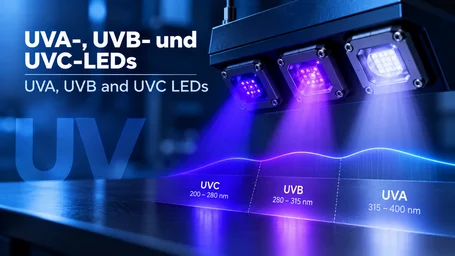
UVA, UVB and UVC LEDs
Key concept: UVA, UVB, UVC LED, peak wavelength, efficiency
UV LEDs are built from III-V semiconductors and deliver narrow-band spectra from UVA to UVC. The article compares the three ranges, how they are made and the applications in which they replace mercury lamps.
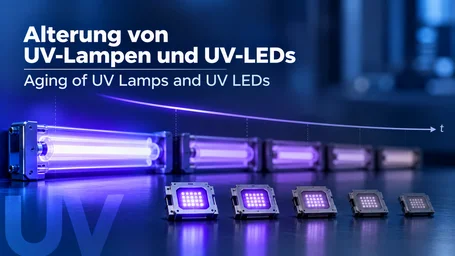
Ageing of UV lamps and LEDs
Key concept: ageing curve, remaining output, maintenance interval
UV lamps and UV LEDs lose irradiance over operating time, often without any visible sign. The article explains the causes – electrode erosion, envelope solarisation, degradation – and how measurements set the replacement point.
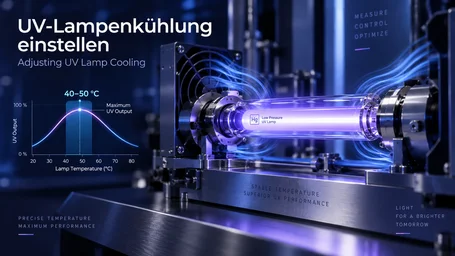
Setting the UV lamp cooling
Short answer: adjust cooling until the measured UVC output peaks
Low-pressure mercury lamps reach their highest UV output at a wall temperature of about 40 to 50 °C. The article explains why lamps that are too cold or too warm emit less and how cooling is adjusted with a radiometer.
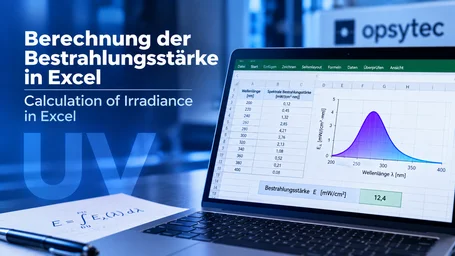
Calculate spectrum and irradiance in Excel
Short answer: =SUM(readings)·step width, check the units
Irradiance is the integral of spectral irradiance over the wavelength range – in Excel the sum of the readings times the step width. The article shows the formula and the typical mistakes with units and step width.
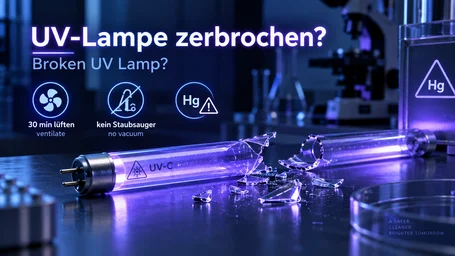
What to do if a UV lamp breaks?
Short answer: ventilate 30 minutes, do not vacuum, lift fragments with tape
When a UV lamp breaks, mercury escapes into the room air. The article says what to do immediately – ventilate, switch off air conditioning, leave the room – and how to pick up and dispose of fragments and residues safely.
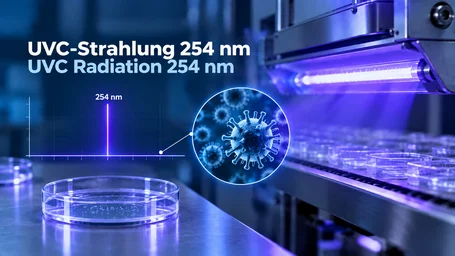
Measuring and monitoring UVC radiation at 254 nm
The 253.7 nm line arises as a resonance line of the mercury atom in a low-pressure discharge and sits close to the maximum of the germicidal action curve. The article places the wavelength in its historical context, explains the lamp physics…

Measuring 172 nm VUV radiation from xenon excimer lamps
Xenon excimer lamps emit in a narrow band at around 172 nm; the photon energy of about 7.2 eV breaks organic bonds directly. The article explains the dielectric barrier discharge and the decay of Xe₂*, places the technology in its historical context,…