


Calibrated illuminance measurement – from workplace lighting up to 500,000 lx.
Lux meters and illuminance meters for precise light measurement
Illuminance describes the luminous flux incident on a surface and is one of the fundamental photometric quantities. It is expressed in lux. For reproducible measurements, the light must be weighted according to the spectral luminous sensitivity of the human eye.
Opsytec offers calibrated measuring systems for determining illuminance. With a LUX sensor, the RMD and RM-12 radiometers become lux meters – calibrated light meters that display illuminance in lux. The sensor covers the visible spectral range from 380 to 780 nm and weights the incident light according to the V(λ) function.
What does a lux meter measure?
A lux meter measures the illuminance Ev. It describes the luminous flux that falls on a given surface. The unit is the lux:
1 lx = 1 lm/m²
Illuminance is a photometric quantity. It weights optical radiation according to the spectral sensitivity of the human eye in daylight vision.
This makes lux measurement fundamentally different from a radiometric measurement in W/m². Two light sources with the same radiant power can produce different lux values because of their different spectra.
V(λ) weighting and V-lambda sensor
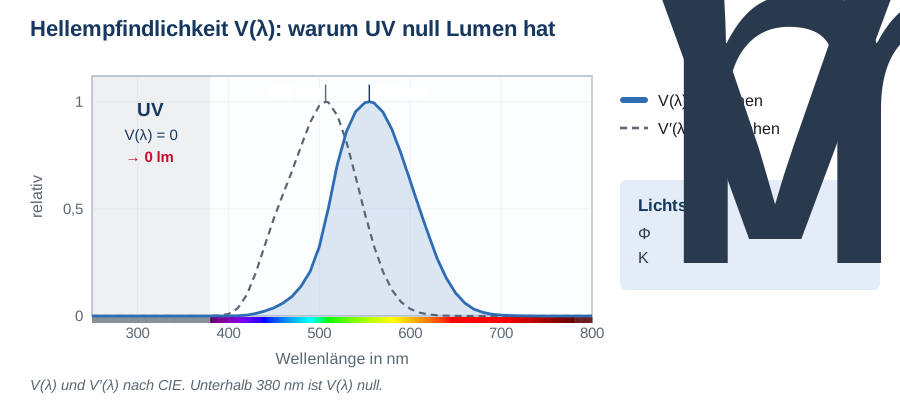
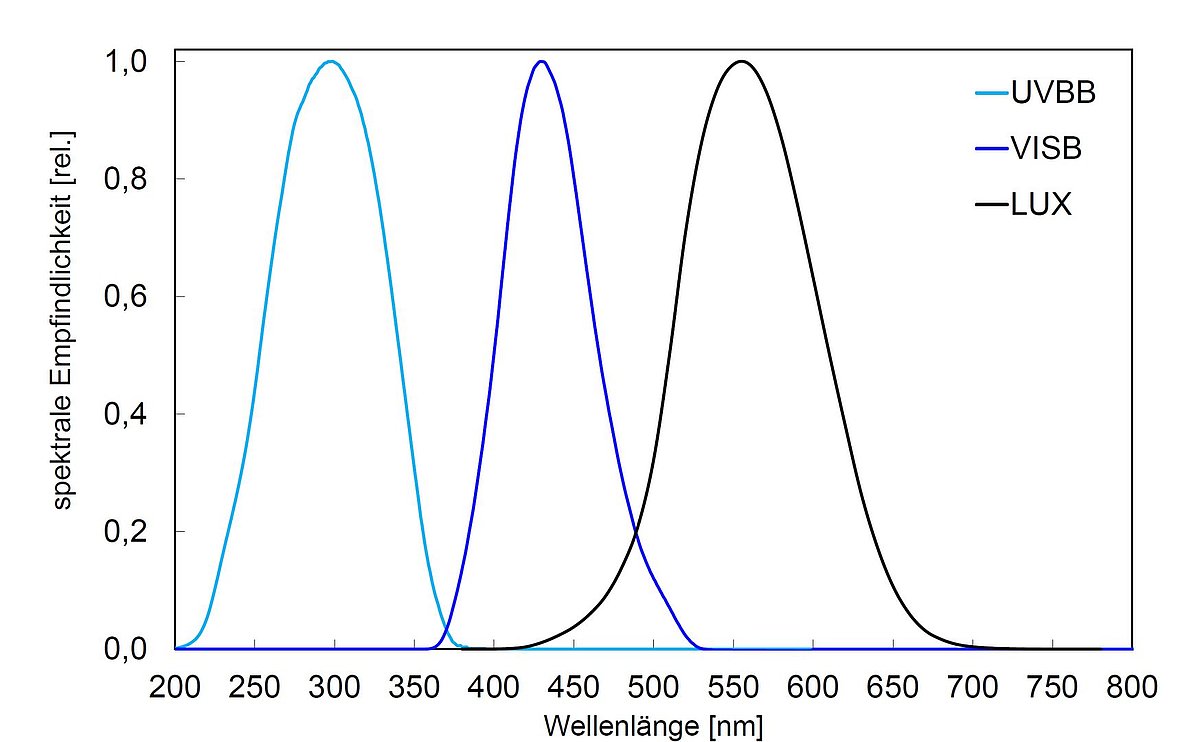
For photometric measurements, the spectral luminous sensitivity of the human eye is described by the V(λ) function. It peaks at 555 nm and falls off steeply towards the edges of the visible range.
An illuminance meter therefore needs a V-lambda sensor: a sensor whose spectral sensitivity matches this weighting function as closely as possible. Deviations between the sensor response and V(λ) can lead to measurement errors, particularly with narrow-band LEDs or unusual spectra.
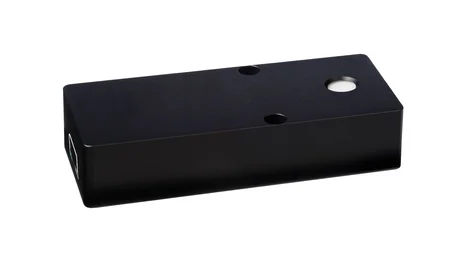
The Opsytec LUX sensor operates from 380 to 780 nm with V(λ) weighting and can be used on the RMD and RM-12 radiometers.
Cosine correction
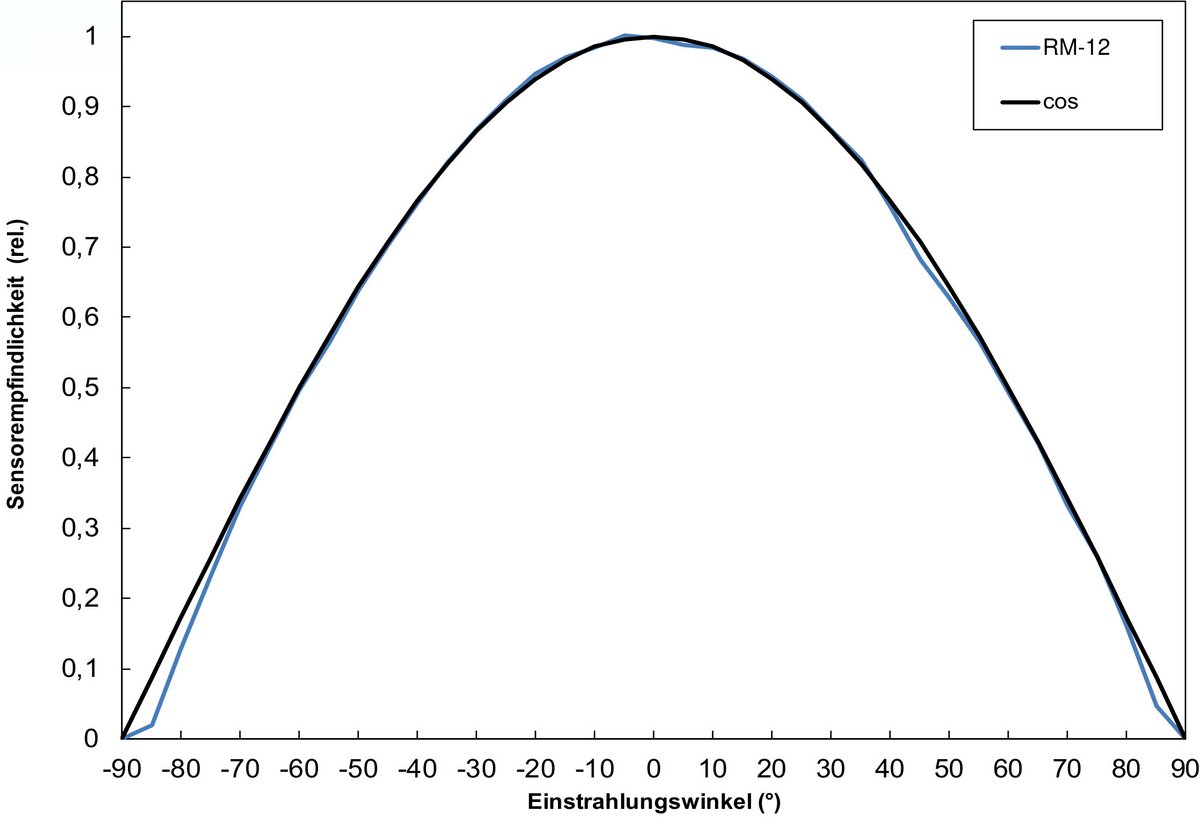
Illuminance is an area-related quantity. Radiation striking the measuring surface at an oblique angle contributes to the illuminance according to the cosine of the angle of incidence. A suitable measuring head must reproduce this angular behaviour.
Opsytec sensors use diffusers for cosine correction. This improves measurement accuracy for light that does not fall exclusively perpendicular onto the sensor.
Lux scale: how bright is that?
Between a starlit new-moon night and the sun at its zenith lies a factor of more than 100 million – and the eye sees in both. The pupil changes the amount of incoming light by only about a factor of 16; the retina does the far greater part of the adaptation. The scale shows typical illuminance levels and standard values on a logarithmic axis. Drag the slider on the axis, move the mouse over a symbol or enter your own reading.
| Situation | Illuminance |
|---|---|
| Clear sky, sun at zenith | 130,000 lx |
| Summer noon in Central Europe, clear sky | 90,000 lx |
| Winter noon, clear sky | 20,000 lx |
| Summer noon, overcast sky | 19,000 lx |
| In the shade in summer | 10,000 lx |
| Overcast winter day | 3,500 lx |
| Overcast day, typical | 1,000 lx |
| Twilight (sun just below the horizon) | 750 lx |
| Very dark overcast day | 100 lx |
| Twilight (sun 6° below the horizon) | 3 lx |
| Full moon night | 0.05–0.36 lx |
| Quarter moon, clear sky | 0.01 lx |
| Starlit night at new moon | 0.001 lx |
| Moonless night, overcast sky | 0.0001 lx |
| Situation | Illuminance |
|---|---|
| Modern surgical lighting | 160,000 lx |
| Photostability chamber to ICH Q1B (worked example) | 75,000 lx |
| Dental operating light (minimum) | 15,000 lx |
| Office or room lighting | 500 lx |
| Corridor | 100 lx |
| Living room | 50 lx |
| Fluorescent inspection to ISO 3059 (ambient light, maximum) | 20 lx |
| Street lighting | 10 lx |
| Candle at about 1 m | 1 lx |
| Emergency lighting of escape routes to EN 1838 (minimum) | 1 lx |
Standards: ISO 3059, EN 1838, ICH Q1B.
| Task / room | Maintained illuminance |
|---|---|
| Technical drawing | 750 lx |
| Office, screen work, conference rooms | 500 lx |
| CAD workstations | 500 lx |
| Sales areas, reception | 300 lx |
| Corridors, stairwells | 100 lx |
| Car parks | 75 lx |
The standard values are maintained values: the illuminance must not fall below them even after ageing and soiling of the luminaires. With a maintenance factor of 0.8, a new installation for 500 lx must therefore deliver about 625 lx. For screen work, the standard also requires glare limitation of UGR ≤ 19 and a colour rendering index of Ra ≥ 80.
Standard: EN 12464-1:2021.
Where illuminance is measured
Typical applications are:
- Testing LED luminaires
- Development of lighting systems
- Quality control and production testing
- Comparative measurements on lamps
- Research and development
- Characterisation of optical systems
In several applications, standards specify the illuminance directly:
- Fluorescent crack detection to ISO 3059: During inspection, visible ambient light must not exceed 20 lx, with a UV-A irradiance of at least 10 W/m². For this case, a combined sensor for 365 nm and LUX is available for the RMD.
- Photostability to ICH Q1B: Drug samples must receive at least 1.2 million lux hours of visible light and 200 Wh/m² of near UV. Illuminance and UV irradiance are measured at the sample position for this purpose.
- Workplace lighting to EN 12464-1: The standard specifies maintained illuminance values for workplaces, from 75 lx in car parks to 750 lx for technical drawing.
- LED and display technology: Illuminance describes the ambient light and the light output of LED modules on a surface.
Lux meters from Opsytec: RM-12 and RMD
The choice of measuring system depends on the spectrum, intensity, measurement geometry and whether UV radiation is to be assessed in addition to visible light. The RMD or RM-12 with LUX sensor are suitable for fast and reproducible lux measurements. For permanently installed monitoring in systems, the LUX sensor is also available as a PLC sensor with analogue output and as PLC.net with Ethernet connection.
RM-12 as a compact lux meter
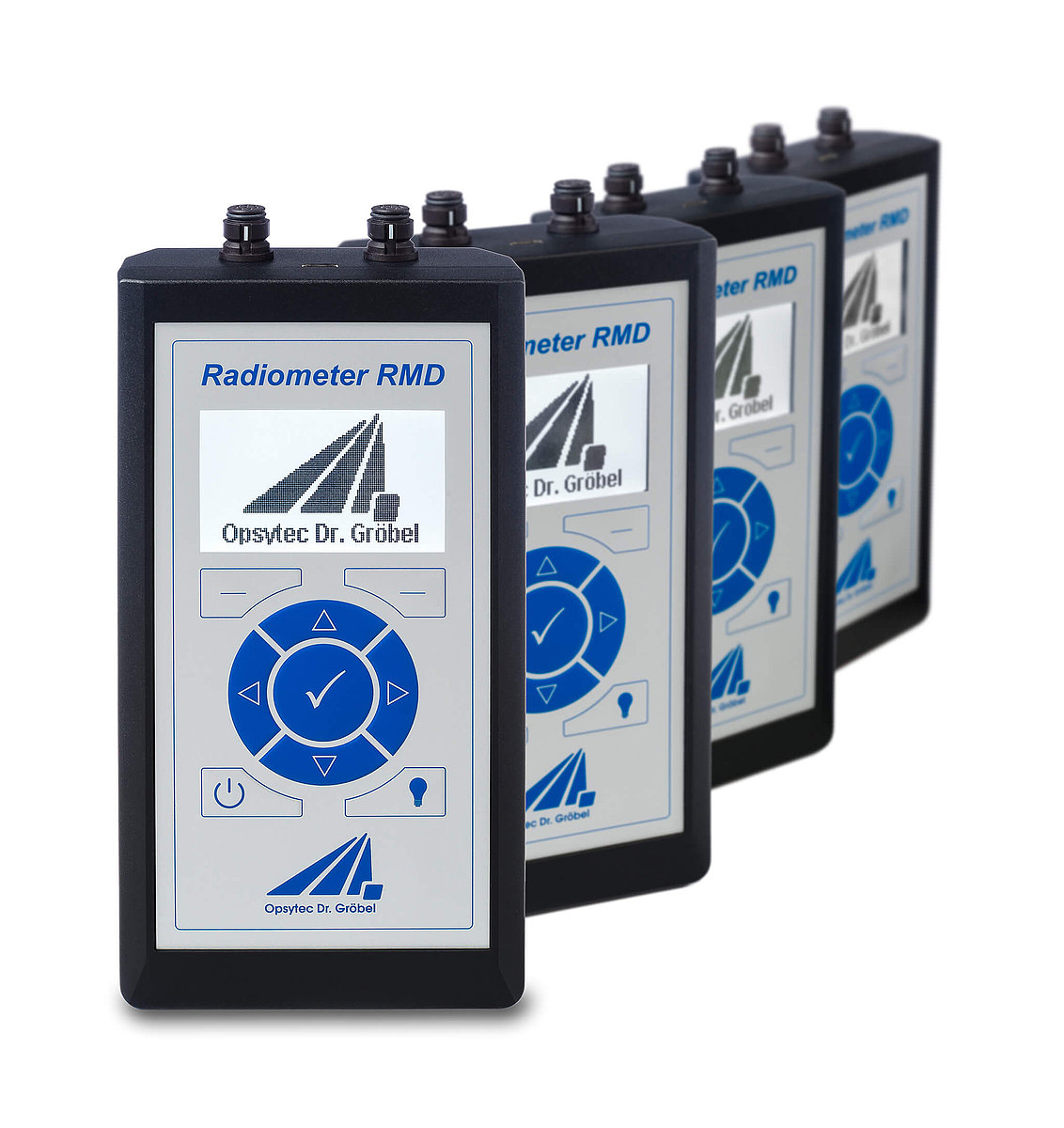
The RM-12 is a compact, battery-powered hand-held radiometer that can be operated with different measuring heads. Combined with the LUX sensor, it becomes a handy lux measuring device.
The modular design allows the same basic unit to be used for photometric and radiometric measurements. In addition to illuminance, suitable sensors can measure UVA, UVB or UVC irradiance, for example.
This is particularly advantageous in applications where visible light and UV radiation have to be assessed together.
RMD: digital lux meter up to 500,000 lx
The RMD is a fully digital hand-held radiometer with two sensor inputs. It is suitable for precise, high-dynamic-range measurements with different sensors. With its measuring range up to 500,000 lx, both typical artificial lighting situations and very high illuminances can be examined – for example in irradiation chambers or under surgical and treatment lights.
- two digital sensor inputs, for example for measuring illuminance and UVA irradiance simultaneously
- 24-bit conversion and a dynamic range of 1 : 10,000,000
- illuminance up to 500,000 lx
- display of irradiance, illuminance and dose
- calibration uncertainty of the sensors typically 4.5–6.0 % (k = 2)
The system is suitable for laboratories, development, quality assurance and industrial testing and, with two sensor inputs, offers the greater reserve.

RM-12
Handheld meter for irradiance and illuminance with interchangeable sensors.

Radiometer RMD Pro
All-digital handheld radiometer for irradiance and dose with two sensor inputs and 8 GB memory.
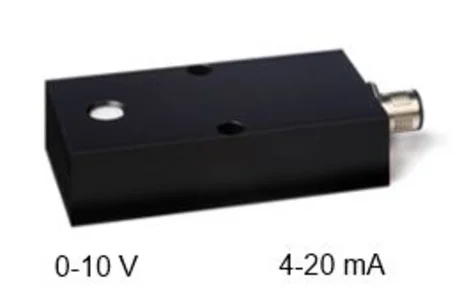
PLC sensors with analog output signals
UV and light sensors with 4–20 mA, 0–10 V or 0–2 V output for direct connection to PLC controllers.
PLC.net – Ethernet UV sensor
UV sensor with Ethernet and PoE; readings available via Modbus TCP and HTTP/JSON directly on the network.
Measuring LED illuminance
LEDs can have very narrow spectra or spectra composed of several peaks. The spectral match of a lux meter to V(λ) is therefore particularly relevant for LED measurements: if the sensor sensitivity at the emission wavelength lies slightly above or below the V(λ) curve, this deviation has its full effect on the reading for a narrow-band source. How large the effect can be is explained in the article on spectral mismatch.
A calibrated lux meter with a V(λ)-matched sensor is suitable for routine testing.
Measuring lux: how to get it right
- Define the measuring plane: The sensor lies in the plane for which the value is to apply – for workplaces usually the work surface – and is aligned parallel to it.
- Keep the distance constant: With point sources, illuminance falls with the square of the distance. Even a few millimetres make a clear difference to the reading.
- Avoid shading: Bodies, hands and cables must not keep light away from the sensor.
- Several measuring points: The illuminance of a surface is rarely uniform. A grid of several points shows the mean value and uniformity.
- Mind the temperature: Sensor and light source should have reached their operating temperature; many lamps and LEDs change their light output while warming up.
Calibrated and reproducible
Traceable calibration of the measuring system is essential for reproducible measurements.
Opsytec sensors are supplied calibrated and can be recalibrated. This makes the systems suitable for recurring tests, quality assurance and measuring tasks that require documentation.
FAQ: lux meters
What is the difference between a measurement in lux and a measurement in W/m²?
A radiometric measurement in W/m² records the physically present radiant power without weighting. A photometric measurement in lux weights the same radiation with the luminous efficiency function V(λ) of the human eye and is zero outside roughly 380–780 nm. Two sources with the same radiant power can therefore have very different lux values.
Why is illuminance measured in fluorescent inspection to ISO 3059?
Visible ambient light reduces the contrast between the fluorescent indication and the background. The standard therefore limits the illuminance during inspection to a maximum of 20 lx, with a UV-A irradiance of at least 10 W/m². Both are measured at the inspection surface.
What does V(λ) weighting mean?
V(λ) is the internationally defined luminous efficiency curve of the human eye in photopic vision, with its maximum at 555 nm. A lux meter sensor must follow this curve spectrally so that its reading corresponds to the perceived brightness. With narrow-band sources such as LEDs, deviations have a greater effect than with broadband light.
What is cosine correction for?
Light falling obliquely on a surface contributes to the illuminance only with the cosine of the angle of incidence. A diffuser in front of the optical area of the sensor reproduces this behaviour. Without cosine correction, light arriving at an angle – for example from several luminaires or large-area sources – would be weighted incorrectly.