


Photochemistry: fundamentals, photoreactors and measurement
Photochemistry denotes chemical reactions triggered by the absorption of photons – here light is not an energy source in the thermal sense but a reagent. What matters is not the electrical power of the lamp and not the exposure time, but the number of photons of an effective wavelength that are actually taken up in the absorbing reaction volume. That quantity is the photon flux, and it behaves differently from the familiar dose in J/m²: equal energy means different numbers of photons at different wavelengths. Anyone stating a quantum yield, designing a reactor or switching from a mercury lamp to LEDs is therefore necessarily working with spectrally resolved quantities. This page covers the fundamentals, the reactor concepts and the measurement technology common to all photochemical applications.
Why is photochemistry a future market?
There is no dependable market figure for "photochemistry" as such, because the field cuts across the usual market boundaries: it ranges from fine chemical synthesis through photoinitiators and reactor engineering to water treatment. Available studies each cover a different slice. What is meaningful instead are four developments that can be justified on technical grounds.
The photon as a residue-free reagent. In many cases photochemical excitation replaces stoichiometric oxidising or reducing agents. What would otherwise end up as a salt load or heavy metal residue in the wastewater is introduced as radiation and leaves no by-products. This makes photochemistry one of the few approaches in which an improvement in atom economy does not come with a trade-off – and explains why photochemistry reagents are tracked under "green synthesis" in market observation.
Photoredox catalysis has shifted the field into the visible. A photoredox catalyst absorbing in the visible range abstracts an electron from simple organic substrates on excitation, or transfers one to them. This single-electron transfer opens up highly reactive radical species under mild conditions – reactions that are thermally inaccessible or only accessible under harsh conditions. What began as academic method development is currently migrating into process development. In measurement terms this is a break: excitation lies at 405 or 450 nm and thus outside what classical UV sensors represent.
Continuous operation solves the real scaling problem. Photochemistry does not scale with volume. In a large vessel the radiation is absorbed in a layer near the wall according to the Beer-Lambert law; the core stays dark. Flow reactors with a small cross-section circumvent this, because the optical path length matches the absorption length and output is increased through residence time and parallelisation rather than reactor diameter. Photochemistry is therefore regarded – alongside electrochemistry, hydrogenation, oxidation and nitration – as a preferred application of flow chemistry, particularly for hazardous reactions. Synthetic photochemistry is carried out in both batch and flow operation, and at both macro and micro scale.
The change of source has greater consequences for photochemistry than for curing. The revised EU Mercury Regulation has been in force since 30 July 2024, and the RoHS exemption for mercury expires in early 2027. Replacing a line-rich medium-pressure spectrum with a narrow LED band is not merely swapping a component: excitation then takes place in a different wavelength range, with a different photon energy and without the secondary lines that may have contributed in the old process. Selectivity and product distribution can shift as a result. Conversely, this is precisely where the opportunity lies: an LED that targets one absorption band produces fewer by-products than a broadband source that also excites where one does not want it.
The installed base remains. For decades the economically most significant industrial photoreactions have been radical chlorination, sulfochlorination, sulfoxidation and nitrosation; increasingly, syntheses of vitamins, pharmaceuticals and fragrances are added. The photonitrosation of cyclohexane to the caprolactam precursor is still regarded as the textbook case for planning a photochemical production plant. These processes are not disappearing – they are being converted to new sources and characterised anew in the process.
What follows from this for the coming years. The photon balance will become the key figure of process development, because it is the only quantity that makes batch and flow set-ups, laboratory and pilot scale comparable with one another. Comparability between laboratories will become the real bottleneck: as long as irradiance values are reported without a spectrum, without geometry and without traceability, published quantum yields cannot be verified. And the criterion for scale-up will shift definitively from reactor size to irradiated area and optical path length.
How does photochemistry work?
Everything begins with the Grotthuss-Draper law: only absorbed radiation can act photochemically. Radiation that passes through the reactor, is reflected or scattered without being absorbed contributes nothing. From this follows immediately the most important practical consequence of this page – a measurement outside the reactor does not describe the reaction conditions.
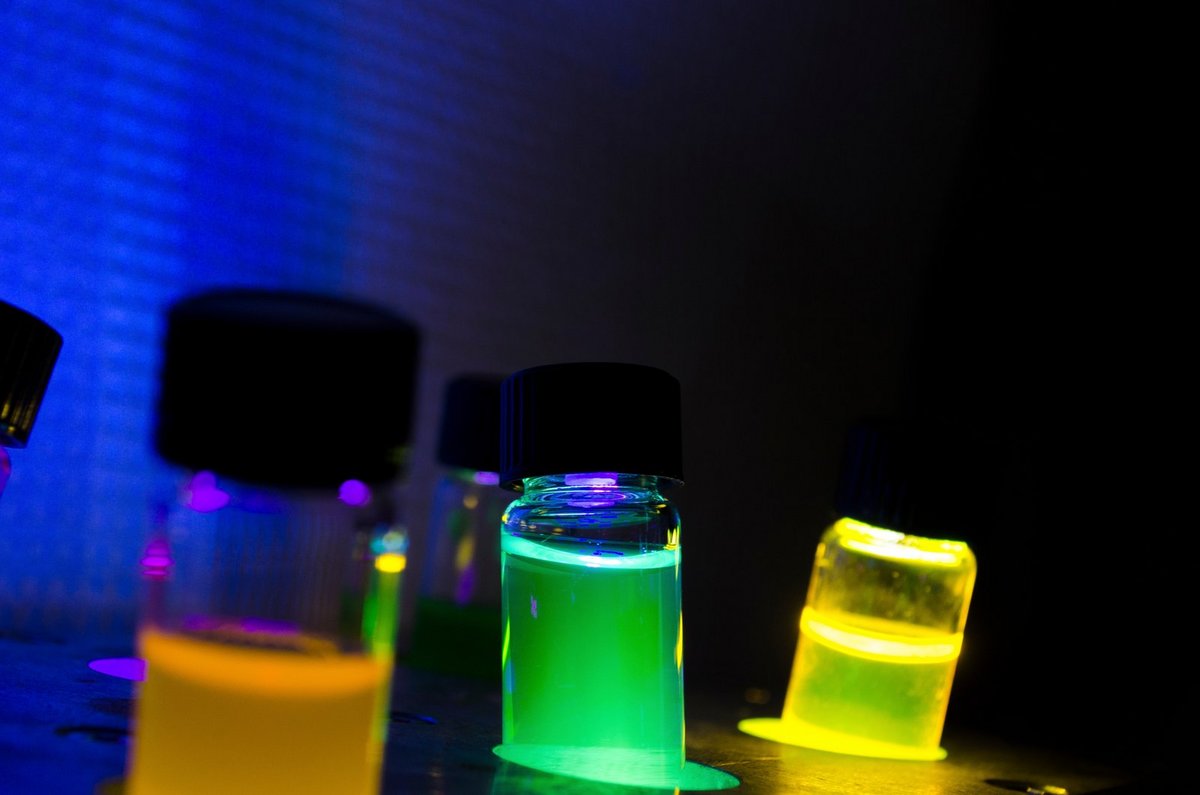
When a molecule absorbs a photon it passes into an electronically excited state. The Jablonski diagram orders the competing pathways available from there: radiationless relaxation, fluorescence, intersystem crossing to the triplet state, phosphorescence, energy or electron transfer to another molecule – and chemical reaction. Under Kasha's rule, emission occurs predominantly from the lowest excited state of a given multiplicity, because internal conversion is faster than everything else. Nonetheless, the excitation wavelength can influence the product: it decides which state is reached at all, and which competing processes are thereby accessible.
The Stark-Einstein law – the photochemical equivalence law – states that one absorbed photon primarily activates one molecule. It describes the primary step, not the balance: quantum yields can lie well above 1 when the primary step starts a chain reaction, as in radical photochlorination, where one photon triggers many conversions. And they can lie far below 1 when deactivation, recombination or quenching dominate. Neither contradicts the law; both follow from what happens after the primary step.
In sensitised reactions it is not the substrate that absorbs but a photosensitiser, which transfers the energy. Photooxygenation with a porphyrin sensitiser is the industrially most relevant example. For measurement this means: the governing absorption spectrum is that of the sensitiser, not of the starting material.
Which technologies are used?
Radiation sources
| Technology | Characteristics | Advantages | Limits | Typical application |
|---|---|---|---|---|
| Hg low-pressure and amalgam lamp | quasi-monochromatic at 254 nm, low-pressure additionally with a 185 nm component; the amalgam variant with markedly higher output | simple photon balance through a single wavelength, high UV-C efficiency | only 254 nm usable, temperature dependence, mercury regulation | photolysis, UV/H₂O₂, 254 nm kinetics |
| Hg medium-pressure lamp | line-rich full spectrum from UV-C into the visible, high power density | broad excitation, short exposure times, effective in depth in absorbing media | the effective share is hard to attribute to one line, thermal load, mercury regulation | technical synthesis, broad excitation, bonding and curing |
| UV fluorescent lamp | band-limited in UV-A, UV-B or UV-C | defined choice of band, homogeneous fields over larger areas | limited irradiance | kinetics, ageing, photostability |
| UV LED | narrow-band, 365–450 nm | targets one absorption band, instant start without warm-up, dimmable below 2 %, no IR input | limited availability below 300 nm, initial degradation, band width must suit the absorber | photoredox catalysis, photopolymerisation, visible-light-driven synthesis |
| Excimer and VUV source, 172 nm | quasi-monochromatic, very high photon energy | breaks bonds that remain untouched in the UV-C; absorption close to the surface | strong absorption in air and oxygen, demanding measurement | surface activation, VUV photochemistry |
| Xenon solar simulator | continuous spectrum, sun-like with an AM1.5 filter | assessment of visible-light-active systems under a realistic spectrum | equipment effort, lamp ageing | solar-driven photochemistry and photocatalysis |
Reactor concepts
| Concept | Characteristics | Advantages | Limits | Typical application |
|---|---|---|---|---|
| Immersion lamp reactor | lamp in a protective tube at the centre of the reaction volume | short paths from source into the medium, high photon utilisation | deposit formation on the protective tube, strong radial gradient | batch synthesis at laboratory and pilot scale |
| Falling film reactor | thin, circulating liquid film | optical path length matches the absorption length, good photon utilisation | film stability, wetting | technical chlorination and nitrosation |
| Collimated beam device | collimated beam onto a defined area | fluence is cleanly defined, kinetics become comparable | small volumes, no production scale | quantum yield, kinetics, reference determination |
| Irradiation chamber with area emitter | sample in a homogeneous field at fixed geometry | reproducible geometry, direct dose control, inerting possible | sample size limited | screening, photostability, material irradiation |
| Capillary or coil flow with LED module | small cross-section, continuous operation | scale-up through residence time and parallelisation instead of volume | risk of blockage, residence time distribution | photoredox chemistry, fine chemicals, hazardous reactions |
| Microreactor | structured channels, very short paths | excellent photon and heat management, small hold-up volume | throughput, fabrication effort | method development, vitamin D₃ synthesis |
What limits the process or leads to errors?
The most common false conclusion is to take electrical lamp power as a measure of photon flux. Between input power and usable photons lie the radiant efficiency of the source, its spectrum, the transmission of protective tube and reactor wall, the geometry and ageing. A blanket manufacturer specification is no substitute for a measurement.
The second false conclusion is to treat the irradiance outside the reactor as the irradiance in the reaction volume. Between the two lie wall transmission, deposit formation, scattering by particles or gas bubbles, and absorption by the medium itself.
The third false conclusion is to confuse quantum yield Φ with apparent quantum yield (AQY). AQY takes the incident rather than the absorbed photons as its basis. It is therefore not a material constant but depends on concentration, reactor geometry and light intensity. Comparing AQY values from different studies without identical geometry is not permissible.
The fourth false conclusion is to state a dose in J/m² without the wavelength. Since photon energy is inversely proportional to wavelength, the same energy corresponds to about 44 % more photons at 365 nm than at 254 nm. A dose without a wavelength is photochemically incomplete.
The fifth false conclusion is assumed reciprocity. Trading exposure time against intensity presumes that E · t alone determines the effect. With chain reactions, oxygen depletion, heating and photobleaching of the absorber, that does not hold.
The sixth error concerns scale-up: enlarging by reactor volume instead of by irradiated area and optical path length. A reactor of twice the diameter has four times the cross-sectional area but not four times the photon uptake – the radiation penetrates no deeper than before.
How do absorption, optical path length and reactor geometry interact?
The Beer-Lambert law describes the attenuation of radiation in an absorbing medium. In practice it means: at high optical density the radiation is taken up completely in a thin layer near the wall. The core of the reactor sees no light. This is not a technical shortcoming but a physical limit, and it is the real reason why photochemistry scales differently from thermal chemistry.
Three consequences for design follow. First: the optical path length should be of the order of the absorption length. If it is shorter, radiation goes unused; if it is longer, part of the volume stays dark and merely contributes dilution. Second: a change of concentration is always an optical intervention as well. If the absorber concentration doubles, the penetration depth halves – the same apparatus behaves differently in radiometric terms. Third: in stirred reactors every volume element alternates between the irradiated wall zone and the dark core. The mean irradiance in the volume is then a calculated quantity, not a measured one – and whether it suffices as a description depends on whether the reaction is faster or slower than mixing.
For the comparability of measurements this means: distance, sample height, fill level, path length and measurement grid are part of the result and belong in the documentation. In collimated set-ups the fluence is defined; in immersion lamp and flow reactors it is a model quantity that has to be supported by a measurement.
Photon flux, quantum yield and actinometry
Photon energy and spectral photon flux
The energy of a photon follows from the Planck-Einstein relation
EPh = h · c / λ
with h = 6.626 · 10−34 J·s, c = 2.998 · 108 m/s and λ the wavelength in m. For the most important excitation wavelengths this gives: 172 nm ≈ 7.21 eV, 185 nm ≈ 6.70 eV, 254 nm ≈ 4.88 eV, 365 nm ≈ 3.40 eV, 405 nm ≈ 3.06 eV, 450 nm ≈ 2.76 eV. The photon energy decides which bonds and which electronic transitions are reachable at all – a 450 nm photon cannot trigger a reaction requiring 4 eV, no matter how many of them arrive.
The spectral photon flux is given by
NPh(λ) = E(λ) · λ / (h · c)
with NPh in photons per second and square metre and E(λ) the spectral irradiance. Division by the Avogadro constant NA = 6.022 · 1023 mol−1 gives the molar photon flux in mol/(s·m²). This relation holds exactly; applying it, however, presupposes that E(λ) is known at the site of the reaction – not at the site of a conveniently placed sensor.
Quantum yield and apparent quantum yield
According to IUPAC,
Φ = number of molecules converted / number of photons absorbed
This definition requires the absorbed photons in the denominator. It is thus a property of the photochemical system and, ideally, transferable between set-ups. If the incident photons are used instead, the result is the apparent quantum yield, AQY. It is easier to determine and widely used in practice, but it is not a material constant: it depends on concentration, reactor geometry and light intensity. Restraint is therefore called for when AQY values are compared across studies – without identical geometry the comparison is meaningless. The definitions are set out in the IUPAC glossary of photochemical terms.
Chemical actinometry as a cross-check
A chemical actinometer is a reaction of known quantum yield that runs in the reactor itself. Potassium ferrioxalate is the IUPAC-recommended standard actinometer for this. Its advantage is that it measures exactly where the reaction takes place and integrates the absorbed photon flux over the entire volume – including all losses through wall transmission, deposits and scattering that a sensor placed outside does not capture.
The actinometer does not replace physical radiometry, however, and radiometry does not replace it. Two tasks must be distinguished: the actinometer gives the absorbed photon flux in the reactor volume, but it is laborious, wavelength-dependent in its own quantum yield, unsuitable for ongoing monitoring and not itself traceably calibrated. The spectroradiometer gives the traceable, spectrally resolved irradiance and enables ongoing monitoring, but sees only what arrives at its measurement location. A photochemical process becomes dependable only with both: the actinometer for a one-off determination of photon uptake in the reactor, radiometry for traceability and monitoring in operation. If the two differ by more than the combined uncertainty, that is a finding about the reactor – not about the instruments.
Worked example: how many photons does 365 nm irradiation deliver?
Assumptions: a UV LED chamber delivers an irradiance of 100 mW/cm² at 365 nm onto an irradiated sample area of 10 cm². For the estimate, the LED's band width is taken as narrow compared with the absorption band.
Conversion: 100 mW/cm² = 1,000 W/m²; 10 cm² = 1.0 · 10−3 m².
Photon energy at 365 nm: EPh = 1.986 · 10−25 J·m / 3.65 · 10−7 m = 5.44 · 10−19 J, corresponding to 3.40 eV.
Photon flux per area: 1,000 W/m² / 5.44 · 10−19 J = 1.84 · 1021 photons/(s·m²); divided by NA this gives 3.05 · 10−3 mol/(s·m²).
Referred to the sample area: 3.05 · 10−3 mol/(s·m²) · 1.0 · 10−3 m² = 3.05 · 10−6 mol/s, that is 11.0 mmol of photons per hour.
At a quantum yield of Φ = 0.1 and complete absorption, a theoretical product formation of 1.1 mmol/h follows. If the medium absorbs only 60 % of the incident photons over the available path length, the value falls to 0.66 mmol/h – the remaining 40 % leave the reactor unused and, following Grotthuss-Draper, contribute nothing.
The instructive comparison is the change of wavelength. At an identical irradiance of 100 mW/cm² but 254 nm instead of 365 nm, the photon energy is 7.82 · 10−19 J and the photon flux only 7.65 mmol/h. The same dose in J/m² thus delivers about 44 % more photons at 365 nm than at 254 nm.
A design working solely with the dose in mJ/cm² would have concealed this difference and, on changing the excitation wavelength, produced a change in yield for which the chemistry would subsequently have been blamed.
The same calculation with your own figures: the calculator takes the radiant power entering the sample in milliwatts and the wavelength in nanometres. For the example above, 100 mW/cm² over 10 cm² equals 1000 mW – the calculator thus confirms the 3.05 · 10−6 mol/s. If you need the photon energy on its own, see the photon energy calculator; transmission, dose and exposure time are in the radiometry calculator together with the other calculators.
The calculator runs entirely in your browser — no data is transmitted.
Where is photochemistry used?
Preparative and technical synthesis. Radical chlorination, sulfochlorination, sulfoxidation and nitrosation are the economically most significant industrial photoreactions. The photonitrosation of cyclohexane en route to caprolactam is the classic example for the design of a photochemical production plant. Characteristic here is the chain reaction: quantum yields well above 1 make photon flux the economic lever and lamp ageing a cost factor.
Pharmaceuticals and fine chemicals. Vitamin D₃ is produced photochemically, including sensitised and in UV microreactors. For the antimalarial artemisinin, dihydroartemisinic acid is converted to the hydroperoxide intermediate in a photochemical-thermal tandem process via TPP-sensitised photooxygenation. Fragrances and flavours are added to this. Pharmaceuticals and fine chemicals are also the principal users of continuous reactors, above all for active ingredients and complex molecules.
Flow photochemistry and method development. LED lamp units at fixed wavelengths turn reactor modules into photoreactors; the combination of photochemical synthesis and microprocess engineering is now established. Its appeal lies in making hazardous reactions manageable at small hold-up volume.
Photoredox catalysis. Metal-catalysed photoredox transformations with visible light, carried out in flow, open access to heterocycles and other structural classes under mild conditions.
Photopolymerisation. Radical systems with acrylates and cationic systems with epoxides or vinyl ethers are photochemical chain reactions of particular technical importance. Details on photoinitiators, oxygen inhibition and layer thickness effects are given under UV curing and photopolymerisation.
Photolysis and photochemical oxidation processes. Direct photolysis and the combinations UV/H₂O₂, UV/chlorine and UV/persulfate serve to degrade trace contaminants. The germicidal effect of the same 254 nm radiation is covered under UV Disinfection. The governing quantity is fluence and the fluence-based rate constant derived from it; the transmission of the medium determines how much of it arrives. More on the application side under water and environmental technology.
Heterogeneous photocatalysis. Semiconductors such as TiO₂ use the same fundamentals but move the excitation into the solid. Band gap, reactive oxygen species and AQY are covered under photocatalysis, solar water splitting under photocatalytic hydrogen production.
Photostability and photobiology. The photodegradation of active ingredients and polymers follows the same laws with the sign reversed: here the reaction is not the goal but the risk. For plastics this is set out under UV aging and color fastness of plastics. Test regimes to ICH Q1B under pharmaceuticals and photostability, action spectra and sensitisation under photobiology and biotechnology.
What helps with strongly absorbing media, scale-up and the switch from mercury lamp to LED?
Strongly absorbing media. When the penetration depth is in the millimetre range, more power does not help – a shorter optical path length does. Falling film and thin film arrangements, capillaries of small internal diameter, or dilution where the kinetics permit it are all workable. For determining the kinetics themselves, a collimated set-up is the cleanest solution, because there the fluence is defined and does not have to be modelled. With suspensions, scattering is added: it shortens the effective penetration depth further and is concentration-dependent, which is why a photon uptake determined at one loading no longer applies at another.
Scale-up. The sound rule is: do not scale the volume, scale the irradiated area at constant optical path length. In continuous operation this means lengthening or parallelising the path at the same cross-section; in batch operation it means more area instead of more depth. Every step in scale needs a fresh optical assessment – the photon uptake determined in the laboratory is not a transferable quantity, because it contains geometry. To predict the distribution in a new geometry, an optical simulation can reduce the number of iterations; it does not replace the measurement.
Switching from mercury to LED. The switch is not a power matching exercise but a re-characterisation. The following order is advisable: first determine the absorption spectrum of the effective absorber – for sensitised reactions that of the sensitiser, not of the starting material. Then measure the emission spectrum of the candidate LED spectrally and overlay it with the absorption spectrum; what matters is the overlap integral, not the nominal wavelength. Next, match the photon number rather than the dose, because an LED at a longer wavelength delivers more photons at the same irradiance. Finally, check which secondary lines of the medium-pressure spectrum are lost and whether they contributed in the old process. For oxygen-sensitive radical systems an inertable set-up is also advisable, so that the influence of oxygen is not confounded with the change of source.
Which quantities must be measured or monitored?
Reference characterisation, spectral. Everything begins with a spectrally resolved measurement of the source at the position of the sample. Without E(λ) neither the photon flux can be calculated nor the spectral mismatch of a broadband sensor estimated. A spectroradiometer such as the SR900 covers both the UV and the visible range with 200–1100 nm and thus also photoredox excitation at 405 and 450 nm; mismatch correction follows CIE 220:2016. For VUV and excimer set-ups the tinyTracker 172 nm is available. Conversion between irradiance, photon flux and dose is handled by the UV tools.
Defined irradiation geometry. For kinetics and quantum yield a set-up is needed in which the geometry is not part of the uncertainty. Collimated arrangements such as the BSH-03 CBD with a UVC amalgam lamp and the BSM-03 CBD with an Hg medium-pressure lamp deliver a collimated beam onto liquid samples – the prerequisite for a fluence to be cleanly defined at all. For narrow-band excitation the UV LED chambers BSL-02, BSL-03 and BSL-04 are available with 365–450 nm and 100 to 1,100 mW/cm²; the BSL-01i with an inert chamber and 100 to 1,000 mW/cm² allows radical reactions to be run free of oxygen. Where a broad excitation spectrum is required, the BSM-03 with an Hg medium-pressure emitter delivers a line-rich full spectrum at high power density; for 254 nm chemistry the BSH-02 with a UVC amalgam lamp reaches 85 mW/cm² and thus roughly eight times that of comparable set-ups with UV fluorescent lamps. Band-limited irradiation in UV-A, UV-B or UV-C is provided by the chambers BS-02 to BS-05 with UV fluorescent lamps, and for oxidative surface chemistry by the BS-OX with 185 and 254 nm. Small sample volumes and cuvettes can be irradiated with the HP-120i via a light guide; its spectrum spans 280 to 700 nm, and the integrated shutter together with the digital timer at 0.1 s resolution makes short, defined exposures reproducible.
Traceability. The calibration uncertainty is typically 4.5 to 6.0 % (k = 2); temperature coefficients from −0.8 %/K to +0.4 %/K must be taken into account with warm reactors. Without traceable calibration, quantum yields are not comparable between laboratories – the uncertainty of the photon determination feeds directly into Φ. Fundamentals under calibration laboratory, radiometric quantities and calibration interval for UV meters.
What do scientific publications show?
Fischer, Angewandte Chemie 1978 – "Photochemische Synthesen in technischem Maßstab". The reference work on the design of technical photoreactors, in which the photonitrosation of cyclohexane serves as the example for planning a photochemical production plant. Relevant to measurement practice because the photon balance is treated as a design quantity from the outset rather than as a subsequent check.
Braslavsky et al., IUPAC 2011 – glossary of photochemical terms. Fixes the definitions of quantum yield, apparent quantum yield and photon flux and recommends potassium ferrioxalate as the standard actinometer. Anyone reporting Φ should check against this definition which quantity was actually determined.
Buzzetti et al., Angewandte Chemie 2019 – mechanistic studies in photocatalysis. Shows how strongly mechanistic assignments depend on the excitation conditions. For measurement practice this means: a proposed mechanism is only as dependable as the characterisation of the light source under which it was obtained.
Barham & König, Angewandte Chemie 2020 – synthetic photoelectrochemistry. Combines photochemical and electrochemical excitation. Relevant because two energy inputs have to be accounted for separately here – the photon balance can no longer be derived from the overall energy balance.
GDCh, Aktuelle Wochenschau 2015, week 42 – "Photochemie im Fluss". Brings together photochemical synthesis and microprocess engineering and explains why a small cross-section improves photon utilisation.
Springer 2024 – "Photochemical synthesis of heterocycles". Combining flow processing with metal-catalysed photoredox transformations using visible light; instrumental fundamentals and practical examples for continuous operation.
Work in which Opsytec measurement equipment was used is collected under customer publications.
FAQ on photochemistry
Why does lamp power not replace a measurement of photon flux?
Between electrical power and usable photons lie the radiant efficiency of the source, its spectrum, the transmission of protective tube and reactor wall, the geometry and ageing. Under the Grotthuss-Draper law, moreover, only absorbed radiation acts. A power rating in watts therefore permits no conclusion about the photons that arrive and are taken up in the reaction volume.
What distinguishes quantum yield from apparent quantum yield?
The quantum yield Φ relates the molecules converted to the absorbed photons and is thus a property of the photochemical system. The apparent quantum yield AQY relates them to the incident photons. It is easier to determine but is not a material constant: it depends on concentration, reactor geometry and light intensity, and is not comparable across studies without identical geometry.
Is 405 nm still UV?
No. The CIE limits UV-A to 315–400 nm, ISO 20473 even to 315–380 nm; 405 nm lies in the visible range under both definitions. In curing technology the wavelength is nonetheless often treated as a UV process. In measurement terms the label is irrelevant – what matters is whether the sensor band captures the wavelength under calibration.
When is a broadband sensor sufficient in photochemistry?
For ongoing monitoring it is sufficient if source and spectrum remain unchanged and the sensor was adjusted against a spectrally resolved reference on precisely that source. For determining a photon flux, for quantum yields and under narrow-band LED excitation it is not sufficient: spectral mismatch causes documented deviations of 9 to 91 %.
Does chemical actinometry replace a calibrated radiometer?
No, the two answer different questions. The ferrioxalate actinometer gives the photon flux absorbed in the reactor volume including all losses, but it is laborious and unsuitable for monitoring. The radiometer gives traceable, spectrally resolved values and the ongoing operating record. A process becomes dependable with both – deviations beyond that are a finding about the reactor.
Does the same dose in J/m² mean the same number of photons?
No. Photon energy is inversely proportional to wavelength: 254 nm corresponds to about 4.88 eV, 365 nm to about 3.40 eV. The same energy therefore delivers about 44 % more photons at 365 nm than at 254 nm. A dose stated without a wavelength is photochemically incomplete – and a reliable source of error when the excitation wavelength changes.
Why do flow reactors scale better than large vessels?
Because photochemistry does not scale with volume. Under the Beer-Lambert law, radiation at high optical density is absorbed in a layer near the wall; the core of a large vessel stays dark. A small cross-section keeps the optical path length of the order of the absorption length, and output is increased through residence time and parallelisation rather than diameter.
Why is traceability necessary for comparable quantum yields?
Because the uncertainty of the photon determination feeds directly into Φ. Without traceable calibration, values are not comparable between laboratories, and sensors drift over time even within one laboratory. The calibration uncertainty is typically 4.5 to 6.0 % (k = 2); temperature coefficients from −0.8 %/K to +0.4 %/K and the ageing of the source are added to this.
Related application fields
- Photocatalysis – the heterogeneous variant with excitation in the semiconductor: band gap, reactive oxygen species and AQY.
- Photocatalytic hydrogen production – solar water splitting with STH efficiency and Z-scheme reactor concepts.
- UV curing and photopolymerisation – the technically most important photochemical chain reaction, with photoinitiators and oxygen inhibition.
- Pharmaceuticals and photostability – the same photochemistry with the goal reversed: photodegradation as a risk, testing to ICH Q1B.
- Water and environmental technology – photolysis and photochemical oxidation processes at application scale.
- Photobiology and biotechnology – action spectra, sensitisation and photochemical processes in biological systems.
The full picture is in the UV applications overview.
Consulting on photochemistry
Unsure how many photons are actually absorbed in your reactor – or whether a quantum yield from the laboratory will survive the step in scale? We characterise your source spectrally, assess the reactor geometry and set up dose control so that the number of photons, not time, is the process variable. Get in touch.
Dr Mark Paravia
Managing Director and Head of the Calibration Laboratory
Opsytec Dr. Gröbel GmbH, Ettlingen, Germany
Tel. +49 (0)7243 / 94 783-50 · mark.paravia@opsytec.de