

UV ageing and colour fastness of plastics
UV ageing changes polymers, coatings and dyes through photochemical reactions, oxidation and the breakdown of stabilising components. Accelerated tests can make material differences visible, but they represent real weathering dependably only where spectrum, dose, temperature, humidity and sample geometry suit the question being asked. This page explains ageing mechanisms, influencing variables and the measurement planning of short-term irradiation.
Ageing due to UV radiation
Ultraviolet radiation leads to a variety of changes in polymer-based and other light-sensitive materials as a result of photochemical reactions. Typical damage mechanisms include solarization, photodiscoloration, photodegradation and material ageing caused by ozone formation:
a) Solarization
Solarization is the UV-induced loss of transmission in transparent substrates such as glass or plastics: colour centres and degradation products absorb light, the material discolours and appears clouded.
b) Photodiscoloration
Photodiscoloration describes the spectral change in translucent plastics such as thermoplastic polyurethane (TPU), silicones or polycarbonates. Exposure to UV radiation results in a gradual yellowing or a whitish-chalky surface change (so-called "chalking"), caused by molecular restructuring or degradation of additives.
c) Photodegradation
Photodegradation is characterized by the breakdown of molecular bonds in the polymer network. These processes result in a significant reduction in tensile strength and lead to a change in mechanical and thermal properties, which severely impairs the integrity of the material.
d) Ozone-induced oxidation
Ozone, which can be produced from atmospheric oxygen by photolytic reactions under the influence of UV radiation, is a strong oxidizing agent. It accelerates oxidative ageing processes and causes embrittlement and cracking, particularly in elastomers, seals and polymer-based closures.
Short-wave radiation is a case of its own: UVC material ageing proceeds faster and more superficially than under UVA, because the photons carry more energy and are absorbed within the first few micrometres – which is why UVC disinfection can chalk a surface that years of daylight leave intact.

UV radiation induces photochemical reactions in the polymer structure of plastics. The resulting material degradation depends on the intensity and spectral composition of the radiation. Textiles are subject to similar damage mechanisms as conventional plastics.
These effects under UV irradiation are considered below:
Polymers are predominantly composed of organic, covalently bonded structural units. A dominant damage mechanism is photolytic chain scission. Here, high-energy photons cause the polymer main chain to break through direct absorption. In addition, the formation of free radicals occurs due to excited states within the polymer composite. The degradation processes described are mainly limited to the layers near the surface and typically do not extend deeper than 0.5 mm into the material interior. Nevertheless, stress concentrations caused by increased brittleness can initiate structural failure mechanisms, especially in technical molded parts.
UV-C radiation has the highest energy compared to longer wavelengths and therefore represents the greatest potential for damage to polymer materials. Due to absorption by the earth's atmosphere, natural UV-C radiation does not occur on the ground. Industrial use is also limited to specific applications. As a result, there is only limited empirical data on the ageing behavior of materials under isolated UV-C exposure. If UV-C radiation is used in technical devices, these can be tested accordingly.
Types of UV radiation
UV radiation is differentiated based on its spectral composition and the respective physical influences on materials. Natural sunlight - known as global radiation - primarily contains UV-A and UV-B radiation. While UV-A (315–400 nm) and UV-B (280–315 nm) occur in the free atmosphere, UV-B is almost completely absorbed by normal window glass. This means that only a reduced proportion of UV-A radiation is effective indoors.
A test with increased UV-A and UV-B irradiance simulates accelerated photochemical ageing under controlled laboratory conditions. However, this accelerated ageing cannot be described by a universal conversion factor, as it is highly dependent on the type of material, the duration of irradiation, the wavelength, temperature and humidity.
The maximum global irradiance on the ground under optimum conditions (clear sky, summer sun, 45° sun elevation) is around 1000–1100 W/m². The UV component is around 5–6 % for UV-A and around 0.5–1 % for UV-B. This results in typical values for terrestrial UV irradiance of approx. 62 W/m² (UV-A) and approx. 5.6 W/m² (UV-B).
For comparison: The BS-02 UV irradiation device generates UV-A irradiances of up to approx. 80 W/m² and UV-B irradiances of up to approx. 50 W/m², depending on the lamps fitted. The UV-B component is therefore up to nine times higher than under natural solar radiation. Assuming an annual global radiation time of around 1000 hours of sunshine, an equivalent annual UVA dose can be achieved with the BS-02 device after approx. 30 days.
In the UV-B range, this intensive irradiation - depending on the polymer type and its stabilization - enables acceleration factors of ageing of up to 200. However, the actual effectiveness of such laboratory ageing simulations must always be evaluated depending on the material and application and requires comparative irradiation.
Examples of UV aging
The image illustrates the comparison between new and aged electronic components using the example of light-emitting diodes. New components are shown on the left, while the samples after artificial UV ageing for 350 hours are shown on the right. The picture illustrates the ageing process as an example. The aged light-emitting diodes show yellowing and fading. In addition, the faded protective coating is partially cracked and brittle.
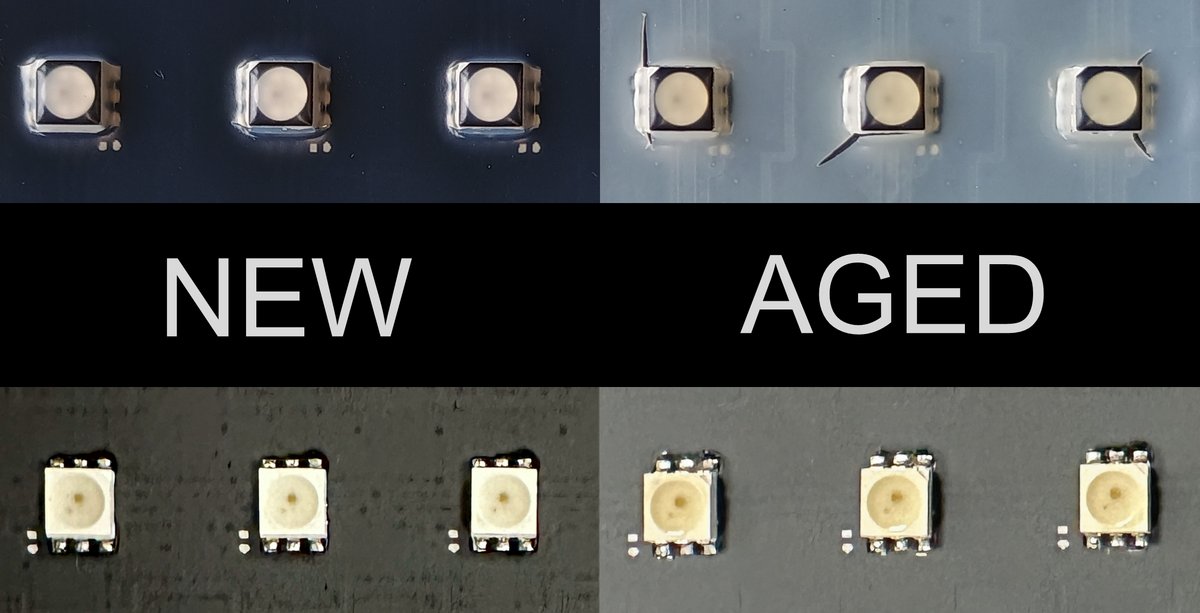
The difference in the light source for artificial ageing is particularly interesting. A comparison was made between UVB-313 irradiation (bottom) and artificial weathering with filtered xenon lamps (top). The total dose of irradiation was around 70 MJ/m² for UVB-313 irradiation and around 190 MJ/m² for artificial weathering with filtered xenon lamps.
According to [Schulz, Kurzzeitbewitterung, 2007], weathering methods that work with fluorescent lamps show an increasing yellowing of the samples due to UV irradiation. In contrast, irradiation with xenon arc lamps leads to stronger fading of the samples.
Another difference between the two methods lies in the temperature of the samples. When using fluorescent lamps, the samples remain colder. This is due to the restriction to the UV spectrum, which means that the samples are only exposed to about 6% of the irradiance generated in a xenon lamp device.
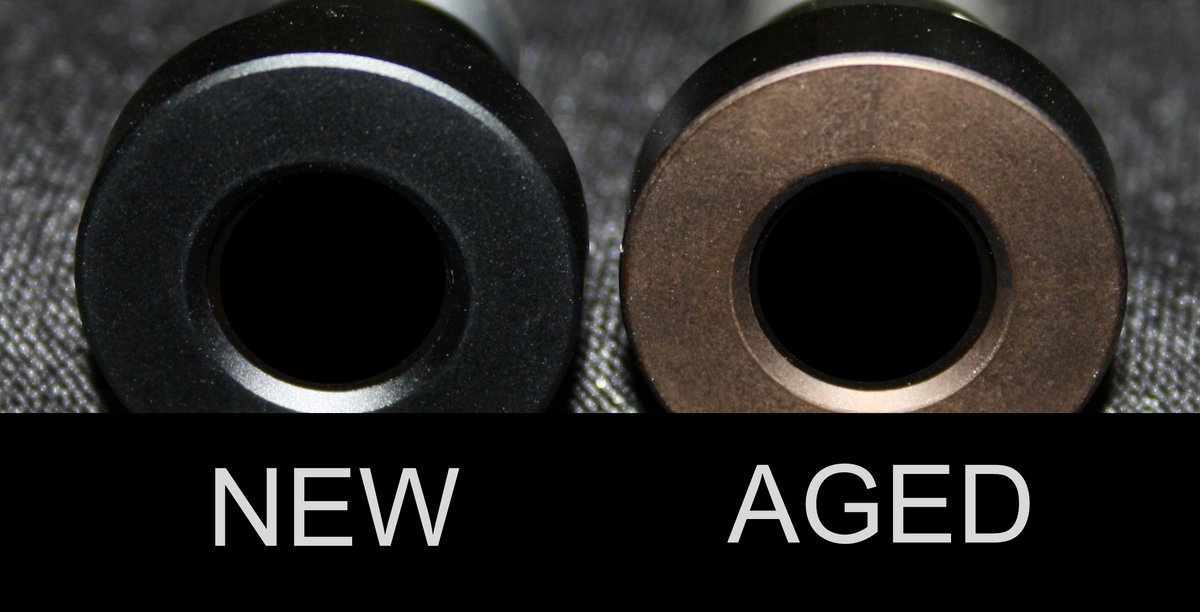
The following figure shows two anodized aluminum surfaces in direct comparison: on the left a new component, on the right an aged variant of the same type.
After ageing with UVB and UVA, the aged component shows clear photodiscoloration (discoloration). This visual change is characteristic of UV-induced ageing processes in which the color stability of the anodized layer is impaired. The causes can be photochemical decomposition of organic color pigments as well as structural changes in the oxide layer due to long-term exposure to UV radiation.
Scope and suitable test equipment
Photostability testing of medicinal products follows a regulatory question of its own and is covered on the specialist page on ICH Q1B. This page concentrates on materials, coatings and colour fastness.
Such tests are carried out in shielded chambers with defined uniformity and time- or dose-controlled irradiation; the designs and their assignment to testing tasks are set out under UV irradiation chambers. How the dose set is verified at the sample position is covered under UV meters and radiometers.
Frequently asked questions on UV ageing in the laboratory
How long does it take to simulate solar irradiation in the laboratory?
This follows from the ratio of the irradiances alone. At ground level the sun delivers about 62 W/m² of UVA and 5.6 W/m² of UVB; at roughly 1,000 hours of sunshine per year this gives an annual UVA dose of 223 MJ/m² and an annual UVB dose of 20 MJ/m². A laboratory chamber with 80 W/m² of UVA and 50 W/m² of UVB delivers the annual UVA dose in about 775 operating hours, that is some 32 days, and the annual UVB dose in about 112 hours, just under five days. A single day of sunshine therefore corresponds to about two hours of UVA or 18 minutes of UVB. The calculation is a dose balance; whether the same damage occurs is decided only by a comparative exposure against a known reference.
How fast is accelerated ageing with UVB?
A laboratory chamber with 50 W/m² of UVB reaches about nine times the natural UVB irradiance and delivers it without night and without weather. Compared with outdoor weathering at roughly 1,000 hours of sunshine per year this gives an acceleration factor of about 80; depending on the material, factors of up to 200 are observed. The factor is not a material property: chain scission, yellowing and embrittlement respond differently to an increased irradiance, and above a material-dependent limit damage patterns appear that do not occur outdoors. Time compression therefore becomes reliable only in comparison against a known reference.
How high is the irradiance of a UV test chamber compared with the sun?
In the UVA a typical test chamber with 80 W/m² is at about 1.3 times the sun, which reaches roughly 62 W/m² at ground level. In the UVB, 50 W/m² against the natural 5.6 W/m² is already nine times as much. For the UVC there is no comparison, because radiation below 280 nm does not reach the surface of the earth – a UVC test is therefore not a solar simulation but the test of a technical load case. Every stated acceleration factor thus belongs together with the spectral range it refers to.
Author: Dr. Mark Paravia
Dr.-Ing. Mark Paravia is the managing director of Opsytec Dr. Gröbel GmbH in Ettlingen and heads the accredited calibration laboratory. Following his research on pulsed xenon excimer discharges at the Institute of Lighting Technology at KIT, his current focus is on optical radiation measurement technology. He is vice-chair of the DIN Standards Committee FNL 7 “Optical Radiation,” and a member of the DVGW Project Group on UV Disinfection.