


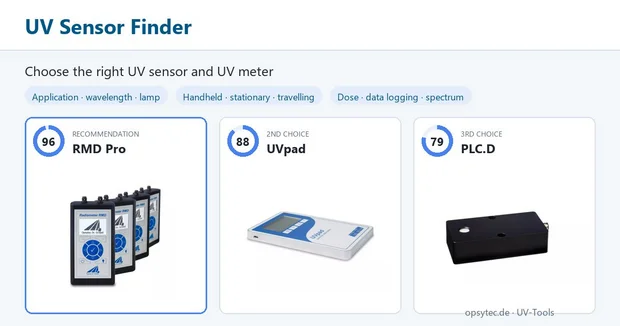
The UV Sensor Finder proposes, from 20 UV sensors, UV meters and spectroradiometers by Opsytec Dr. Gröbel, the three products that fit your measuring task. Type an application (“UV adhesive curing”), a topic (“drinking water disinfection”), a wavelength (“254 nm”) or a lamp type (“KrCl excimer”), pick the lamp or LED to be measured with its peak wavelength from the list and choose the form factor (handheld meter, benchtop or laboratory instrument, built-in device, conveyor radiometer / data logger), the measuring principle (one spectral range, several spectral ranges, full spectrum, erythema-weighted occupational safety), dose measurement and data logging. Each recommendation names three key values, the matching system partner of sensor and instrument as well as reasons and limits, and leads to the product inquiry with one click.
The finder is a pre-selection based on the published datasheets and the application fields of the Markets & Applications section; advice from Opsytec remains binding, in particular for source-specific calibration and standard requirements. All calculations run in the browser; no input is transmitted. Basics of sensor selection: Selecting UV sensors and How UV sensors work.
Data status of the product data: 2026-09-11. Sources: product pages and datasheets of Opsytec Dr. Gröbel, application fields of the Markets & Applications section, spectral database. The percentage in the ring is a match with your request, not a measured quantity; 100 % is deliberately never awarded.
Beyond the spectral range, the decisive entry is the measuring range: choose it too wide and the resolution is lost at the low end; too narrow and the sensor saturates.
What does the UV Sensor Finder do?
The finder assigns a measuring task to the products whose spectral range, measuring range, design and interfaces fit it. The basis is 20 products from the sections UV sensors, UV meters and spectrometers with their published technical data, 303 concrete applications from 29 industries, 45 measured lamp spectra from the spectral database and the product mentions on the 22 application-field pages. First the chosen criteria exclude products, then the remaining ones are rated by their match with the free text. The result is three cards with key values, system partner, reasons and limits plus a list of all matching and all excluded products with the respective reason.
Which measured quantities are considered?
Irradiance E in W/m² or mW/cm² is the power arriving per area on the measuring plane; it is the measurand of all sensors and radiometers in the finder. Radiant exposure (dose) H in J/cm² or mJ/cm² is the time integral of irradiance and decides on curing and germ reduction; it is delivered by instruments with dose function (RMD Pro, RMD Touch, curelog, tinyTracker, UVpad) or by sensors via their instrument. Spectral irradiance E(λ) in W/(m²·nm) is measured only by spectroradiometers (UVpad, UVpad E, SR900); peak wavelength, half width and any action spectrum follow from it. Illuminance in lx is captured by LUX sensors with V(λ) weighting. For safety assessments, actinically weighted quantities per DIN EN 62471:2009-03 and DIN EN 14255-1:2005 are measured with weighted sensors on the RMD.
Which UV ranges are supported?
The finder follows the classification per CIE S 017: UVC 100–280 nm, UVB 280–315 nm, UVA 315–400 nm. Opsytec sensors cover these ranges as UVC (200–280 nm), UVB (280–315 nm), UVA (315–400 nm); in addition there are UVA+ (330–455 nm) for UV LEDs up to 405 nm, UVBB (230–400 nm) as UV broadband, VISB (400–480 nm) for blue LEDs and LUX (380–780 nm, V(λ)). Vacuum UV below 200 nm is absorbed by air and needs its own system: the tinyTracker 172 nm for xenon excimer lamps. Other standards set the limits differently, e.g. ISO 20473:2007 with UVA 315–380 nm or DIN EN ISO 24444:2022-07 with UVA 320–400 nm for sunscreen testing; an overview is given under What is UV radiation?. An entered wavelength such as “254 nm” or “365 nm” is assigned to the band and compared with the range of each sensor; sensors designed for this nominal wavelength receive additional points.
UV LEDs, mercury lamps, excimer lamps: lamp type and measuring technique
The lamp type determines which measuring technique is reliable. Low-pressure mercury and amalgam lamps emit practically only at 253.7 nm: narrow-band UVC sensors (radiometer sensors, UVC-SE, PLC family) or an online sensor at the reactor. Medium-pressure lamps (also iron- or gallium-doped) emit a line and continuum spectrum from the UVC into the visible: spectroradiometers (UVpad, SR900) or source-specifically calibrated multi-channel instruments (curelog PRO, RMD with UVBB sensor). UV LEDs at 365, 385, 395 or 405 nm have narrow emission bands whose peak shifts with temperature and current: UVA+ sensors (330–455 nm) or spectroradiometers; UVC LEDs (255–280 nm) and UVB LEDs (280–295 nm) are calibrated to their peak wavelength. Excimer lamps: KrCl at 222 nm with a specific sensor plus spectroradiometer to check side emissions, Xe₂ at 172 nm with the tinyTracker 172 nm. Xenon lamps and solar simulators require a spectroradiometer plus a weighted control radiometer. The corresponding spectra can be compared in the spectral database. In the finder the lamp is chosen from a list of 13 types, for LEDs with their peak wavelength in nm; the finder derives spectral range and preferred measuring technique from it.
Handheld meter, benchtop or laboratory instrument, built-in device or conveyor radiometer
Handheld meters (RMD Pro, RM-12) with interchangeable sensors (radiometer sensors, UV curing sensors XT, UV probes, DVGW reference radiometer) are intended for check measurements, acceptance tests and safety checks at changing locations. Built-in devices: process sensors (PLC sensors, PLC.D, PLC.net, inline sensors FLT, UVC-SE, UVx-SE) sit permanently in the machine and deliver a continuous signal to the controller; they detect lamp ageing and contamination during operation. This includes the panel meter RM-32, which displays the signal of a PLC sensor in the control cabinet and switches two alarm relays. Benchtop and laboratory instruments: the RMD Touch is the mains-powered laboratory radiometer with two sensor inputs for the measuring station, the spectroradiometer SR900 the laboratory instrument for spectral measurements from 200 to 900 nm. Travelling devices (curelog, curelog Base, tinyTracker, tinyTracker 172 nm, UVpad) pass through conveyor systems instead of the workpiece and record peak, dose and time profile – with heights of 10 to 14.4 mm also in narrow gaps.
Analogue and digital interfaces
For controllers the PLC sensors deliver 4–20 mA, 0–10 V or 0–2 V; the current loop is insensitive to line resistance and interference and is connected directly to an analogue input. RS-485 and RS-232 transmit, with the PLC.D, calibration status, serial number and temperature in addition to the reading as an ASCII telegram with CRC-16; up to eight sensors share one line. Ethernet with PoE, Modbus TCP and HTTP/JSON are offered by PLC.net for networks and remote monitoring, with CSV export via the built-in web server. USB is the interface of handheld instruments and dosimeters to the PC (RMD Pro, curelog, tinyTracker, UVpad, SR900). The panel-mount RM-32 adds alarm relays with threshold for systems without PLC. In the finder the interface is chosen under “More criteria”; sensors that provide the signal via an instrument stay in the list with a note.
Selection by application
The application fields of the Markets & Applications section name, per field, the measured quantities and the measuring equipment used there; the finder uses this assignment as a rating basis and links the matching pages. The table shows the fields with the measuring equipment stored in the finder.
| Application field | typical measuring equipment in the finder |
|---|---|
| Additive Manufacturing & 3D Printing | RMD Pro / RMD, curelog, UVpad |
| Occupational Safety & Photobiological Safety | Radiometer sensors, UV curing sensors XT, RMD Pro / RMD, RMD Touch, RM-12 |
| Automation & Process Integration | Inline sensors FLT, PLC.D digital UV sensors, PLC sensors (analogue), RM-32, PLC.net Ethernet UV sensors |
| Automotive & Vehicle Components | Inline sensors FLT, RMD Pro / RMD, curelog, UVpad E, UVpad |
| Electronics & Semiconductor Industry | UV curing sensors XT, Inline sensors FLT, UV probes, RMD Pro / RMD, UVpad E |
| Fluorescent Penetrant Testing & Industrial Inspection | Radiometer sensors, RMD Pro / RMD, RM-12 |
| Laser Processes & Transmission Testing | UV curing sensors XT, RMD Pro / RMD, SR900 |
| Lighting Technology, LED & Display Technology | RMD Touch, SR900 |
| Aerospace | RMD Pro / RMD, SR900 |
| Medicine & Phototherapy | Radiometer sensors, RMD Pro / RMD, RMD Touch, SR900 |
| Optics & Precision Components | Inline sensors FLT, UV probes, RMD Pro / RMD, UVpad, tinyTracker |
| Plants, Agriculture & Food Technology | Radiometer sensors, UV curing sensors XT, RMD Pro / RMD, UVpad |
| Pharma & Photostability | RMD Pro / RMD, RMD Touch, UVpad E, UVpad, SR900 |
| Photobiology & Biotechnology | Radiometer sensors, RMD Pro / RMD, RMD Touch, UVpad E, SR900 |
| Photocatalysis | RMD Pro / RMD, SR900 |
| Photocatalytic Hydrogen Production | RMD Pro / RMD, SR900 |
| Photovoltaics & Solar Simulation | RMD Pro / RMD, RMD Touch, SR900 |
| UV Disinfection | Radiometer sensors, PLC.D digital UV sensors, PLC sensors (analogue), DVGW/ÖNORM reference radiometer, UVC-SE |
| UV Curing & Photopolymerization | Radiometer sensors, UV curing sensors XT, PLC sensors (analogue), UV probes, UVx-SE |
| UV Bonding, Potting and Encapsulation | UV curing sensors XT, RMD Pro / RMD, curelog, curelog Base, UVpad |
| Packaging & Filling Technology | Inline sensors FLT, PLC.D digital UV sensors, PLC sensors (analogue), DVGW/ÖNORM reference radiometer, UVC-SE |
| Water & Environmental Technology | PLC.D digital UV sensors, DVGW/ÖNORM reference radiometer, UVC-SE, UVx-SE, RMD Pro / RMD |
How the recommendation is formed
The finder works in two stages. In the first, the chips exclude products: form factor, measuring principle (with “occupational safety” only instruments with an erythema-weighted sensor or spectroradiometers remain), dose, data logging and – if set – irradiance, interface, temperature and water contact. Sensors without their own dose function remain with the note “via the instrument”. In the second stage the remaining products score points: up to 25 for a matching primary application, 20 for the covered spectral range or wavelength (with a bonus for the nominal wavelength), 10 for the measuring technique preferred for the lamp type, 10 for standard reference, 8 for the mention on the application page and up to 60 from technical rules, such as “fast time profile on the conveyor” for the curelog or “standard-compliant drinking water reference measurement” for the DVGW reference radiometer. The percentage relates the points achieved to the maximum possible for the specific request; it lies between 35 and 99 %. If no standard product meets all criteria, the finder proposes a custom sensor and shows which criterion excludes the most products.
Relevant measuring principles
Broadband radiometers weight the radiation with a filter stack in front of a photodiode and deliver a single number according to a fixed sensitivity function; they are fast, robust and, with dynamic ranges up to 10⁷:1, also suitable for stray radiation, but only as accurate as the spectrum of the measured source matches that of the calibration source. This spectral mismatch per CIE 220:2016 is why the finder prefers UVA+ sensors and source-specific calibration for LED applications; background under Spectral mismatch of UV sensors. Spectroradiometers split the radiation into wavelengths at a grating; they are free of mismatch but struggle in the UVC with stray light (10⁻³ to 10⁻⁵ for array instruments) and limited dynamic range. Erythema-weighted sensors (Ery(λ), 200–400 nm) weight the radiation with the action function for skin reddening; the RMD Pro and the RMD Touch use them to measure skin-effective irradiance and dose for occupational safety assessments per DIN EN 14255-1:2005 and for UV index readings; spectroradiometers calculate the same weighting from the measured spectrum. In the finder the measuring principle “occupational safety (erythema-weighted)” selects exactly these instruments. The cosine correction of the diffuser determines how radiation from oblique angles is weighted (figure f2), and traceability to PTB irradiance standards in the calibration laboratory per DIN EN ISO/IEC 17025:2018 makes readings of different instruments comparable. In detail: How UV sensors work.
Sources and standards
Spectral ranges: CIE S 017:2020 (ILV), DIN 5031-7:1984 (withdrawn, still widespread), ISO 21348:2007, ISO 20473:2007. Radiometers and calibration: CIE 220:2016 (characterisation and calibration of UV radiometers), CIE 250:2022 (spectroradiometry), DIN EN ISO/IEC 17025:2018 (accredited calibration laboratory). Drinking water: DIN 19294-1:2020-08 and DIN 19294-3:2020-08 (low pressure), DIN 19294-2:2026-04 and DIN 19294-4:2026-04 (medium pressure), DVGW W 294-1:2023-12, ÖNORM M 5873-1:2020-01. Safety: DIN EN 62471:2009-03, IEC 62471-6:2022, DIN EN 14255-1:2005, ISO 15858:2016. Product data: datasheets and product pages of Opsytec Dr. Gröbel (status 2026-09-11), spectra of the spectral database. Calibrations are performed by Opsytec's calibration laboratory.
Frequently asked questions about the UV Sensor Finder
Applications (“curing of solder resist”), industries (“food and beverage industry”), measuring tasks, topics of the Markets & Applications section, wavelengths (“254 nm”, “253.7 nm”, “365 nm”), lamp types (“amalgam”, “KrCl”, “UVA LED 395 nm”), standards (“DVGW W 294”, “EN 62471”) and product names. From two characters onwards up to eight suggestions appear; typing errors with one transposed letter are recognised.
No. Without chips the finder shows the most versatile instruments, sorted by the free text. Every chip set excludes products; the counter “n of 20 products” shows immediately how many remain. If no product remains, the finder names the criterion whose relaxation brings back the most products.
Sensors such as the radiometer sensors or the DVGW reference radiometer deliver the measuring signal; display, dose calculation and storage are done by an instrument. “System partners” states which instrument is required or recommended, for example RMD Pro or RM-32. With the “dose” and “data logging” chips such sensors stay in the list with the note “via the instrument”.
It is the share of the points achieved in the maximum possible for your request and lies between 35 and 99 %. It compares the products with each other for exactly this input; it is neither a measurement uncertainty nor a quality judgement. The finder deliberately never awards 100 % because advice on calibration and environment completes the selection.
Yes. “Copy selection as link” puts the inputs, chips and further criteria into the address of this page. Anyone opening the link sees the same three recommendations. No data are transmitted to Opsytec; the evaluation runs entirely in the browser.
Further answers
The technical questions behind the finder are answered on the section and knowledge pages: Which UV sensor is suitable for 254 nm? · How do you measure the UV dose of an LED? · Broadband radiometer or spectroradiometer? · 4–20 mA, 0–10 V or RS-485 for UV sensors? · Which irradiance does UV adhesive need? · How do you measure UVC in a water disinfection system?.
Author: Dr. Mark Paravia
Dr.-Ing. Mark Paravia is the managing director of Opsytec Dr. Gröbel GmbH in Ettlingen and heads the accredited calibration laboratory. Following his research on pulsed xenon excimer discharges at the Institute of Lighting Technology at KIT, his current focus is on optical radiation measurement technology. He is vice-chair of the DIN Standards Committee FNL 7 “Optical Radiation,” and a member of the DVGW Project Group on UV Disinfection.
Which UV sensor suits my measuring task?
The question of which UV sensor is the right one comes down to four entries: spectral range, measuring range, interface and mounting position. The finder above asks for exactly those and proposes the matching models.
Anyone trying to select a UV sensor without knowing the measuring task usually chooses too broadly: a sensor covering UVC to visible reports changes that mean nothing for the process.