

Markets & applications for UV radiation and optical measurement
In research and production, optical radiation is three things at once: a tool, a process variable and a test variable. It drives chemical reactions, inactivates micro-organisms, cross-links polymers, ages materials under controlled conditions and stimulates biological systems. In nearly every case the engineering question is the same: which spectral radiation actually reaches the sample, how evenly is it distributed, and for how long?
Market development of UV technology
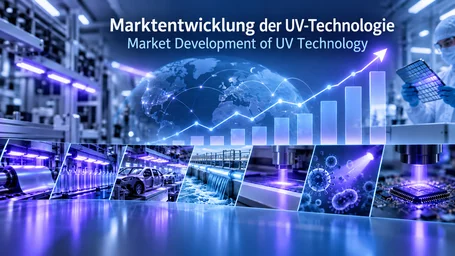
Market sizes, growth rates and sources for the application fields of UV technology – from curing and disinfection through photocatalysis to additive manufacturing. Because studies define these fields differently, every figure names its source and…
Life sciences
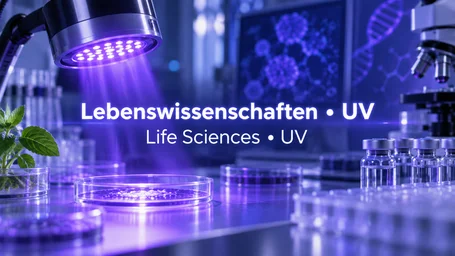
Here radiation meets living systems, whether intended or damaging – from UV disinfection through photobiology and plant science to photostability and phototherapy.

Industry & manufacturing
In industry and manufacturing, UV radiation is a production step with a cycle time and a release criterion – from UV curing and bonding through electronics, packaging and optics to vehicle manufacturing.

Aerospace
Measurand: UV-A irradiance, UVC dose, spectral irradiance in testing
In aerospace UV serves fluorescent crack detection, UVC/ozone cleaning and standardised ageing tests. The article places the three tasks and their measurement requirements.
Lighting Technology, LED & Display Technology
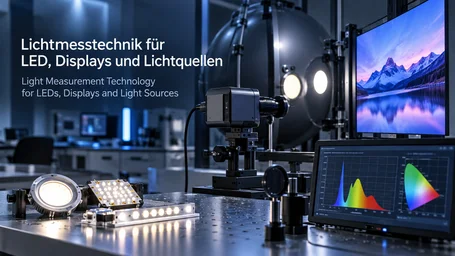
Measurand: luminance, illuminance, spectral radiance
Light measurement for LED and displays evaluates how much radiation a source emits and how the eye or an image sensor perceives it. The article explains the difference between photometric and radiometric evaluation of the same radiation.
How these markets are developing technologically
UV technology is rarely a market of its own. More often it is an enabling technology inside larger production, research and testing systems. The individual UV segments – curing, disinfection, measurement – are two to three orders of magnitude smaller.
Technologically the emphasis is shifting away from picking a lamp towards integrated optical processes. UV LEDs offer narrow spectra, fast switching and locally confined energy input. Discharge lamps remain relevant wherever high power, broad spectra or established process windows are required. Alongside them, spectral measurement, inline sensors, digital interfaces and automated dose control keep gaining ground. The primary engineering figure is no longer the electrical rating of the source but the spectral radiation arriving at the point of process.
Market sizes, growth rates and sources for this application field are summarised on the page Market development of UV technology.
How publications connect to the applications
How optical measurement and UV irradiation are used in real research questions is best shown by the work of users. Each application page carries a small annotated selection; the complete lists, ordered by product and by topic, are collected under publications by customers and publications by topic.
A single study often belongs to more than one field, and that is intentional. Photocatalytic removal of a pharmaceutical from water sits with photocatalysis on the mechanism side and with water and environmental technology on the application side. Photocatalysis names a mechanism, water technology names an application – the two do not exclude each other.
Author: Dr. Mark Paravia
Dr.-Ing. Mark Paravia is the managing director of Opsytec Dr. Gröbel GmbH in Ettlingen and heads the accredited calibration laboratory. Following his research on pulsed xenon excimer discharges at the Institute of Lighting Technology at KIT, his current focus is on optical radiation measurement technology. He is vice-chair of the DIN Standards Committee FNL 7 “Optical Radiation,” and a member of the DVGW Project Group on UV Disinfection.