


UV knowledge: from the measurand to the rulebook
This section explains the fundamentals of UV technology: what UV radiation is, which quantities describe it, how a sensor turns them into a trustworthy reading, which source delivers which spectrum, and which rules apply to UV systems.
The entry point covers spectral ranges and the radiometric and photometric quantities. Building on these are measuring UV with the design, selection and calibration of the sensors, UV sources & lifetime with spectrum, ageing and operation, and safety, standards & regulation with exposure limits, substance law and the Machinery Regulation. Recurring individual questions are answered in the UV FAQs.
How UV is used in production and testing is covered under UV applications.
Once the measurand is settled, the instrument question follows: spectrometer, spectrophotometer or spectroradiometer?
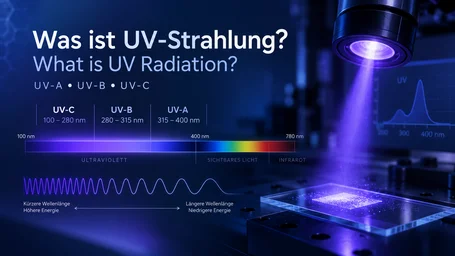
What is UV radiation?
Key concept: spectral ranges 100–400 nm, irradiance, dose
UV radiation is electromagnetic radiation below visible light, divided by CIE into UV-A, UV-B and UV-C. The article explains the spectral ranges, how UV differs from light and the quantities used to describe it.
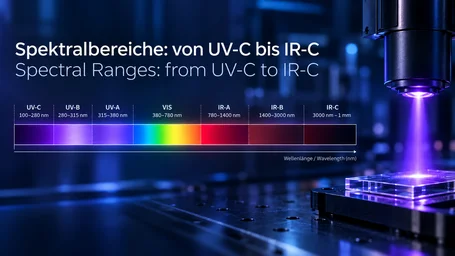
Spectral ranges and standards
Key concept: range limits per DIN/ISO 20473, CIE, WHO and US practice
The boundaries between UV-C, UV-B, UV-A, VIS and IR are set by convention, not by physics – and they differ between standards. The article puts DIN/ISO 20473 next to CIE, WHO and US practice and shows why a UV-B figure needs its division.
Glossary of Optical Quantities
75 optical quantities with symbol, unit and definition — each with the calculator that converts it.
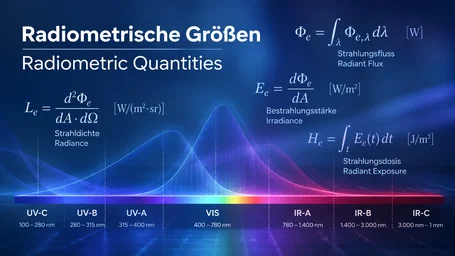
Radiometric quantities
Measurand: radiant flux Φ in W, irradiance E in W/m²
Radiometric quantities describe radiation in energetic terms, independently of the sensitivity of the eye. The article explains radiant flux, irradiance, radiant intensity and radiance with their units and conversions.
Photometric quantities
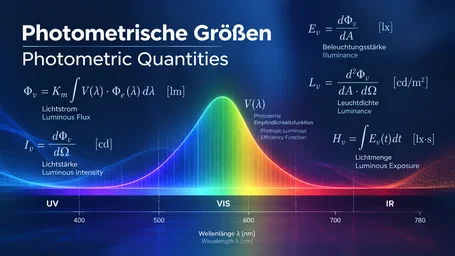
Measurand: luminous flux Φ in lm, illuminance E in lx
Photometric quantities describe light as the eye perceives it – weighted with the luminous efficiency function V(λ). The article explains luminous flux, illuminance, luminous intensity and luminance and sets them apart from radiometric ones.
Colorimetric quantities
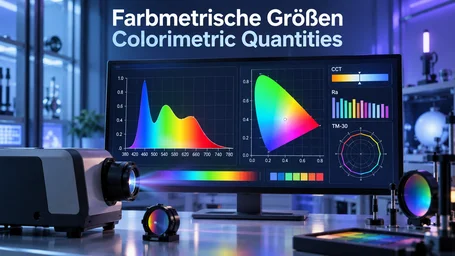
Chromaticity, colour temperature and colour rendering: how X, Y, Z, u′v′, CCT, Ra and TM-30 come out of a spectrum.
Measuring UV
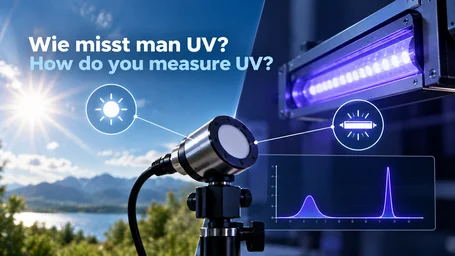
How to measure UV radiation correctly: sensor design and selection, spectral and measuring range, spectral mismatch, calibration interval and capability analysis.
UV Sources & Lifetime
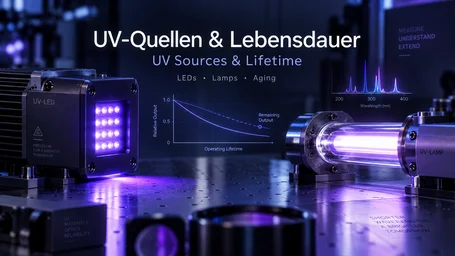
Which source delivers which spectrum, how its output declines over operating time and how irradiance is calculated from a measured spectrum.
Safety, Standards & Regulation
Workplace exposure limits, product safety and the rules that apply to UV systems.
UV FAQs
Short answers to questions that keep coming up in practice – from lamp cooling and calibration intervals to what to do when a UV lamp breaks.