



Laboratory UV radiometer RMD Touch
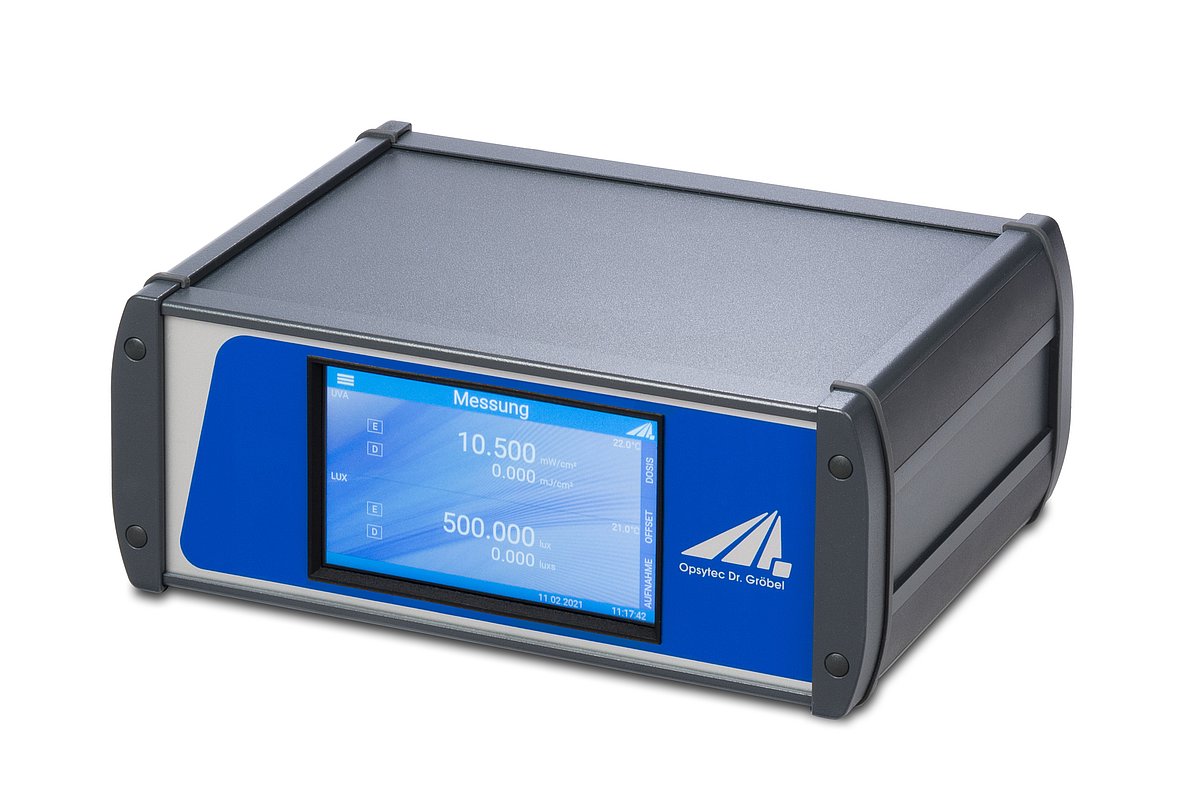
The RMD Touch is a laboratory UV radiometer for the simultaneous measurement of UV irradiance, UV dose and illuminance with up to two sensors. Each channel uses a 24-bit ADC and multi-stage amplification; typical measuring ranges are 0–10 W/cm², a dose up to 100 MJ/cm² and 0–500,000 lx. It is operated through a 5-inch touch display, and measurement series are written to a USB stick.
This incorporates the latest technologies such as capacitive touch displays, precision ADCs, data storage, remote update capability and much more. This makes the RMD Touch one of the most powerful multichannel UV radiometers on the market with superior features such as the highest accuracy, reliability and modular extensions.
The RMD Touch allows simultaneous measurement with multiple sensors and recording of irradiance and dose.
Each sensor channel contains a high-precision 24-bit ADC and a multi-stage amplification to achieve a wide dynamic range of up to 7 orders of magnitude. The measurement of all channels is performed simultaneously. Calibration and sensor information are permanently stored in the sensor and are automatically transferred to the RMD Touch. This makes the RMD Touch the perfect measuring instrument for all laboratory applications.
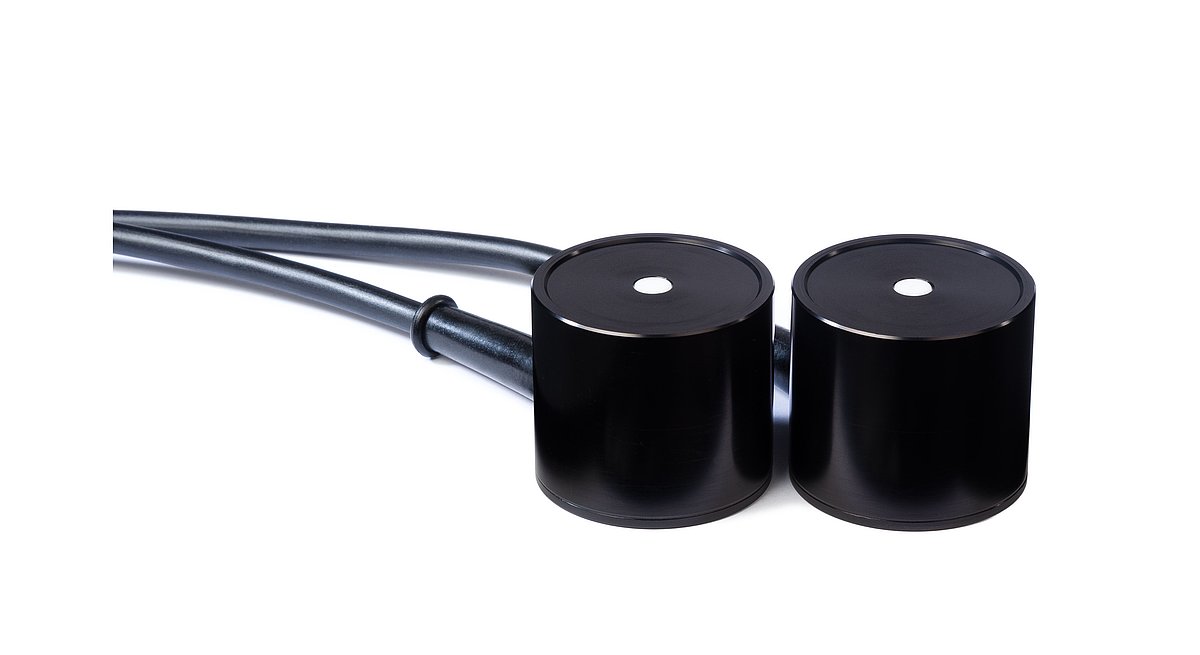
The RMD Touch also has a wide range of sensors. The radiometric sensors are long-term stable, robust and suitable for many applications.
The sensors can be connected to the laboratory UV radiometer RMD Touch and to the mobile UV radiometers RMD & RMD Pro.
Applications:
- UV radiometry
- low-light detection
- LED measurements
- germicidal UVC radiation and disinfection (UVGI)
- optical hazard analysis
- lifetime measurements
- plant photobiology
- phototherapy
- UV curing
- and many more
Optical measuring systems usually consist of the radiometer, a sensor with filter and cosine-corrected optics, and a calibration that allows a direct reading in the corresponding units. The sensor memory contains all sensor identifications and the calibration history. The sensor also contains a temperature sensor.
The RMD Touch is operated by a high-resolution capacitive touchscreen. A powerful Cortex ARM processor ensures durability and remote update capability. This means that new functions can be installed directly on site.
The RMD Touch and the PC software are Windows 10/11 compatible. The fully digital interface communicates with the PC via USB.
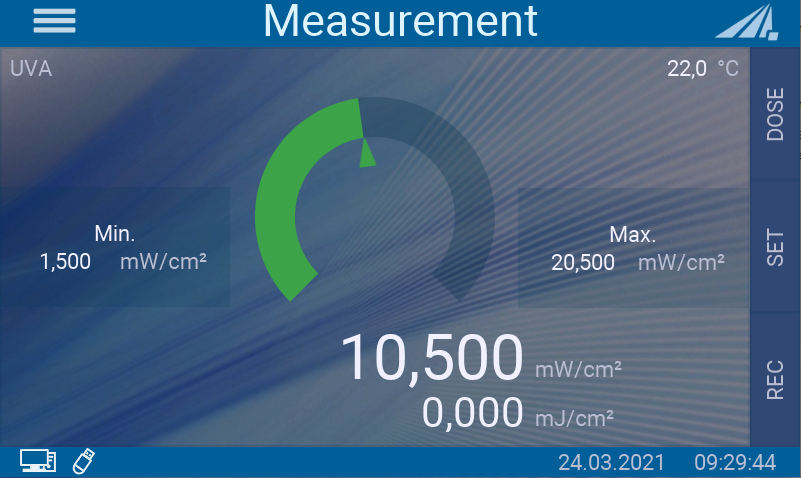
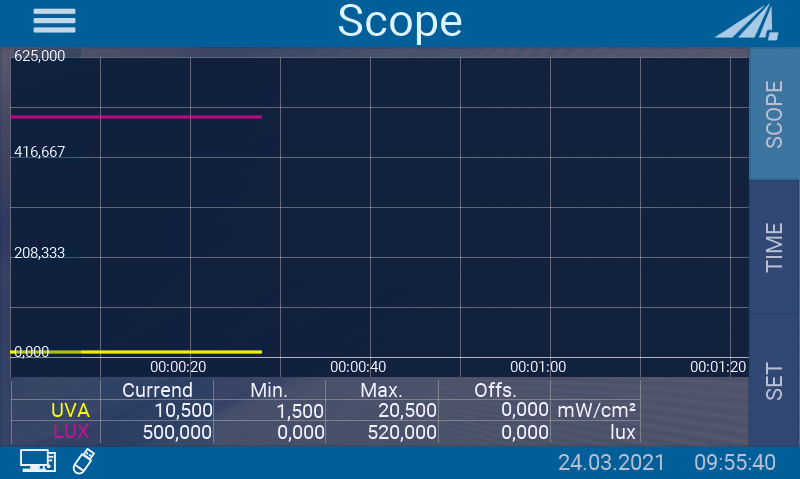
The evaluations and units, such as W/m², µW/cm², J/m², lux and klx, are adjustable. Numerical and graphical single and multi-channel measurements, oscillograms and data logger measurements such as min/max and other measurement modes are clearly displayed. The parameterization is done intuitively directly on the RMD Touch and is password protected.
The RMD Touch can be easily used in laboratory, pharmaceutical and industrial environments. With the associated software, the RMD Touch can be controlled from the PC. The meter records measurement data directly to a USB stick for up to 1000 days at a time.
The resolutions given in the technical data are display resolutions. The actual detection limit is determined by the sensor's noise equivalent power and depends on the selected measuring range; for high-sensitivity sensors it is typically around 25 µW/m².


| Product type | UV meter: Laboratory UV radiometer with touch display, oscilloscope function and long-term recording |
| Spectral range | depending on the interchangeable sensor: UVC 200–280 nm, UVB 280–315 nm, UVA 315–400 nm, UVA+ 330–455 nm, UVBB 230–400 nm, VISB 400–480 nm, LUX 380–780 nm, V(λ) |
| Measuring range | 0–10 W/cm²; 0–1 W/cm²; Dose measuring range: 0–100 MJ/cm² |
| Calibration uncertainty (typ.) | 4.5–6.0 % (k = 2) |
| Output / interface | Sensor connections: 2; PC interface: USB 2.0 |
| Time resolution | Data recording rate: adjustable: 1 s–1 h |
| Calibration | factory calibration, ISO 17025 calibration optional (DIN EN ISO/IEC 17025:2018) |
| Standards / guidelines | DIN EN 62471:2009-03 |
| Suitable for | Photobiology and biotechnology; Lighting, LED and display; Photovoltaics and solar simulation; Pharma and photostability |
| Not suitable for | spectrally resolved measurement (peak wavelength, bandwidth); sensor temperatures above 60 °C; use under water or under pressure; VUV measurement at 172 nm |
| Datasheet revision | Rev. 2026-09-08 (E_RMD_Touch.pdf) |
The calibration uncertainty stated above is the expanded uncertainty of the calibration (k = 2, confidence level approx. 95 %) and applies to the calibration source and the calibration conditions. In use the measurement uncertainty is larger: spectral mismatch at the source actually used, the sensor temperature, ageing since calibration as well as distance and alignment to the source are added to it. How these combine into an uncertainty budget is explained under Measurement uncertainty in UV measurement.
Technical data RMD Touch
| Sensor spec | 24 bit, full digital |
| Sensor connections | 2 |
| Display | capacitive touch display |
| 5" WVGA | |
| Display output | Irradiance + dose |
| Oscilloscope view | |
| Min/max irradiance | |
| Relative view | |
| Dimensions | 185 × 251 × 100 mm |
| Mains connection | 100–240 V, 50/60 Hz |
| Power (el.) | 20 W |
| Operating temperature | 5 to 60 °C |
| Storage temperature | -10 to 60 °C |
| Humidity | < 80%, non-condensing |
| Data recording rate | adjustable: 1 s - 1 h |
| Recording duration | > 24000 h |
| PC interface | USB 2.0 |
| Memory interface | 1 x USB stick (up to 32 GB) |
| UVC | 200–280 nm |
| UVB | 280–315 nm |
| UVA | 315–400 nm |
| UVA+ | 330–455 nm |
| UVBB (broadband) | 230–400 nm |
| VISB | 400–480 nm |
| LUX | 380–780 nm, V(λ) |
| NDT (365 nm + LUX) | 315–400 nm, 380–780 nm |
| Erythema + UVA | 200–400 nm, Ery(λ) |
| Spectral ranges | UVA, UVA+, UVBB |
| Measuring range, typ. | 0–10 W/cm² |
| Resolution | 1 µW/cm² |
| Spectral ranges | UVB, UVC, VISB |
| Measuring range, typ. | 0–1 W/cm² |
| Resolution | 0.1 µW/cm² |
| Recommended for proof of occupational safety | UVC, erythema + UVA with the high-sensitivity measuring range 0–10 mW/cm², resolution 0.001 µW/cm² |
| Dose measuring range | 0–100 MJ/cm² |
| Illuminance, measuring range | 0–500,000 lx |
| Resolution | 0.001 lux |
| Dynamic range | 1 : 10⁷ |
| AD conversion | 24 bit |
| Temperature sensor | integrated |
| Dimensions | Ø 40 mm, h 35 mm |
| Optical surface | Ø 7 mm |
| Weight | 160 g |
| Connecting cable | 1.8 m |
| Operating temperature | 0 to 60 °C |
| Storage temperature | -10 to 60 °C |
| Humidity | below 80 %, non-condensing |
| Calibration uncertainty (typ.) | 4.5–6.0 % (k = 2) |
| Linearity error | < 1 % |
| Ageing per year | < 3 % |


Frequently asked questions: RMD Touch
The RMD Touch is a mains-powered bench-top instrument for measuring stations where measurements run permanently: lamp testing in the laboratory, ageing tests over days or phototherapy devices in quality assurance. It records without battery changes, shows measurement series on the touch display and has an oscilloscope function for flickering or pulsed sources. Handheld instruments such as the RMD Pro are intended for mobile checks.
The RMD Touch has two sensor connections and measures both digital sensors simultaneously, for example UVA and UVB on a weathering lamp or irradiance at two positions of a chamber. The relative measurement sets one channel as reference and shows the deviation of the other in per cent, which speeds up homogeneity checks.
Yes. With the 24-bit digital sensors and a resolution of 0.001 µW/cm² the instrument captures stray radiation and leakage radiation of enclosed UV devices, as measured for the safety assessment per DIN EN 62471:2009-03. For such measurements the sensor should be operated with dark offset and the ambient lighting taken into account; the LUX sensor with V(λ) weighting helps to record the visible component separately.
The calibration certificate states the expanded calibration uncertainty with k = 2; for the RMD Touch it is typically 4.5–6.0 %. In use the measurement uncertainty is larger, because spectral mismatch at the source actually used, sensor temperature, ageing and measuring geometry are added to it. How these combine into an uncertainty budget is explained under Measurement uncertainty in UV measurement.
Application notes
UV low-pressure lamps and UVC amalgam lamps usually reach irradiances below 200 mW/cm². UV spot light sources such as the HP-120i, by contrast, lie in the range of a few W/cm².
UV LEDs emit at 365, 385, 395 or 405 nm, for example. The UVA+ sensor was developed for measuring them - it covers 330 to 455 nm and thus captures the common LED wavelengths with one sensitivity curve.
For medical applications, process reliability and calibration come first. Our sensors are stable over the long term and can be recalibrated; repair and spare-parts service are available for many years. Applications with different UV emitters can be measured reproducibly with our radiometer sensors. Where all spectral ranges are to be captured at once, the UVpad is the right choice.
For risk assessments and considerations of occupational safety, DIN EN 14255-1:2005 governs the measurement and assessment of personal exposure to artificial optical radiation. The standard itself contains no limit values - these are given in directive 2006/25/EC on artificial optical radiation, which has been transposed into national law. For UVA radiation the limit there is 104 J/m².
For such measurements the sensors have to be sensitive enough. Choose a sensor - UVA or UVB, for example - with the measuring range 0 to 2 mW/cm².
For process monitoring, the spectral range of the sensor follows the UV application and therefore usually the photoinitiator. The measuring ranges stated are our recommendations; they can be adapted to customer requirements. Please ask us about this or state the required measuring range with your order.
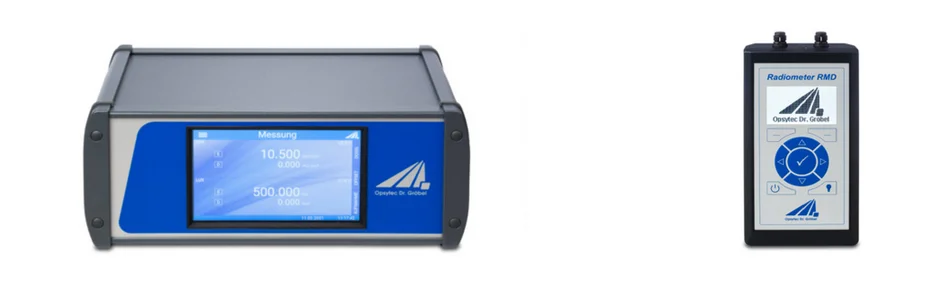
RMD Touch and RMD Pro compared
| Function | RMD Touch | RMD Pro |
|---|---|---|
| Number of channels | 2 | 2 |
| Irradiance, dose and temperature measurement | yes | yes |
| Oscilloscope view | yes | – |
| Relative view | yes | – |
| Screenshots can be saved to a USB stick | yes | – |
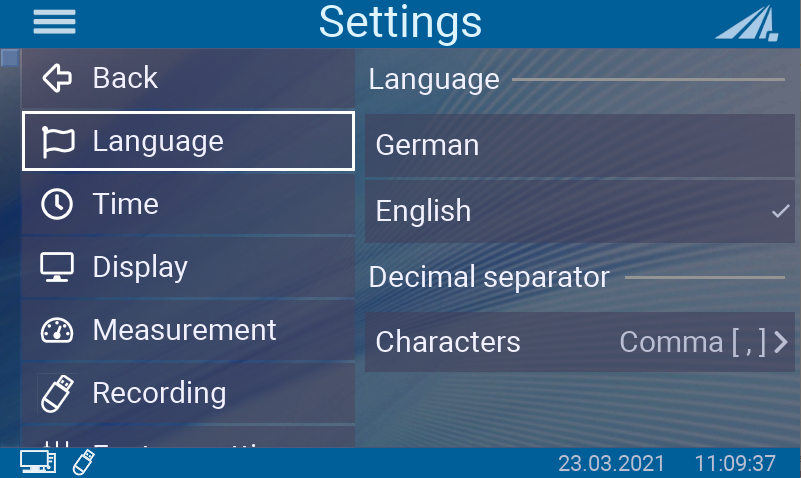
| Language switching German / English | yes | yes |
| Memory | USB stick up to 32 GB | SD card 8 GB |
| Recording of measurements | yes | yes |
| Real-time clock | yes | yes |
| Remote control from the PC | yes | yes |
| Easy firmware upgrades | yes | yes |
Both devices work with the same sensors and measure irradiance, dose and temperature. The difference lies in the display and in the memory.
Two sensors at once
The RMD Touch runs two sensors at the same time – one per 24-bit channel, both readable side by side on the 5-inch touch display. That is the difference from the handheld instrument: two spectral ranges or two measuring points in one pass instead of one after the other.
Which series sits on the channel is open. The same calibrated measuring heads as on the RMD Pro can be connected; for a low overall height or high temperatures the further sensor series are available. The overview of the designs is given further down with the order numbers.
Which quantity requires which instrument for LEDs – radiometer, spectroradiometer or integrating sphere – is compared on the page LED meters for spectrum and irradiance.
Order numbers, scope of delivery, accessories and versions
| Version | Order number |
|---|---|
| RMD Touch | 814405 |
Scope of delivery: the radiometer, the power supply unit, a USB cable, the manual and one sensor to suit the application. Calibration is traceable to PTB standards, with a factory calibration certificate and optionally with an ISO 17025 calibration certificate.
| Spectral range | Order number |
|---|---|
| UVC | 814410 |
| UVB | 814420 |
| UVA | 814432 |
| UVA+ | 814447 |
| UVBB (broadband) | 814412 |
| VISB | 814443 |
| LUX | 814461 |
| NDT (365 nm + LUX) | 814491 |
| Erythema + UVA | 814470 |
The sensors of the RMD Touch are the same as those of the RMD and RMD Pro. They are calibrated with traceability to the PTB and can be recalibrated.
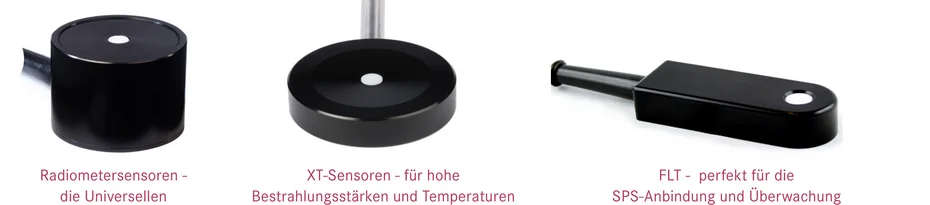
| Design | Suitable for |
|---|---|
| Radiometer sensors | the universal sensor for most applications |
| XT sensors | high irradiance and high temperatures |
| FLT | PLC connection and continuous monitoring |
All designs can be connected to the RMD Touch. For some applications - where only a low overall height is available or at high temperatures - we recommend one of the other sensor series.
| Service | Order number |
|---|---|
| Factory calibration | 710000 |
| ISO 17025 calibration | 17025 |
Accredited ISO 17025 calibration and testing in our own calibration laboratory. On delivery the device is already factory-calibrated.