


UV LED curing chambers: 110 to 800 mW/cm²
Four sizes, five wavelengths, three power levels – the BSL series covers everything from curing samples in the laboratory to batch curing of large parts. Compared with the fluorescent-lamp chambers of the BS series the irradiance is 14 to 80 times higher; minutes become seconds.
The choice is made in two steps: first the interior the part needs, then the power level. The second decision carries more weight than it looks – between ECO and HO there is a factor of two in exposure time.
All four are UV LED curing chambers in the narrow sense: they irradiate an enclosed sample area at a known irradiance and end the run at a dose reached.
BS-02
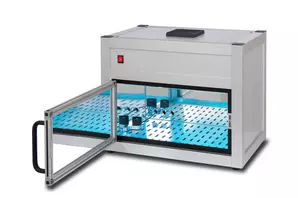
Compact benchtop chamber with eight lamps for UVA, UVB or UVC, time- or dose-controlled via the UV-MAT.
BS-03
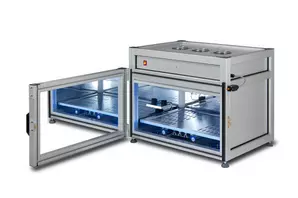
Mid-size irradiation chamber for several samples per batch, lamps for UVA, UVB or UVC, dose-controlled.
BS-04
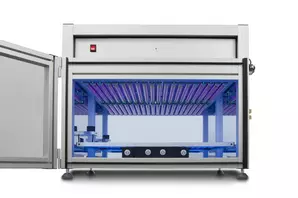
Large irradiation chamber for samples that do not fit in the hand, with lamps for UVA, UVB or UVC.
BS-05
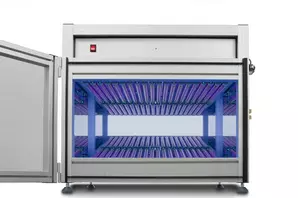
Large UV test chamber for double-sided irradiation through a quartz glass plate, footprint 86 × 65 cm.
UV-MAT
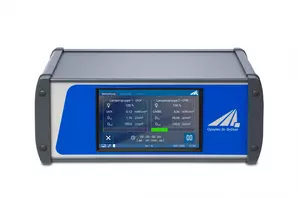
Dose and irradiation controller for UV irradiation chambers and UV systems with calibrated radiometer sensors.
BSL-01i
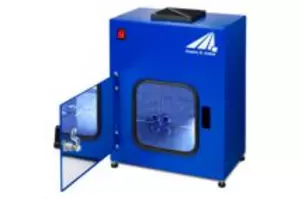
Inert UV-LED chamber with protective-gas purging, 365 to 450 nm, for curing without oxygen inhibition.


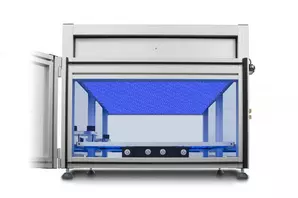
BS-02CT IEC 60335-1

Irradiation chamber BS-02CT with temperature control for tests according to IEC 60335-1.
BS-02+ ICH Q1B
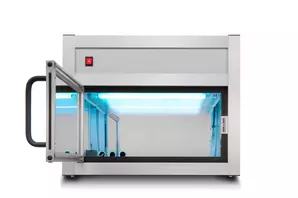
UV irradiation chamber BS-02+ for photostability testing according to ICH Q1B and VICH GL5.
BSH-02
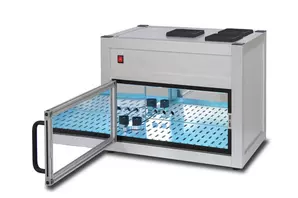
UVC irradiation chamber with amalgam lamps for disinfection trials and surface treatment at high irradiance.

BSH-03 CBD
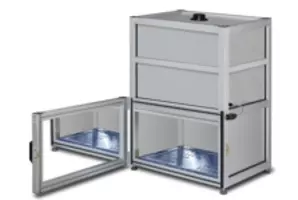
Collimated beam device with UVC amalgam lamps for dose-response curves of microorganisms in the laboratory.
BSM-03 CBD
Irradiation chamber for liquid samples based on the collimated-beam principle with a medium-pressure mercury lamp.
BS-OX
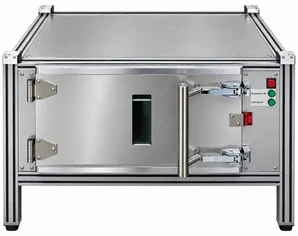
Ozone-UVC irradiation chamber with 185 and 254 nm for surface activation, cleaning and contact-angle improvement.
The four models compared
| Model | Interior (W × D × H) | max. irradiance | Levels | Power input | Weight | What for |
|---|---|---|---|---|---|---|
| BSL-01i | 20 × 20 × 20 cm | 800 mW/cm² (450 nm) | EcO+ · EcO · HO | 200–650 W | ~ 20 kg | Inert operation with nitrogen, heating and cooling plate, benchtop unit |
| BSL-02 | 46 × 32 × 25 cm | 300 mW/cm² (385–405 nm) | ECO · HO | 600–1200 W | ~ 40 kg | Standard size for laboratory and small series |
| BSL-03 | 68 × 51 × 31 cm | 220 mW/cm² (450 nm) | ECO · HO | 1000–2000 W | ~ 70 kg | Sliding sample tray 64 × 49 cm |
| BSL-04 | 86 × 64 × 28 cm | 110 mW/cm² (450 nm) | single level | 1200 W | ~ 80 kg | Largest area, batch curing |
Irradiance by wavelength and level
| Model | Level | 365 nm | 385, 395, 405 nm | 450 nm |
|---|---|---|---|---|
| BSL-01i | EcO+ (base version) | 100 mW/cm² | 150 mW/cm² | 200 mW/cm² |
| BSL-01i | EcO | 200 mW/cm² | 300 mW/cm² | 400 mW/cm² |
| BSL-01i | HO | 400 mW/cm² | 600 mW/cm² | 800 mW/cm² |
| BSL-02 | ECO | 100 mW/cm² | 150 mW/cm² | 125 mW/cm² |
| BSL-02 | HO | 200 mW/cm² | 300 mW/cm² | 250 mW/cm² |
| BSL-03 | ECO | 60 mW/cm² | 100 mW/cm² | 110 mW/cm² |
| BSL-03 | HO | 120 mW/cm² | 200 mW/cm² | 220 mW/cm² |
| BSL-04 | single level | 60 mW/cm² | 100 mW/cm² | 110 mW/cm² |
Wavelengths: 365 to 450 nm, optionally two under separate control
All four chambers are available with 365, 385, 395, 405 or 450 nm, peak wavelength ± 5 nm, FWHM 10 to 20 nm. On request two wavelengths under separate control are fitted. The chamber is then populated half with each LED type – so half the irradiance in the table is available per wavelength.
Which wavelength suits the adhesive or coating is set by the photoinitiator. 365 nm is the classic range for acrylates, 385 to 405 nm the working range of most modern UV adhesives, 450 nm also reaches pigmented and thick layers. The measured spectra are in the spectral database.
HO against ECO – the decision that actually matters
The size is decided quickly: it follows the part. The power level does not – and it costs in both directions.
- HO halves the exposure time. At twice the irradiance the same dose is reached in half the time (H = E · t). Anyone working to a cycle time should count this in seconds per part over the whole service life.
- ECO is enough where time is not the constraint. For laboratory trials, sample production and overnight curing, twice the power buys nothing that pays for itself.
- The reciprocity law has limits. At very high irradiance and with oxygen-inhibited coatings, twice the irradiance does not give half the time. When in doubt this belongs in a trial – not in the order.
On the BSL-01i the base version is EcO+; the EcO and HO levels can be ordered as an upgrade. The BSL-02 and BSL-03 offer ECO and HO, the BSL-04 comes in a single level.
To the model pages
- BSL-01i – inert operation under nitrogen, heating and cooling plate, up to 800 mW/cm²
- BSL-02 – the standard size, up to 300 mW/cm²
- BSL-03 – sliding sample tray 64 × 49 cm, up to 220 mW/cm²
- BSL-04 – largest area for batch curing, up to 110 mW/cm²
How irradiance and dose spread across the interior is shown by the UV chamber simulator before the trial. The conventional chambers with fluorescent lamps are listed under irradiation chambers.