


Spectra of UV lamps and UV LEDs
The Opsytec spectra database contains 66 spectra of UV lamps and UV LEDs – from low-pressure and medium-pressure mercury lamps through excimer and deuterium lamps to UVA, UVC and infrared LEDs, plus reference spectra: the measured sun, the AM reference spectra per ASTM G173-03, the standard illuminants per CIE 15 and the narrow-band 365 nm reference condition per DIN EN ISO 3059. The lamp and LED spectra were measured in the Opsytec laboratory in accordance with CIE 250:2022; the reference spectra and two clearly marked external measurements come from other sources, each of which is named. All may be used freely and can be downloaded to calculate the UV-A, UV-B and UV-C components.
The spectra are typical for the respective lamp class; we therefore do not give type designations. How the irradiance in UVA, UVB and UVC is calculated from the spectral irradiance is shown in the instructions for Excel; the basics of UV LEDs are covered under UV LED technology for UVA, UVB and UVC.
Compare and Analyze Spectra Online
With the Spectral Database Explorer, you can view and compare all spectra in this database directly in your browser—no downloads or spreadsheets required.
The Explorer calculates the most important photometric and photobiological parameters from each spectrum:
- Proportions of UV-C, UV-B, UV-A, and visible light
- Illuminance and color temperature
- Actinic irradiance (risk to skin and eyes)
- Erythemal irradiance
- Vitamin D-inducing and melanopic irradiance
This makes it easy to quickly determine which lamp or UV LED is suitable for a given application, how much two emitters differ spectrally, and which spectral range is relevant for the measurement. When designing a process, the Explorer is not a substitute for measurements taken with a calibrated radiometer.
All spectra with their characteristic values – measured range, peak wavelength and the shares in UV-C, UV-B, UV-A and the visible range – are listed in the overview at the end of this page.
Visualisation and analysis of spectral data
Free of charge in the browser, no registration required.

Spectra of medium pressure mercury lamps
- Typical outputs: 1 kW - 40 kW
- Doping:
- HG
- iron
- gallium
- ozone-free and ozone-generating
- Links:


Spectra of high-pressure mercury lamps
- Typical power: 100 W - 40 kW
- Doping:
- none
- ozone-free and ozone-generating
- Links:


Spectra of low-pressure mercury lamps
- Typical power: 4 W - 600 W
- Doping:
- none
- ozone-free and ozone-generating (185 nm)
- Links:


Spectra of UV fluorescent lamps
- Typical power: 4 W - 200 W
- Doping:
- none (emission by the phosphor layer)
- ozone-free
- Links
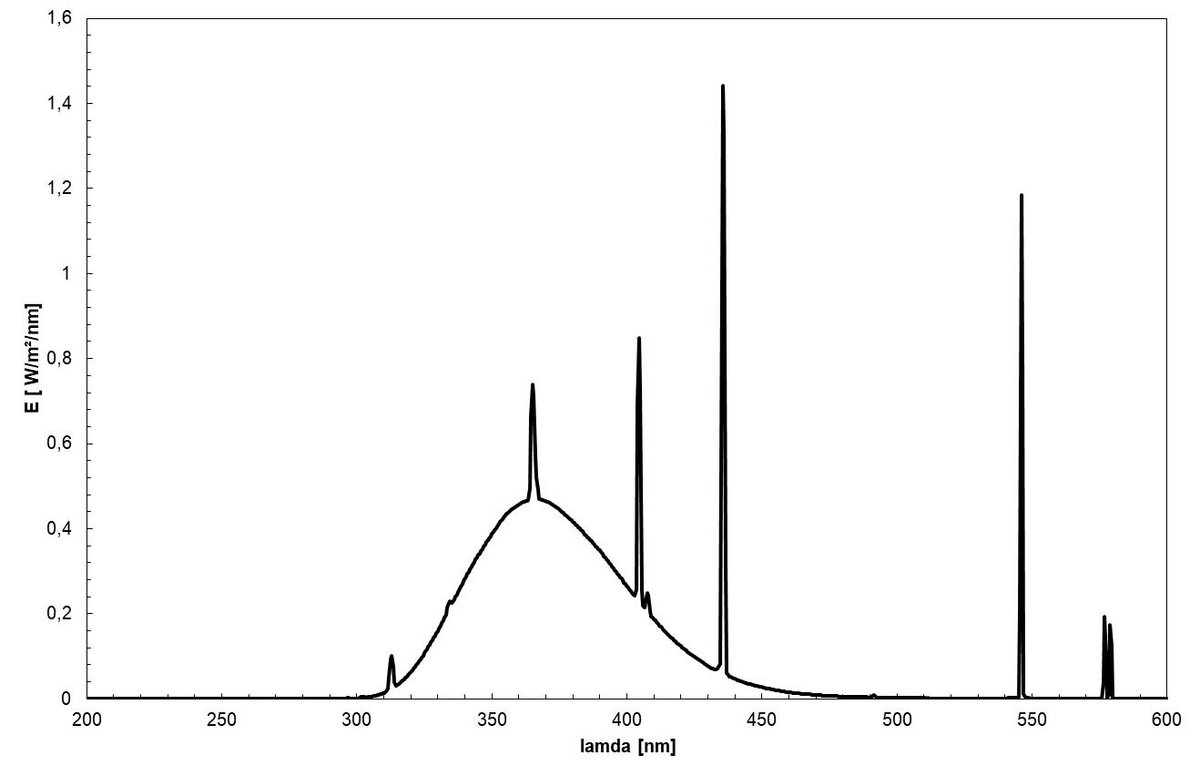
- Fluorescent lamp (Helarium)
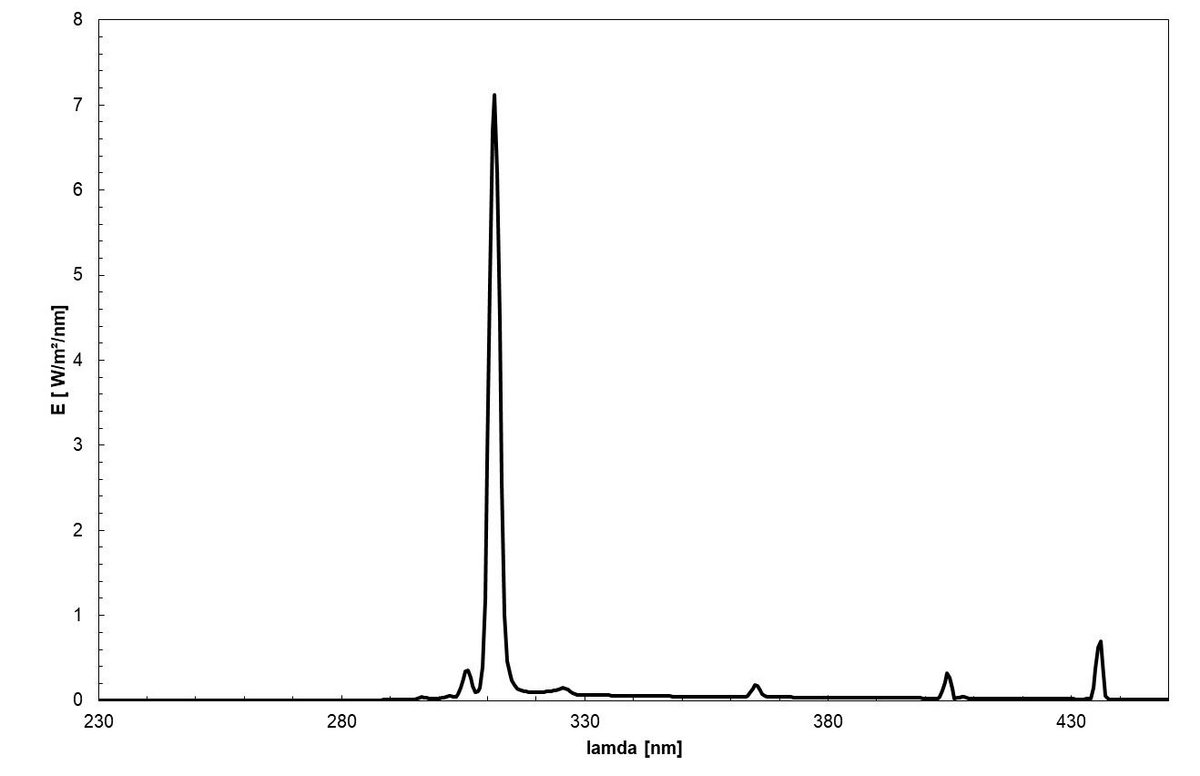
- Fluorescent lamp (UVB-311)
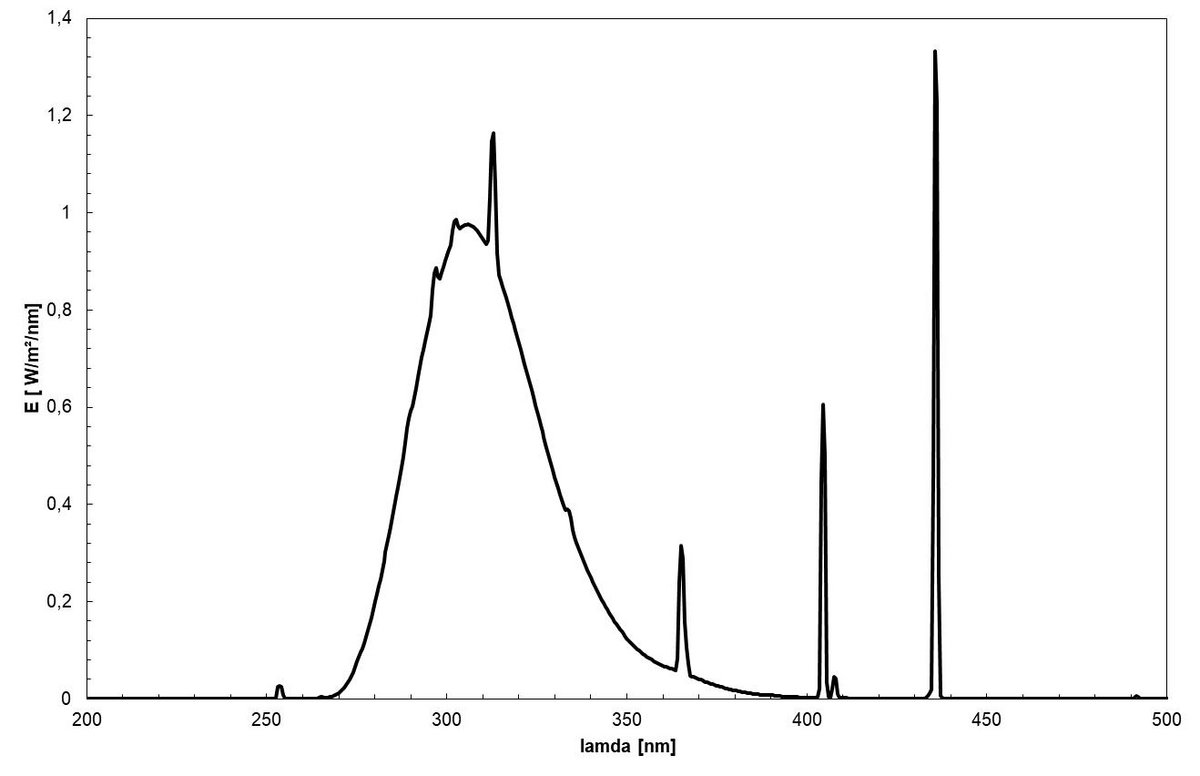
- Fluorescent lamp (UVB broadband)
- Fluorescent lamp(UVA-340)
- Fluorescent lamp (100 W, light colour 79)
- Fluorescent lamp(BlacklightBlue 352 nm)
- Fluorescent lamp (BlacklightBlue 368 nm)
- Fluorescent lamp (light color 05)
- Fluorescent lamp (Philips Actinic BL)
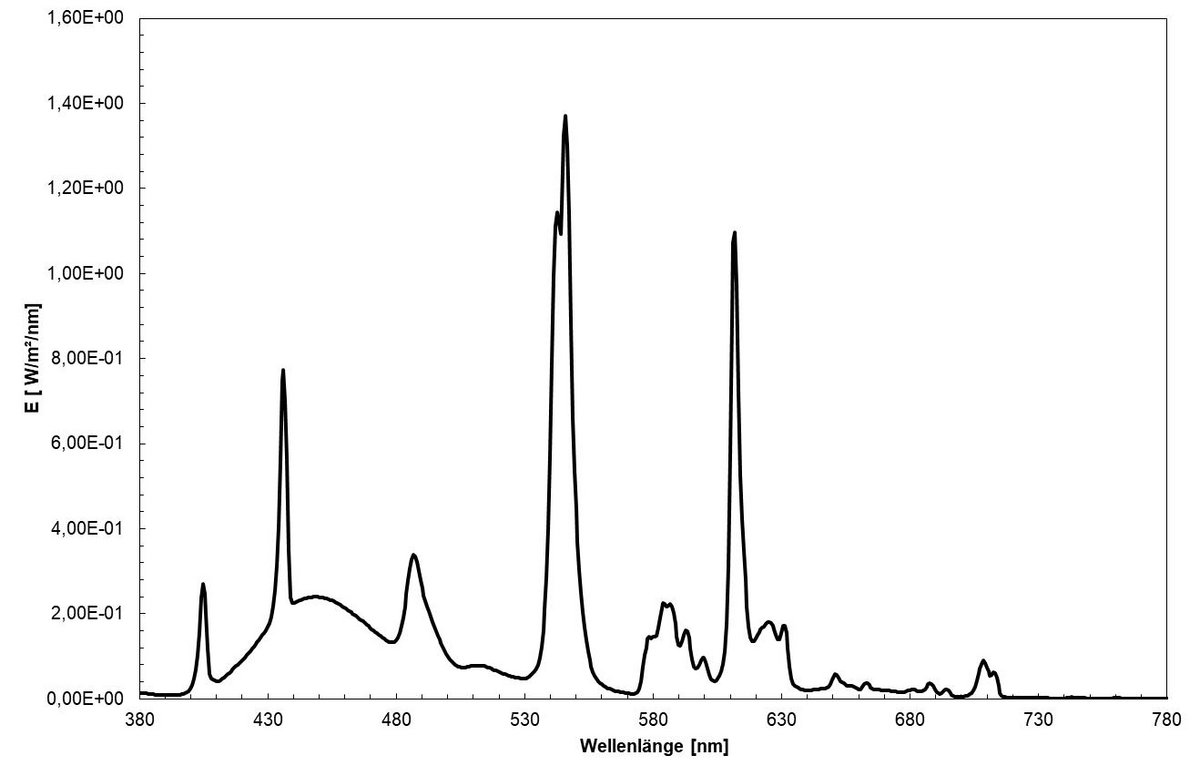
- Fluorescent lamp (6500 K)
- Fluorescent lamp T8 15 W (cool daylight)





Spectra of excimer lamps
- Typical power: 10 W - 1000 W
- Excimer:
- KrCl, Xe₂
- usually ozone-generating
- Links:
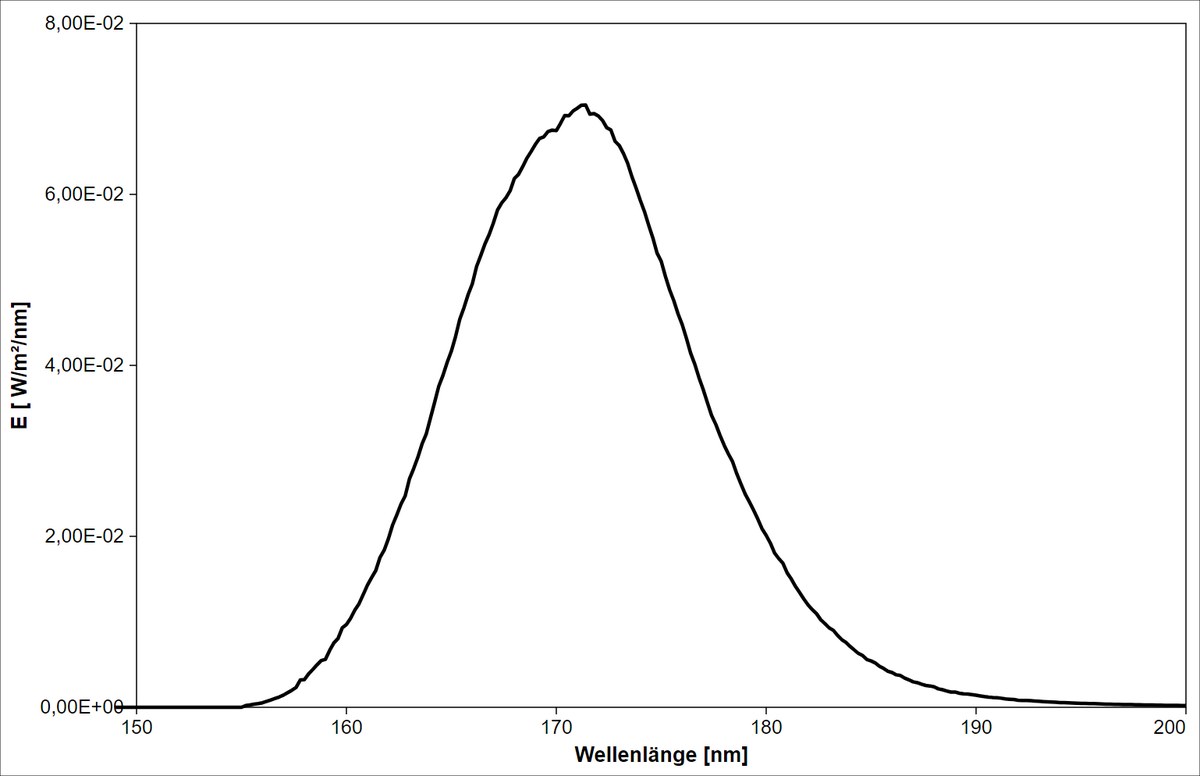
Excimer lamp (Xe₂) 172 nm: Measurement by the Lichttechnisches Institut, Xe₂ fill at 250 mbar. Not measured in the Opsytec calibration laboratory. The measured quantity was radiant intensity in W/(sr·nm). The curve is normalised to an irradiance of 1 W/m²; shape, shares and ratios are unaffected.
Spectra of blue-emitting LEDs and LED modules
- Typical wattages: 1–5 W as single LED, as LED module also up to 2000 W
- Doping:
- none
- ozone-free
- Links:


Spectra of visible-range LEDs (VIS)
- Typical wattages: 1–5 W as single LED, as LED module also up to 2000 W
- Doping:
- none
- ozone-free
- Links:






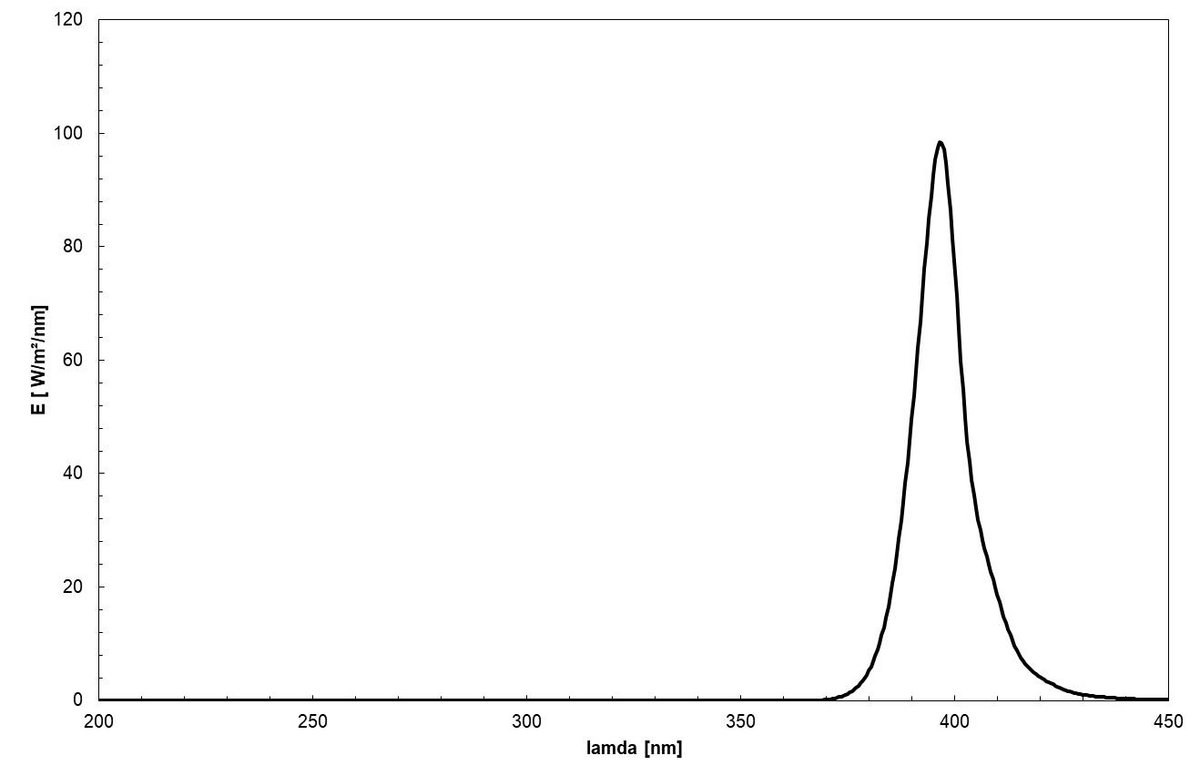
Spectra of UVA LEDs and UVA LED modules
- Typical wattages: 1–5 W as single LED, as LED module also up to 2000 W
- Doping:
- none
- ozone-free
- Links:


Spectra of UVB LEDs and UVB LED modules
- Typical wattages: 1–4 W as single LED, as LED module also up to 200 W
- Doping:
- none
- ozone-free
- Links:

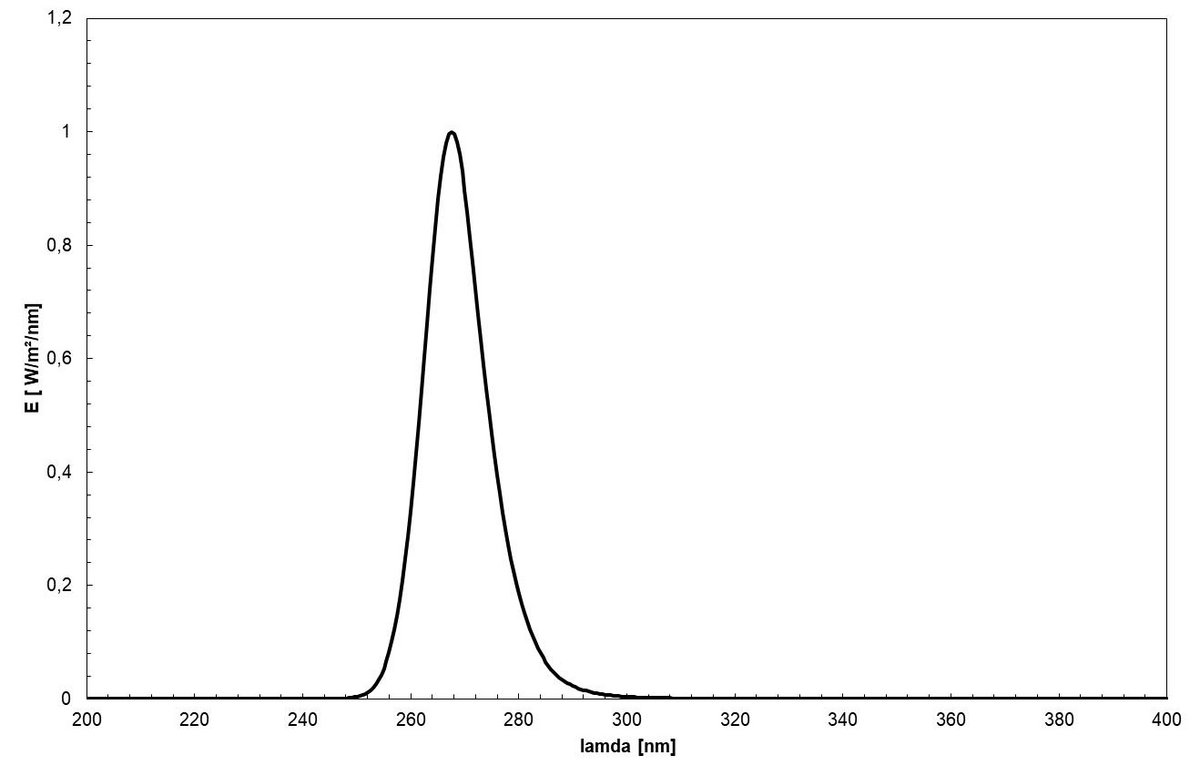
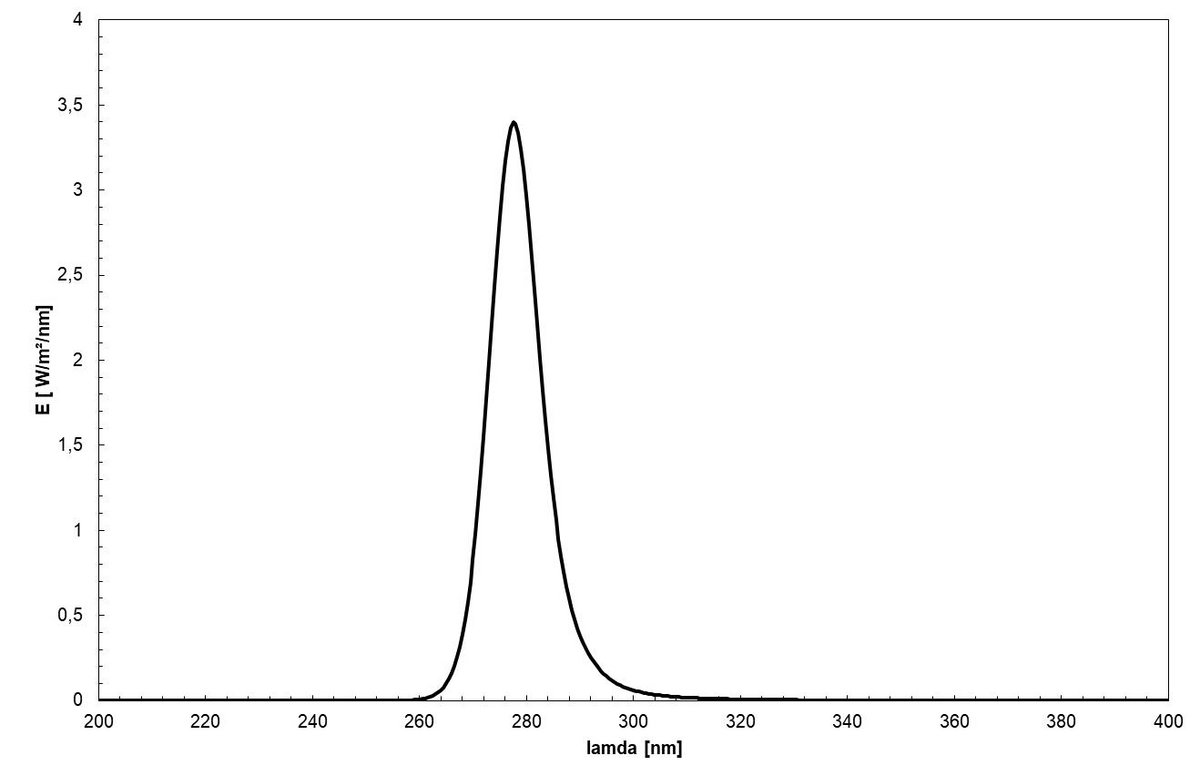
Spectra of UVC LEDs and UVC LED modules
- Typical wattages: 1–4 W as single LED, as LED module also up to 200 W
- Doping:
- none
- ozone-free
- Links:



Spectra of xenon lamps, xenon short arc lamps and xenon flash lamps
- Typical power: 150 W - 5000 W
- Doping:
- none
- ozone-free and ozone-generating
- DC-operated or pulsed operated
- Links:


Spectra of metal halide lamps
- Typical power: 400 W - 4000W
- Dopants:
- Metal halides
- usually ozone-free
- Links:


Spectra of halogen lamps
- Typical power: 10 W - 1 kW
- Doping:
- none
- ozone-free
- Links:

Spectra of deuterium lamps, D2 lamps
- Typical power: 10 W - 300 W
- Doping:
- none
- ozone-generating and ozone-free
- Links:

Reference spectra: sun, AM spectra, standard illuminants and reference conditions
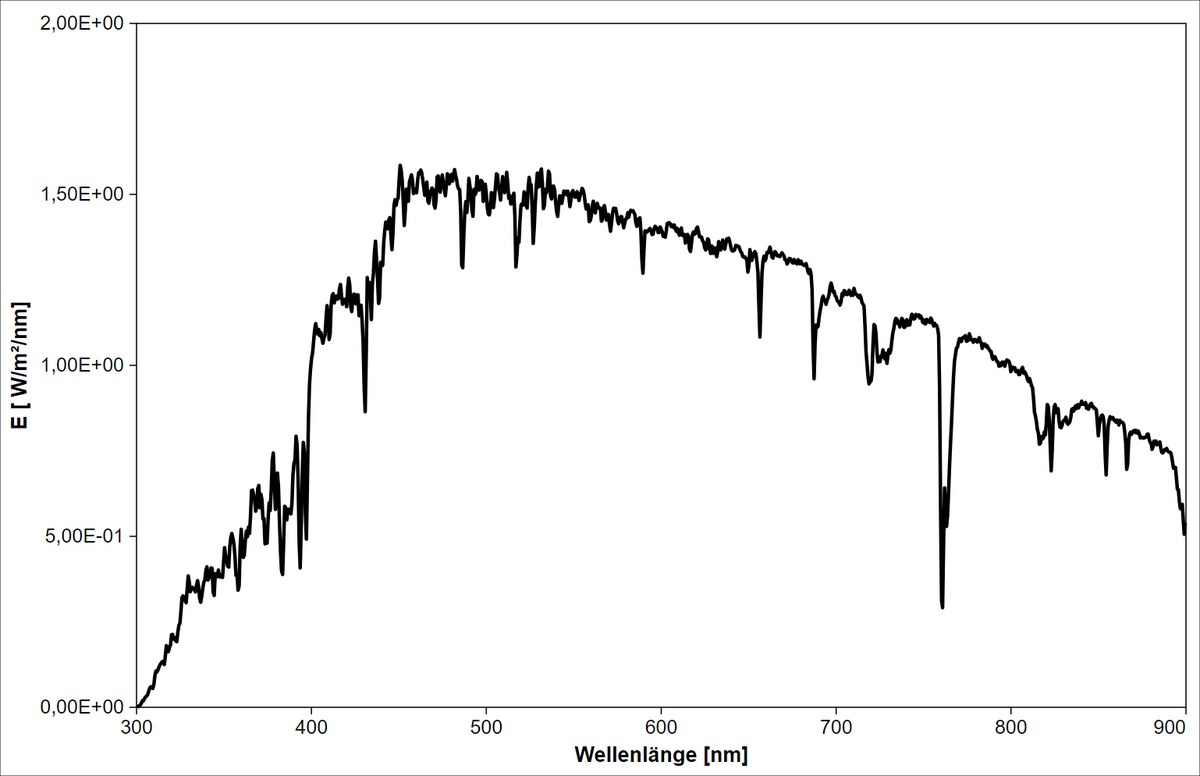
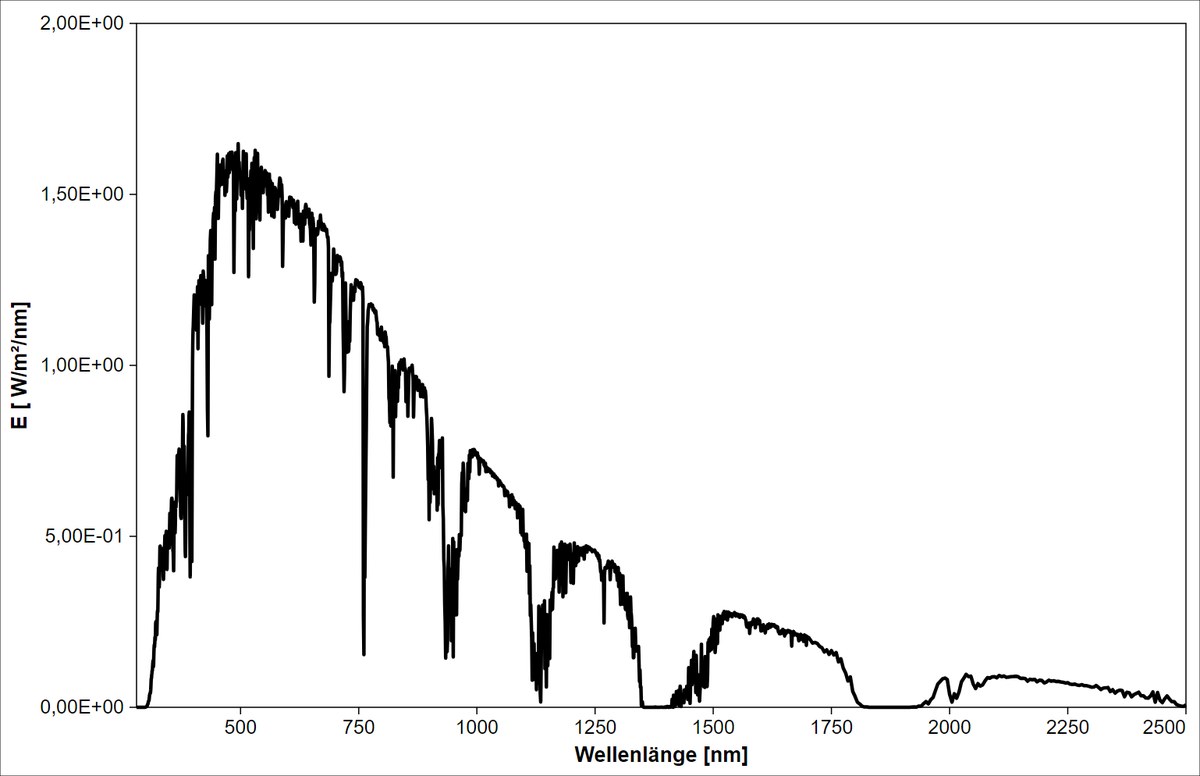
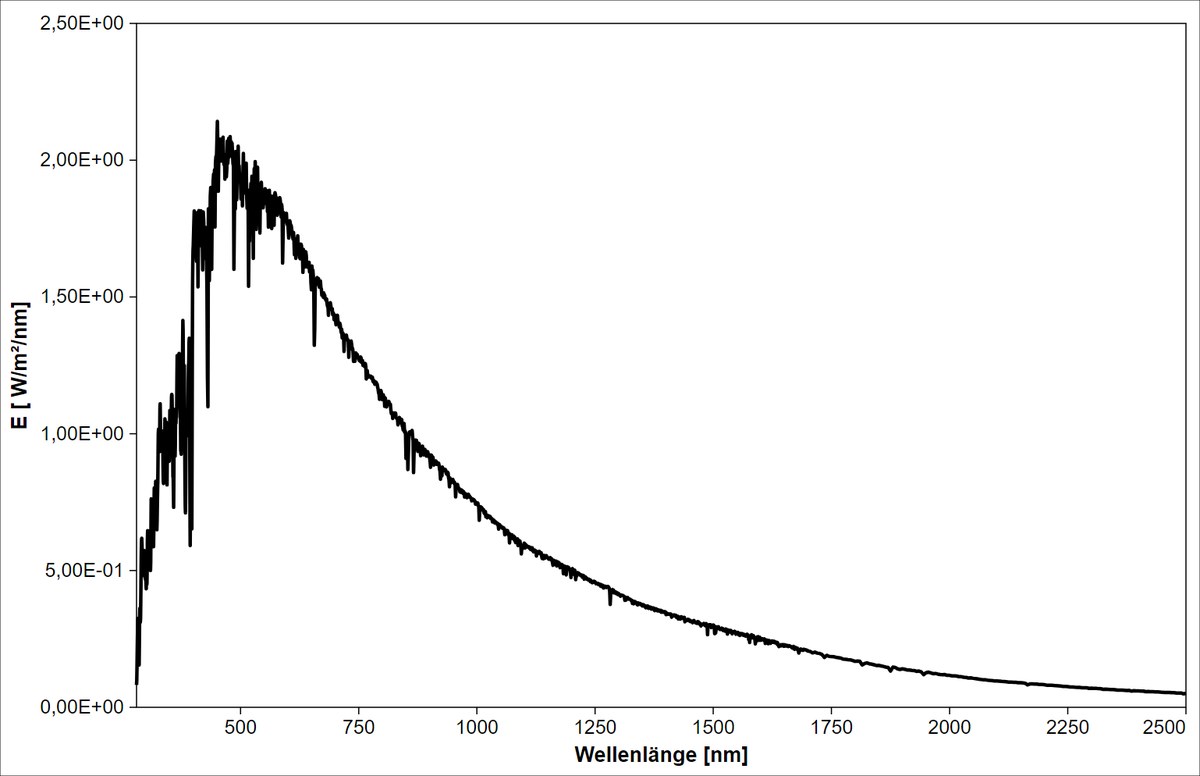
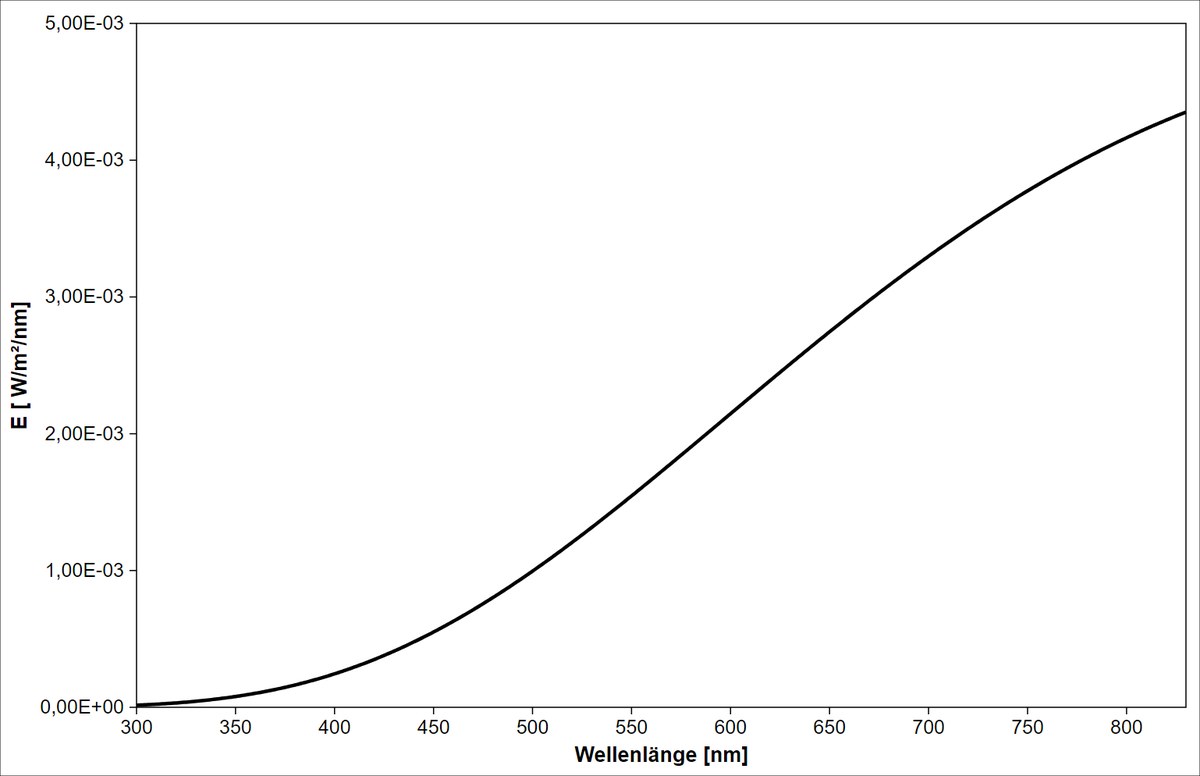
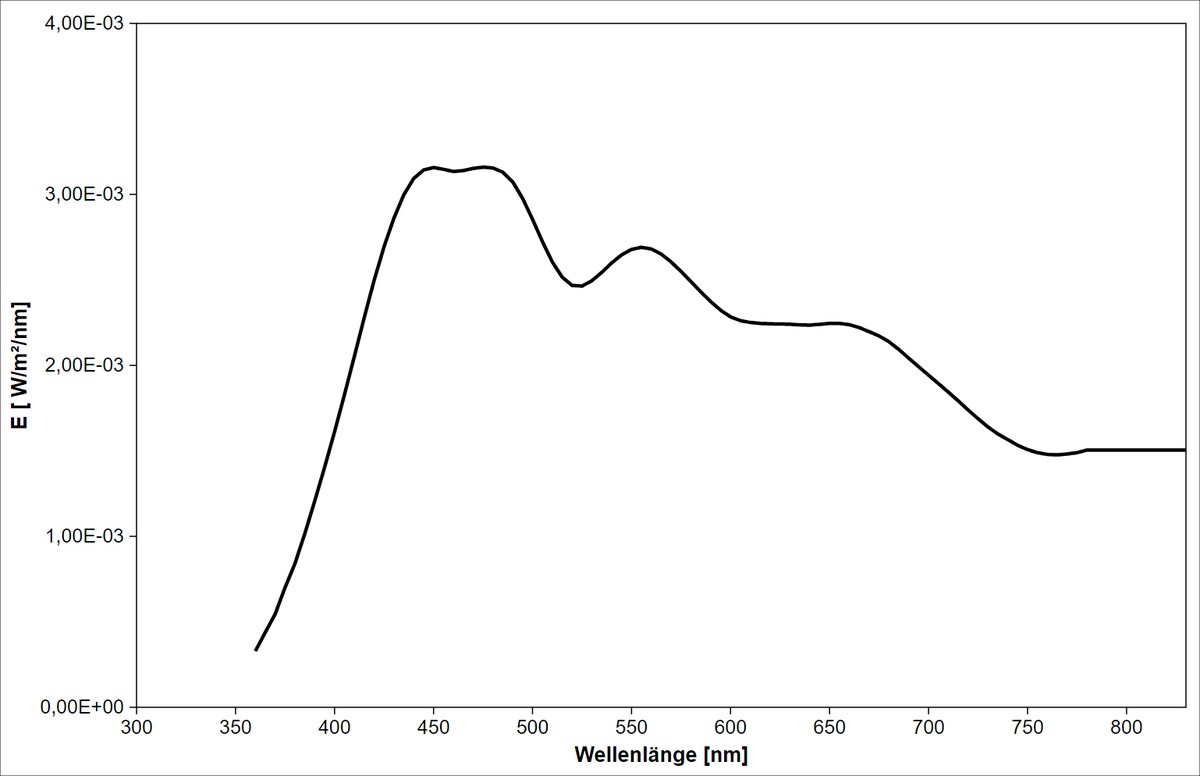
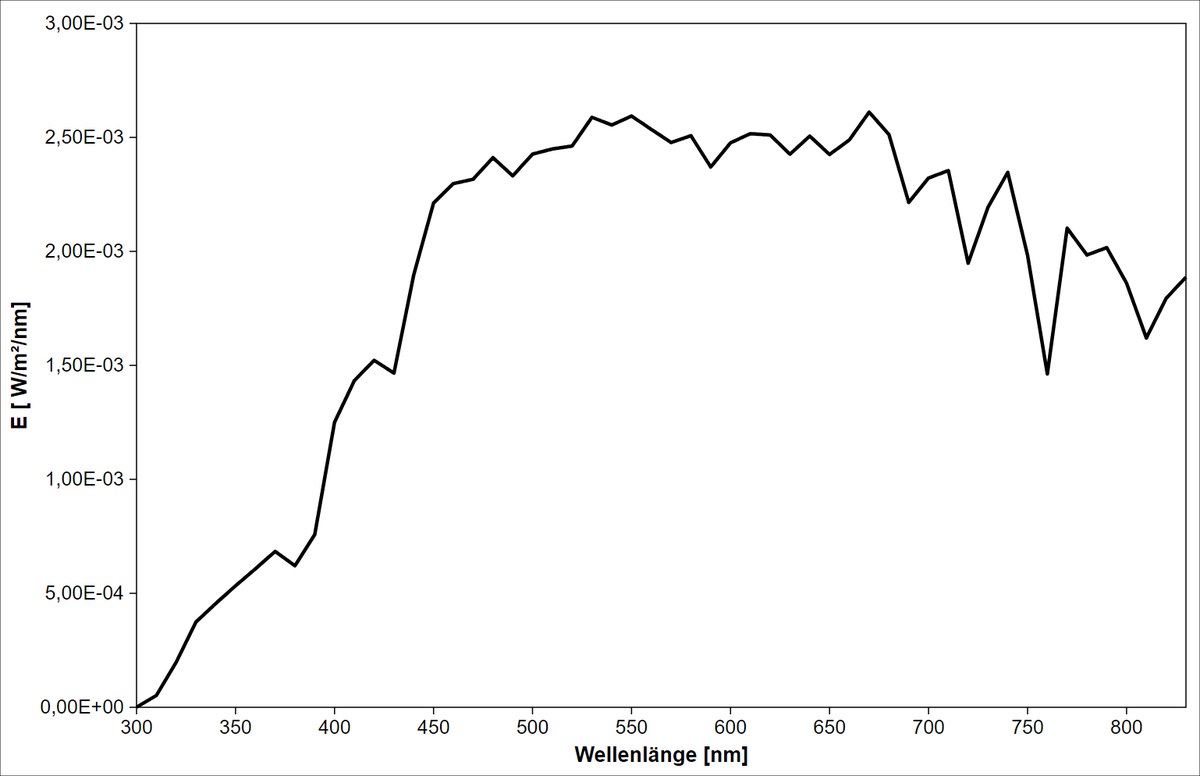
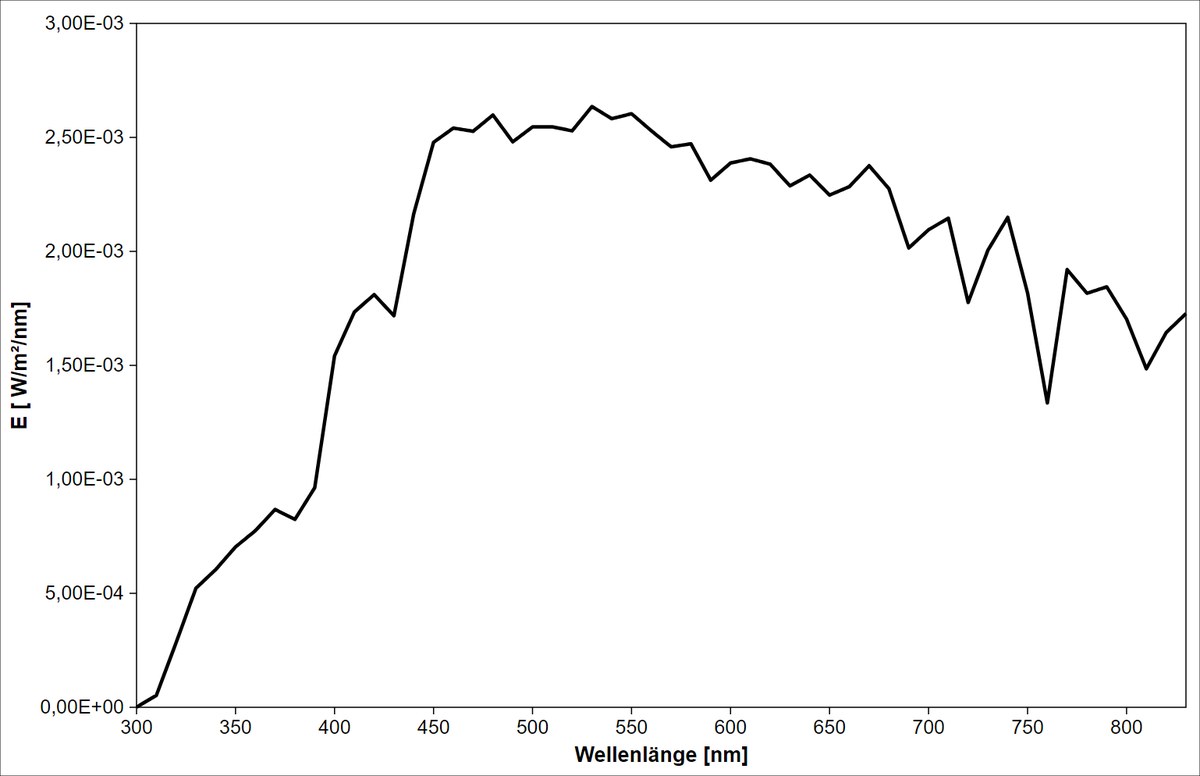
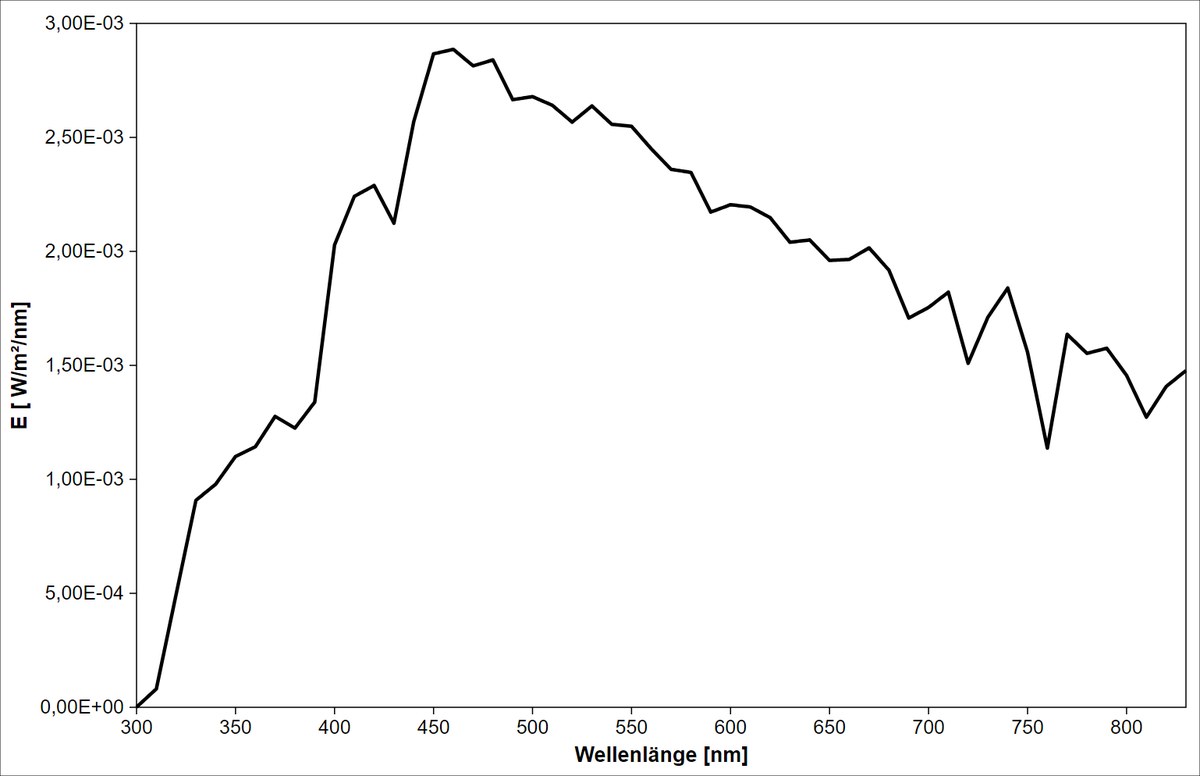
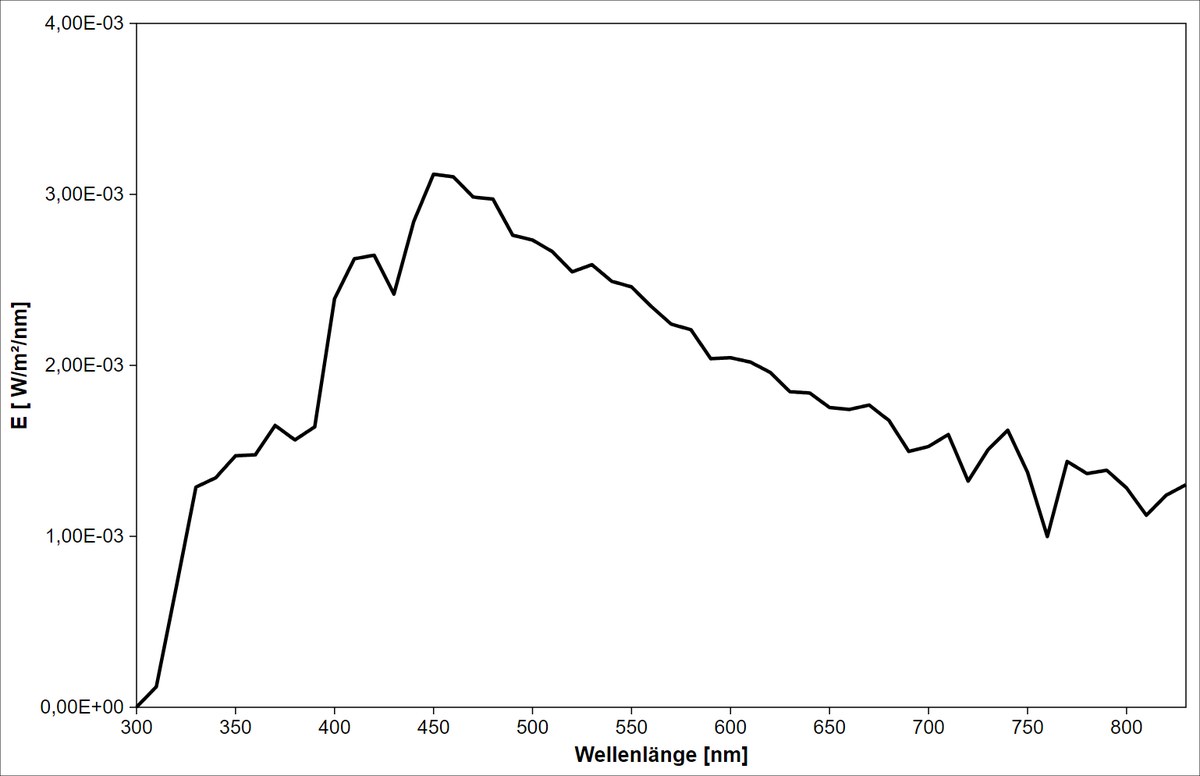
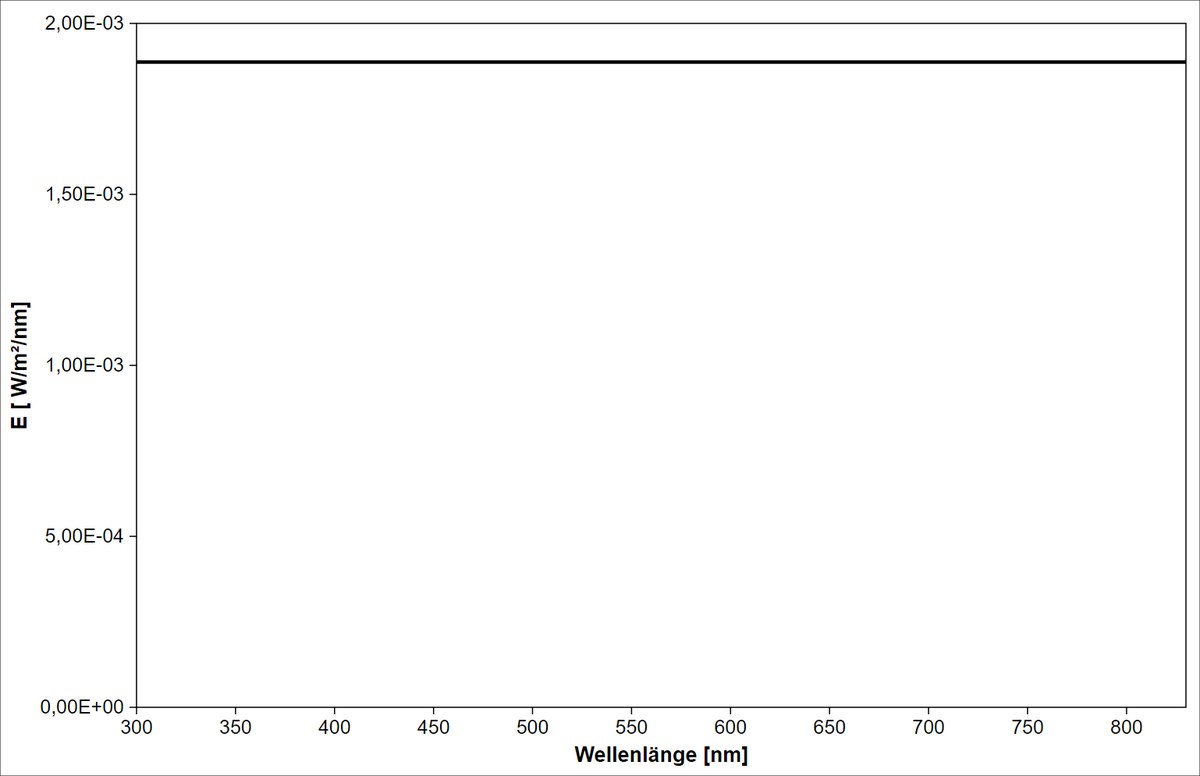
These spectra serve as a reference, not as a sample of a lamp class. Apart from the 365 nm reference condition, none of them comes from the Opsytec calibration laboratory: the solar spectrum is a user measurement, the AM spectra are reference spectra per ASTM G173-03, and the standard illuminants are calculated according to CIE 15. The standard illuminants are relative distributions; they are normalised here to an irradiance of 1 W/m² so that they can be compared with the measured spectra. The narrow-band 365 nm reference per DIN EN ISO 3059, by contrast, is a measurement from our calibration laboratory; it shows the irradiance to which UV-A meters for penetrant and magnetic particle testing are referred.
- Links:
- Solar spectrum (measured 7 April 2026)
- AM1.5 global (ASTM G173-03)
- AM0, extraterrestrial (ASTM G173-03)
- Standard illuminant A
- Standard illuminant C
- Standard illuminant D50
- Standard illuminant D55
- Standard illuminant D65
- Standard illuminant D75
- Standard illuminant E
- 365 nm filtered (2 nm bandwidth), DIN EN ISO 3059

Overview of the Spectra
The overview lists all 66 spectra of the Opsytec spectral database with their calculated characteristic values: measured range, peak wavelength and the shares in UV-C, UV-B, UV-A and the visible range. The shares refer to the total measured irradiance. The spectra are typical of the respective lamp class and may be used freely; every row links to the measurement data as an XLSX file.
The characteristic values are obtained by trapezoidal integration over the native measurement grid. Band limits according to CIE: UV-C 100–280 nm, UV-B 280–315 nm, UV-A 315–400 nm, visible 380–780 nm; the UV-A and visible ranges overlap between 380 and 400 nm. A share in parentheses indicates that the measured range does not fully cover the band. Where the measured range extends beyond 780 nm, the remainder not listed lies in the infrared. Spectra marked with † do not come from the Opsytec calibration laboratory; the footnote below the table names their origin and normalisation. All other measurements according to CIE 250:2022. Information without guarantee – the values are for orientation and do not replace a measurement.
| Lamp | Measured rangenm | Peaknm | UV-C% | UV-B% | UV-A% | visible% | Download |
|---|---|---|---|---|---|---|---|
| Medium-pressure mercury lamp | 200–600 | 546.5 | (26.6) | 16.8 | 17.7 | (39.4) | Spectrum (XLSX) |
| Ozone-free medium-pressure mercury lamp | 200–600 | 546.0 | (8.8) | 20.5 | 21.5 | (49.9) | Spectrum (XLSX) |
| Ozone-free medium-pressure lamp (iron-doped) | 200–600 | 546.0 | (5.1) | 11.7 | 45.0 | (49.1) | Spectrum (XLSX) |
| Gallium lamp (medium pressure) | 200–600 | 419.0 | (4.1) | 13.1 | 20.7 | (67.5) | Spectrum (XLSX) |
| Medium-pressure mercury lamp OSRAM UltraVitalux 300 W | 200–450 | 365.5 | (0.1) | 11.4 | 45.0 | (45.0) | Spectrum (XLSX) |
| High-pressure Hg lamp LC5 (with light guide) | 200–600 | 365.0 | (1.2) | 37.1 | 43.1 | (21.6) | Spectrum (XLSX) |
| High-pressure mercury lamp (with light guide) | 200–600 | 438.5 | (<0.1) | 2.5 | 35.1 | (70.2) | Spectrum (XLSX) |
| UVC low-pressure mercury lamp (253.7 nm) | 200–600 | 253.5 | (92.7) | 1.6 | 1.2 | (4.6) | Spectrum (XLSX) |
| Mercury amalgam lamp (253.7 nm, high power) | 200–600 | 253.5 | (71.0) | 5.1 | 3.8 | (20.4) | Spectrum (XLSX) |
| Fluorescent lamp (Helarium) | 200–600 | 546.5 | (<0.1) | 3.2 | 74.7 | (28.6) | Spectrum (XLSX) |
| Fluorescent lamp (UVB-311) | 230–450 | 311.5 | (<0.1) | 73.2 | 17.6 | (11.4) | Spectrum (XLSX) |
| Fluorescent lamp (UVB broadband) | 200–600 | 435.5 | (1.9) | 53.8 | 36.1 | (8.5) | Spectrum (XLSX) |
| Fluorescent lamp (UVA-340) | 200–600 | 435.5 | (<0.1) | 3.7 | 83.9 | (18.4) | Spectrum (XLSX) |
| Fluorescent lamp (100 W, colour 79) | 200–600 | 546.0 | (<0.1) | 0.3 | 78.1 | (28.1) | Spectrum (XLSX) |
| Fluorescent lamp (BlacklightBlue 352 nm) | 200–600 | 365.0 | (<0.1) | 0.5 | 98.9 | (5.6) | Spectrum (XLSX) |
| Fluorescent lamp (BlacklightBlue 368 nm) | 300–450 | 365.5 | (–) | (0.1) | 99.5 | (11.0) | Spectrum (XLSX) |
| Fluorescent lamp (colour 05) | 200–600 | 435.5 | (<0.1) | 0.8 | 72.2 | (45.0) | Spectrum (XLSX) |
| Fluorescent lamp (Philips Actinic BL) | 200–600 | 369.0 | (<0.1) | <0.1 | 91.2 | (22.6) | Spectrum (XLSX) |
| Fluorescent lamp (6500 K) | 379–780 | 546.0 | (–) | (–) | (0.5) | 100.0 | Spectrum (XLSX) |
| Fluorescent lamp T8 15 W (cool daylight) | 379–1045 | 545.3 | (–) | (–) | (0.3) | 99.7 | Spectrum (XLSX) |
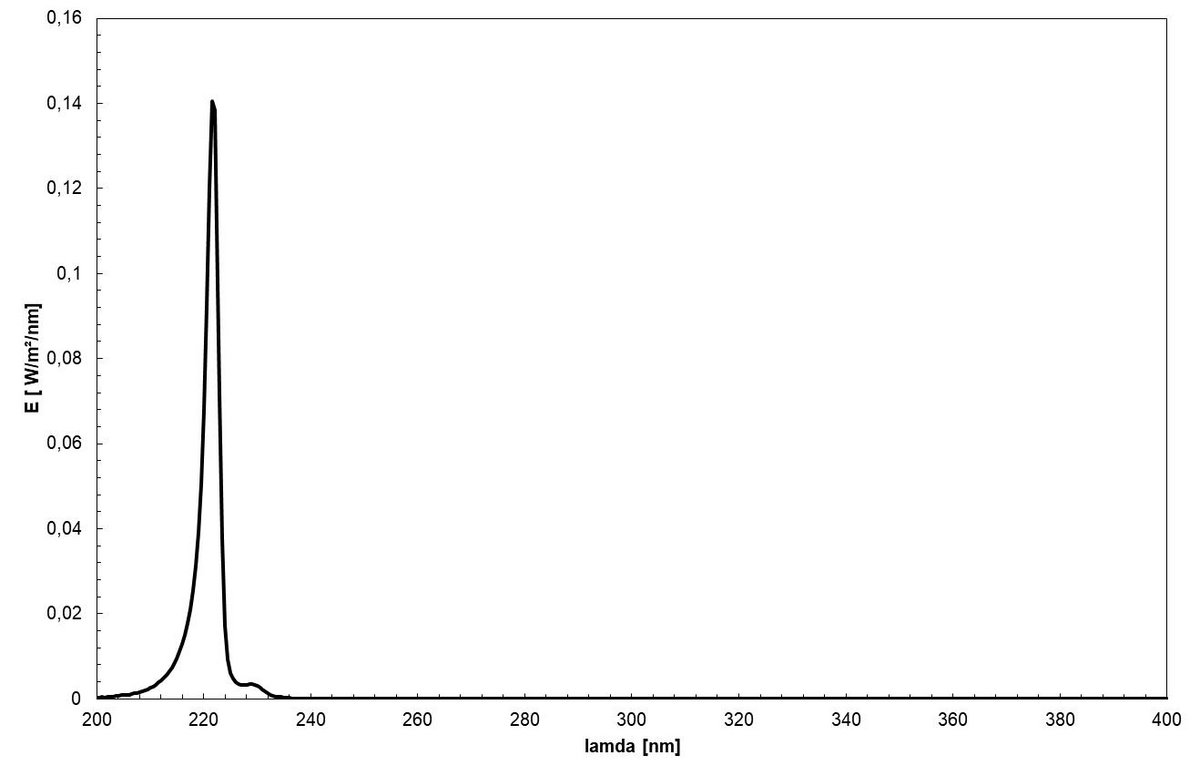
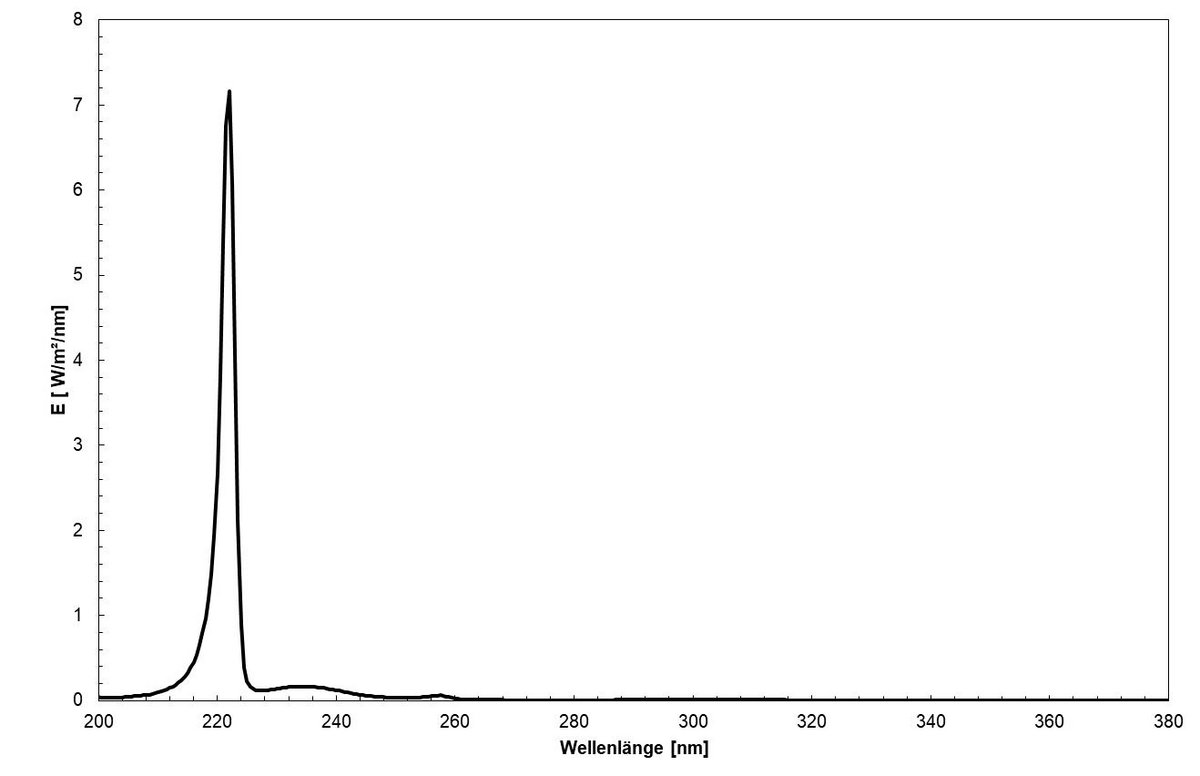
| Filtered excimer lamp (KrCl) 222 nm | 200–400 | 221.5 | (99.8) | <0.1 | 0.2 | (0.1) | Spectrum (XLSX) |
| Excimer lamp (KrCl) 222 nm | 200–380 | 222.0 | (98.6) | 0.8 | (0.6) | (–) | Spectrum (XLSX) |
| Excimer lamp (Xe₂) 172 nm † | 148–200 | 171.4 | (100.0) | (–) | (–) | (–) | Spectrum (XLSX) |
| Blue LED (405 nm) | 330–450 | 405.0 | (–) | (–) | (28.1) | (99.7) | Spectrum (XLSX) |
| Blue LED (420 nm) | 320–520 | 423.5 | (–) | (–) | (1.0) | (100.0) | Spectrum (XLSX) |
| Blue LED (445 nm) | 330–520 | 447.0 | (–) | (–) | (<0.1) | (100.0) | Spectrum (XLSX) |
| Blue LED (450 nm) | 330–520 | 451.0 | (–) | (–) | (<0.1) | (100.0) | Spectrum (XLSX) |
| VIS blue (450 nm) | 379–780 | 450.3 | (–) | (–) | (0.1) | 100.0 | Spectrum (XLSX) |
| VIS green (520 nm) | 379–780 | 519.7 | (–) | (–) | (<0.1) | 100.0 | Spectrum (XLSX) |
| VIS red (630 nm) | 379–780 | 631.8 | (–) | (–) | (<0.1) | 100.0 | Spectrum (XLSX) |
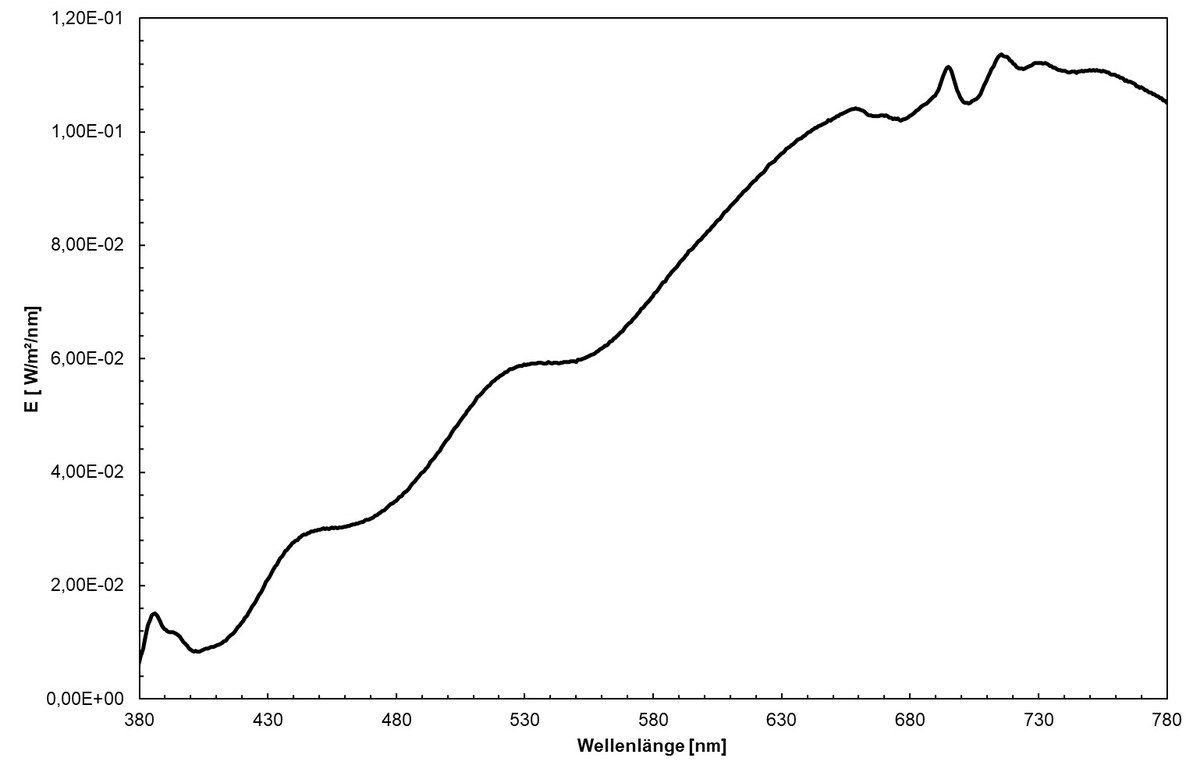
| VIS white (CIE A, 3139 K) | 379–780 | 715.7 | (–) | (–) | (0.9) | 99.8 | Spectrum (XLSX) |
| VIS white (CIE D50, 5235 K) | 379–780 | 511.6 | (–) | (–) | (0.2) | 99.9 | Spectrum (XLSX) |
| VIS white (CIE E, 5616 K) | 379–780 | 502.8 | (–) | (–) | (1.3) | 99.9 | Spectrum (XLSX) |
| White LED (5670 K) | 379–1039 | 451.6 | (–) | (–) | (0.1) | 99.4 | Spectrum (XLSX) |
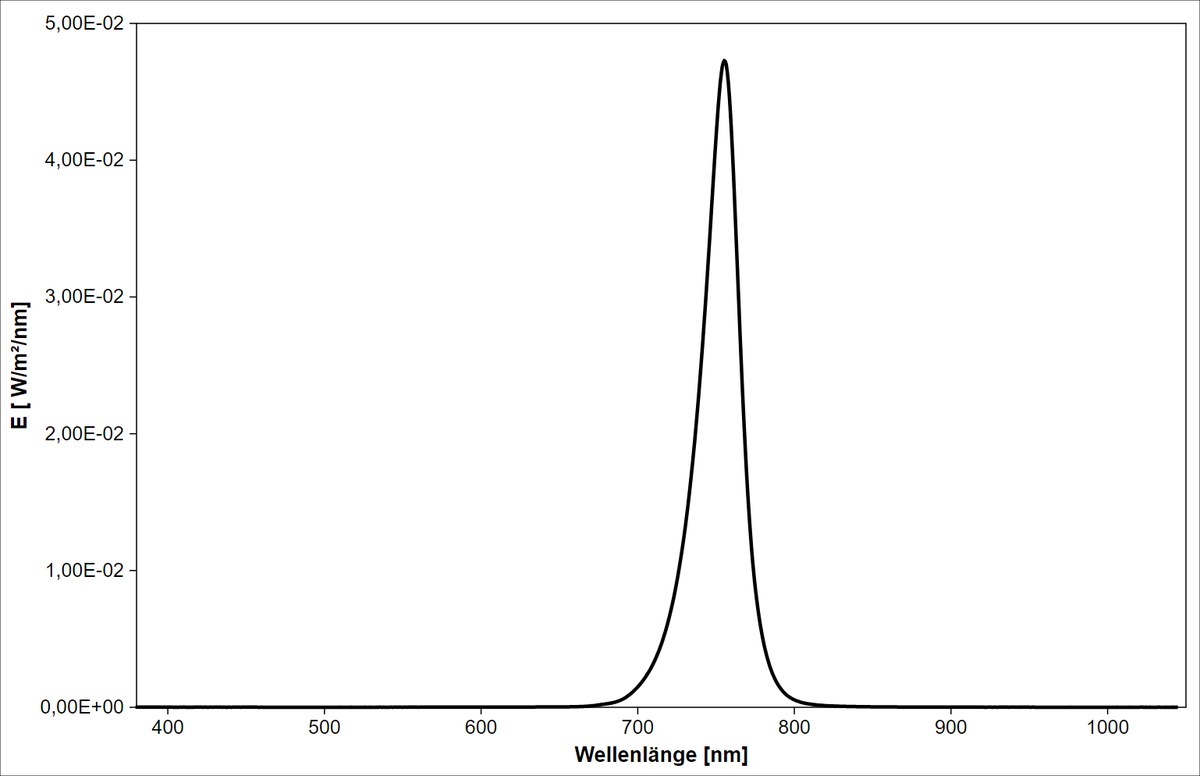
| IR LED (750 nm) | 379–1045 | 755.2 | (–) | (–) | (<0.1) | 96.9 | Spectrum (XLSX) |
| IR LED (810 nm) | 379–1045 | 804.1 | (–) | (–) | (<0.1) | 12.3 | Spectrum (XLSX) |
| IR LED (940 nm) | 379–1039 | 944.8 | (–) | (–) | (<0.1) | 0.2 | Spectrum (XLSX) |
| UVA LED (365 nm) | 330–450 | 371.0 | (–) | (–) | (99.3) | (14.4) | Spectrum (XLSX) |
| UVA LED (385 nm) | 330–450 | 385.0 | (–) | (–) | (94.9) | (84.0) | Spectrum (XLSX) |
| UVA LED (395 nm) | 330–455 | 396.5 | (–) | (–) | (67.3) | (98.9) | Spectrum (XLSX) |
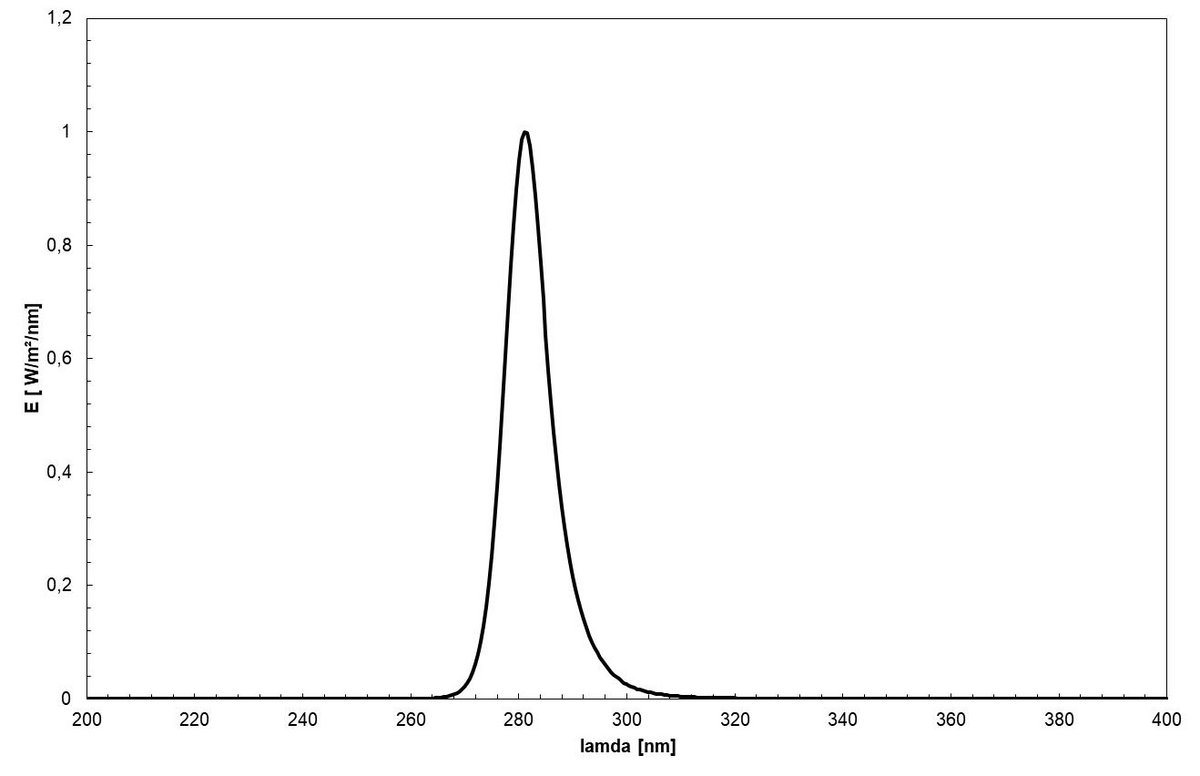
| UVB LED (280 nm) | 200–400 | 281.0 | (32.3) | 67.4 | 0.3 | (<0.1) | Spectrum (XLSX) |
| UVB LED (285 nm) | 200–400 | 283.5 | (23.8) | 75.6 | 0.7 | (0.1) | Spectrum (XLSX) |
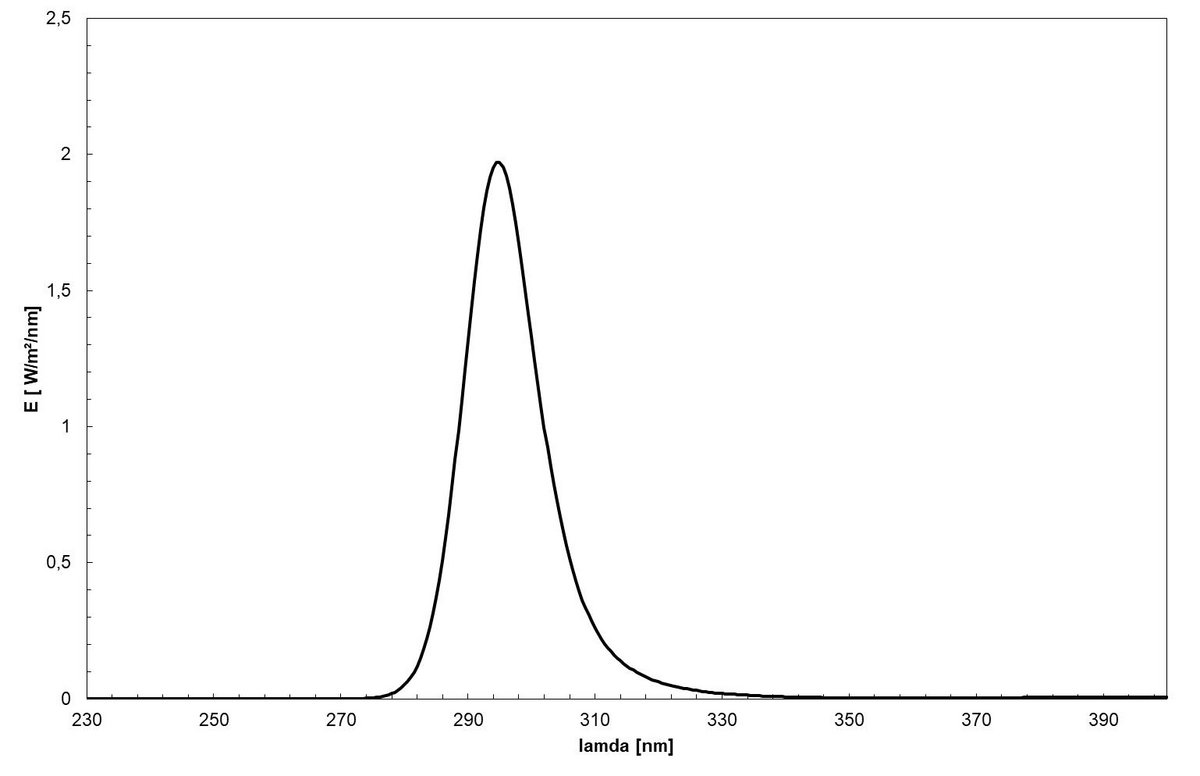
| UVB LED (295 nm) | 230–400 | 295.0 | (0.3) | 95.8 | 3.9 | (0.4) | Spectrum (XLSX) |
| UVC LED (255 nm) | 200–400 | 255.5 | (99.2) | 0.6 | 0.3 | (0.1) | Spectrum (XLSX) |
| UVC LED (265 nm) | 200–320 | 266.5 | (95.5) | 4.4 | (0.1) | (–) | Spectrum (XLSX) |
| UVC LED (267 nm) | 200–400 | 267.5 | (93.8) | 6.2 | <0.1 | (<0.1) | Spectrum (XLSX) |
| UVC LED (270 nm) | 200–400 | 270.5 | (88.5) | 10.7 | 0.7 | (0.3) | Spectrum (XLSX) |
| UVC LED (275 nm) | 200–400 | 277.5 | (63.0) | 36.7 | 0.4 | (<0.1) | Spectrum (XLSX) |
| Xenon lamp (pulsed) | 215–441 | 424.6 | (18.3) | 13.7 | 41.0 | (37.8) | Spectrum (XLSX) |
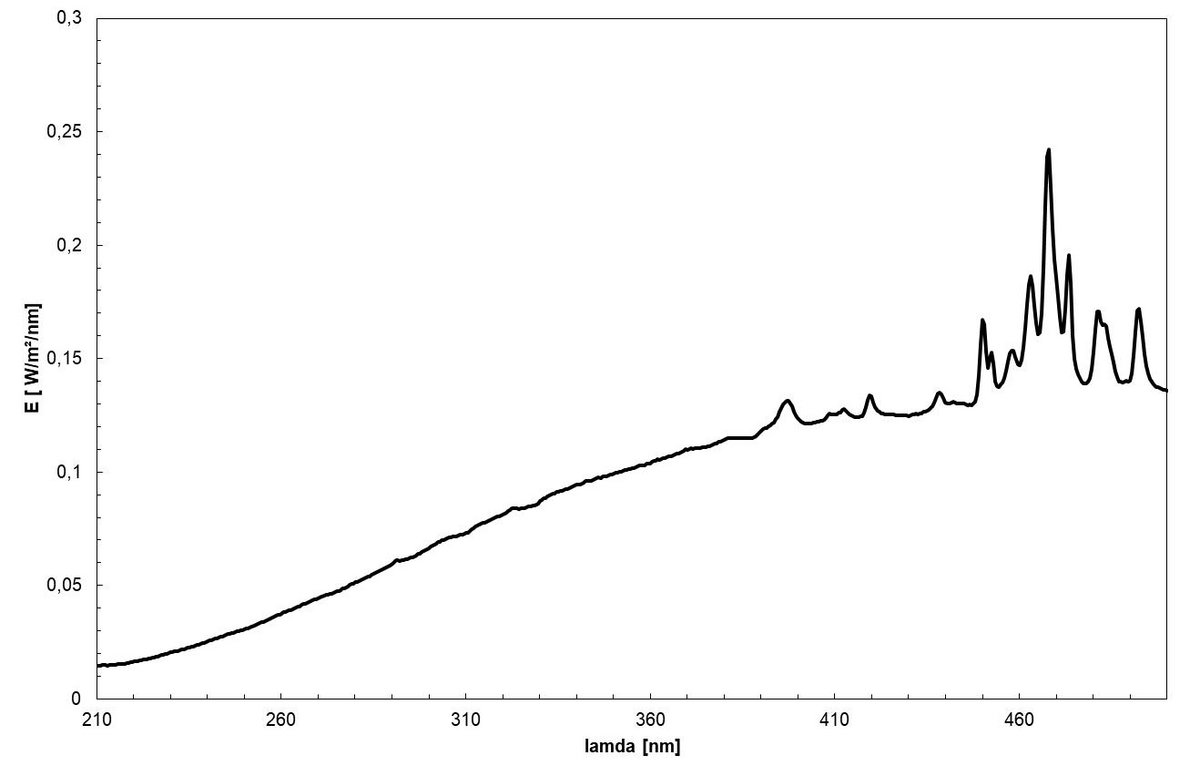
| Xenon lamp (DC operated, XBO) | 210–500 | 468.0 | (7.6) | 8.3 | 31.9 | (61.0) | Spectrum (XLSX) |
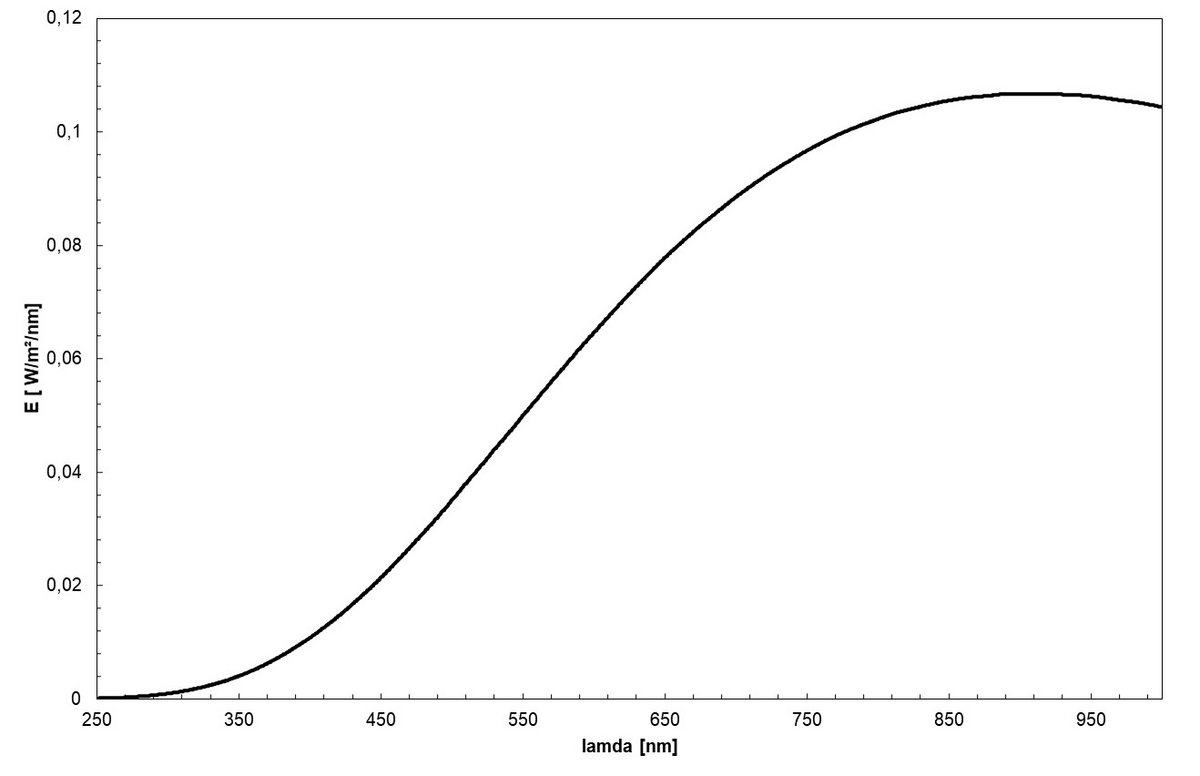
| Xenon short-arc lamp (Cermax, VIS–NIR) | 379–1039 | 882.4 | (–) | (–) | (2.6) | 49.8 | Spectrum (XLSX) |
| Metal halide lamp OSRAM HMI 575 W | 200–600 | 546.5 | (1.7) | 7.6 | 28.2 | (69.0) | Spectrum (XLSX) |
| FEL lamp (110 V) | 250–1100 | 893.5 | (<0.1) | 0.1 | 0.8 | 40.4 | Spectrum (XLSX) |
| Halogen lamp (standard illuminant A, 2856 K) | 379–780 | 779.1 | (–) | (–) | (0.5) | 99.8 | Spectrum (XLSX) |
| Deuterium lamp (D2) | 200–400 | 200.0 | (73.2) | 12.6 | 14.2 | (2.3) | Spectrum (XLSX) |
| Solar spectrum (measured 7 April 2026) † | 300–900 | 450.7 | (–) | (0.1) | 6.1 | 79.7 | Spectrum (XLSX) |
| AM1.5 global (ASTM G173-03) † | 280–2500 | 495.0 | (–) | 0.1 | 4.6 | 53.8 | Spectrum (XLSX) |
| AM0, extraterrestrial (ASTM G173-03) † | 280–2500 | 451.0 | (–) | 1.3 | 6.5 | 49.9 | Spectrum (XLSX) |
| Standard illuminant A † | 300–830 | 830.0 | (–) | (<0.1) | 0.9 | 78.5 | Spectrum (XLSX) |
| Standard illuminant C † | 360–830 | 475.0 | (–) | (–) | (3.6) | 91.3 | Spectrum (XLSX) |
| Standard illuminant D50 † | 300–830 | 670.0 | (–) | (0.1) | 4.8 | 87.6 | Spectrum (XLSX) |
| Standard illuminant D55 † | 300–830 | 530.0 | (–) | (0.1) | 6.3 | 87.3 | Spectrum (XLSX) |
| Standard illuminant D65 † | 300–830 | 460.0 | (–) | (0.1) | 9.4 | 86.2 | Spectrum (XLSX) |
| Standard illuminant D75 † | 300–830 | 450.0 | (–) | (0.2) | 12.3 | 84.8 | Spectrum (XLSX) |
| Standard illuminant E † | 300–830 | 300.0 | (–) | (2.8) | 16.0 | 75.5 | Spectrum (XLSX) |
| 365 nm filtered (2 nm bandwidth), DIN EN ISO 3059 | 315–400 | 365.0 | (–) | (–) | 100.0 | (<0.1) | Spectrum (XLSX) |
| Medium-pressure lamp (iron-doped) | 200–600 | 546.0 | (5.1) | 11.7 | 45.0 | (49.1) | Spectrum (XLSX) |
Spectra marked with † do not come from the Opsytec calibration laboratory: the solar spectrum is a user measurement, the 172 nm excimer lamp was measured at the Lichttechnisches Institut, the AM spectra are reference spectra per ASTM G173-03 and the standard illuminants are calculated according to CIE 15. Where a source does not yield an irradiance — the excimer lamp and the standard illuminants — the curve is normalised to 1 W/m²; shape and shares are unaffected.
Author: Dr. Mark Paravia
Dr.-Ing. Mark Paravia is the managing director of Opsytec Dr. Gröbel GmbH in Ettlingen and heads the accredited calibration laboratory. Following his research on pulsed xenon excimer discharges at the Institute of Lighting Technology at KIT, his current focus is on optical radiation measurement technology. He is vice-chair of the DIN Standards Committee FNL 7 “Optical Radiation,” and a member of the DVGW Project Group on UV Disinfection.