


Measuring 172 nm VUV radiation from xenon excimer lamps
Xenon excimer lamps emit in a narrow band in the vacuum UV at around 172 nm. Measuring this radiation differs fundamentally from classic UVA, UVB or UVC radiometry, because VUV is strongly absorbed over very short air paths. Measuring distance, atmosphere, window and detector material and the calibration geometry therefore become part of the measurement result.
This page describes what is different at 172 nm and how a reliable measurement is set up. Technical data for the instruments are given on the respective product pages.
What makes 172 nm special
A photon at 172 nm carries about 7.2 eV. That is enough to break C–C, C–H and C–O bonds directly. The radiation therefore acts on molecules immediately and not, as at 254 nm, through absorption in nucleic acids: 172 nm is primarily photochemical, 254 nm primarily photobiological. No photoinitiator is required.
The second defining property is the strong absorption in air. Molecular oxygen absorbs so strongly around 172 nm that an air path of only a few millimetres noticeably attenuates the radiation; over longer distances virtually nothing reaches the target. The absorbed energy splits oxygen molecules, so that atomic oxygen and ozone form in the beam path and act chemically in their own right.
What appears as an obstacle in measurement is the benefit in the process: it is precisely the short range and the reactive species formed in the beam path that make dry fine cleaning and surface activation possible.
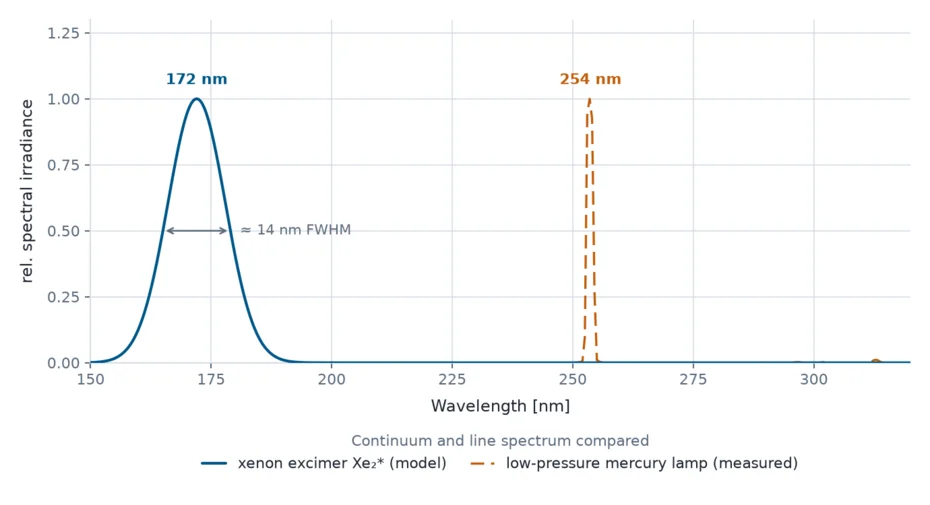
The figure below compares the Xe₂* continuum with the measured line spectrum of a low-pressure mercury lamp. The continuum is a model centred at 172 nm with a full width at half maximum of 14 nm; the spectral database holds no measurement for the VUV range itself.
Lamp physics: barrier discharge and the Xe₂* excimer
Excitation takes place in a dielectric barrier discharge (DBD): xenon at close to atmospheric pressure sits in a gap of a few millimetres between electrodes covered with quartz, glass or ceramic, driven with high voltage in the kilohertz range. The discharge is not a steady plasma but a large number of short-lived microdischarges lasting from a few to several hundred nanoseconds, which quickly fill the gas volume. The dielectric limits the current, terminates each microdischarge by itself and prevents the transition into a thermal arc – the gas stays at ambient temperature (Falkenstein, Ushio).
In the gas, electron impact first produces excited xenon atoms. In a three-body reaction with two ground-state xenon atoms these form the excimer Xe₂*. Because this formation channel is a three-body collision, the high operating pressure close to atmospheric pressure is needed in the first place.
The decisive point is the ground state of the dimer: it is repulsive, or only very weakly bound, and therefore thermally unstable. The molecule dissociates immediately after emission, so no absorber exists for its own radiation. The result is a continuum around 172 nm, free of self-absorption, with a full width at half maximum of about 14 nm (Fraunhofer IFAM, in German). This is exactly where it differs from the mercury lamp, whose resonance lines are repeatedly reabsorbed in the plasma and whose output therefore depends on the wall temperature.
The practical properties follow from this physics: up to 40 % of the electrical power is converted into usable VUV radiation, the radiation field is very homogeneous, the irradiated parts hardly heat up, the lamp can be switched on and off instantly without a warm-up phase, and it operates mercury-free.
From the barrier discharge to the excimer lamp
The excitation principle is older than the mercury vapour lamp. In 1855 Theodose du Moncel reported on a planar electrode arrangement covered with glass and separated by a small gas gap; in 1857 Werner von Siemens described the cylindrical ozone generator with tin foil electrodes and glass as the dielectric – the dielectric barrier discharge in the form still common today (review of the history of the DBD).
Excimer emission from noble gases was initially used in laser technology in the 1970s and 1980s. Only when Ulrich Kogelschatz and Baldur Eliasson established the DBD as an efficient way of exciting incoherent excimer sources did the excimer lamp emerge as a source in its own right. Industrial 172 nm xenon excimer lamps appeared in the 1990s and quickly found their way into semiconductor cleaning and surface activation.
The chronology is notable: the principle dates from the middle of the 19th century, while industrial use as a radiation source for surface processes begins some 140 years later.
Fields of application for 172 nm irradiation
The most widespread use is the dry fine cleaning of surfaces: hydrocarbons are split photolytically and oxidised to carbon dioxide and water by the atomic oxygen and ozone formed in the beam path – without solvents and without mechanical attack. Directly related is surface activation before bonding, painting, wire bonding and coating, including the activation of polymers; it is carried out in-line or as a batch process, in air or in a nitrogen atmosphere.
In semiconductor and electronics manufacturing, 172 nm radiation is used for wafer and mask cleaning, for removing photoresist and adsorbate residues and for improving wetting; similar tasks arise in the production of precision optical components and in display technology. Photochemically, layers can also be formed at low temperature, for example SiOₓ barrier layers from polysilazanes. In water and exhaust air treatment, VUV radiation is used to generate OH radicals.
What all applications share is their dependence on distance and atmosphere. Because absorption in air limits the usable working distance to a few millimetres, process geometry, purging and irradiation time are not boundary conditions but the actual process parameters – and for exactly that reason they have to be measured and documented as well.
Why 172 nm is measured differently
Oxygen absorbs strongly around 172 nm. An air path of only a few millimetres already attenuates the radiation noticeably; over longer distances virtually nothing reaches the detector. The absorbed energy dissociates oxygen molecules, so ozone additionally forms along the beam path, which in turn absorbs in the UVC and changes the conditions over time.
The practical consequence: a 172 nm measurement is only reproducible if the distance and the atmosphere along the beam path are defined and documented. Very short measuring distances, a nitrogen purge or an evacuated setup are common. At 172 nm, a reading without a stated distance and atmosphere cannot be interpreted.
What determines the measurement result
- Atmosphere in the beam path. Air, purged nitrogen or vacuum lead to clearly different readings. The purge rate and the residual oxygen concentration belong in the measurement record.
- Measuring distance. Because of the strong absorption, distance matters far more than the inverse-square law alone would suggest. The distance has to refer to the real process plane.
- Window material. Ordinary fused silica already absorbs strongly at 172 nm. Materials with sufficient VUV transmission are used instead, such as magnesium fluoride or calcium fluoride; high-purity synthetic fused silica only down to about 160 nm.
- Detector and ageing. Solar-blind detectors avoid cross sensitivity to longer wavelengths. Windows and detectors age under VUV load, so short recalibration intervals are advisable.
- Contamination. Organic deposits on windows are broken down particularly effectively in the VUV, but until then they change the transmission. Cleaning state and operating hours belong in the assessment.
Measurement setup and calibration
For a reliable measurement, the entire path from source to detector is defined: distance, atmosphere, apertures, window material and detector type. This definition is part of the measurement procedure and has to be reproduced for every repetition, otherwise the values are not comparable.
Traceability in the VUV is more demanding than in the UVA or UVC range. If a process is to rely on VUV readings, a contract measurement under defined conditions in the UV laboratory is advisable; calibration and traceability are described by the accredited calibration laboratory.
Suitable instruments and applications
For dose measurement at xenon excimer sources, the tinyTracker 172 nm is available; it records the radiant exposure directly at the process plane. For spectral questions outside the VUV, the SR900 is suitable in the laboratory, although it does not cover the VUV range around 172 nm.
Typical fields for 172 nm irradiation and its measurement are surface cleaning and activation, semiconductor and electronics manufacturing and the production of optical precision components.
Author: Dr. Mark Paravia
Dr.-Ing. Mark Paravia is the managing director of Opsytec Dr. Gröbel GmbH in Ettlingen and heads the accredited calibration laboratory. Following his research on pulsed xenon excimer discharges at the Institute of Lighting Technology at KIT, his focus today is optical radiation measurement. He is vice-chair of the DIN standards committee FNL 7 “Optical radiation” and a member of the DVGW project group on UV disinfection.