


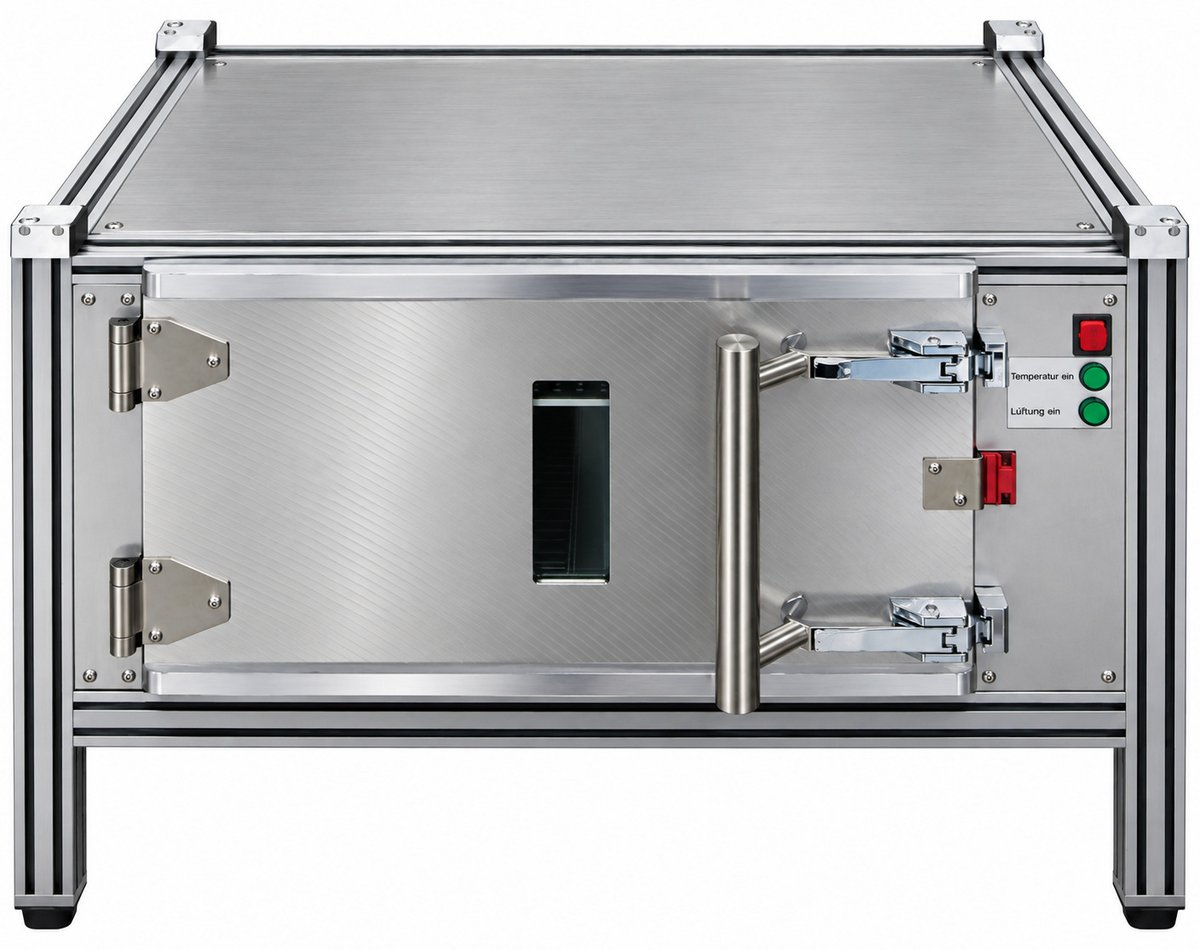
UV AOP chamber BS-OX: photochemical surface cleaning with 185 nm and ozone
The BS-OX is a UV AOP irradiation chamber for photochemical surface cleaning, ozone treatment and targeted contact angle modification. It removes organic contamination and raises the surface energy before parts are bonded, coated or printed – without wet-chemical pretreatment. In an oxygen-reduced atmosphere with typically 1 % oxygen, 185 nm generates ozone and reactive oxygen species that oxidise residues; 254 nm covers disinfection and direct photolysis. Eight UVC lamps can be fitted ozone-free, ozone-generating or mixed (4+4).
Photochemical cleaning and activation with 185 nm UVC in an oxygen-reduced atmosphere leads to ozone formation and the generation of reactive oxygen species. These efficiently oxidize organic contaminants and increase surface energy. This results in improved wettability and a reproducible reduction in the contact angle. This interplay of 185 nm UVC, ozone and radicals is an advanced oxidation process (AOP) – hence the name UV AOP chamber.
At the same time, the UV radiation is energetic enough to split organic compounds, for example.
The 185 nm spectrum is used for ozone and radical formation as well as direct photolysis of organic residues.
The underlying mechanism is described in Surface cleaning and activation with UVC.
The 254 nm wavelength also enables classic UVC processes such as disinfection and pretreatment for coating processes.
The BS-OX can operate with 8 ozone-free or ozone-generating UVC lamps. A mixed configuration in a 4+4 ratio allows for optional operation with an ozone-containing or ozone-free process atmosphere, thus supporting precise control of cleaning, oxidation, and surface activation.
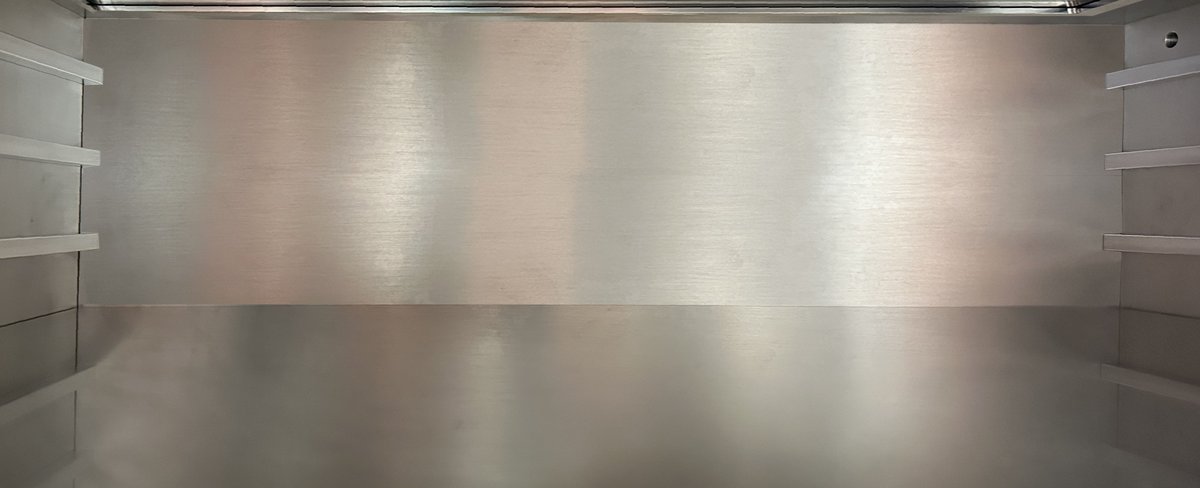
All internal surfaces are made of uncoated metals and quartz glass. Organic coatings or polymer-based protective layers are completely dispensed with. This means that there are no degradation products and no outgassing under 185 nm/254 nm irradiation. The result is a process chamber with stable boundary conditions for surface cleaning, ozone treatment, and reproducible contact angle changes.
The BS-OX is designed for industrial and scientific applications in which organic residual films, photoresist residues, or adsorbates limit the functionality of components.
Fields of application for AOP chamber BS-OX
- Activation of polymer, glass, ceramic, and metal surfaces prior to bonding, sealing, or coating
- Cleaning of optical components, wafers, microchips, and filters with subsequent increase in the polar surface area
- Adjustment of contact angle and surface energy for microfluidics, medical technology, and sensor technology
- Sterilization and degradation of odor- or color-active organic contaminants
Dual irradiation at 185 nm and 254 nm enables reliable degradation of organic residues through photolysis and downstream ozone/oxidation & radical reactions.
At the same time, the polar portion of the surface increases, which defines the wettability and contact angle.
Based on the proven BS irradiation chamber platform, a homogeneous, high-performance UVC sample chamber with generous internal dimensions is available. Short process times, moderate sample temperatures, and flexible lamp configurations qualify the BS-OX as a robust system for research, development, and production, especially in semiconductor and optics manufacturing as well as in the surface pretreatment of modern materials.
Technical data of AOP chamber BS-OX
| Interior chamber | 50 × 30 × 25 cm |
| Dimensions, chamber | 81 × 59 × 63 cm |
| Dimensions, UV-MAT | 19 × 25 × 10 cm |
| Weight | ~ 60 kg |
| Irradiation time | 1 s to 999 days |
| Power consumption | 225 W |
| Mains | 230 VAC, 2 A |
| Operation temperature | 10 to 40 °C |
| Humidity | < 80% non-condensing |
| Lamp lifetime | up to 8,000 h |
| Number of lamps | 8 |
| Lamp type | UVC, ozone generating; alternatively ozone free |
| Lamp power | 20 W each |
| Sample temperature | 25 °C ± 5 °C |
| Gas inlet / Gas outlet | Festo QSK-G1/4-10 for 10 mm hose diameter |
| Exhaust air | DN 100 connector for corrugated metal hose and suitable exhaust air treatment |
| Classification | Group 0 according to DIN EN 12198:2000 |
Ozone UVC chamber: what 185 nm is needed for
A plain UVC chamber works at 254 nm and breaks bonds. An ozone UVC chamber adds 185 nm – that wavelength splits atmospheric oxygen and generates ozone inside the chamber. The ozone then decays under 254 nm to atomic oxygen.
Only that combination cleans surfaces down to molecular residue. With 254 nm alone the organic film stays; with 185 nm alone the second step is missing.
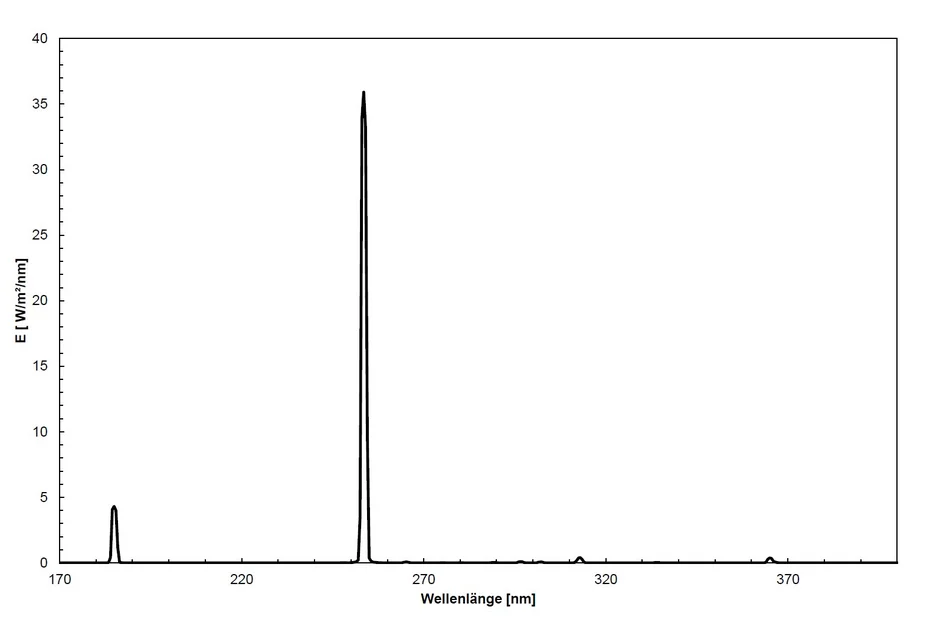
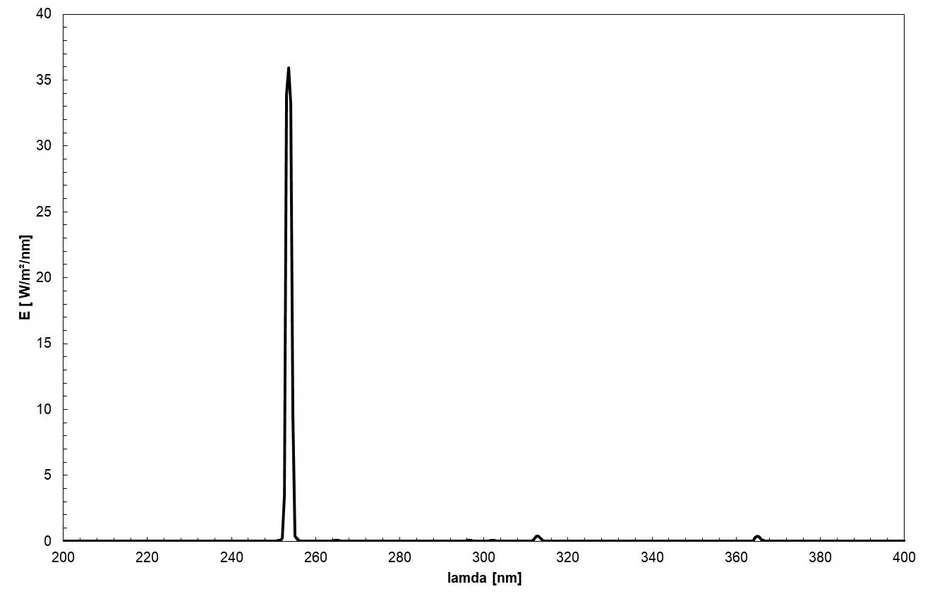
Spectra of the irradiation chamber BS-OX
The lamp configuration decides the process. The first figure shows the ozone-generating UVC lamp: besides 254 nm it emits at 185 nm, and that line splits oxygen into ozone and reactive oxygen species. The second shows the ozone-free lamp, where 185 nm is missing and only direct photolysis at 254 nm is at work. Both types can be mixed (4+4) to balance oxidation against photolysis.
Frequently asked questions about ozone and exhaust air on the BS-OX
No. While irradiation is running, the door of the BS-OX is locked. Once irradiation has ended the door is not released straight away: the integrated purge control first carries out the specified purge and extraction phase and only then unlocks the door. This rules out the chamber being opened directly after the ozone process, with the operator exposed to the ozone still present.
Allow for 5 minutes. The ozone concentration that actually remains depends on mixing, load and initial concentration and is to be assessed as part of the operator's risk assessment.
Continuous measurement of the ozone concentration inside the closed chamber is not part of the standard BS-OX. The concentration actually present depends on several process parameters: the lamp configuration (ozone-generating, ozone-free or mixed 4+4), the irradiation time, the oxygen concentration, the air flow and the oxidation reactions taking place inside the chamber. In addition, oxygen and ozone sensors age comparatively quickly and have to be calibrated about every six months – a permanently installed measurement therefore creates continuous maintenance effort. In practice, reproducible results are achieved by keeping the process parameters constant.
The BS-OX has a DN 100 connection and is intended for connection to suitable exhaust air or exhaust air treatment. A generally valid minimum or maximum volume flow in l/min cannot sensibly be specified, because it depends on the particular installation and on the intended process. As a guide value for extraction, assume one chamber volume per minute, that is about 40 l/min or 2.4 m³/h. What matters is the direction of the effect: a high continuous air exchange during irradiation reduces the ozone concentration inside the chamber and thus weakens the process, whereas a high volume flow is desirable during the purge phase.
The two irradiation controls compared
| Feature | 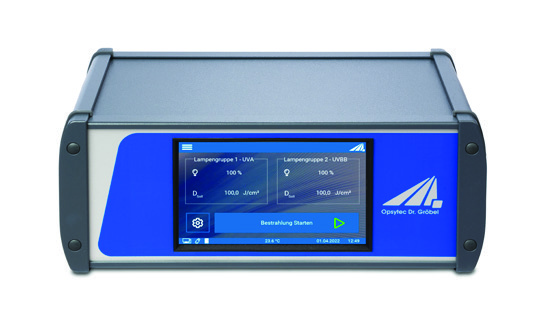 |  |
|---|---|---|
| Display | capacitive touch display | monochrome, 128 x 64 px |
| Memory | USB stick | – |
| Time-controlled irradiations | yes | yes |
| Recording of measurements | yes | – |
| Screenshots can be saved to a USB stick | yes | – |
| Pausing and restarting irradiations | yes | – |
| Adding notes and comments to an irradiation | yes | – |
| Remote control from a PC | yes | – |
| Irradiation records | on a USB stick | on the PC |
| User management and admin mode | yes | – |
| Simple firmware upgrades | yes | yes |
Both controls use the same sensors, so one sensor can be used with either device.
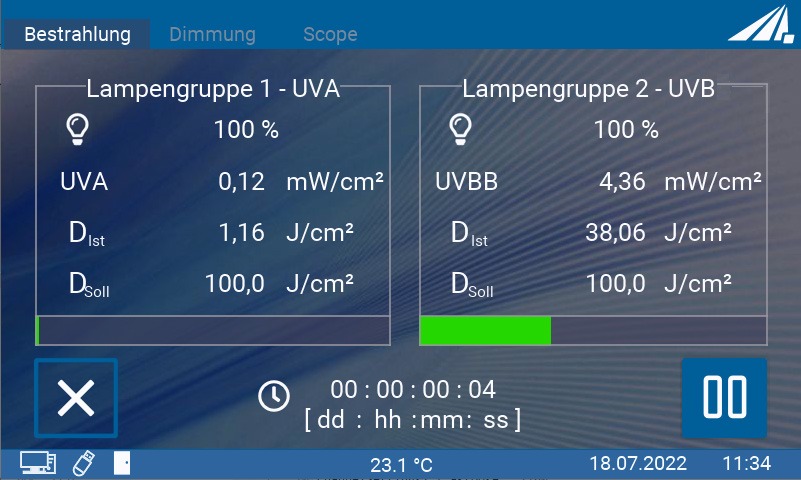
The UV-MAT Touch is operated through a high-resolution capacitive touchscreen. A Cortex ARM processor provides durability and the ability to update - new functions can be installed on site. The device and the PC software are compatible with Windows 10 and 11. Single- and multi-channel irradiations are shown numerically and graphically, together with oscillograms and the settings. Parameters are set directly on the device and are password protected.
Options
This option is available in addition to the standard equipment:
 | Remote control option Complex, multi-stage irradiations - for example a pre-irradiation at low irradiance followed by a high-intensity UVC irradiation - can be parameterised with the remote control option. Up to 30 dose- or time-controlled steps and pauses are possible. At the same time the irradiation is logged and stored on the PC. |
Order numbers, scope of delivery, accessories and versions
| Version | Order number |
|---|---|
| BS-OX | 860950 |
At 185 nm the chamber generates ozone and cleans surfaces with it; the 254 nm radiation additionally reduces microbial load. The scope of delivery comprises the BS-OX, the UV-MAT, the mains cable, the manual and UVC lamps - ozone-generating unless specified otherwise.
| Version | Order number |
|---|---|
| UV-MAT Touch | 820930ox |
| UV-MAT | 820920ox |
The chamber is controlled by the UV-MAT - either as the UV-MAT with a graphic display or as the UV-MAT Touch with a 5-inch touch display and oscilloscope view. Both measure the irradiance and switch off under dose control.
| Designation | Order number |
|---|---|
| PC software for the UV-MAT Touch | 860901 |
| Designation | Order number |
|---|---|
| curelog ONE dose meter | 680001C |
The curelog ONE in the UVC version records irradiance and dose inside the chamber. It is a measuring device in its own right with its own product page. For checking lamp intensity and ageing we recommend these cordless instruments: they record the irradiance and can be used for cyclic process monitoring.
| Service | Order number |
|---|---|
| Factory calibration | 710000 |
| ISO 17025 calibration | 17025 |
Accredited calibration to ISO/IEC 17025 in our own calibration laboratory. The calibrations are available as factory and as ISO 17025 calibration and are traceable to PTB standards.