

UV reflectance of materials – values, measurement methods and sources
UV reflectance is the fraction of incident UV radiation that a surface reflects. It depends on wavelength, material, surface condition and measurement geometry – and in the UV it often differs fundamentally from what the eye perceives in the visible range.
The range is wide: white emulsion and oil paints reflect less than 10 % at 254 nm in some cases [1][7], microporous PTFE averages 97.4 % over 250 to 500 nm [6], and UV-optimised mirror aluminium reaches at least 90 % at 254 nm [10]. For the design of disinfection systems, irradiation chambers and optical measurement set-ups, what counts is the reflectance at the wavelength actually used, not the name of the material.
This page compiles over 70 published measurements, each with wavelength, measurement method and source.
What is UV reflectance?
Reflectance ρ is the ratio of reflected to incident radiant flux, given as a number between 0 and 1 or as a percentage. At every wavelength the balance ρ + α + τ = 1 applies, with reflectance ρ, absorptance α and transmittance τ: whatever is neither reflected nor transmitted is absorbed. These quantities are explained in the Glossary of Optical Quantities and under Radiometric quantities.
- Specular (regular) reflection: angle of reflection equals angle of incidence – typical of polished metals and mirrors.
- Diffuse reflection: the radiation is scattered in all directions – typical of PTFE, plaster, matt paints and powders.
- Total reflection: specular and diffuse components together. Most table values refer to this quantity, but not all – see “Why published values differ”.
Wavelength is decisive
| Range | Wavelength | Typical sources and applications |
|---|---|---|
| Far-UVC | 200–230 nm | KrCl excimer lamps at 222 nm, disinfection in occupied rooms |
| UV-C | 100–280 nm | Low-pressure mercury lamps at 254 nm, UVC LEDs, disinfection |
| UV-B | 280–315 nm | Phototherapy, material ageing |
| UV-A | 315–400 nm | UV curing, fluorescence inspection, UV LEDs at 365–405 nm |
UV-A, UV-B and UV-C follow DIN 5031-7; “Far-UVC” is not a standardised limit, 200–230 nm is common. Details under Spectral ranges and standards. A material that reflects well at 365 nm can absorb much more strongly at 254 nm or 222 nm – values cannot be transferred from one wavelength to another.
UV reflectance at a glance
For each value the tables give the wavelength and, in the last column, the source; the measurement methods are explained further below. “200–400 nm” means an average over the whole UV range, not a value at a single wavelength.
Aluminium
| Material | Wavelength | Reflectance | Source |
|---|---|---|---|
| Anolux MIRO UVC (UV mirror aluminium) | 254 nm | min. 90 % | [10] |
| Anolux UVS | 254 nm | min. 86 % | [10] |
| MIRO UV C (Alanod) | UV-C, not specified | above 90 % | [9] |
| Aluminium, sputtered on glass | 254 nm | 75–85 % | [1] |
| Aluminium foil, matt / shiny side | 254 nm | 75.7 / 65.9 % | [2] |
| ALZAK-treated aluminium | 254 nm | 65–75 % | [1] |
| Aluminium, surface-treated | 254 nm | 60–89 % | [1] |
| Aluminium, anodised | 222 and 254 nm | 61–62 % (45°, mainly specular) | [5] |
| Aluminium, anodised, mirror grade | 222 nm | 58–64 % | [4] |
| Aluminium, untreated | 254 nm | 40–60 % | [1] |
| Aluminium, polished | 222 nm | 42.8 % (NIST, 8°:d) to 55.6 % (d:d) | [4] |
| Aluminium, shiny, untreated | 200–400 nm | 39 % | [7] |
| Aluminium, sandblasted | 222 nm | 29.5 % (NIST) or 36 % | [4] [3] |
| Aluminium sheet | 254 nm | 32.2 % | [2] |
| Duralumin | 254 nm | 16 % | [1] |
| Aluminium, black anodised | 222 nm | 4–7.8 % | [3] |
“Aluminium” on its own says little about UV reflectance: between UV mirror aluminium and black anodised sheet there is more than a factor of ten. Alloy, roughness, oxide and anodic layer determine the value.
Stainless steel, steel, chromium, copper, brass, titanium
| Material | Wavelength | Reflectance | Source |
|---|---|---|---|
| Chrome-plated | 254 nm | 39 % | [1] |
| Stainless steel 316 | 222 nm | 36 % | [3] |
| Stainless steel, polished | 222 nm | 33.9 % | [3] |
| Chromium, polished | 222 nm | 32.6 % | [3] |
| Stainless steel / tinplate | 254 nm | 25–30 % | [1] |
| Mild steel, brushed / oxidised | 200–400 nm | 29 / 10 % | [7] |
| Copper foil | 222 nm | 27.6 % | [3] |
| Copper sheet | 254 nm | 26.4 % | [2] |
| Stainless steel sheet | 254 nm | 24.5 % | [2] |
| Brass 260 | 222 nm | 24.2 % | [3] |
| Stainless steel 304 | 222 nm | 22.4 % | [3] |
| Titanium 6Al4V | 222 nm | 21.4 % | [3] |
| Stainless steel #4, brushed | 222 nm | 12 % (45°, mainly specular) | [5] |
| Copper Cu-110 | 222 nm | 6.8 % | [3] |
Metals that look bright and shiny in the visible range usually reflect only 20 to 40 % of UV-C – far less than optimised aluminium.
PTFE and other diffuse reflectors
| Material | Wavelength | Reflectance | Source |
|---|---|---|---|
| Microporous PTFE, 2 mm | 250–500 nm (average) | 97.4 % | [6] |
| e-PTFE | UV-C | above 95 % | [8] |
| Spectralon | 250–2500 nm | above 95 % | [11] |
| PTFE, solid | 250–500 nm | 85–95 % | [6] |
| PTFE sheet, 1.5 mm | 222 nm | approx. 88 % | [4] |
| Magnesium oxide | 254 nm | 75–88 % | [1] |
| Barium sulfate | 222 nm | 72.1 % | [4] |
| Calcium carbonate | 254 nm | 70–80 % | [1] |
| Multi-layer insulation (MLI) | 222 nm | 66 % | [13] |
| PTFE tape | 222 nm | 27.6 % | [4] |
Not all PTFE reflects alike: pore structure and thickness are decisive. Thin PTFE tape transmits a large part of the radiation and reaches only 27.6 % at 222 nm. Below about 240 nm, absorption increases even in PTFE [6].
Barium sulfate is a reflector for UV-A and the visible range, not for UV-C. Between 300 and 400 nm it reaches just under 90 %, in the visible about 93 %; below that it drops – to around 80 % at 250 nm and 72 % at 222 nm [4]. For measurements at 254 nm and 222 nm, PTFE is the suitable coating, see Integrating spheres.

Paints and coatings
| Paint or coating | Wavelength | Reflectance | Source |
|---|---|---|---|
| Aluminium paint | 254 nm | 40–75 % | [1] |
| White water-based paints | 254 nm | 10–35 % | [1] |
| Mineral interior paint (lime white) | 200–400 nm | 17.3 % | [7] |
| White emulsion paints (PVAc, styrene acrylic) | 200–400 nm | 7.4–11 % | [7] |
| Wall paint white/grey on plasterboard | 222 nm | 6.7–8.1 % | [3] |
| White paint (interior) | 254 nm | 6.7 % | [2] |
| White oil paints | 254 nm | 3–10 % | [1] |
| White baked enamel | 254 nm | 5–10 % | [1] |
| Black lacquer | 254 nm | 5 % | [1] |
| Zinc oxide paint | 254 nm | 4–5 % | [1] |
Building materials and indoor surfaces
| Material | Wavelength | Reflectance | Source |
|---|---|---|---|
| Plaster with 90 % BaSO₄ (laboratory formulation) | 254 nm | 77.2 % | [2] |
| Plaster with CaCO₃ (laboratory formulation) | 254 nm | 73.4 % | [2] |
| New gypsum plaster | 254 nm | 55–60 % | [1] |
| Expanded polystyrene | above 230 nm | 51 % | [7] |
| White plaster | 254 nm | 40–60 % | [1] |
| Japanese plaster (commercial) | 254 nm | 38.3 % | [2] |
| Tile white / grey | above 230 nm | 34 / 17 % | [7] |
| Mortar | 254 nm | 21.2 % | [2] |
| Concrete | 254 nm | 14.9 % | [2] |
| Concrete, raw / sealed | 222 nm | 8.6 / 6.1 % | [3] |
| Red brick | above 230 nm | 7.1 % | [7] |
| Ceiling tiles, 37 types | 254 nm | 3.5–45.9 % | [14] |
| Ceiling tiles, white | 222 nm | 4.9–33 % | [3] |
| Vinyl flooring / LVT | 222 nm | 6.3–9.4 % | [4] |
Wood, plastics and work surfaces
| Material | Wavelength | Reflectance | Source |
|---|---|---|---|
| Laminate worktop, white | 222 nm | 15.4 % | [3] |
| Walnut / oak (veneer) | 222 nm | 9.0 / 8.6 % | [3] |
| Corian / quartz stone | 222 nm | 8.6 % each | [3] |
| Particle board / construction timber | above 230 nm | 6.3 / 5.9 % | [7] |
| Cedar wood | 254 nm | 4.7 % | [2] |
| High-pressure laminate, smooth / rough | 200–400 nm | 4.7 / 3.3 % | [7] |
| Polyimide / PVC | 222 nm | 4.2 / 3.9 % | [13] |
Outdoor surfaces: UV albedo in sunlight
Outdoors, reflectance is called albedo. The values apply to broadband solar UV (mainly UV-B, usually erythema-weighted) and cannot be transferred to UV-C [12].
| Surface | Albedo in solar UV | Source |
|---|---|---|
| Fresh snow, dry | 85–94 % | [12] |
| Salt lake | 69 % | [12] |
| Sand, dry | 15–18 % | [12] |
| Concrete | 7–16 % | [12] |
| Water (lake shore) | 2.7–4.8 % | [12] |
| Lawn, mown | 0–4 % | [12] |
Fresh snow reflects almost all UV radiation – which is why UV exposure is so high when skiing, even with the sun low in the sky.
Why does aluminium reflect UV so well?
Metals reflect through their free electrons: below the plasma frequency they follow the electric field of the radiation and send it back. For aluminium this limit lies deep in the vacuum UV, at about 80 nm; its strongest absorption due to interband transitions, on the other hand, lies in the near infrared around 800 nm. Across the entire UV, pure, freshly evaporated aluminium therefore remains a reflector of around 90 %.
Other metals lack this advantage. Silver, the best mirror in the visible, collapses below about 320 nm; gold and copper absorb in the blue and UV through interband transitions. Iron, chromium and stainless steel absorb through interband transitions across the whole UV and reflect only 20 to 40 % in the UV-C.
In practice the surface determines how much of this remains. The natural oxide is only a few nanometres thick and transparent in the UV. Anodic layers, dyes in coloured anodising, contamination and roughness, however, lower the value considerably – black anodised aluminium reflects only 4 to 8 % at 222 nm [3]. UV mirror aluminium therefore carries reflective and protective layers designed specifically for the UV.
Why does white paint reflect UV so poorly?
White is an impression in the visible range between about 380 and 780 nm. It says nothing about the UV.
Most white paints contain titanium dioxide as pigment. TiO₂ has a band gap of about 3.0 to 3.2 eV and therefore absorbs radiation below roughly 390 to 410 nm almost completely – the same reason it is used in sunscreens. Zinc oxide behaves similarly. In addition, organic binders absorb in the UV-C.
White wall, emulsion and oil paints therefore mostly stay below 10 % at 254 nm and 222 nm. Exceptions are paints based on lime, barium sulfate or calcium carbonate; in a Japanese laboratory test, plaster with 90 % barium sulfate reached 77 % [2].
Why published values differ
The sources on this page use four different measurement methods, and values from different methods are not directly comparable:
| Method | What is measured | Sources |
|---|---|---|
| Spectrophotometer with integrating sphere, 8°:d | Total reflectance at each wavelength | NIST values in [4]; [2], [6], [11], [14] |
| Lamp and radiometer, d:d (bi-hemispherical) | Total reflectance for the spectrum of the real lamp, e.g. 222 nm | [3]; Ushio values in [4] |
| Lamp and radiometer, 45°/45° | Mainly the specular component; rough surfaces appear lower | [5], [13] |
| Average over 200–400 nm | Unweighted average over the whole UV; field measurements only from 230 nm | [7] |
In addition there are compilations without a stated measurement method (table in [1]) and manufacturer data without stating whether specular or total reflectance is meant ([8], [9], [10]). The reference standard also matters: if measured against Spectralon instead of absolutely, UV values come out slightly too high, because Spectralon itself reaches only about 95 % at 250 nm [7].
Measuring reflectance yourself
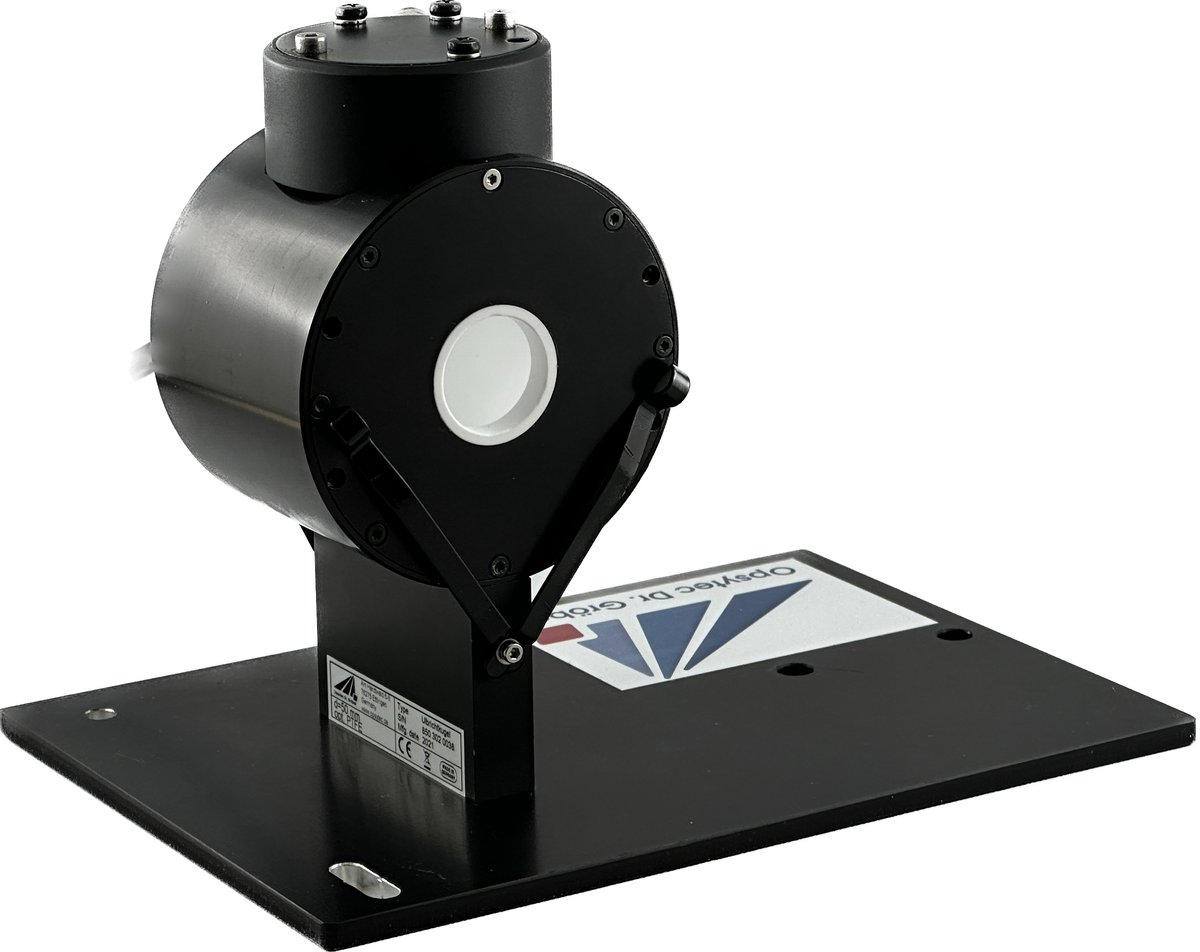
Reflectance is measured with a spectrophotometer and an integrating sphere (Ulbricht sphere). The sphere collects the radiation reflected by the sample from all directions. With the 8°:d geometry, radiation strikes the sample at 8° and the sum of all directions is detected. For glossy samples it must be stated whether the specular component is included (SCI, Specular Component Included) or excluded by a gloss trap (SCE, Specular Component Excluded).
For UV-C measurements the sphere must be coated with PTFE; barium sulfate only reaches down to about 300 nm. Opsytec manufactures integrating spheres with PTFE, barium sulfate and gold coatings. The integrating sphere for the Agilent Cary 60 extends the spectrophotometer to measure diffuse reflectance and transmittance from 200 to 1100 nm, with 0° and 8° geometries. How coating, ports and diameter interact is calculated in the integrating sphere design tool.
Which material for which purpose?
- High diffuse reflectance in the UV-C (254 nm, 222 nm): microporous PTFE, e-PTFE, solid PTFE. Spectralon is only specified from 250 nm.
- High diffuse reflectance in the UV-A: additionally barium sulfate, magnesium oxide and calcium carbonate.
- High specular reflectance: UV mirror aluminium (e.g. MIRO UV C, Anolux UVC) as well as evaporated or sputtered aluminium.
- Low reflectance, e.g. for shielding: black lacquer (5 %), black anodised aluminium (4–8 %), wood (5–9 %), titanium dioxide or zinc oxide paints (below 10 %).
In rooms with UV disinfection, a reflective environment increases the effect, but it also increases the radiation that reaches people. The safety assessment must therefore take the reflectance of room surfaces into account, see Safety of UV disinfection. In irradiation chambers, the wall materials determine how uniformly the sample is irradiated; you can try this out in the UV chamber irradiance calculator.
Ageing of reflective materials
UV-C alters plastics, coatings and organic binders: yellowing, embrittlement, changed scattering and decreasing reflectance are the result. Even Spectralon loses significant reflectance at 250 nm after long UV exposure [11]. PTFE and aluminium are considered comparatively stable. Anyone who needs constant conditions over years should re-measure the reflectance and check the UV irradiance regularly, see UVC meter.
Frequently asked questions about UV reflectance
Which material reflects UV radiation most strongly?
Diffuse: microporous PTFE with an average of 97.4 % over 250–500 nm [6]. Specular: UV mirror aluminium with at least 90 % at 254 nm [10].
What is the UV reflectance of aluminium?
That depends on the surface. At 254 nm, 40–60 % is given for untreated aluminium, 60–89 % for surface-treated aluminium and at least 90 % for UV mirror aluminium [1][10]. Aluminium sheet measured 32 % in one study [2]; black anodised aluminium reflects only 4–8 % at 222 nm [3].
What is the reflectance of stainless steel in the UV-C?
Usually 20 to 36 %: 25–30 % at 254 nm [1], 22–36 % at 222 nm depending on grade and surface [3]. Brushed stainless steel #4 reached only 12 % in a 45° measurement [5].
Does white paint reflect UV radiation?
Hardly. Common white wall, emulsion and oil paints mostly stay below 10 % at 254 nm and 222 nm [1][2][3][7], because the white pigment titanium dioxide absorbs UV. Only some water-based and lime paints reach 10 to 35 %.
What is the UV reflectance of PTFE?
Microporous PTFE reaches an average of 97.4 % over 250–500 nm, solid PTFE 85–95 % [6]. A 1.5 mm PTFE sheet measured around 88 % at 222 nm, thin PTFE tape only 28 % [4].
Is barium sulfate suitable as a reflector in the UV-C?
Only to a limited extent. Barium sulfate reflects just under 90 % between 300 and 400 nm, but only 72 % at 222 nm [4]. For integrating spheres and chambers in the UV-C, PTFE is the better choice.
Which coating does an integrating sphere need for UV measurements?
PTFE, as soon as measurements are made below 300 nm. Barium sulfate is suitable for UV-A and the visible range, gold for the infrared, see Integrating spheres.
Does snow reflect UV radiation?
Yes, very strongly: fresh, dry snow reflects 85 to 94 % of solar UV [12], sand 15 to 18 %, water only 3 to 5 %.
Does the reflectance have to be known at the actual wavelength?
Yes. Values at 222 nm, 254 nm, 365 nm or averages over 200–400 nm are not interchangeable. For a design, what counts is the reflectance in the spectrum of the source used, measured in a comparable geometry.
Sources
- Signify/Philips (2020): UV Purification Application Information, Table 3 “Reflectance of various materials to UV-254 nm radiation” – compilation without stated measurement method – open source
- Endo et al. (2021), Scientific Reports – 254 nm, spectrophotometer with integrating sphere – open source
- Ushio America (2022): Reflectance of materials at 222 nm – KrCl lamp, d:d, uncertainty about 7 % – open source
- Claus (Ushio) & Cooksey (NIST), CORM 2022 – 222 nm, NIST 8°:d and Ushio d:d – open source
- Ma et al. (2023), Science of the Total Environment – 222 and 254 nm, 45°/45° – open source
- Quill et al., Porex: Ultraviolet Reflectance of Microporous PTFE – total reflectance 250–500 nm – open source
- BAuA report F2422 (German Federal Institute for Occupational Safety and Health) – unweighted average 200–400 nm; field measurements from 230 nm – open source
- CIS UVC (2024): AN011 Reflective Materials – open source
- Alanod: UV Applications Brochure – open source
- Anomet: Reflective Aluminum – Anolux MIRO UVC and UVS, 254 nm – open source
- Labsphere: Technical Guide – Reflectance Coatings and Materials – open source
- Turner & Parisi (2018): Ultraviolet Radiation Albedo and Reflectance in Review, Int. J. Environ. Res. Public Health – solar UV – open source
- Petersen et al. (2025), Microbiology Spectrum – 222 nm, 45°/45° – open source
- Wengraitis & Reed (2012), Photochemistry and Photobiology – 37 ceiling tiles, spectral with integrating sphere – open source
All values are data from the respective authors and manufacturers, checked against the original sources on 28 September 2026. Alloy, surface finish, layer thickness, ageing and measurement geometry lead to different results; safety-relevant designs require measurements on the materials actually used.
Author: Dr. Mark Paravia
Dr.-Ing. Mark Paravia is the managing director of Opsytec Dr. Gröbel GmbH in Ettlingen and heads the accredited calibration laboratory. Following his research on pulsed xenon excimer discharges at the Institute of Lighting Technology at KIT, his focus today is optical radiation measurement. He is vice-chair of the DIN standards committee FNL 7 “Optical radiation” and a member of the DVGW project group on UV disinfection.