


UV erythema in the workplace
UV erythema is a reddening of the skin caused by ultraviolet radiation – commonly known as sunburn and a visible indicator that skin damage has already occurred. In the workplace it affects not only people working outdoors but everyone exposed to artificial UV radiation, for example during welding, UV curing or UV disinfection.
How high the exposure actually is can be determined by measurements with UV meters and radiometers.
Consequences of UV erythema in the workplace
The mild effects of UV erythema can include slight redness, itching and pain.
These symptoms are usually short-lived and normally subside within one to two days, but can last up to five days. For the eyes, UVC can cause photokeratitis and photoconjunctivitis, both conditions which, although unpleasant, are usually reversible and preventable by wearing appropriate protective eyewear.

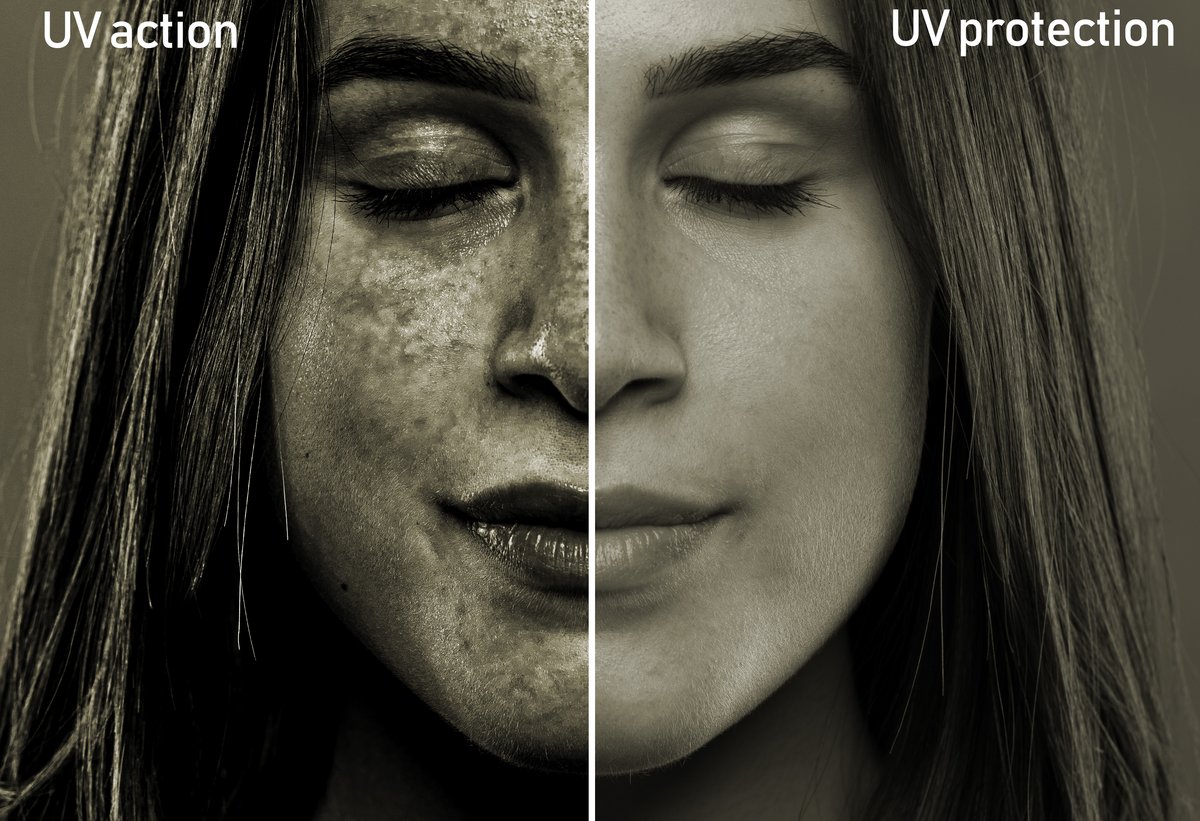
Although these symptoms are usually temporary, a recurrence of UV erythema is a warning sign of potential damage to the skin, including an increased risk of skin cancer. It is therefore important to take the symptoms seriously and take preventative measures.
Although UV erythema in the workplace often appears as a mild skin irritation, in some cases, especially with long-term exposure, it can have more serious consequences. These include:
- premature skin aging
- pigmentation disorders
- an increased risk of skin cancer
Protective measures and personal protective equipment (PPE)
Various protective measures are required to prevent UV erythema in the workplace, including The first priority is to determine the exposure. The spectrum, irradiance and duration of exposure are important.
According to § 7 OStrV, the following order of priority must be taken into account when determining and implementing protective measures:
- avoidance or minimization of hazards from incoherent optical radiation
- technical protective measures
- organizational protective measures
- personal measures, in particular personal protective equipment
- Employers should provide appropriate personal protective equipment (PPE), such as protective goggles, gloves, long-sleeved clothing, but also sun creams with a high sun protection factor (SPF)
- Education and training: training on the risks of UV exposure and the proper use of PPE can help raise employee awareness of the importance of UV
- protection measurements and risk assessments
- measurement data is used to assess worker exposure on the basis of the "Artificial Optical Radiation Directive" and to determine the permissible daily exposure Heff and HUVA according to guideline 2006/25/EC. These limit values are defined specifically for UV radiation with wavelengths between 180 and 400 nm. They represent conditions under which most healthy workers can be repeatedly exposed without suffering acute health damage such as erythema (reddening of the skin) or photokeratitis (a type of eye damage). These limits apply particularly to continuous radiation sources and are designed to provide a guideline that makes the use of UV sources safer, but should not be seen as a strict dividing line between safe and unsafe.
Erythemally effective irradiance: the quantity behind sunburn
Erythema is not caused by “UV” but by a very narrow part of it. Between 297 and 400 nm the effectiveness falls by about four orders of magnitude: 1 mW/cm² at 300 nm reddens the skin, the same irradiance at 380 nm practically does not. A figure in mW/cm² UV-A therefore says nothing about the hazard to skin as long as the wavelength is left open.
The erythema action spectrum ser(λ) to ISO/CIE 17166 captures this in one curve. It is normalised to 1 between 250 and 298 nm and falls off above that in two stages. Multiplying the measured spectrum by this curve and summing over the range gives the erythemally effective irradiance Eer in W/m² – the only quantity with which two different sources can be compared at all where skin is concerned.
From irradiance to dose
| Quantity | Symbol | Unit | Definition |
|---|---|---|---|
| Erythemally effective irradiance | Eₑᵣ | W/m² | Spectrum times sₑᵣ(λ), summed over 250–400 nm |
| Erythemally effective exposure (dose) | Hₑᵣ | J/m² | Eₑᵣ times time |
| Standard erythema dose | SED | 1 SED = 100 J/m² | Standardised dose unit, independent of skin type |
| Minimal erythema dose | MED | depends on skin type | Dose at which reddening appears – about 2.5 SED for skin type II |
| UV index | UVI | – | UVI = 40 · Eₑᵣ in W/m² |
How erythemally effective radiation is measured
Two routes lead to the value, and they differ in effort and scope:
- Measure spectrally and calculate. A spectroradiometer such as the UVpad E delivers the spectrum; the weighting with ser(λ) is then applied computationally. That is the accurate route and the only one when the source is unknown or narrowband – and from the same spectrum the actinic weighting to IEC 62471 and the erythema weighting can be determined side by side.
- Measure weighted. A sensor whose spectral responsivity reproduces the erythema curve delivers Eer directly. Such interchangeable measuring heads are available for the RMD Pro; the instrument then shows not a raw irradiance but the assessed quantity. That is the quick route for recurring checks of a known source.
The second route depends entirely on how closely the sensor matches the curve. Because ser(λ) spans four orders of magnitude, a small deviation of the flank at 300 nm matters more than a large error in the UV-A. Any figure therefore belongs together with the spectral mismatch of the sensor against the real source – and a traceable calibration to ISO 17025.
How the dose converts into SED and MED, and which values apply to the skin types, is set out in detail under standard erythema dose and minimal erythema dose. The legal framework at the workplace – limits, risk groups and risk assessment – is covered by occupational safety and photobiological safety.
Choosing a sensor for workplace exposure measurements
For risk assessment and occupational safety, DIN EN 14255-1 governs the measurement and assessment of personal exposure to artificial optical radiation. DIN EN 14255-1 contains no limit values of its own; these are set out in Directive 2006/25/EC on artificial optical radiation, which has been transposed into national law.
The sensors need a certain sensitivity for these measurements. Choose a sensor – UVA or UVB, for instance – with a measuring range of 0–2 mW/cm². Under Directive 2006/25/EC the limit for UVA radiation is 104 J/m². For a daily working time of eight hours this corresponds to a continuous irradiance of 0.035 mW/cm².
For short tasks the irradiance may be correspondingly higher. Example:
- Task: daily cleaning
- Duration: 10 min
- Exposure limit: HUVA = 104 J/m²
- Resulting permissible irradiance: 1.68 mW/cm²
- Calculate UV dose from irradiance and time
Tip: When designing UV installations, make sure the irradiance – seen against the duration of the activity – does not exceed the exposure limit. Any installation at which employees may be exposed to the radiation should be assessed: even fractions of a µW/cm² of weighted irradiance use up the daily limit of 30 J/m² within an eight-hour shift.
For permanent installation in equipment, inline sensors are available; which sensor type suits which source is set out in the UV sensor selection guide.
Author: Dr. Mark Paravia
Dr.-Ing. Mark Paravia is the managing director of Opsytec Dr. Gröbel GmbH in Ettlingen and heads the accredited calibration laboratory. Following his research on pulsed xenon excimer discharges at the Institute of Lighting Technology at KIT, his current focus is on optical radiation measurement technology. He is vice-chair of the DIN Standards Committee FNL 7 “Optical Radiation,” and a member of the DVGW Project Group on UV Disinfection.