



UV irradiation chamber BS-02CT for IEC 60335-1
The irradiation chamber BS-02CT tests non-metallic materials according to IEC 60335-1 – German adoption DIN EN IEC 60335-1 VDE 0700-1:2026-09 – for their stability against direct or reflected UVC radiation from 200 nm to 280 nm. The UVC low-pressure mercury lamps emit a continuous spectral irradiance of 10 W/m² at 254 nm, IR heaters hold a black-panel temperature of 63 °C ± 3 °C, and the exposure duration can be set to 1000 h.
The full title of the standard is “Household and similar electrical appliances – Safety – Part 1: General requirements - Edition 5.2”. The test is used to verify radiation stability against UVC radiation that can cause aging like discolorations, changes in material properties, crack formation and smell.
The irradiation chamber BS-02CT can also be used to test material properties that are disinfected by UV-C. Typically the UVC dose of a daily disinfection for a period of two years can be accelerated to 12 hours.
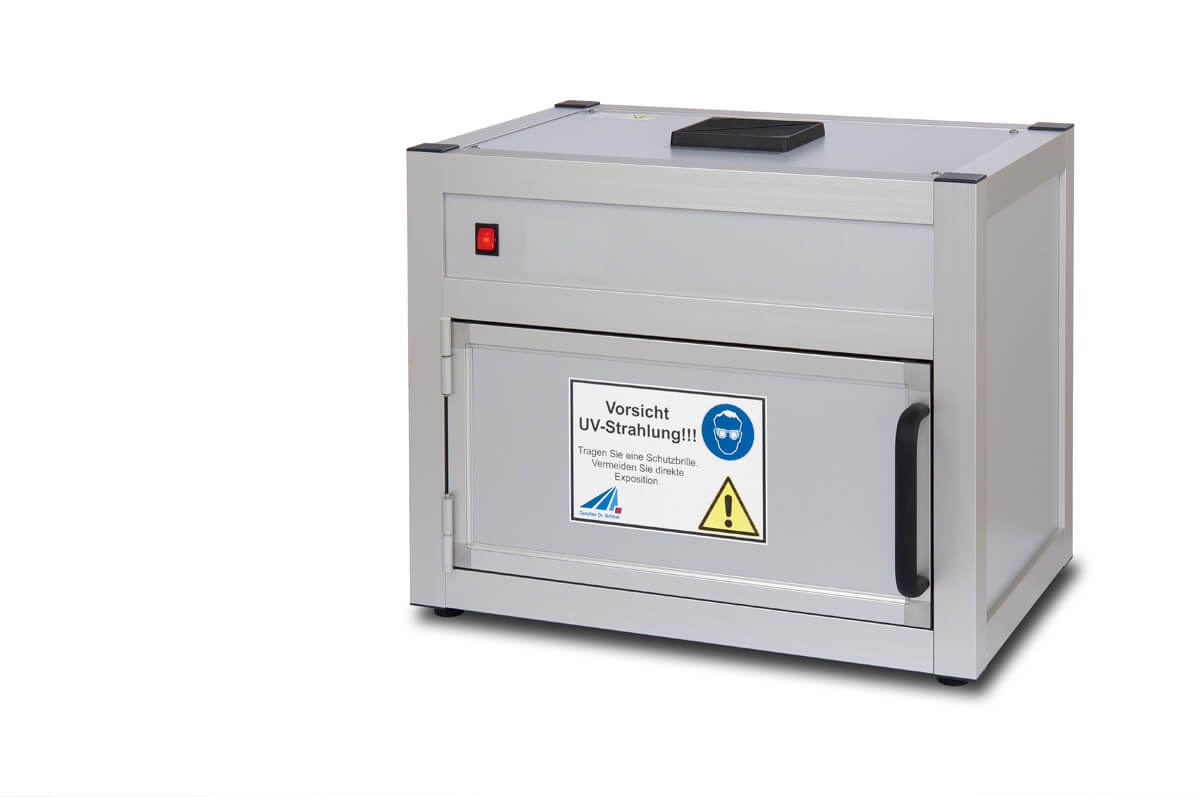
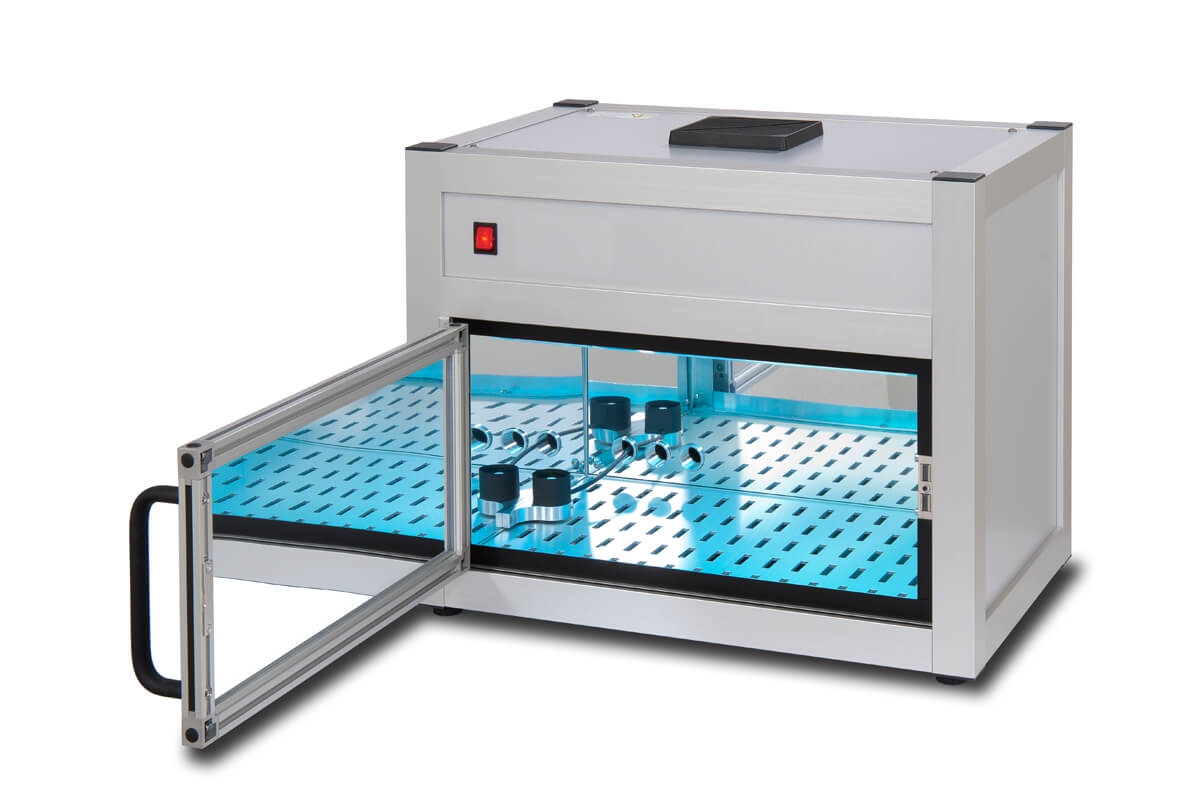
The BS-02CT is a compact, robust piece of equipment for the time- or dose-controlled irradiation of samples with UVC.
The interior irradiation chamber has a base area of 46 × 32 cm² and a height of 23 cm. The sample chamber operating temperature is about 25 °C to 70 °C so that thermal damage to the specimen can be avoided or accelerated. Due to the high uniformity of the irradiation, the samples may be positioned in any order.
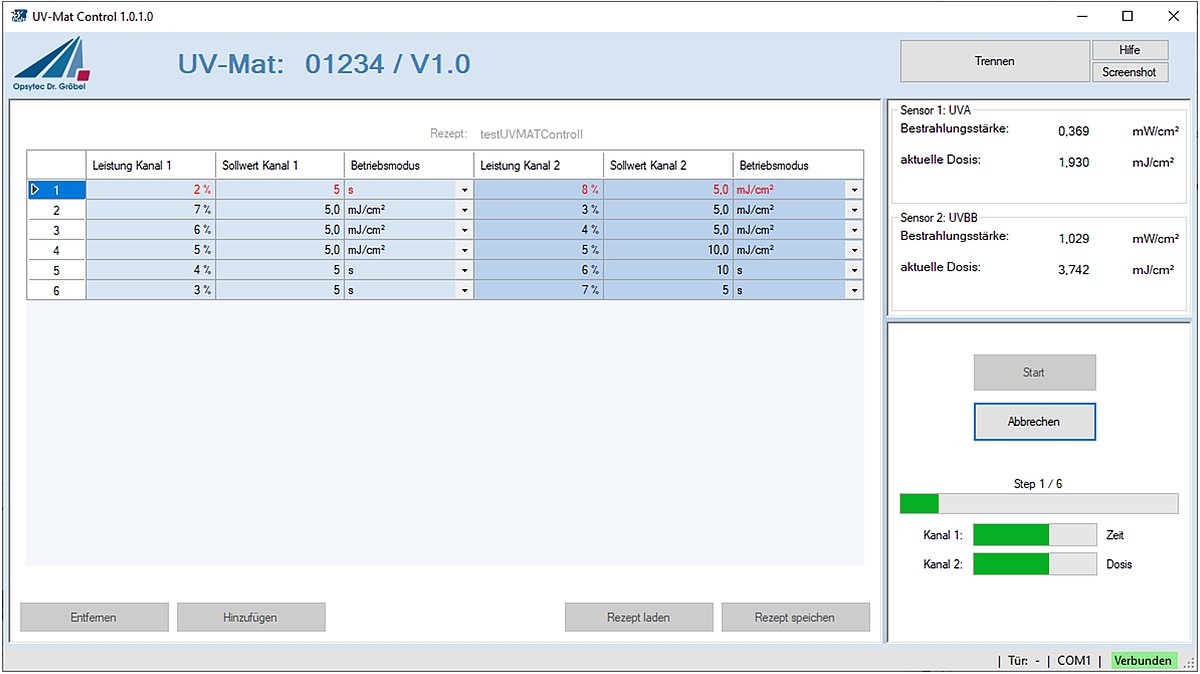
The irradiation control UV-MAT can control the UVC lamps to achieve a constant dose independent of lamp aging, contamination or temperature. The dose is measured with a calibrated sensor. For this purpose, the sensor already contains an extremely precise analog-digital converter and a temperature sensor. This can also be calibrated according to ISO/IEC 17025 on request.
The UV-MAT can optionally be controlled by a PC. This allows multi-stage irradiation and documentation of the irradiation.
Temperature control is provided by an external PID controller that measures the temperature of a thermocouple or black-panel temperature sensor.
This makes the BS-02CT the chamber for UV testing of household appliances to IEC 60335-1 – standard, sample temperature and dose control working together in one instrument.
Applications of Irradiation chamber BS-02CT
- Testing for non-metallic materials
- Testing of samples according to IEC 60335-1
- Resistance to UVC disinfection
- UVC ageing
Technical data BS-02CT
| Interior chamber | 46 × 32 × 23 cm |
| Dimensions | 58 × 40 × 47 cm |
| Weight | ~ 32 kg |
| Power consumption | 700 W |
| Mains | 110–230 VAC, 50/60 Hz |
| Operation temperature | 10 to 40 °C |
| Humidity | < 80% non-condensing |
| Lamp lifetime | up to 9,000 h |
| Number of UVC lamps | 4 |
| UVC lamp power | 15 W each |
| Irradiance UVC | 10–50 W/m² |
| IR heater | 4, emitting from the top |
| IR lamp power | 150 W each |
| Sample temperature | 25 °C to 70 °C; cooling uses ambient air, so the sample temperature is at least 5 °C above ambient |
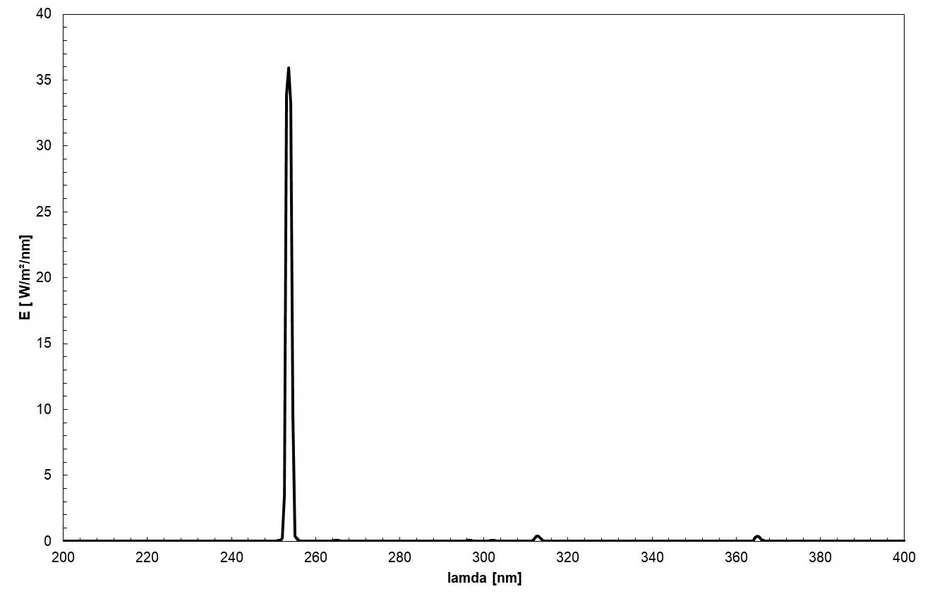
Spectra of the irradiation chamber BS-02CT
The four UVC low-pressure mercury lamps of the BS-02CT emit almost their entire UV output on the resonance line at 254 nm – inside the 200 to 280 nm range that IEC 60335-1 prescribes for the test. How small the remaining lines are is what the figure shows in absolute terms: 313, 365, 405 and 436 nm stay far below. The IR emitters radiate beyond 780 nm and only hold the black-panel temperature of 63 °C.
Equipment in detail
The BS-02CT has a modular design and can therefore be adapted to different test tasks. These functions are always included:
 | Dose control The irradiance is measured continuously; the UV-MAT ends the irradiation once the set target dose is reached. |
 | Sensors Suitable materials give the sensors excellent long-term stability. They are traceably calibrated, can be recalibrated and are supplied with a factory or ISO 17025 calibration certificate. |
 | Control and dimming The UVC lamps can be dimmed; the irradiance can be reduced to about 30 %. |
 | Timer As an alternative to dose control the UV-MAT offers an adjustable timer for time-controlled irradiations between 1 s and 999 days. |
Options
This option is available in addition to the standard equipment:
 | Remote control option Complex, multi-stage irradiations - for example a pre-irradiation at low irradiance followed by a high-intensity UVC irradiation - can be parameterised with the remote control option. Up to 30 dose- or time-controlled steps and pauses are possible. At the same time the irradiation is logged and stored on the PC. The chamber is connected via USB 2.0. |
Irradiation control and temperature controller
The UV-MAT measures the irradiance through a fully digital sensor input and ends the irradiation once the set dose is reached.
| Measuring range | 0 to 200 mW/cm² |
| Resolution | 24 bit |
| Sensor inputs | 1, fully digital |
| PC interface | USB 2.0 (optional) |
| Display | graphic, 128 × 64 px |
| Dimensions | 185 × 251 × 100 mm |
| Permissible operating temperature | 0 to 40 °C |
The sample temperature is set with an external PID controller. It is measured with a thermocouple, available as an accessory.
| Temperature control | external PID controller |
| Measuring range | 0 to 150 °C |
| Resolution | 0.1 °C |
| Sensor inputs | 1, thermocouple |
| Dimensions | 185 × 251 × 100 mm |
| Permissible operating temperature | 0 to 40 °C |
Order numbers, scope of delivery, accessories and versions
| Version | Order number |
|---|---|
| BS-02CT | 860902CT |
The temperature-controlled chamber tests to IEC 60335-1. The scope of delivery comprises the BS-02CT, the UV-MAT, the temperature controller, the mains cable, the manual, ozone-free UVC lamps and four lamp attenuators.
| Designation | Order number |
|---|---|
| Remote control | 860900 |
The USB remote control operates the chamber from a PC and integrates it into an automated test sequence.
| Designation | Order number |
|---|---|
| Radiometer sensor | 814410 |
The UVC sensor measures the irradiance inside the chamber. Further spectral ranges are listed under radiometer sensors.
| Designation | Order number |
|---|---|
| Thermocouple | 860902TCK |
The type K thermocouple records the sample temperature during the irradiation.
| Service | Order number |
|---|---|
| Factory calibration | 710000 |
| ISO 17025 calibration | 17025 |
Accredited calibration to ISO/IEC 17025 in our own calibration laboratory. The calibrations are available as factory and as ISO 17025 calibration and are traceable to PTB standards.