



Collimated Beam Device BSM-03 CBD
The collimated beam device BSM-03 CBD is an irradiation chamber for the reproducible, dose-accurate UV irradiation of liquid samples in a collimated beam. An ozone-free medium-pressure Hg lamp with a pneumatically controlled shutter irradiates a sample chamber of 60 × 40 × 25 cm at room temperature plus 2 to 5 °C. It is used for the UV irradiation specified in Section 4.2.4.6 of the ECHA/EFSA guidance on drinking water treatment.
The „Guidance document on the impact of water treatment processes on residues of active substances or their metabolites in water abstracted for the production of drinking water“ of the European Chemicals Agency (ECHA) and the European Food Safety Authority (EFSA) provides a framework for risk assessment with regard to the authorization of active substances contained in plant protection products (PPPs) and biocidal products and the approval of these products.
The guidance enables the identification of actual health concerns that may arise from exposure to harmful compounds that may be formed during water treatment for drinking water production.
The focus is on common water treatment methods within the European Union (EU). The UV irradiation specified in Section 4.2.4.6 of the guideline can be implemented by the BSM-03 in a reproducible way.
The BSM-03CBD is a highly developed and robust irradiation chamber that has been specially designed for the time- or dose-controlled UV irradiation of liquid samples according to the collimated beam principle.

The BSM-03CBD is a sophisticated and robust irradiation chamber designed for time- or dose-controlled UV irradiation of liquid samples according to the collimated beam principle. It is particularly suitable for applications in the field of UV disinfection and for carrying out scientific experiments to investigate the effects of water treatment processes on residues of active substances or their metabolites.
Based on UV irradiation using the collimated beam principle, the effects of water treatment processes on residues of active substances or their metabolites can be analyzed. This includes in particular the formation of transformation products (TPs).
The BSM-03CBD is ideal for carrying out UV disinfection tests and irradiating samples under controlled conditions. The radiation is emitted vertically downwards and illuminates the suspension evenly with the aid of a apertures.
In a continuously stirred volume of e.g. 150 mL and a water depth of 1.6 cm, samples can be treated with an exact UV dose of 100 mJ/cm².
With its high irradiance of a few mW/cm², the BSM-03CBD achieves the required UV dose in typically a few seconds to two minutes, enabling fast and efficient treatment of samples.
The chamber can also be safely opened during active operation to load and unload samples. The internal shutter is controlled by the UV-MAT to ensure exact dosing. Safety monitoring ensures that no UV radiation escapes outside the chamber.
The BSM-03CBD irradiation chamber is therefore a reliable and precise solution for scientific research and industrial UV disinfection applications. Its robust design, safety and user-friendly operation make it an indispensable tool in water treatment and chemical analysis.
Main features of the collimated beam device:
The BSM-03CBD is equipped with an ozone-free medium pressure lamp with an output of 1 kW. This lamp ensures uniform and high UV irradiation.
The closed protective housing fully shields the radiation of the 1 kW medium-pressure lamp.
The 60 × 40 cm irradiation area takes customer-supplied Petri dishes together with magnetic stirrers – for example 150 mL at a water depth of 1.6 cm for a dose of 100 mJ/cm².
- Reference UV sensor for dose-controlled operation to ensure precise UV doses
- A 2nd UV sensor enables easy system set-up
- The UV-MAT Touch controls the shutter, monitors the irradiation via the UV reference sensor and logs every run.
- Monitored & locking door: Safety mechanisms prevent the emission of UV radiation when the door is open.
- The base plate with screw threads allows the irradiation field to be measured and the sample to be positioned reproducibly.
- Leveling feet for precise, horizontal alignment of the chamber
- Pneumatic plate shutter: the medium-pressure lamp stays in operation, the exposure time is defined by the shutter alone.
- Operating hours counter – the medium-pressure lamp reaches a typical service life of 1,000 to 3,000 h.
- The PC software stores raw data and generates short reports as PDF; the user administration knows two permission levels.
BSM-03 CBD or BSH-03 CBD?
Both chambers work on the collimated beam principle and share the same platform; they differ in the radiation source. The BSM-03 CBD uses a 1 kW medium-pressure mercury lamp and therefore emits polychromatically from 200 to 400 nm. That is the choice wherever spectral width is needed: photolysis of organic micropollutants, AOP experiments in combination with ozone, hydrogen peroxide or chlorine, and the assessment of active-substance residues in water treatment. For monochromatic experiments at 254 nm – such as determining the average fluence rate to DIN 19294-1 – the BSH-03 CBD with three UVC amalgam lamps is the matching variant.

Technical data collimated beam device
| Interior chamber | 60 × 40 × 25 cm |
| Dimensions | 130 × 62 × 76 cm |
| Weight | ~ 80 kg |
| Power consumption | 1200 W |
| Mains | 3 × 230/400 VAC, 16 A, CEE 400V 16A |
| Power factor | 0.9 |
| Operation temperature | 15 to 30 °C |
| Humidity | < 80%, non condensing |
| Lamp lifetime | 1,000 h to 3,000 h, typical |
| Number of lamps | 1 |
| Lamp type | mercury medium pressure |
| ozone free | yes |
| Sample temperature | Room temperature + ~ 2–5 °C |
| Shutter control | Pneumatic, 4–6 bar |
| Cooling | 1 x DN 100 |
Equipment in detail
In addition to the main features listed above, these functions are always part of the scope of delivery:
 | Sensors Suitable materials give the sensors excellent long-term stability. They are traceably calibrated, can be recalibrated and are supplied with a factory or ISO 17025 calibration certificate. |
 | Timer As an alternative to dose control the UV-MAT Touch offers an adjustable timer for time-controlled irradiations between 1 s and 999 days. |
 | Irradiation records Irradiations can be recorded with a PC. The UV-MAT Touch also records them to a USB stick without a PC. |
The UV-MAT Touch irradiation control
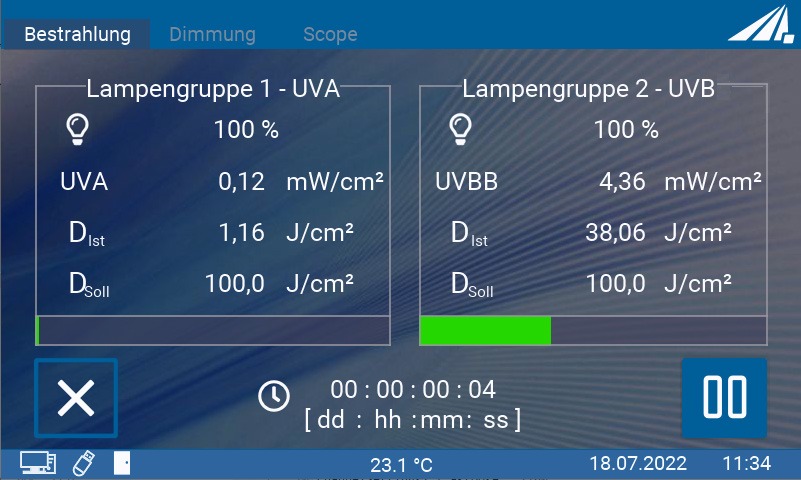
The UV-MAT Touch is operated through a high-resolution capacitive touchscreen. A Cortex ARM processor provides durability and the ability to update - new functions can be installed on site. The device and the PC software are compatible with Windows 10 and 11. Single- and multi-channel irradiations are shown numerically and graphically, together with oscillograms and the settings. Parameters are set directly on the device and are password protected.
| Display | capacitive touch display, 5″ WVGA |
| Display output | irradiance and dose, oscilloscope view |
| Data recording rate | adjustable: 1 s to 1 h |
| Recording period | > 24,000 h |
| Storage interface | 1 × USB stick (up to 32 GB) |
Options
This option is available in addition to the standard equipment:
 | Remote control option Complex, multi-stage irradiations - for example a pre-irradiation at low irradiance followed by a high-intensity irradiation - can be parameterised with the remote control option. Up to 30 dose- or time-controlled steps and pauses are possible. At the same time the irradiation is logged and stored on the PC. |
Order numbers, scope of delivery, accessories and versions
| Version | Order number |
|---|---|
| Collimated Beam Device BSM-03CBD | 860914 |
The collimated beam device with a medium-pressure lamp produces a parallel, broadband UV field for fluence determination.
| Version | Order number |
|---|---|
| UV-MAT Touch | 820930C |
The chamber is controlled by the UV-MAT Touch. It measures the irradiance, controls the pneumatic shutter and switches off once the target dose is reached.
| Designation | Order number |
|---|---|
| Radiometer sensors | 814412 |
The chamber works with a UV reference sensor for dose-controlled operation; a second UV sensor makes setting up easier. Further spectral ranges are listed under radiometer sensors.
| Designation | Order number |
|---|---|
| Replacement lamp | 860814H |
| Service | Order number |
|---|---|
| Calibration 200–300 nm | CALBSM300 |
| 17025 calibration | 17025 |
CALBSM300 is the calibration of the measuring channel from 200 to 300 nm; in addition we offer accredited calibration to ISO/IEC 17025. The calibrations are available as factory and as ISO 17025 calibration and are traceable to PTB standards. Further measuring and spectral ranges are available on request.
Background of a collimated beam device
A collimated beam device is used for precise and controlled experiments in the field of UV disinfection and UV irradiation of liquids. Jim Bolton, a renowned expert in this field, has made significant contributions to the development and distribution of such devices.
A collimated beam device produces a parallel beam of UV light that ensures uniform intensity over the entire beam area. The advantages of the parallel UV light beam are:
- uniform irradiation
- no different angles of incidence
- low reflection on the liquid surface
- a constant layer thickness and penetration depth
- simple radiometric measurement
- determination of the dose and fluence (spherical dose) from the irradiance
The dose describes the radiation energy that is incident on a surface element from one side. It differs significantly from fluence, which by definition considers a spherical incidence on a spherical surface element (from all directions).
In a UV reactor, a particle is irradiated from all spatial directions as it passes through the UV reactor. This is very difficult to determine experimentally. Therefore, the adjustment is carried out under the optimum conditions in a collimated beam device. In this device, the dose corresponds exactly to the fluence, as the geometry allows this. The unit of dose and fluence is J/m².
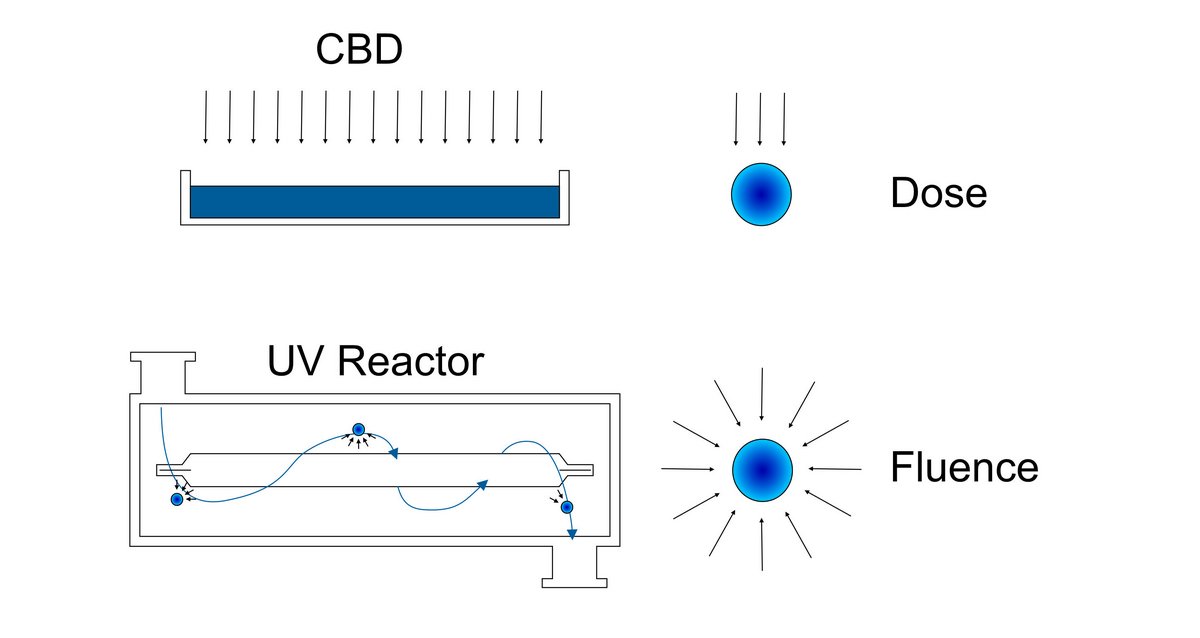
A CBD is mainly used in research laboratories to test the efficiency of UV disinfection under controlled conditions.
Here are the basic steps of how it works:
- Preparation: the samples to be tested (e.g. water, surfaces, air samples) are placed in suitable holders.
- Irradiation: The collimated UV beam is directed at the samples. The irradiation time and the UV dose are determined on the basis of the experimental requirements.
- Monitoring: sensors continuously measure the UV intensity to ensure that the samples receive a consistent and precise UV dose.
- Analysis: After irradiation, samples are analyzed to determine the effectiveness of UV disinfection. This can be done by microbiological testing or chemical analysis.
UV irradiation is often used for disinfection purposes. UV-C radiation has a wavelength of 100–280 nm and is known to damage DNA by triggering a reaction between two thymide molecules (dimer formation). This method is very effective for inactivating bacteria and viruses, depending on the UV permeability of the water. Either medium or low pressure UV lamps are generally used for UV disinfection.
Medium-pressure UV lamps emit radiation in the range of 200 to 400 nm, while low-pressure UV lamps mainly generate radiation at 253.7 nm. To prevent the formation of unwanted by-products at lower wavelengths, MP lamps are equipped with quartz tubes that filter out wavelengths below 240 nm.
By using DVGW sensors and DVGW referenceradiometers, the intensity of the UV beam is continuously measured and monitored. This enables the exact dose applied to the samples to be determined.
For disinfection purposes, a UV dose of around 20–70 mJ/cm² is usually applied. These doses are relatively low and therefore photolysis reactions of organic micropollutants are generally not very effective under these conditions.
However, UV radiation is also used in combination with ozone, hydrogen peroxide or chlorine, which leads to the formation of hydroxyl radicals. Such processes are very effective in removing contaminants.