


Measuring UV: from the sensor to a trustworthy reading
A UV reading is only as good as the chain behind it: sensor, filter, calibration and measurement geometry. These pages show how a UV sensor is built, how spectral and measuring range match the task, and which deviations arise systematically.
Spectral mismatch is central: every filtered sensor departs from the target responsivity, and that departure enters the result as measurement uncertainty. Added to it are the calibration interval, which keeps traceability over time, and the measurement system analysis, which shows the system is fit for the testing task.
The quantities themselves – radiometric and photometric – and the spectral ranges and standards sit one level up under UV knowledge.
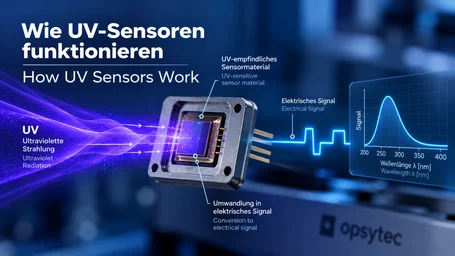
How UV Sensors Work
Key concept: broadband radiometer, spectroradiometer, measurement uncertainty
UV radiation can only be measured indirectly, through its effect on a detector. The article compares broadband radiometers and spectroradiometers and shows how spectral responsivity, angular response and stray light govern the uncertainty.
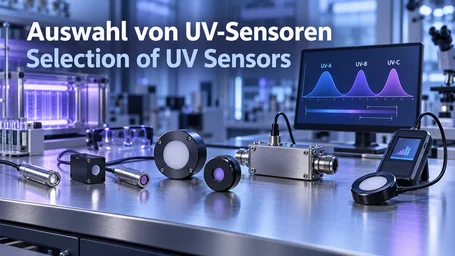
Selection of UV sensors
Key concept: spectral range, measuring range, measurement geometry
Choosing a UV sensor comes down to two quantities: the spectral range of the application or photoinitiator and the irradiance to be expected. The article walks through both decisions and gives typical values.
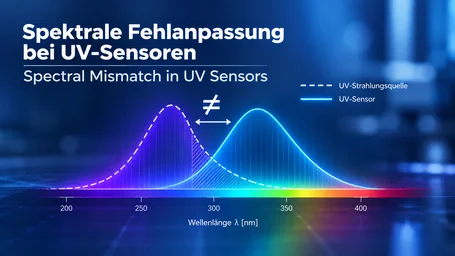
Spectral mismatch for UV sensors
Short answer: every filtered sensor has it – calibrating to the source helps
Spectral mismatch is the deviation of a sensor's real responsivity from the ideal rectangular weighting function. The article explains how it arises, how large it typically is and how the resulting error is corrected.
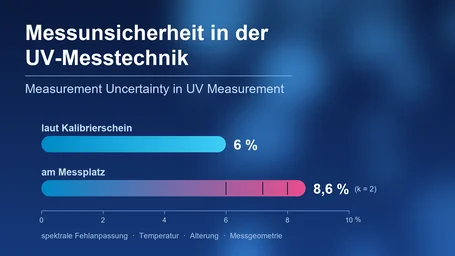
Measurement uncertainty in UV measurement
The calibration certificate states the calibration uncertainty, your own setup a larger measurement uncertainty. The article explains the coverage factor k = 2, the contributions to the uncertainty budget and works through an example.
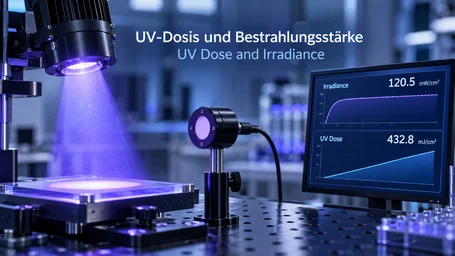
Measuring UV dose and irradiance correctly
Irradiance is the incident radiant power, radiant exposure its time integral – in everyday use both are called dose. The article separates the quantities and their units and shows which five influences, from spectral responsivity to measurement…
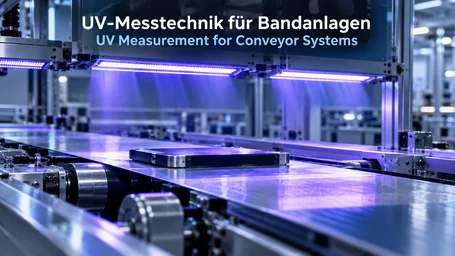
UV measurement for conveyor systems and continuous processes
In a conveyor system the workpiece passes through the irradiation zone in finite time – the effective dose is the integral of that profile, not peak irradiance times dwell time. The article shows which three quantities a belt radiometer delivers and…
Calibration interval for UV measuring devices
Short answer: 12 months as a rule, shorter under heavy load
How long a calibration stays valid depends on sensor type, load and storage. The article gives the recommended interval of 12 months and the conditions that shorten it.
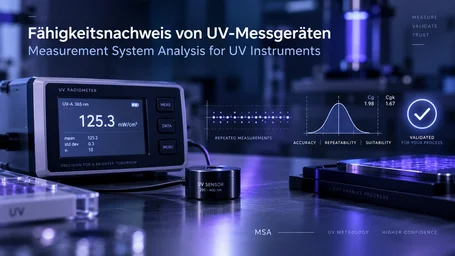
Measurement system analysis of UV sensors
Short answer: cg and cgk from a measurement system analysis (MSA)
A capability study proves statistically that a UV measurement system is fit for its task. The article explains the cg and cgk indices, how a measurement system analysis is run and how much spread is still acceptable.