



UV irradiation chamber BS-02 – benchtop unit with eight lamps
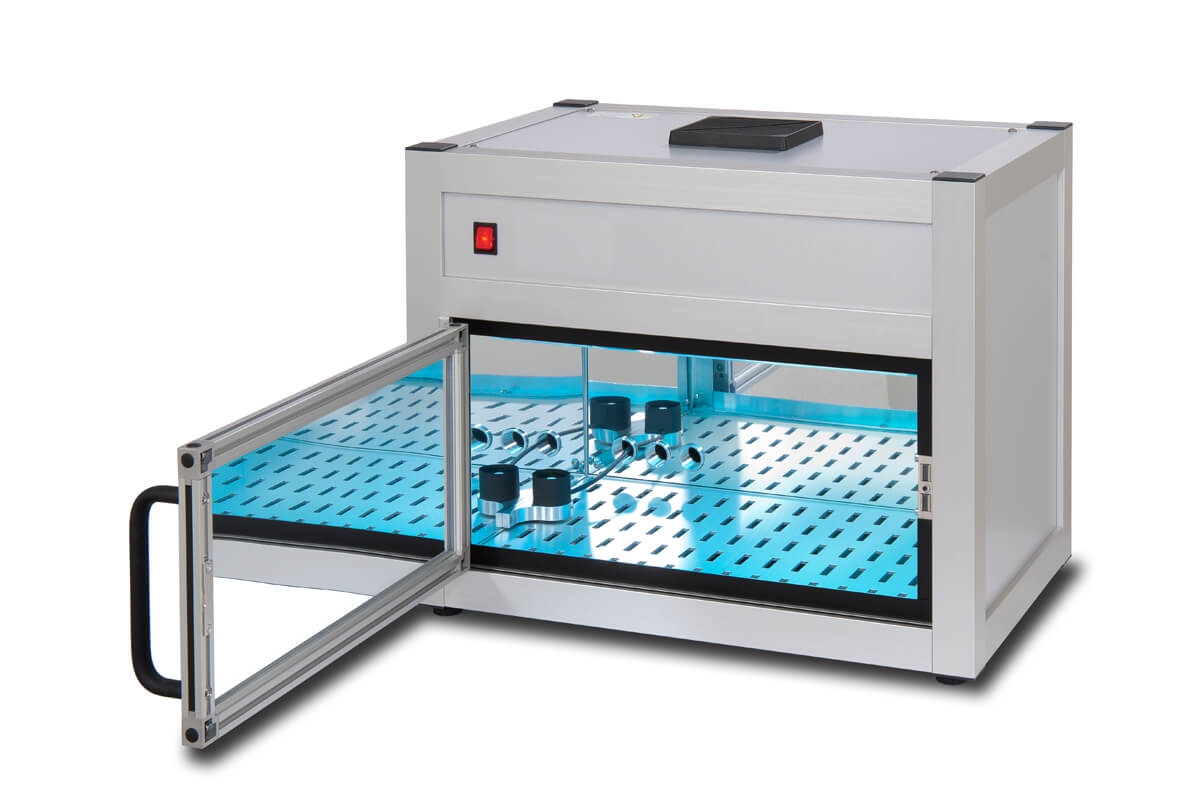
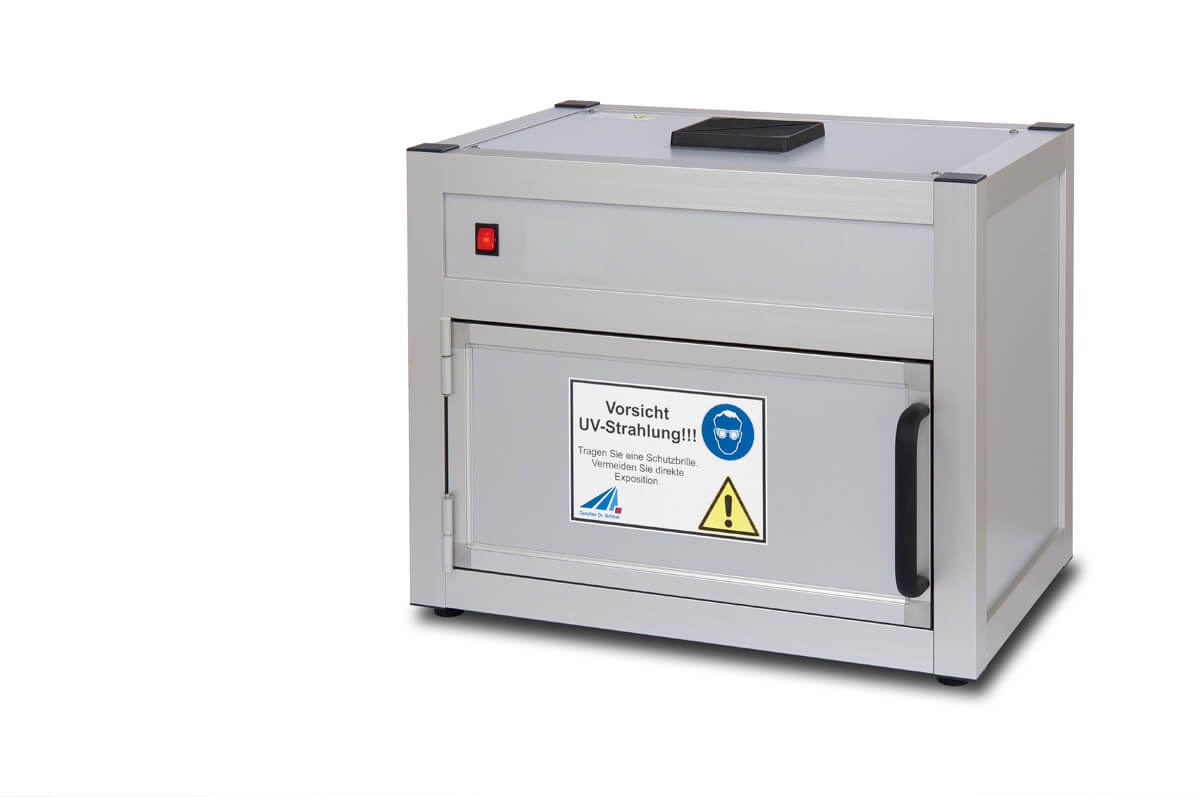
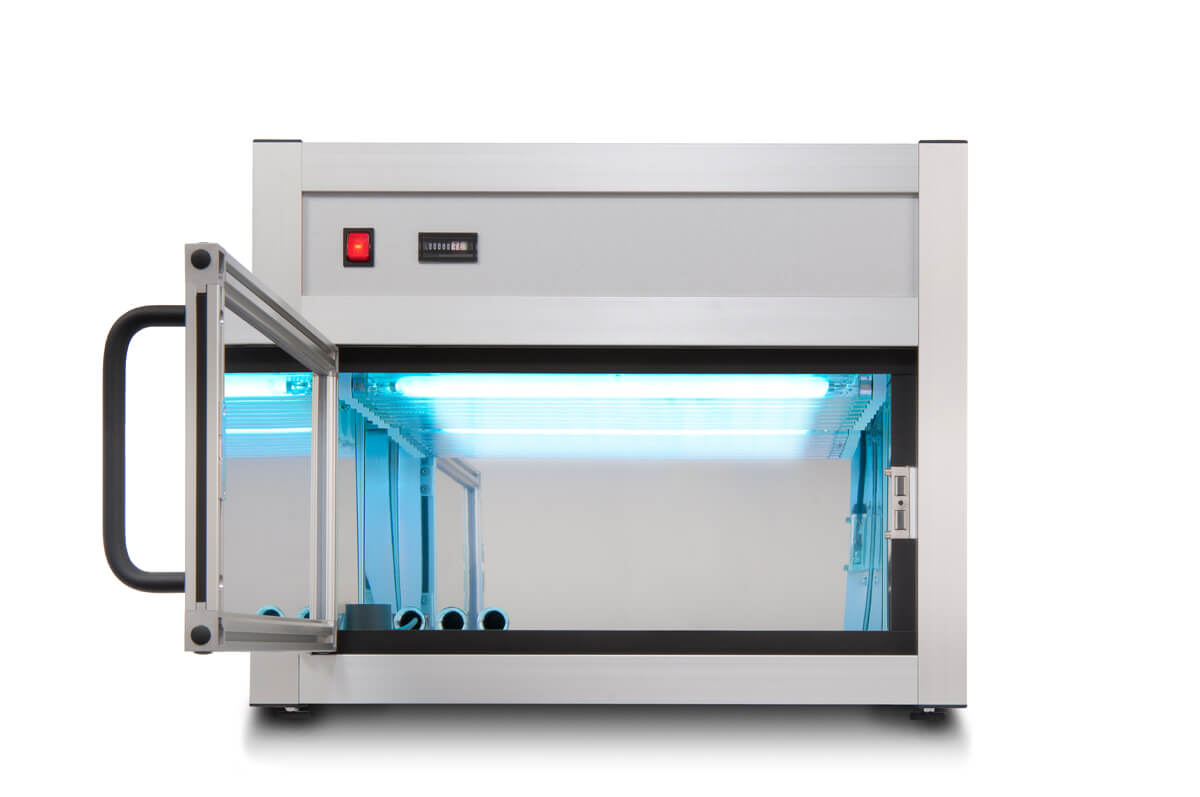
The BS-02 is a compact, robust irradiation chamber for the time- or dose-controlled irradiation of samples with UV radiation. It can be fully equipped for one of the spectral ranges UVC, UVB or UVA to reach the highest irradiance – 10 mW/cm² in UVC, 5 mW/cm² in UVB and 8 mW/cm² in UVA – or with two separately controlled lamp groups for two spectral ranges. The lamps are interchangeable without tools, so the chamber can be adapted to a new test task.
The interior irradiation chamber has a base area of 49 × 32 cm² and a height of 23 cm. The sample chamber operating temperature is about 25 °C - 30 °C so that thermal damage to the specimen is avoided. Due to the high uniformity of the irradiation, the samples may be positioned in any order.
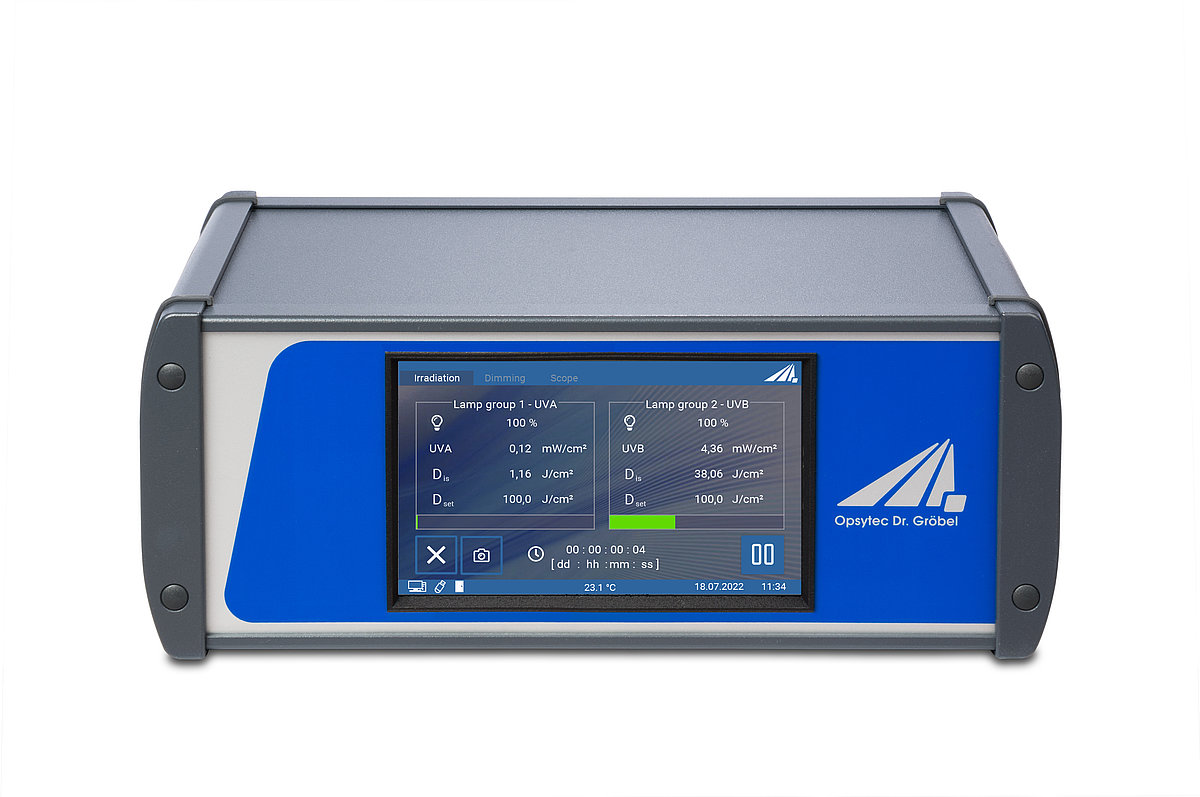
For the BS-02 we offer two irradiation controllers, the UV-MAT and the UV-MAT Touch. Both irradiation controllers can control two spectral ranges separately and achieve a consistent dose regardless of lamp aging, contamination or temperature. The dose is measured with calibrated sensors. For this purpose, the sensor already contains a precise analog-digital converter and a temperature sensor.
The memory in the sensor contains all sensor identifications and the calibration history.
The UV-MAT Touch is operated via a high-resolution capacitive touchscreen. Firmware updates can be installed on site. The UV-MAT Touch and the associated PC software are compatible with Windows 10/11. Numerical and graphical single and multi-channel irradiations, oscillograms and settings are clearly displayed. Parameterization is intuitive and password-protected directly on the device.
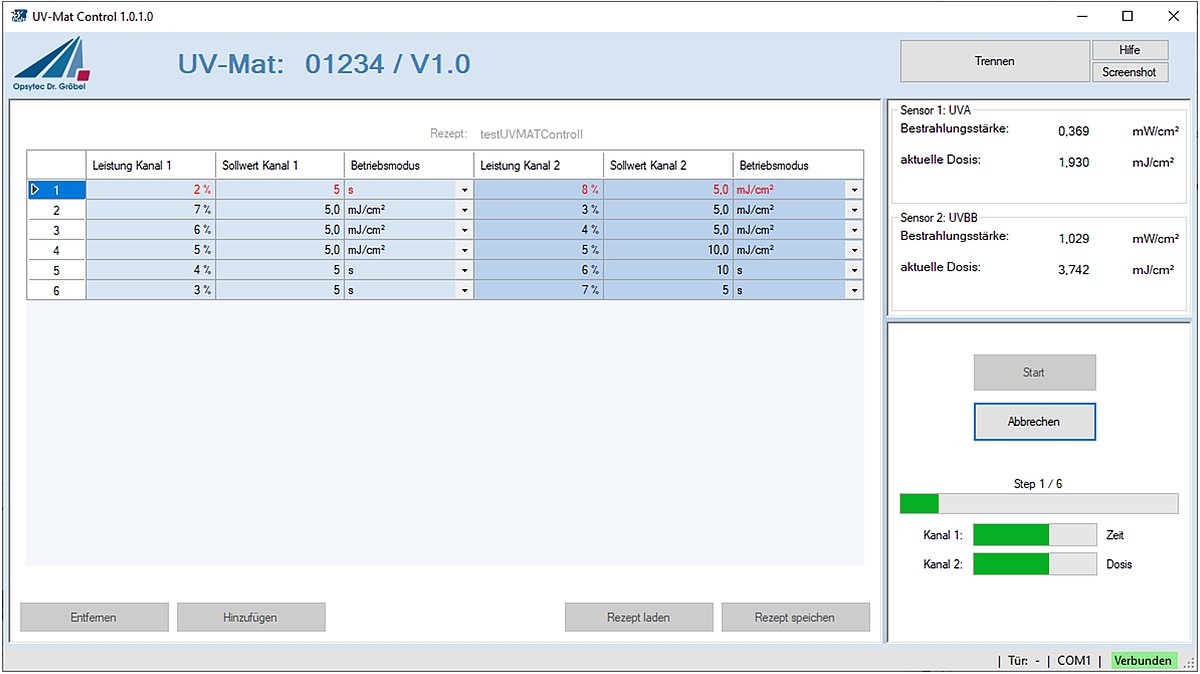
The UV-MAT Touch offers the option of being controlled via the PC, enabling multi-stage irradiations and complete documentation of the irradiation.
Fitted with UVB lamps the BS-02 becomes a UVB chamber; with UVA or UVC tubes it covers the other ranges. It is the compact UV irradiation chamber of the series – same control, same dose guidance, smaller footprint.
As a compact UV irradiator the BS-02 sits on the bench and needs neither extraction nor special installation.
Test setup and evaluation of UV ageing are described on the page UV ageing and colour fastness of plastics.
Calculate irradiance and dose of the BS-02
Set up the BS-02 virtually in advance:
Calculate irradiance, uniformity and exposure time for UVA, UVB and UVC.
Simulate the BS-02 in advance: calculate irradiance and dose
The BS-02 can be set up virtually in the UV irradiation chamber simulator before the experiment: for the 49 × 32 cm irradiation area it calculates the irradiance in the selected measurement plane and shows as a heat map how evenly the eight lamps illuminate the sample chamber. This makes it possible to estimate in advance which exposure time a target dose in UVA, UVB or UVC requires.


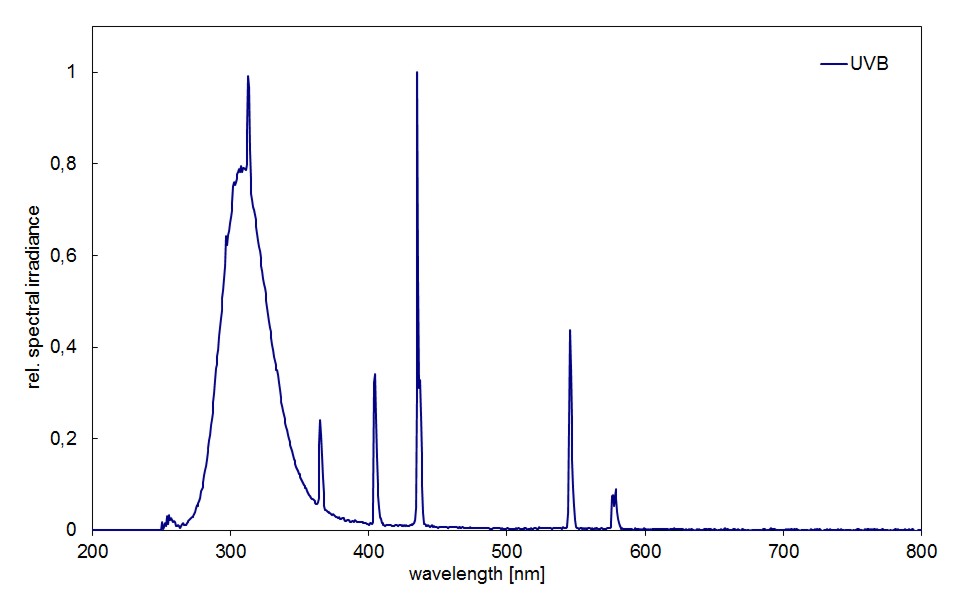
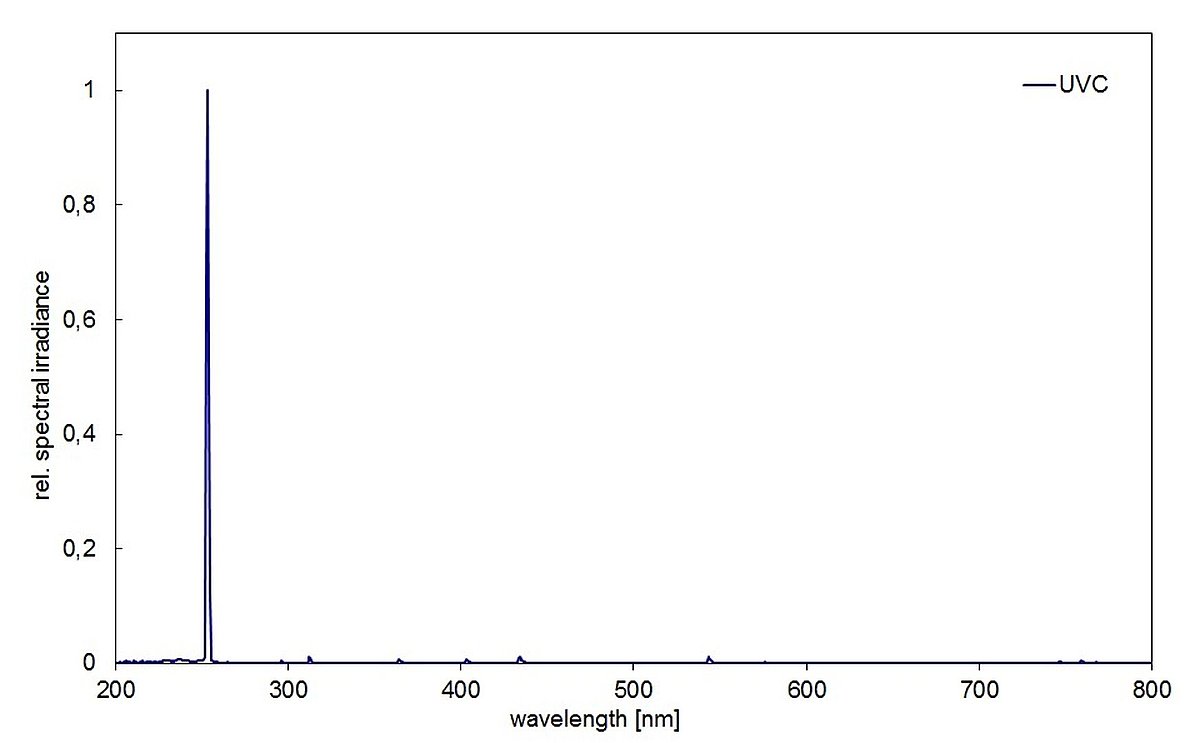
The chambers of the BS series are fitted with the same fluorescent lamp types. The spectra shown therefore apply unchanged to the other models – the chambers differ in interior size and number of lamps, and hence in irradiance, not in spectral distribution. The BS-02 works with eight lamps in an interior of 49 × 32 × 23 cm; the irradiance it reaches is given in the technical data below.
Equipment in detail
The irradiation chamber has a modular design and can therefore be adapted to different applications. The following functions are always included:
 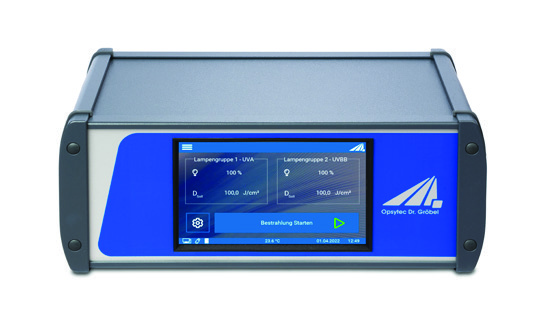 | Dose control The irradiance is measured continuously; the UV-MAT ends the irradiation once the set target dose is reached. The UV-MAT Touch offers the same functions but simplifies operation and documentation. |
 | Sensors Suitable materials give the sensors excellent long-term stability. They are traceably calibrated, can be recalibrated and are supplied with a factory or ISO 17025 calibration certificate. Sensors in IP65 as well as further measuring and spectral ranges are available on request. |
 Similar to illustration | Sensor holder The sensor holder fixes two radiometer sensors at the side of the chamber. For measurements on the sample the sensors can be removed, so that the irradiance can be determined at the required position. The UV-MAT can be adjusted to this by a factor. |
 | Control and dimming Two lamp groups can be controlled and dimmed separately - for example four UVA and four UVB lamps. Dimming reduces the irradiance to about 30 %. |
 | Lamps The fluorescent lamps can be changed without tools. We supply the matching lamps for different applications: UVA-352 for UV ageing in indoor applications, UVB lamps for accelerated outdoor applications, UVC for UV disinfection. |
 | Timer As an alternative to dose control the UV-MAT offers an adjustable timer for time-controlled irradiations between 1 s and 999 days. |
 | Irradiation records Irradiations can be recorded with a PC. The UV-MAT Touch also records them to a USB stick without a PC. |
Options
All irradiation chambers can be equipped with different options. For cell and virus irradiation and other laboratory applications the UV-MAT Touch dose control and attenuators are often combined in order to achieve a very uniform and reproducible irradiation. Medical applications benefit from the irradiation documentation that the remote control keeps automatically.
 | Attenuation Attenuators reduce the irradiance to about 30 %. We offer surface attenuators and lamp attenuators - used for example when irradiating cell cultures. |
 | Inert gas box The removable inert gas boxes allow work under inert conditions. Separate gas inlets and outlets make it possible to measure the O₂ concentration at the gas outlet. Available with a top window of high-quality glass for UVA and VIS irradiation or of UV quartz glass for UVB and UVC irradiation. |
 | PC software for the UV-MAT Touch Complex, multi-stage irradiations - for example a pre-irradiation with UVA at low irradiance followed by a high-intensity UVC irradiation - can be parameterised with the remote control option. Up to 30 dose- or time-controlled steps and pauses are possible. At the same time the irradiation is logged and stored on the PC. |
Applications of Irradiation chamber BS-02
- Irradiation of bacteria and cell cultures
- Photostability testing
- UV and daylight materials testing
- UV curing, sealing, and bonding
- Disinfection
Technical data BS-02 irradiation chamber
| Interior chamber | 49 × 32 × 23 cm |
| Dimensions | 58 × 40 × 47 cm |
| Weight | ~ 32 kg |
| Power consumption | 180 W |
| Mains | 110–230 V, 50/60 Hz |
| Spectra ranges | 2 |
| Irradiance UVA | 8 mW/cm² |
| Irradiance UVA Act. | 8 mW/cm² |
| Irradiance UVB | 5 mW/cm² |
| Irradiance UVC | 10 mW/cm² |
| Lamp lifetime UVA | up to 4.000 h |
| Lamp lifetime UVB | up to 4.000 h |
| Lamp lifetime UVC | up to 9.000 h |
| Number of lamps | 8 |
| Sample temperature | 25 °C ± 5 °C |
| Cooling is by ambient air; the sample temperature is about 5 °C higher. | |
| Operating temperature | 10 to 40 °C |
| Humidity | < 80%, non-condensing |
The two irradiation controls compared
| Feature | | |
|---|---|---|
| Display | capacitive touch display | monochrome, 128 x 64 px |
| Memory | USB stick | – |
| Number of channels | 2 | 2 |
| Irradiance, dose and temperature measurement | yes | yes |
| Time- and dose-controlled irradiations | yes | yes |
| Recording of measurements | yes | – |
| Oscilloscope view | yes | – |
| Screenshots can be saved to a USB stick | yes | – |
| Pausing and restarting irradiations | yes | – |
| Adding notes and comments to an irradiation | yes | – |
| Remote control from a PC | yes | – |
| Irradiation records | on a USB stick | on the PC |
| User management and admin mode | yes | – |
| Simple firmware upgrades | yes | yes |
Both controls use the same sensors, so one sensor can be used with either device.
Order numbers, scope of delivery, accessories and versions
| Version | Order number |
|---|---|
| BS-02 | 860902 |
The chamber is supplied with lamps, sensor holder and control unit. Please state the required spectral ranges when ordering.
| Version | Order number |
|---|---|
| UV-MAT Touch | 820930 |
| UV-MAT | 820920 |
The chamber is operated by the UV-MAT - either as the UV-MAT with a graphic display or as the UV-MAT Touch with a 5-inch touch display and oscilloscope view. Both measure the irradiance and switch off under dose control.
| Designation | Order number |
|---|---|
| PC software for the UV-MAT Touch | 860901 |
| Designation | Order number |
|---|---|
| Lamp attenuator | 870000 |
| Surface attenuator | 870001 |
| Inert gas box UVA | 86802-iA |
| Inert gas box UVC | 86802-iC |
The attenuators reduce the irradiance - either in front of individual lamps or across the whole area. The inert gas box allows irradiation under a protective atmosphere.
| Designation | Number range |
|---|---|
| Lamps and replacement lamps | 8608XX |
| Radiometer sensors | 8144XX |
Lamps and sensors carry their own number for each spectral range, so the data sheet gives the number range only. You will find the sensors under radiometer sensors. Please talk to us about the right configuration.
| Service | Order number |
|---|---|
| Factory calibration | 710000 |
| ISO 17025 calibration | 17025 |
Accredited calibration to ISO/IEC 17025 in our own calibration laboratory. Calibrations are available as factory and as ISO 17025 calibration and are traceable to PTB standards.
Publications using the BS-02
These works name the BS-02 irradiation chamber explicitly. Listed here are the 10 most recent of them; we know of 66 in total.
Frequently asked questions: BS-02
At ground level and under optimal conditions the sun delivers about 62 W/m² of UVA and 5.6 W/m² of UVB. Fully equipped, the BS-02 reaches 80 W/m² of UVA and 50 W/m² of UVB. Assuming the 1,000 hours of sunshine per year typical for Central Europe, the annual UVA dose of 223 MJ/m² corresponds to roughly 775 operating hours and therefore about 32 days of continuous operation. The annual UVB dose of 20 MJ/m² is reached after some 112 hours, just under five days. A single day of sunshine thus corresponds to about two hours of UVA or 18 minutes of UVB. These are dose equivalents and not a statement that the effect on the material is the same: temperature, humidity and spectrum differ from outdoor weathering, which is why the comparison needs a reference exposure. The test setup and its evaluation are described under UV ageing and colour fastness of plastics.
Seconds. Fully equipped with UVC lamps the BS-02 delivers 10 mW/cm², that is 100 W/m² at 254 nm. For four log reductions E. coli needs about 8 mJ/cm² and therefore 0.8 seconds, Legionella pneumophila 9 mJ/cm² and 0.9 seconds, Cryptosporidium and Giardia 22 mJ/cm² and 2.2 seconds, Bacillus subtilis spores 81 mJ/cm² and 8.1 seconds, adenoviruses 167 mJ/cm² and 16.7 seconds. The reduction-equivalent fluence of 40 mJ/cm² laid down in DIN 19294 and ÖNORM M 5873 is delivered in four seconds. The limiting factor is therefore not the exposure time but the geometry of the sample – whatever lies in the shadow is not irradiated. For high doses on spores the BSH-02 with 85 mW/cm² is the more suitable chamber. The fluences per log level are listed under UV disinfection, the high-power chamber under BSH-02.
In the UVB the BS-02 reaches about nine times the natural irradiance, and it delivers it around the clock. Compared with outdoor weathering at roughly 1,000 hours of sunshine per year this gives an acceleration factor of about 80; depending on the polymer and its stabilisation, factors of up to 200 are observed. Such a factor is not a material property, however. It applies only to the formulation examined, because chain scission, yellowing and embrittlement respond at different rates to an increased irradiance. The statement becomes reliable only through comparative exposures against a known reference.
In the UVA the BS-02 delivers 8 mW/cm², that is 80 W/m², about 1.3 times the sun at ground level with roughly 62 W/m². In the UVB it delivers 5 mW/cm² or 50 W/m², about nine times the natural 5.6 W/m². For the UVC no factor can be given: radiation below 280 nm does not reach the surface of the earth, so the 10 mW/cm² of the BS-02 have no natural counterpart there. For conversion: 10 W/m² correspond to 1 mW/cm². Considerably higher irradiance is offered by the UV-LED chamber BSL-01i with up to 800 mW/cm², roughly 130 times the solar UVA.