



Spectroradiometer or broadband radiometer – making the choice
Two instrument families are available for measuring ultraviolet radiation, and the choice comes down to a single question: is an integral reading enough, or is the spectrum itself required?
Broadband radiometers integrate the radiation within a built-in spectral responsivity and output one reading. Spectroradiometers disperse the radiation and measure each wavelength individually; every integral or action-weighted value is calculated from that. This page sets the two designs side by side criterion by criterion and works from the measuring task to the right instrument class.
What the two instrument classes measure
A broadband radiometer returns the irradiance within a fixed spectral band and, integrated over time, the UV dose. What governs the reading is the spectral responsivity of its sensor: it determines which part of the radiation enters the measurement at all.
A spectroradiometer disperses the radiation and measures each wavelength individually. Every integral or action-weighted value is calculated from that – and because the spectrum is available, any weighting function can be applied afterwards.
How diffuser, filter, photodiode and calibration interact, and where the measurement uncertainty arises, is covered under design and error sources of UV sensors.
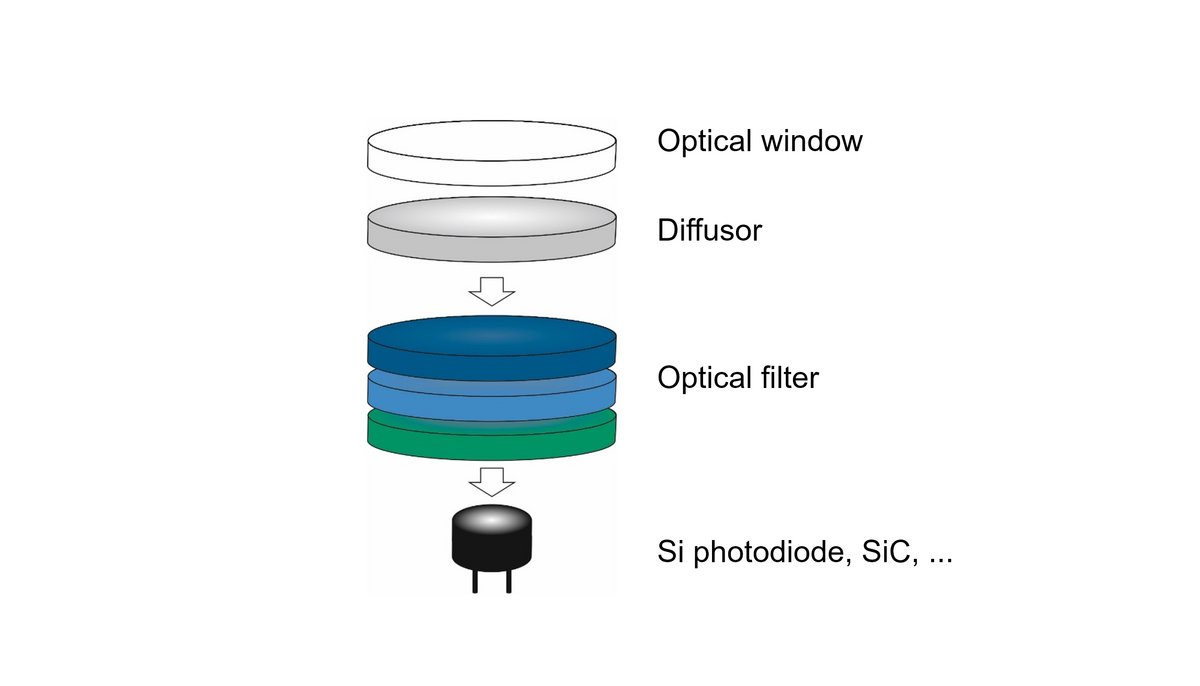
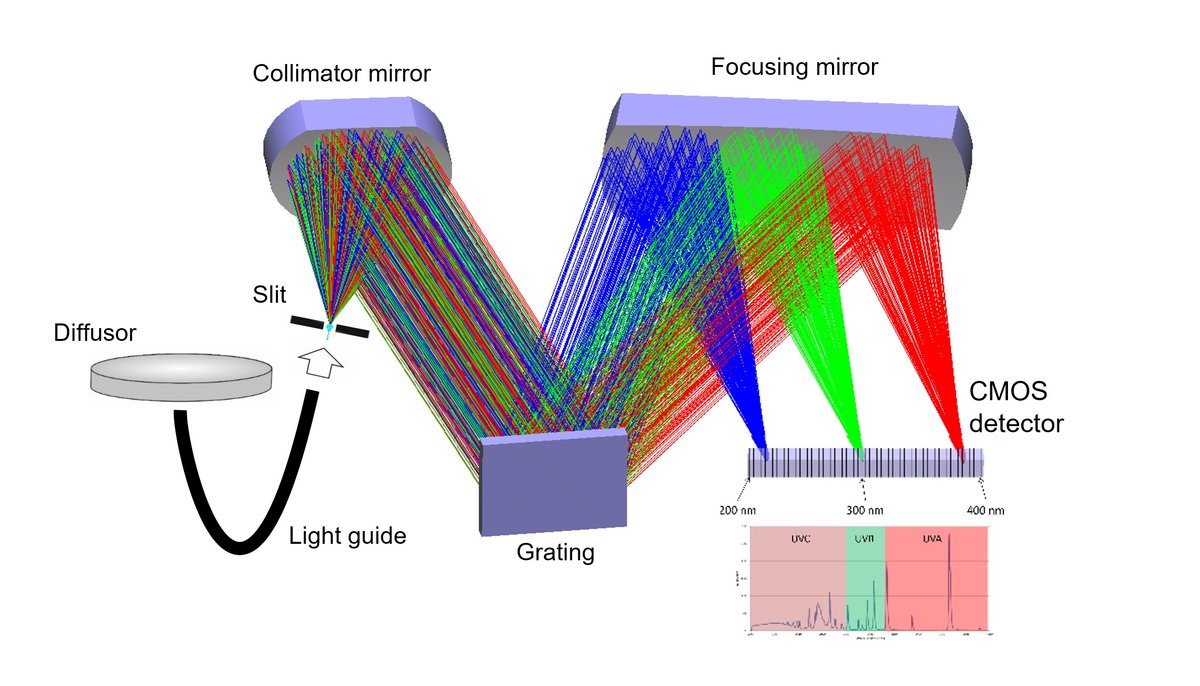
Broadband radiometer and spectroradiometer compared
| Criterion | Broadband radiometer | Spectroradiometer |
|---|---|---|
| Measurand | reading for a fixed spectral range under weighting s(λ) | spectral irradiance E(λ) |
| Versatility | tied to one or a few lamp types | any source, any action spectrum |
| Spectral mismatch | main error source, manufacturer-specific | absent by design |
| Stray light | uncritical | main error source, especially in the UV-C |
| Dynamic range | very large | limited |
| Traceability | well established via transfer standard | more demanding, spectrally resolved |
| Response time | fast, suitable for process monitoring | set by integration time |
| Ruggedness | high, process-capable | more delicate; fibre and alignment effects |
| Operation | simple | requires trained personnel |
| Cost | low to moderate | high |
Two error sources that rule each other out
The table is not a ranking but symmetrical: wherever one design has its main error source, the other is unremarkable by design. The broadband radiometer struggles with spectral mismatch – it is calibrated against one spectrum and misjudges any other. The spectroradiometer struggles with stray light – parts of strong wavelengths appear where they do not belong, which is particularly critical in the UV-C.
That is precisely why the choice can rarely be made from the data sheet alone: it follows from the measuring task and above all from whether the spectrum of the source is known and stays constant. How both effects arise inside the instrument and how large they can become is covered under spectral mismatch and stray light in detail.
When a broadband radiometer is enough
A broadband radiometer is the right choice when:
- the lamp type is known and remains constant
- measurement is continuous or accompanies the process
- wide dynamic range or short response times are required
- the sensor is exposed to harsh ambient conditions
- several measuring points have to be equipped
When a spectroradiometer becomes necessary
The greater effort of a spectral measurement pays off whenever the source itself becomes the unknown.
A spectroradiometer is the right choice when:
- the lamp type changes or is unknown
- action spectra have to be evaluated – for example to DIN EN 62471 or for UV disinfection
- the ageing of a lamp has to be tracked spectrally
- radiometers have to be calibrated or verified
- spectral evidence has to be documented
Selection by measuring task
| Measuring task | Instrument class | Product category |
|---|---|---|
| Known, constant source; process reading in UVA, UVB or UVC | Broadband radiometer | UV meters and radiometers |
| Dose over time or along a conveyor | Dosimeter | UV meters and radiometers |
| Permanent plant monitoring, several measuring points | Inline sensors | UV meters and radiometers |
| Changing or unknown source, peak position required | Spectroradiometer | Spectrometers and spectroradiometers |
| Evaluating an action spectrum, verifying radiometers | Spectroradiometer | Spectrometers and spectroradiometers |
Both together: the normal case in a plant
In many installations the combination is the best solution: the spectroradiometer handles periodic verification and the characterisation of the lamp spectrum, while the broadband radiometers take care of continuous process monitoring. This pairs spectral evidence with the ruggedness and economy of filter radiometry.
On to the product selection
Once the instrument class is settled, the corresponding product category leads to the instrument: UV meters and radiometers for irradiance and UV dose in fixed spectral ranges, UV spectroradiometers and optical spectrometers for wavelength-resolved measurements.
Frequently asked questions on choosing an instrument
What is the difference between a broadband radiometer and a spectroradiometer?
A broadband radiometer returns a single reading for a fixed spectral range, weighted by the spectral responsivity of its sensor. A spectroradiometer measures radiation resolved by wavelength and derives any desired integral or action-weighted value from that.
Which instrument measures more accurately?
Neither in principle. Each has exactly one dominant error source, and the two are complementary: spectral mismatch for the broadband radiometer, stray light for the spectroradiometer. If the source is known and constant, a suitably calibrated broadband radiometer delivers the smaller measurement uncertainty.
Can a spectroradiometer fully replace a broadband radiometer?
Technically yes, economically and operationally usually not. Dynamic range, response time, ruggedness and cost all favour the broadband radiometer for continuous process monitoring. The common arrangement combines periodic spectral verification with continuous broadband measurement.
How do I tell that my broadband radiometer is misjudging the source?
By comparing it against a spectral measurement of the same source at the same position. If the integral reading deviates systematically, spectral mismatch is the cause – the instrument is calibrated against a spectrum other than the one it is measuring.