



High-power UVC irradiation chamber BSH-02 for UVC curing and spore inactivation
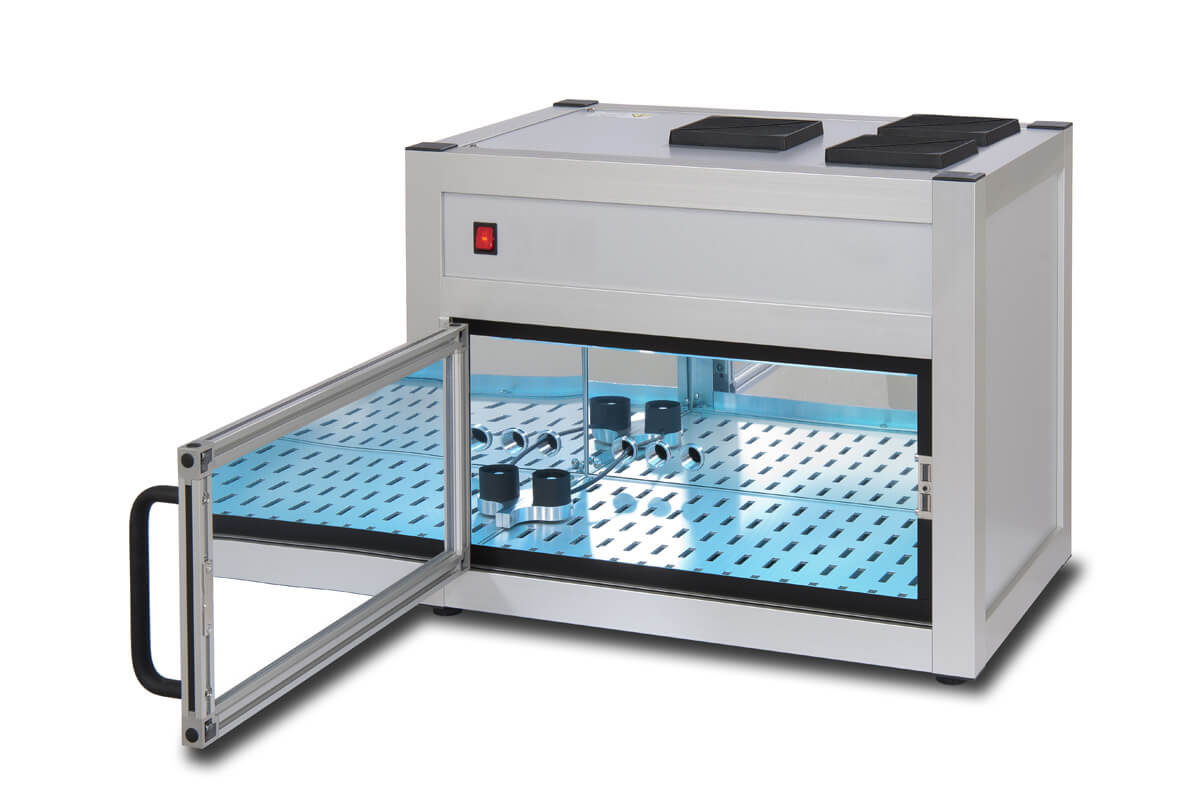
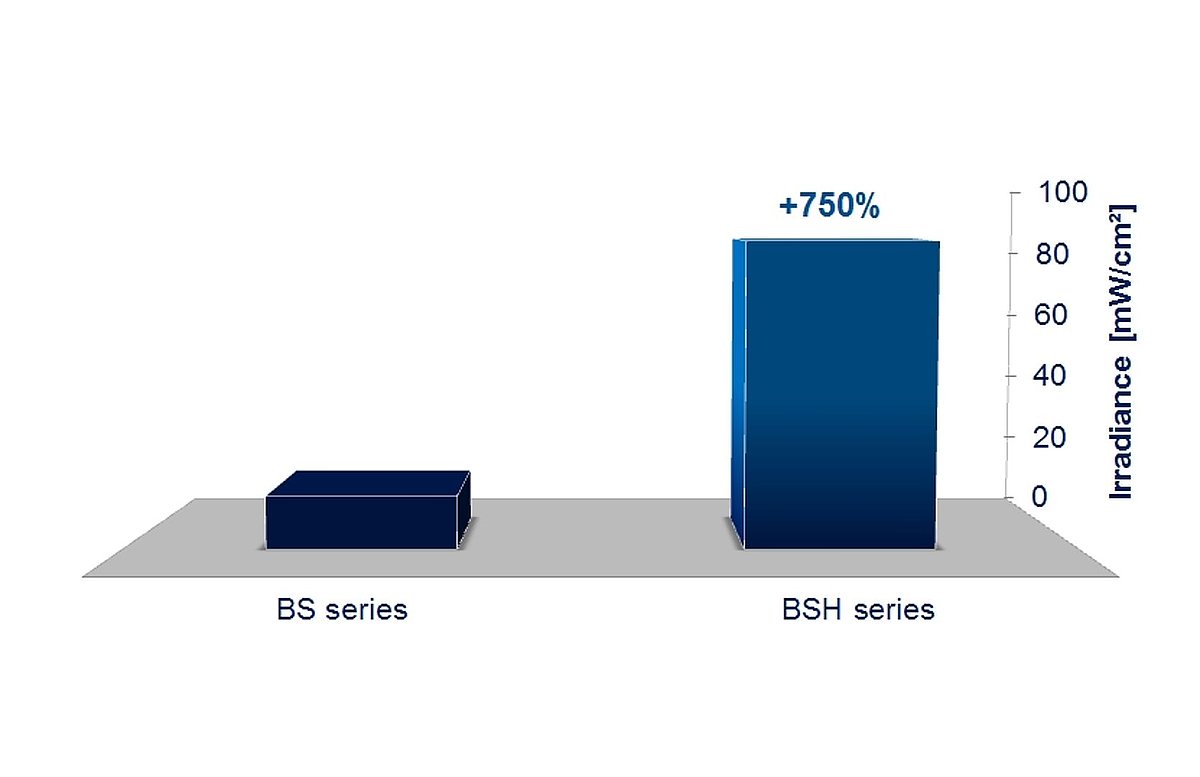
The BSH-02 is a high-power UVC irradiation chamber for UVC curing, UVC bonding and the high-energy irradiation of samples such as bacteria and spores. At 85 mW/cm² it reaches an irradiance 750 % higher than the BS series, so high doses are applied in a short time. Five ozone-free UVC amalgam lamps with a total of 750 W irradiate a sample chamber of 46 × 32 × 25 cm; ozone-generating lamps are available as an alternative. The sample chamber temperature is about 45 °C in operation.
The actual irradiance inside the chamber can be verified with our UV meters and radiometers.
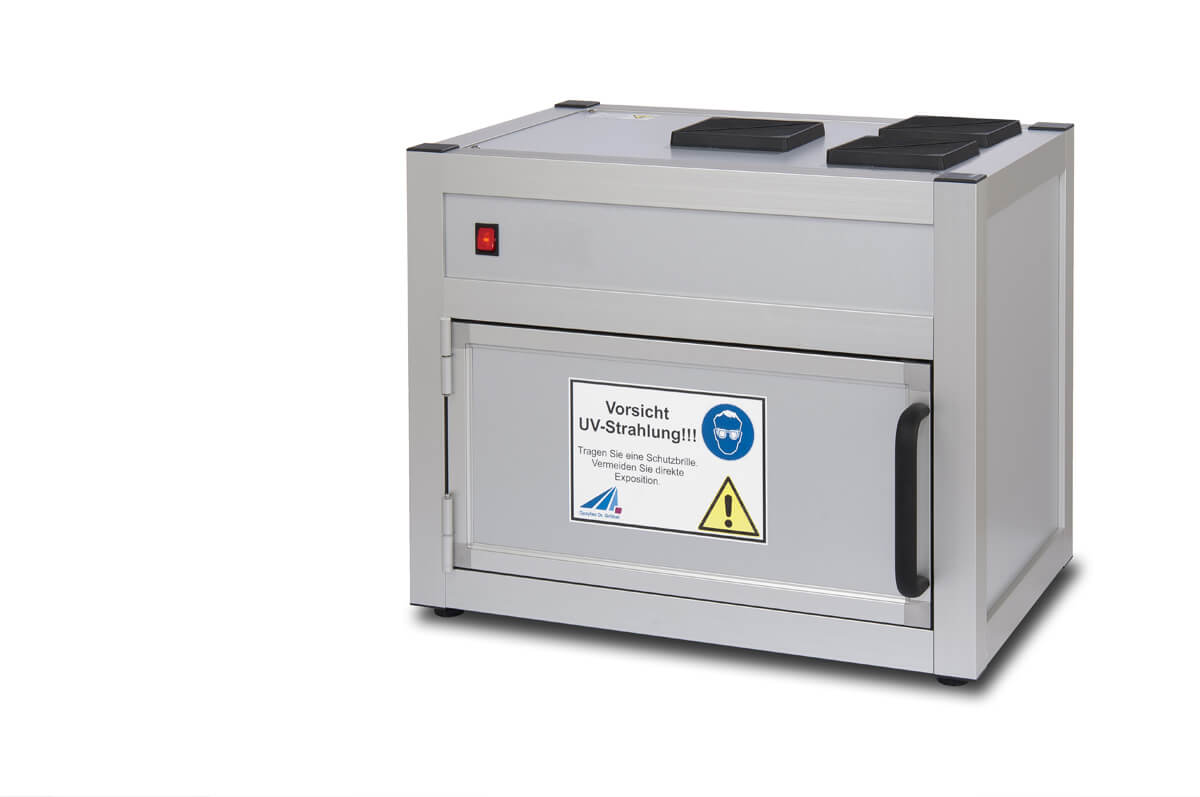
The BSH-02 has compact outer dimensions and the interior irradiation chamber has a base area of 46 × 32 cm and a height of 25 cm. The sample chamber operating temperature is about 45 °C so that thermal damage to the specimen is minimized. Due to the high uniformity of the irradiation, the samples may be positioned in any order.
The irradiation control UV-MAT can control two spectral ranges separately and achieves a constant dose independent of lamp aging, contamination or temperature. The dose is measured with calibrated sensors. For this purpose, the sensor already contains an extremely precise analog-digital converter and a temperature sensor. The integrated diffuser ensures the required cosine correction. Excellent long-term stability is achieved through the use of appropriate materials. The sensors are calibrated with traceability to PTB (Physikalisch Technische Bundesanstalt, the German national test authority); after being calibrated, they are supplied with a factory calibration certificate. The memory in the sensor contains all sensor identifications and the calibration history.
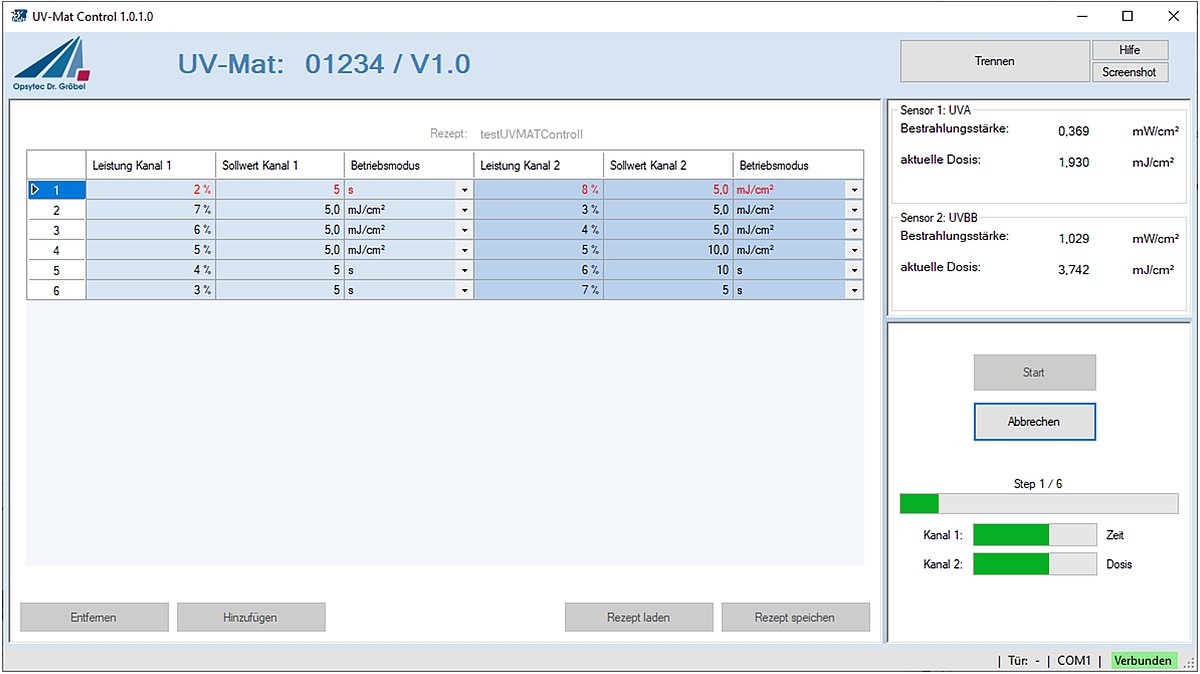
The UV-MAT can optionally be controlled by a PC. This allows multi-stage irradiation and documentation of the irradiation.
Applications of high-power UVC chamber BSH-02
- UV-C curing, sealing and bonding
- Irradiation of bacteria and spore
- UV-C materials testing
- Irradiation of PCB (circuit boards)
- Disinfection
For spore inactivation the irradiance is the decisive point: Bacillus subtilis spores need around 81 mJ/cm² at 254 nm for four log reductions – about ten times as much as E. coli. At 85 mW/cm² the BSH-02 delivers that dose in about a second – the reserve counts where geometry, shadowing or an absorbing matrix pull down the fluence that actually arrives.
Technical data BSH-02 curing chamber
| Interior chamber | 46 × 32 × 25 cm |
| Dimensions | 55.5 × 40 × 43 cm |
| Weight | ~ 32 kg |
| Power consumption | 1000 W |
| Lamp lifetime | up to 8,000 h |
| Number of lamps | 5 |
| Lamp type | UVC amalgam, ozone free; alternatively ozone generating |
| Lamp power | 150 W each |
| Sample temperature | 45 °C ± 5 °C |
| Spectral ranges | 1 (UVC) |
| Irradiance UVC | 85 mW/cm² |
| Mains | 230 V, 6 A; 3 × 110/208 V, 8 A optional |
| Operation temperature | 10 to 40 °C |
| Humidity | below 80 %, non-condensing |
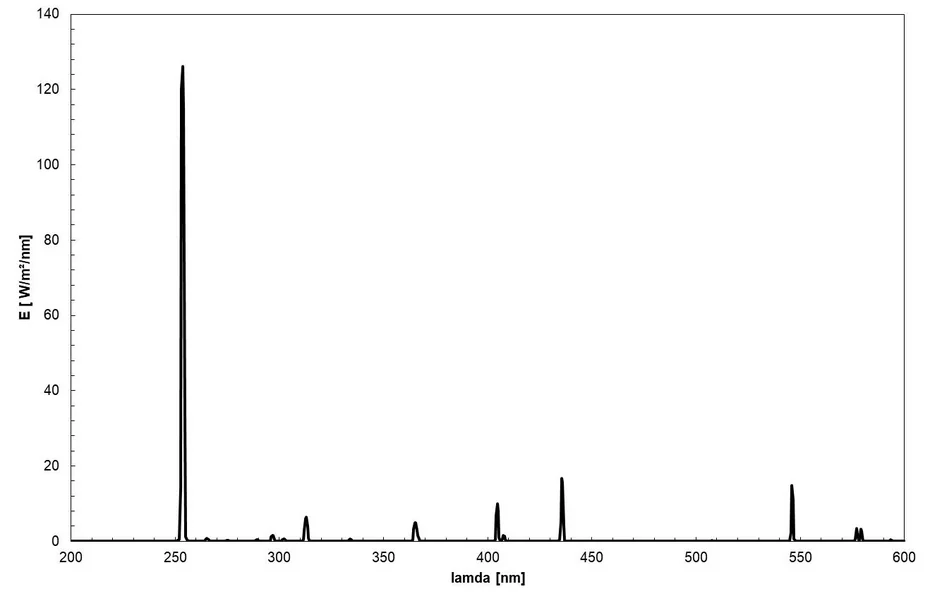
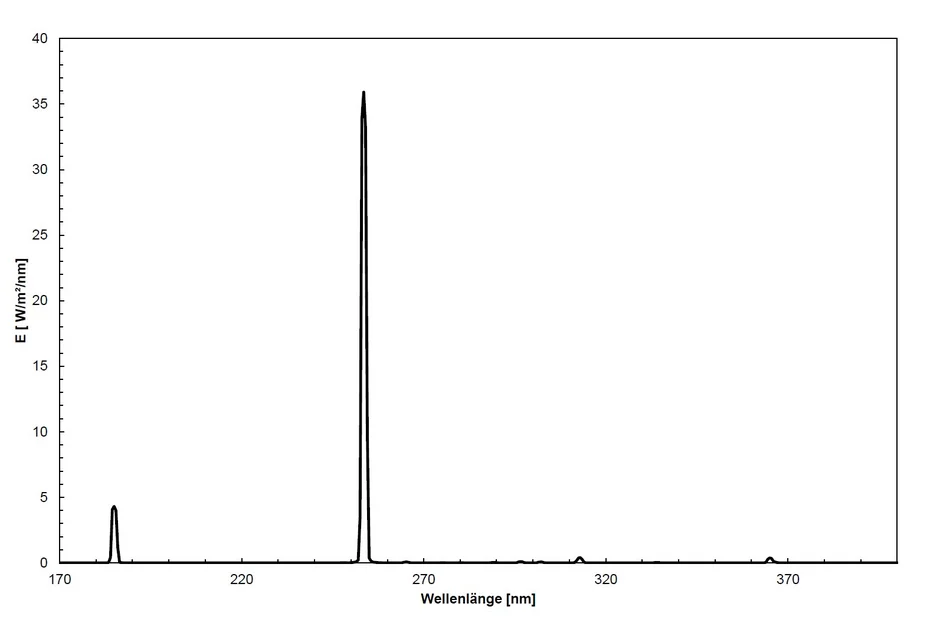
Spectra of the irradiation chamber BSH-02
Five UVC amalgam lamps set the spectrum. Amalgam instead of pure mercury allows the higher lamp power at the same 254-nm line, and hence the 85 mW/cm² in the sample chamber. The first figure shows the ozone-free version: its envelope holds back the 185-nm line, leaving only weak mercury lines besides 254 nm. The second shows the optional ozone-generating lamp, which lets 185 nm through – in air that produces ozone.
Uniformity of the UVC irradiation
The map shows the irradiance across the chamber floor as a percentage of the maximum. 100 % corresponds to the 85 mW/cm² given in the technical data. Across the middle two thirds of the area the irradiance is 90 % and above; towards the edges it falls to about half.
| 53 % | 59 % | 68 % | 84 % | 84 % | 89 % | 92 % | 94 % | 92 % | 87 % | 83 % | 79 % |
| 55 % | 62 % | 71 % | 89 % | 87 % | 93 % | 96 % | 97 % | 95 % | 91 % | 87 % | 83 % |
| 58 % | 65 % | 73 % | 90 % | 91 % | 96 % | 99 % | 100 % | 98 % | 94 % | 91 % | 87 % |
| 59 % | 65 % | 74 % | 90 % | 91 % | 96 % | 99 % | 100 % | 99 % | 95 % | 92 % | 88 % |
| 58 % | 64 % | 73 % | 90 % | 90 % | 95 % | 98 % | 98 % | 98 % | 94 % | 91 % | 87 % |
| 56 % | 61 % | 70 % | 86 % | 85 % | 91 % | 92 % | 94 % | 93 % | 90 % | 87 % | 84 % |
| 52 % | 58 % | 65 % | 80 % | 80 % | 82 % | 87 % | 88 % | 88 % | 86 % | 81 % | 77 % |
| 49 % | 54 % | 63 % | 76 % | 76 % | 79 % | 83 % | 83 % | 84 % | 83 % | 77 % | 70 % |
The two irradiation controls compared
| Feature | 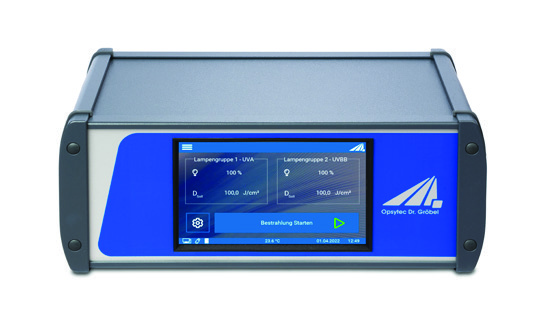 |  |
|---|---|---|
| Display | capacitive touch display | monochrome, 128 x 64 px |
| Memory | USB stick | – |
| Number of channels | 2 | 2 |
| Irradiance, dose and temperature measurement | yes | yes |
| Time- and dose-controlled irradiations | yes | yes |
| Recording of measurements | yes | – |
| Oscilloscope view | yes | – |
| Screenshots can be saved to a USB stick | yes | – |
| Pausing and restarting irradiations | yes | – |
| Adding notes and comments to an irradiation | yes | – |
| Remote control from a PC | yes | – |
| Irradiation records | on a USB stick | on the PC |
| User management and admin mode | yes | – |
| Simple firmware upgrades | yes | yes |
Both controls use the same sensors, so one sensor can be used with either device.
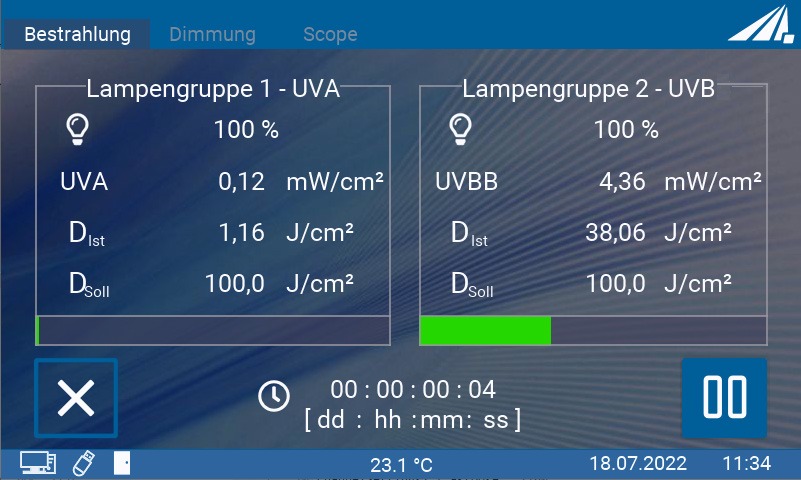
The UV-MAT Touch is operated through a high-resolution capacitive touchscreen. A Cortex ARM processor provides durability and the ability to update - new functions can be installed on site. The device and the PC software are compatible with Windows 10 and 11. Single- and multi-channel irradiations are shown numerically and graphically, together with oscillograms and the settings. Parameters are set directly on the device and are password protected.
| Sensor input | 1, 24 bit, fully digital |
| Dose setting range | 0 to 1,000,000 J/cm² |
| Dose resolution | 1 mJ/cm² |
| Irradiation time | 1 s to 999 days |
| PC interface | USB 2.0 |
| Sensor recognition | yes |
| Dimensions | 185 × 251 × 100 mm |
| Permissible operating temperature | 5 to 60 °C |
| Spectral range UVC | 200 to 280 nm |
| Feature | UV-MAT Touch | UV-MAT |
|---|---|---|
| Display | capacitive touch display, 5″ WVGA | graphic, 128 × 64 px, monochrome |
| Display output | irradiance and dose, oscilloscope view | irradiance and dose |
| Data recording rate | adjustable: 1 s to 1 h | – |
| Recording period | > 24,000 h | – |
| Storage interface | 1 × USB stick (up to 32 GB) | data export via USB |
Options
This option is available in addition to the standard equipment:
 | Remote control option Complex, multi-stage irradiations - for example a pre-irradiation at low irradiance followed by a high-intensity UVC irradiation - can be parameterised with the remote control option. Up to 30 dose- or time-controlled steps and pauses are possible. At the same time the irradiation is logged and stored on the PC. |
Order numbers, scope of delivery, accessories and versions
| Version | Order number |
|---|---|
| BSH-02 | 860902H |
The chamber is supplied with lamps, sensor holder and control. The scope of delivery comprises the BSH-02, the UV-MAT, the mains cable, the manual and UVC lamps - ozone-free unless specified otherwise.
| Version | Order number |
|---|---|
| UV-MAT Touch | 820930 |
| UV-MAT | 820920 |
The chamber is controlled by the UV-MAT - either as the UV-MAT with a graphic display or as the UV-MAT Touch with a 5-inch touch display and oscilloscope view. Both measure the irradiance and switch off under dose control.
| Designation | Order number |
|---|---|
| PC software for the UV-MAT Touch | 860901 |
| Designation | Order number |
|---|---|
| Radiometer sensor | 814410 |
The UVC sensor measures the irradiance inside the chamber; the control uses it to switch off under dose control. Further spectral ranges are listed under radiometer sensors.
| Service | Order number |
|---|---|
| Factory calibration | 710000 |
| ISO 17025 calibration | 17025 |
Accredited calibration to ISO/IEC 17025 in our own calibration laboratory. The calibrations are available as factory and as ISO 17025 calibration and are traceable to PTB standards.